
Hue Uses Ground-Penetrating Radar to Locate Suspected Mass Graves
 | Over 3,500 trees planted around General Giap’s graveside |
| Viet Expat Returns to Find Lost Graves of Heroic Martyrs |
On June 26, the committee, in coordination with the Design Institute under the General Department of Logistics and Technical Services of the Ministry of National Defence, held a meeting to conduct a preliminary assessment of the results from the ground-penetrating radar survey at suspected mass grave sites across the city.
Earlier, on the afternoon and evening of June 25, the institute's technical team carried out radar scans at two locations: Xuan 68 Street and Ton That Thiep Street in Phu Xuan Ward, Hue City, under the direct supervision of Lieutenant General Ha Tho Binh, Commander of Military Region 4. At the survey sites, Ha Tho Binh instructed all participating forces to conduct the work with the highest level of responsibility while closely integrating radar data with information provided by witnesses, veterans, local residents, and historical records to improve the accuracy of identifying suspected mass grave locations.
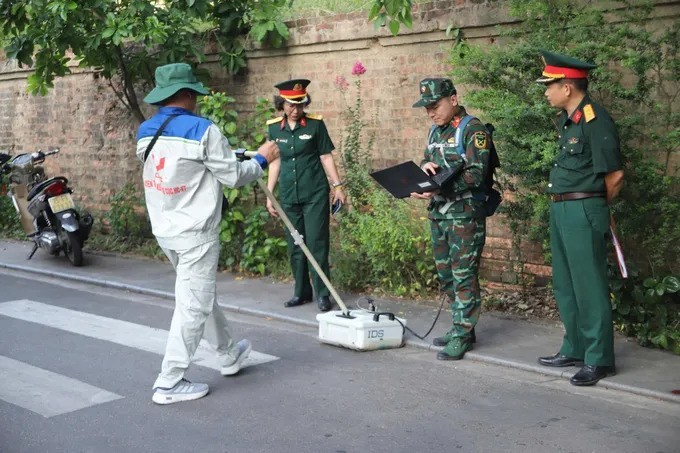 |
| Ground-penetrating radar surveys suspected mass grave sites within the Hue Imperial Citadel. (Photo: Saigon Giai Phong Newspaper) |
According to the survey team, preliminary analysis of the radar signals identified three areas showing signs of disturbed geological formations, providing a basis for further study and verification before proceeding with the next stages of the operation.
On Xuan 68 Street, the radar system detected two suspected disturbed zones near the walls of the Hue Imperial Citadel. These areas are located at a depth of approximately 1.2 meters, with a width of about 2.5 meters and lengths ranging from 10 to 12 meters. At the intersection of Ton That Thiep Street and Thai Phien Street, adjacent to the Chanh Tay Gate of the citadel, the equipment identified another suspected disturbed area at a depth of around 1 meter and measuring between 7 and 9 meters wide. At a depth of roughly 3.5 meters, however, significant signal interference was detected, making data analysis more challenging.
Representatives of the survey team emphasized that these findings remain preliminary. In the coming period, the institute will continue processing the collected data and complete a detailed technical report for submission to the Ministry of National Defence and the Hue Steering Committee for the Search, Recovery, and Identification of Fallen Soldiers' Remains. The report will serve as the basis for considering subsequent survey and excavation activities in accordance with regulations.
Speaking at the meeting, Colonel Ha Van Ai, Deputy Political Commissar of the Hue City Military Command, highly appreciated the support provided by the Design Institute and the General Department of Logistics and Technical Services in applying ground-penetrating radar technology to the survey effort. According to Ha Van Ai, the initial results are of great significance, providing scientific evidence that will help relevant agencies formulate plans and advise competent authorities in directing the search, recovery, and identification of fallen soldiers' remains in a more systematic and effective manner.
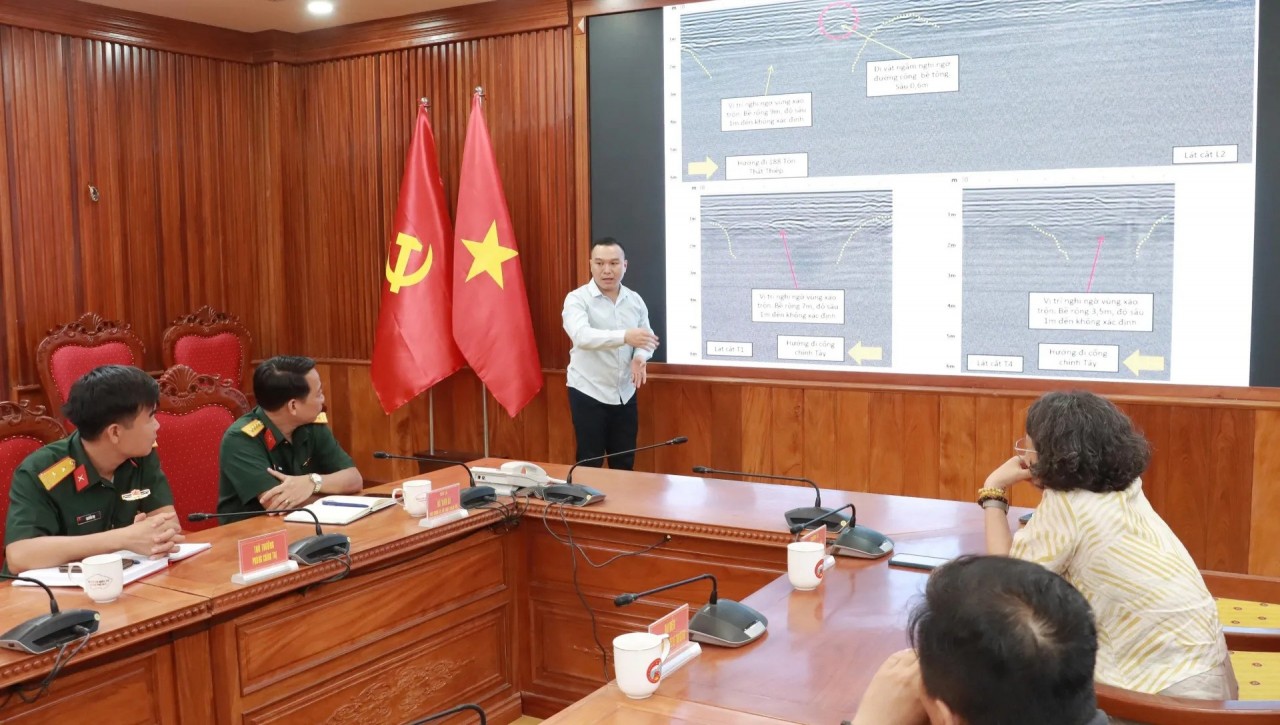 |
| The preliminary meeting reviews the results of ground-penetrating radar surveys at suspected mass grave sites in Hue City. (Photo: Vietnam Veterans Newspaper) |
The leadership of the Hue City Military Command also expressed hope for continued cooperation and technical support from the Design Institute in conducting more in-depth assessments of the survey results, enabling authorities to accurately identify excavation sites and help return the remains of fallen soldiers to their comrades and families.
According to the plan, ground-penetrating radar will continue to be deployed over the coming days to survey additional locations covering a total area of approximately 1,350 square meters. These sites have all been identified based on information collected from witnesses, veterans, and historical documents, with the expectation that the effort will accelerate the search, recovery, and identification of fallen soldiers' remains throughout Hue City.
 | Encounter of the Two Sides: Sharing and Reconciliation A meeting took place between children of Vietnamese martyrs and members of the Two Sides Project (2SP) delegation led by Margot C. Delogne, in Hanoi ... |
 | Vietnam War Veterans Association Holds Successful 8th National Congress The 8th National Congress of the Vietnam War Veterans' Association for the 2026-2031 term successfully concluded on the afternoon of June 17 in Hanoi, after ... |
Related Stories
 National
New Advances in DNA Technology for Identifying Fallen Soldiers
 National
Vietnam War Veterans Association Holds Successful 8th National Congress
Recommended
 National
When Community Becomes an Anchor: Early Progress in Reducing HIV and TB Stigma in Champasak
 National
More Than 50 Records Provide New Leads for Identifying Fallen Soldiers
 National
Vietnam News Today (July 21): Standard Chartered Raises 2026 GDP Growth Forecast for Vietnam to 9.5%
 National
Party Central Committee’s Third Meeting Opens in Hanoi
 National
Vietnam News Today (July 20): Diplomacy Opens New Pathways for Vietnam’s Development
 National
Vietnam News Today (July 18): EVFTA Supports Strong Growth in Vietnam-Nordic Trade
 National
Top Leader Calls for Better Care for Invalids, Revolutionary Contributors
 National