
M.A. Nguyen Thuy Thien Huong: Flexibility and Creativity in Promoting Vietnamese Language in Malaysia
 | Integrating Culture - Key to Sustain Vietnamese Among Younger Overseas Generations |
| Initiatives and Proposals to Preserve “Beloved Mother Tongue” for Vietnamese Children in Japan |
Appeal of Vietnamese Language
In a Vietnamese language class on the theme “Vietnamese Cuisine” at the University of Malaya, Nguyen Thuy Thien Huong guides students in distinguishing how to use familiar words such as pho, bun, nem, and ca phe sua da. The classroom atmosphere is lively as students of Vietnamese, Malaysian, Chinese, Indonesian and other backgrounds take turns reading vocabulary and forming sentences in Vietnamese. Such engaging and approachable lessons have become a bridge for Huong to spread the Vietnamese language and culture to international friends, while also nurturing a love for Vietnamese among the Vietnamese community in Malaysia.
Sharing about the demand for learning Vietnamese in Malaysia, Huong notes that the Vietnamese community there is highly diverse. They include factory workers, manual laborers, women married to local citizens, students, intellectuals, and families who have lived in Malaysia for many years. Along with the community’s growth is a rising need to maintain Vietnamese among younger generations.
At the same time, a portion of native Malaysians also seek to learn Vietnamese for professional or personal reasons. They include law enforcement officers, tour guides, employees of companies that do business with Vietnam, and Malaysians with Vietnamese spouses. For them, Vietnamese is not only a communication tool but also a “key” to expanding career opportunities and fostering respect and understanding in cross-cultural relationships.
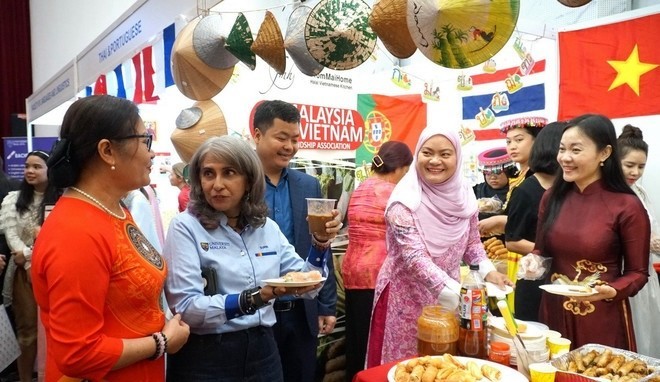 |
| Nguyen Thuy Thien Huong (far right) introduces Vietnamese coffee to Professor Sirinderpal Kaur, Dean of the Faculty of Languages and Linguistics, University of Malaya (second from left). |
In the university environment, Vietnamese language teaching becomes even more specialized. Huong directly teaches Vietnamese language and culture to students from various countries in the region. They come to Vietnamese not only out of academic curiosity but also to broaden their knowledge of Southeast Asia, support research, or prepare for international career opportunities. This group of learners tends to absorb knowledge systematically and often raises questions about phonetics, grammar, socio-political issues, culture, and Vietnamese lifestyles.
Professor Surinderpal Kaur, Dean of the Faculty of Languages and Linguistics at the University of Malaya, noted that Vietnamese is among the faculty’s elective courses, attracting 100-140 student enrollments each term. He considers this a significant figure for a language that is not widely spoken. Many students share very diverse reasons for choosing Vietnamese: some want to find jobs in Vietnam, some love Vietnamese cuisine because it is “full of vegetables and healthy,” while others simply want to make friends with Vietnamese students at the university.
Flexibility as the “Secret Ingredient”
Drawing from her many years of teaching experience, Nguyen Thuy Thien Huong shared that Vietnamese language education in Malaysia is only truly effective when built on flexibility, personalization, and the ability to create cultural connections. Each group of learners has different needs and starting points, requiring teachers to choose suitable methods instead of applying a single uniform model.
In classes for children of Vietnamese origin, she prioritizes creating a familiar and comfortable atmosphere, helping them approach Vietnamese through games, pictures, storytelling, or craft activities. Vietnamese is brought into daily life through the smallest things: naming household objects, reading familiar folk verses, or singing a Vietnamese children’s song. What matters most is helping the children feel the Vietnamese language emotionally before asking them to master reading and writing skills.
For native Malaysians, lessons tend to be highly practical. Real-life communication situations, from greetings and asking for directions to introducing one’s job, are incorporated into the curriculum so learners can immediately see the usefulness of Vietnamese. They learn quickly and seriously, often asking many questions related to specialized vocabulary, cultural etiquette, or Vietnamese customs.
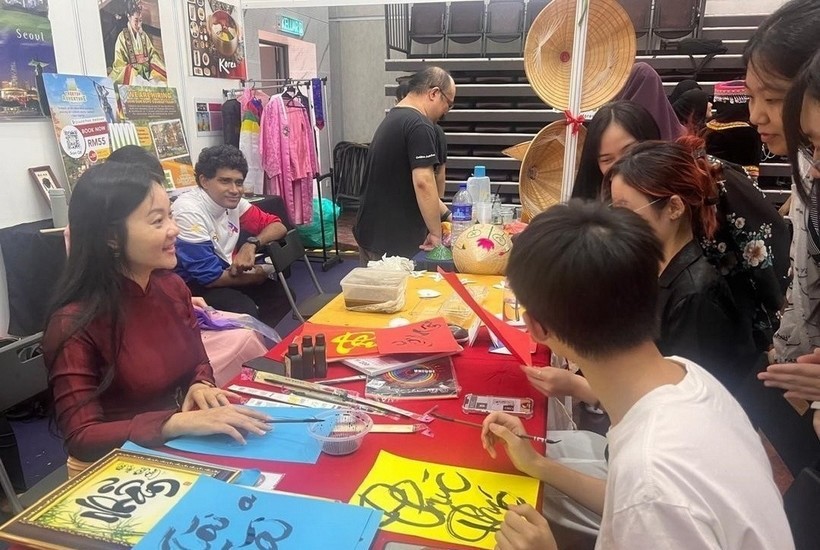 |
| Nguyen Thuy Thien Huong (far left) with students at the University of Malaya during a lesson on learning and practicing Vietnamese calligraphy. |
Meanwhile, teaching at the University of Malaya requires a more academically oriented approach. Vietnamese is not only a system of sounds, characters, and sentences but also a gateway for students to explore Vietnamese culture, history, and ways of thinking. Huong often incorporates cross-cultural comparisons, explaining why Vietnamese has six tones, why Vietnamese people use kinship-based forms of address, or why Vietnamese cuisine favors the balance of yin and yang elements.
To make her lessons more engaging, Huong integrates technology into most of her classes. She uses interactive games such as Kahoot and Quizlet, online classes on Zoom and Google Meet for distant learners, sample videos, QR codes containing pronunciation clips, and WhatsApp groups for parents and learners to keep up with class updates. All these tools help bridge geographical distances and maintain connections throughout the learning process.
Huong also implements various initiatives that allow learners to engage with Vietnamese in natural and emotionally meaningful ways. The “Hometown Mailbox” model encourages students to write handwritten letters in Vietnamese to their grandparents in Vietnam, thereby improving their writing skills while strengthening family bonds. The “Vietnamese Around Me” project inspires students to search for Vietnamese traces in Malaysian life, such as a Vietnamese restaurant, a conversation with their parents in Vietnamese, or a traditional object, and share their findings with the class.
However, for Vietnamese language teaching and learning in Malaysia to achieve sustainable effectiveness, Huong believes more comprehensive support is needed from management agencies and educational institutions. The shortage of learning materials specifically designed for children of overseas Vietnamese forces teachers to create their own teaching resources, which is time-consuming and lacks consistency. Training programs for teachers abroad also need to be expanded in both format and content, with mechanisms for post-training support so teachers can effectively apply what they have learned. In the long term, building an open educational resource repository and a global network of Vietnamese language teachers would form the foundation for methodological alignment and experience sharing across countries.
 | Kaneya Manabu and His Journey to Discover Viet Nam Through the Vietnamese Language Kaneya Manabu, former head of the Saitama Prefectural Police Department in Japan, once gave up a monthly salary of more than 100 million VND and ... |
 | Vietnamese Bookcases: Contributing to Preservation and Development of Vietnamese Language Around the World “The expansion of the Vietnamese Bookcase network not only helps bring official books and learning materials from Vietnam to overseas Vietnamese communities, but also promotes ... |

Most read


Related Stories
 Overseas Vietnamese
Vietnamese Community in India Strengthen Community Ties and Preserve Language
 Viets Home
Foreigners Tell Vietnam’s Stories in Vietnamese
 Overseas Vietnamese
Vietnamese Oratory for Young Generation in RoK
 Friendship
I Have Become a Citizen of Viet Nam
In topics
 Expats in Vietnam
Three Foreign Writers Spreading Vietnamese Language
 Overseas Vietnamese
Dr. Tra My Reveals the Secret to Helping Her Child Become Fluent in Vietnamese
 Viets Home
Press and Media: Expanding Global Reach of Vietnamese Language
 Overseas Vietnamese
Vietnamese Language "Flourishes" in the Land of Tulips
Recommended
 Overseas Vietnamese
Japan Law Quiz Awards Presented to Vietnamese Community in Japan
 Overseas Vietnamese
Vietnamese Community Becomes Japan’s Second-Largest Foreign Community
 Overseas Vietnamese
“Honorary Citizen of Seoul” Tran Ngoc Lam Appointed Prosecutor of Seoul Migrant Network
 Overseas Vietnamese
Vietnamese Community Makes Positive Contributions to Host Society
Popular article
 Multimedia
Vibrant Vietnamese Community Football Tournament Held in Chubu Region (Japan)
 Overseas Vietnamese
Pho and the Bridges That Lead Back Home
 Overseas Vietnamese
Vietnamese Account for Majority of Highly Skilled Foreign Workers in Japan
 Overseas Vietnamese