
More than 1,300 Fallen Soldiers' Remains Recovered After 111 Days of Campaign
 | Hue Uses Ground-Penetrating Radar to Locate Suspected Mass Graves |
| Conclusion No. 57-KL/TW: Highest Priority to the Search, Recovery, and Identification of Fallen Soldiers' Remains |
The "500-Day Campaign to Accelerate the Search, Recovery, and Identification of Fallen Soldiers' Remains" has achieved encouraging results after more than three months of implementation. The information was announced by Senior Colonel Le Van Son, Deputy Director of the Department of Social Policy under the General Department of Politics of the Vietnam People's Army, at the Government's regular press conference for June, held on July 4.
According to Senior Colonel Le Van Son, although the campaign was officially launched on April 2, its implementation period is calculated from March 15, 2026, to July 27, 2027. As of July 4, the campaign had entered its 111th day, bringing about significant progress in the nationwide search, recovery, and identification of fallen soldiers' remains.
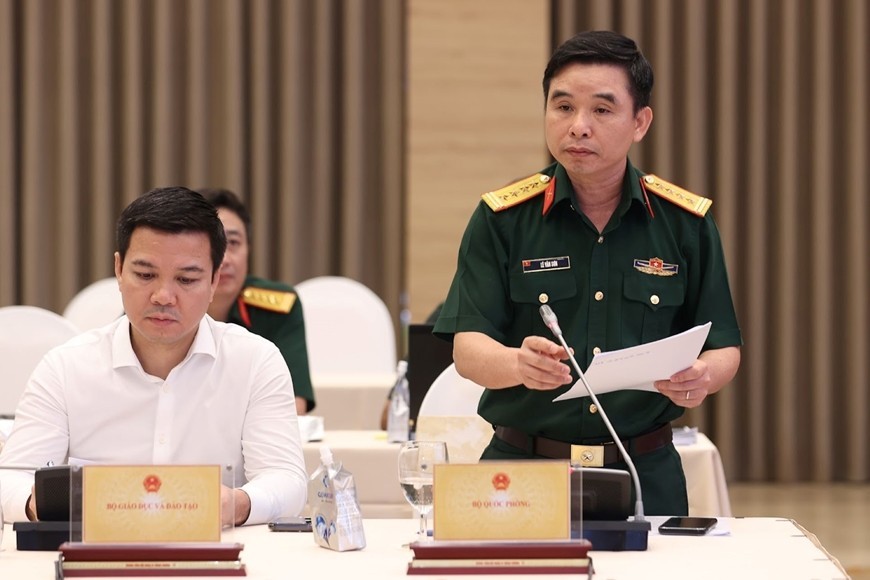 |
| Senior Colonel Le Van Son, Deputy Director of the Department of Social Policy under the General Department of Politics of the Vietnam People's Army. (Photo: Vietnam Navy Newspaper) |
The campaign has set five key objectives: recovering approximately 7,000 sets of fallen soldiers' remains; completing the collection of samples from around 230,000 unidentified graves at martyrs' cemeteries; conducting DNA analysis on approximately 18,000 sets of remains; establishing and operating a genetic database of relatives of unidentified fallen soldiers; and completing mine and unexploded ordnance clearance in key areas, including Vi Xuyen (Tuyen Quang Province), Lao Cai, and Lang Son.
To achieve these objectives, the National Steering Committee has been strengthened and has issued implementation programs and plans for the 2026-2030 period. In the field of search and recovery, the Ministry of National Defence has assigned specific targets to each military region and unit, consolidated the force structure, and maintained 32 recovery teams comprising approximately 1,500 officers and soldiers operating nationwide.
One of the campaign's most effective new approaches has been the compilation and review of historical records and information provided by organizations and individuals both in Vietnam and abroad to verify the locations of collective graves. Following two thematic workshops held in Quang Ngai and Ho Chi Minh City, authorities recovered the remains of one fallen soldier in Quang Ngai and identified another site suspected to contain a collective grave in the Le Thi Rieng Park area of Ho Chi Minh City. Excavation at the site is scheduled to begin on July 6.
In addition to utilizing historical records, search teams have adopted a range of modern technologies. Combining map-coordinate verification with on-site surveys, witness testimonies, and ground-penetrating radar has improved search accuracy, shortened survey time, and reduced excavation work.
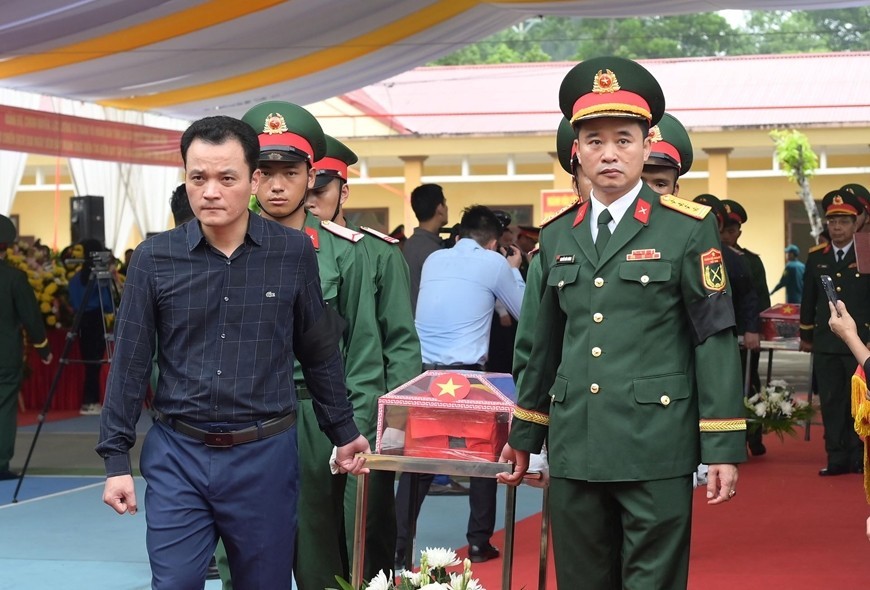 |
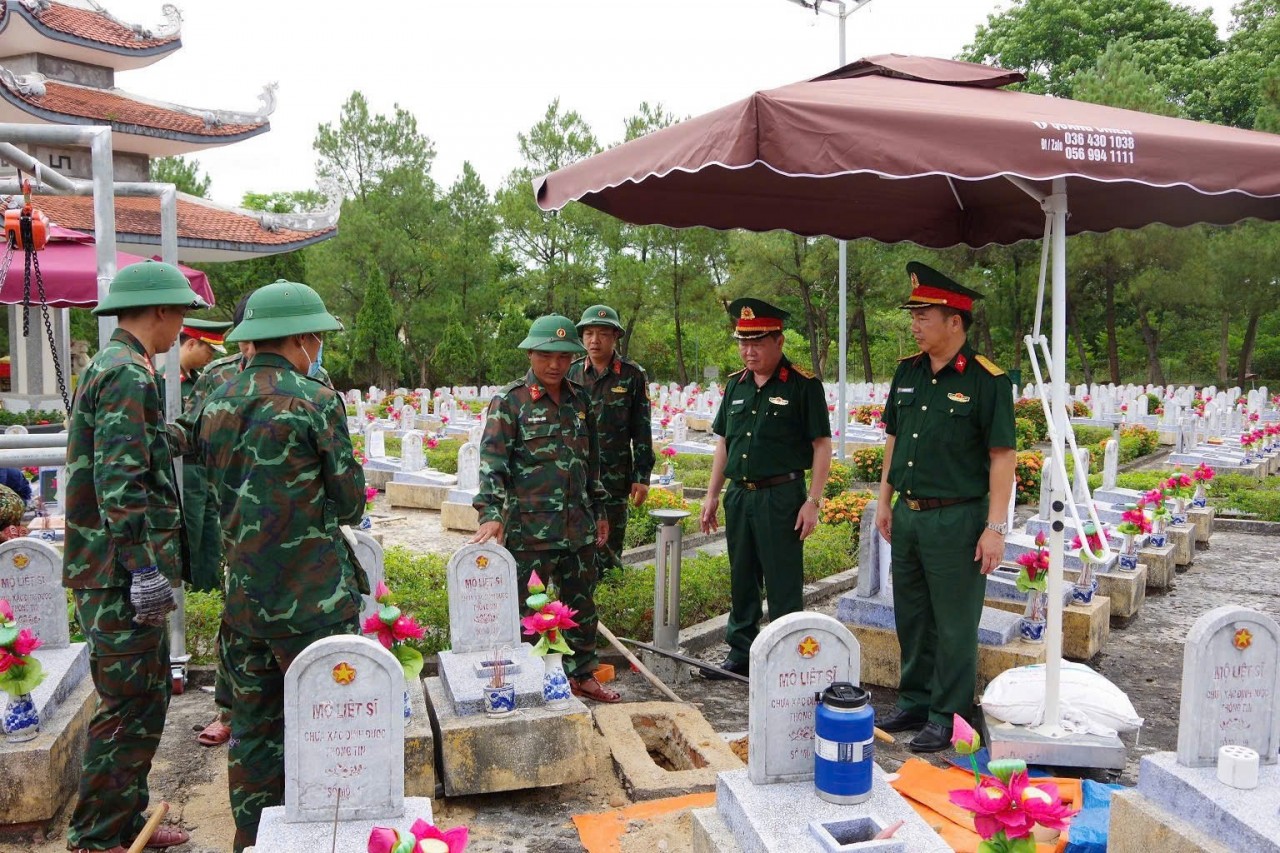
| Leaders of Lao Cai Province and the Lao Cai Provincial Military Command conduct the relocation of the remains of fallen heroes, June 2026. (Photo: Vietnam Navy Newspaper) |
The collection of samples from fallen soldiers' remains and the development of a DNA database have also been implemented in a coordinated manner. The Ministry of National Defence has issued standardized procedures for sample collection, preservation, transportation, and digitalization of information. It has also partnered with Viettel Group to develop software that manages the entire process, minimizing errors and ensuring accuracy in data comparison.
To date, military regions and localities have established more than 300 sampling teams involving approximately 3,500 personnel. The Ministry of Home Affairs has also advised the Government on issuing special mechanisms and policies for DNA testing, providing the legal framework for local authorities to allocate funding and coordinate with specialized agencies in identifying fallen soldiers whose identities remain unknown.
At the same time, mine and unexploded ordnance clearance has continued to intensify in key areas. The Ministry of National Defence has deployed 330 clearance teams, involving more than 5,000 officers and soldiers and over 1,300 specialized vehicles and equipment, to remove explosive remnants of war and ensure safe conditions for search operations.
According to the latest statistics, the participating forces have recovered more than 1,300 sets of fallen soldiers' remains, including three collective graves. They have collected samples from more than 27,000 martyrs' graves, with over 20,000 qualified samples already transferred to DNA testing centers. Mine clearance has been completed across more than 7,000 hectares, including over 3,000 hectares in the Vi Xuyen area alone, equivalent to more than 70% of the planned workload.
Regarding the database of fallen soldiers' relatives, the Ministry of Public Security has collected nearly 95,000 biological samples and analyzed and synchronized more than 50,000 of them into the national database to support future DNA matching.
Senior Colonel Le Van Son said that the Ministry of National Defence will continue advising the National Steering Committee to implement comprehensive measures, mobilize all available resources, and expand the application of science and technology to accelerate the campaign's objectives, thereby helping identify the remains of Vietnam's fallen heroes at the earliest opportunity and reunite them with their families and hometowns.
 | New Advances in DNA Technology for Identifying Fallen Soldiers The Ministry of Public Security's Department of Political Affairs organized the special political-art program "DNA - Reconnecting the Roots" to promote the significance of the ... |
 | 500-Day Campaign: Hope of Reunion Through DNA Evidence Implementing Decision No. 27/QD-BCDQG dated March 22, 2026, issued by the National Steering Committee, and in preparation for the 80th anniversary of War Invalids and ... |
Related Stories
 Handbook
Conclusion No. 57-KL/TW: Highest Priority to the Search, Recovery, and Identification of Fallen Soldiers' Remains
 Viet's Home
Quang Tri Provincial Authority Widen Scope For Search of Fallen Soldiers’ Remain Amidst Limited Information
Recommended
Viet's Home
More than 1,300 Fallen Soldiers' Remains Recovered After 111 Days of Campaign
 Viet's Home
Integrating Local Cultural Values Into Tourism Activities
 Viet's Home
Champasak Proposes Expanded Cooperation with Can Tho Across Multiple Sectors
 Viet's Home
Olympic Champion Shooter Hoang Xuan Vinh Aspires New Viet-RoK Film Project
 Viet's Home