
Oxfam and VCCI-HCM Help Businesses Improve Management and Connect with Markets
| Vietnam Increasingly Affirms Role as Responsible Development Partner Sustaining Land with Bamboo Shoots: New Livelihood for Bru-Van Kieu Women in Quang Tri |
Strengthening professional skills
Japanese customers carefully inspect individual rice paper sheets produced by Tai Ky Flour and Food Joint Stock Company. They also take samples away for testing and visit the factory several times to examine the production process before deciding whether to place an order.
Nguyen Thi Hoang Oanh, Deputy Head of Administration and Human Resources at Tai Ky, said that once customers have gained greater confidence in the company, they conduct only preliminary inspections before placing deposits. To retain customers, the company must regularly monitor product quality and ensure that its production processes meet their requirements.
Oanh also encountered difficulties with internal management due to a lack of clearly defined procedures. Having progressed from a technical position to a management role, she initially relied on experience to handle her responsibilities. Some tasks lacked clearly established step-by-step procedures, leaving employees to ask one another for guidance whenever problems arose. After three rounds of training on process improvement supported by the Vietnam Chamber of Commerce and Industry – Ho Chi Minh City Branch (VCCI-HCM), she gained a clearer understanding of how to develop procedures for individual tasks and define responsibilities among departments. As a result, work became smoother, with less confusion and overlap.
In addition to providing training courses, experts helped Tai Ky review and improve incomplete internal procedures and policies. The company has put many of the recommendations into practice, although further work remains necessary, particularly in environmental management and occupational safety.
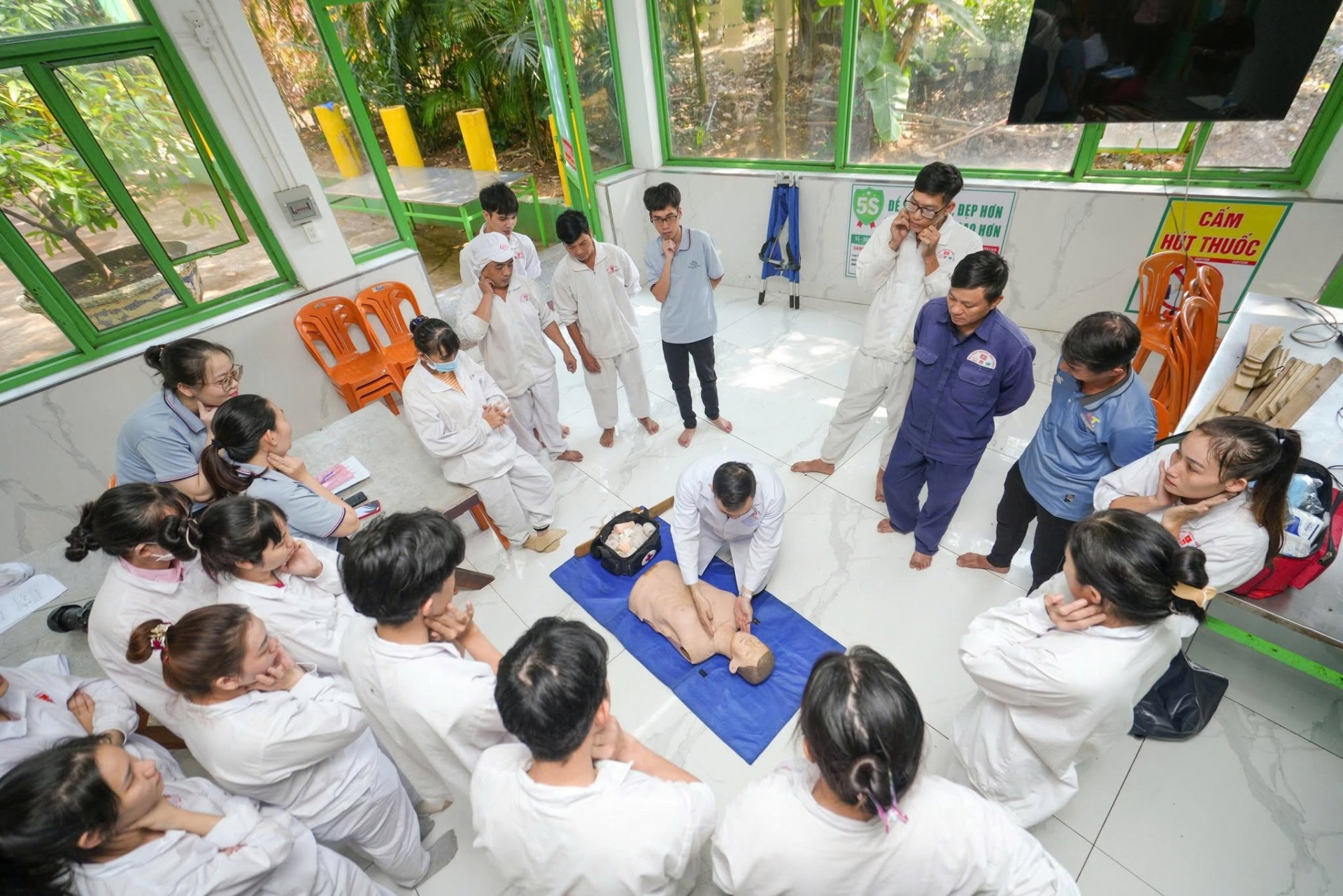 |
| In-depth training on occupational safety and health at Binh Tay Food Joint Stock Company. (Photo: Oxfam in Vietnam) |
These activities form part of a support programme for shrimp and rice businesses implemented by Oxfam in Vietnam in collaboration with VCCI-HCM, with funding from the Directorate-General for Development Cooperation of Belgium. The programme focuses on improving management, workplace skills and occupational safety, as well as addressing requirements related to responsible business practices.
At Binh Tay Food Joint Stock Company, Le Thi Thu Thao works in the rice vermicelli and pho noodle production department. She said the work generates considerable dust, which can affect workers' health if they do not take appropriate protective measures. Workers are therefore required to wear all necessary protective equipment while on duty.
What Thao particularly appreciates is that workers can communicate directly with managers when they have suggestions concerning production or working conditions. If a proposal is reasonable, the factory will consider addressing it. If it is not feasible, managers explain the reasons so that workers can understand.
She added that the factory has installed high-capacity fans to help workers cope with the heat and drinking-water dispensers to keep them hydrated. Meals have also been made more varied.
According to Le Thi Giau, Chairwoman of the Board of Directors of Binh Tay Food Joint Stock Company, the factory applies the 6S methodology to production organisation. Building on the 5S principles of organising and maintaining a tidy, clean workplace, 6S adds an emphasis on occupational safety. Giau said the training activities had helped workers pay greater attention to protecting their own safety while working.
Through its participation in the Oxfam–VCCI-HCM programme, Binh Tay also received consultancy support to review and adjust its policies on employment contracts, working hours, rest periods and workplace dialogue.
Greater opportunities for business connections and access to experts
For Luu Thi Yen Hang, Director of Hong Tan Rice Company Limited, finding new customers addresses only part of the challenge. What concerns her more is whether the company can secure sufficient supplies that meet customers' requirements to ensure repeat orders.
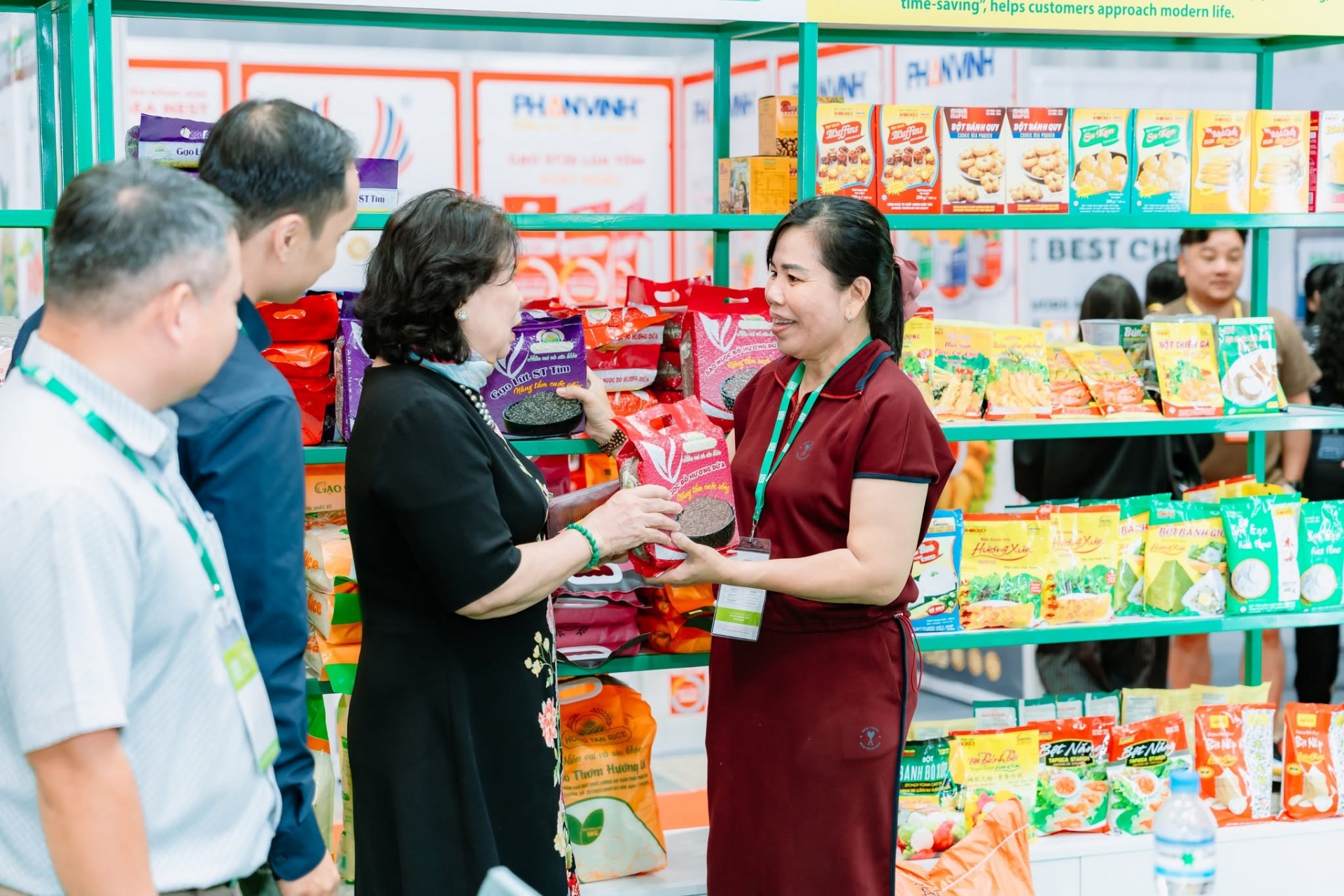 |
| Luu Thi Yen Hang, Director of Hong Tan Rice Company Limited, introduces brown rice and red-striped rice products at Vietnam Foodexpo 2025. (Photo: Oxfam in Vietnam) |
Having worked in the rice industry for more than 30 years, Hang began developing her own brand in 2017, focusing on coloured rice, organic rice and rice-based processed products.
To secure raw materials that meet the required standards, she has had to encourage farmers to change their cultivation practices. She recalled that one farmer had asked her, “What will I gain by working with you?” She had to explain the support available to participating households, including seeds, agricultural inputs, technical guidance and assistance in marketing their produce.
According to Hang, organic rice is harvested only once a year, and production volumes are limited. Meanwhile, Hong Tan's storage facilities, stockholding capacity and financial resources remain constrained. At times, customers have wanted to place repeat orders, but the company has not had enough stock to fulfil them.
As she developed Hong Tan, Hang participated in support activities under the GRAISEA 2 project from 2019 before joining the Oxfam–VCCI-HCM collaborative component in 2024.
Through these programmes, she gained additional knowledge of management, production and the requirements for bringing products to market. In late 2025, she participated in Vietnam Foodexpo for the first time, personally introducing Hong Tan's rice products and meeting and talking with prospective customers.
Hang hopes to continue participating in trade fairs and exhibitions to seek partners. She also hopes to receive the necessary support to access export markets. Nevertheless, for Hong Tan, attracting more customers must go hand in hand with the ability to secure sufficient supplies and maintain a regular supply of products.
In the Tam Giang mangrove forest area of Ca Mau, reaching Tai Thinh Phat Cooperative requires travelling by boat. Mai Thi Thuy Trang, the cooperative’s chairwoman, said that despite the difficult access, officials and experts from Ho Chi Minh City still travelled to the site to provide guidance to members.
Through these training sessions, Trang gained further knowledge of cooperative management and the standards and regulations governing production. Programmes designed for rural women also covered ways to protect their own health and that of their families and children.
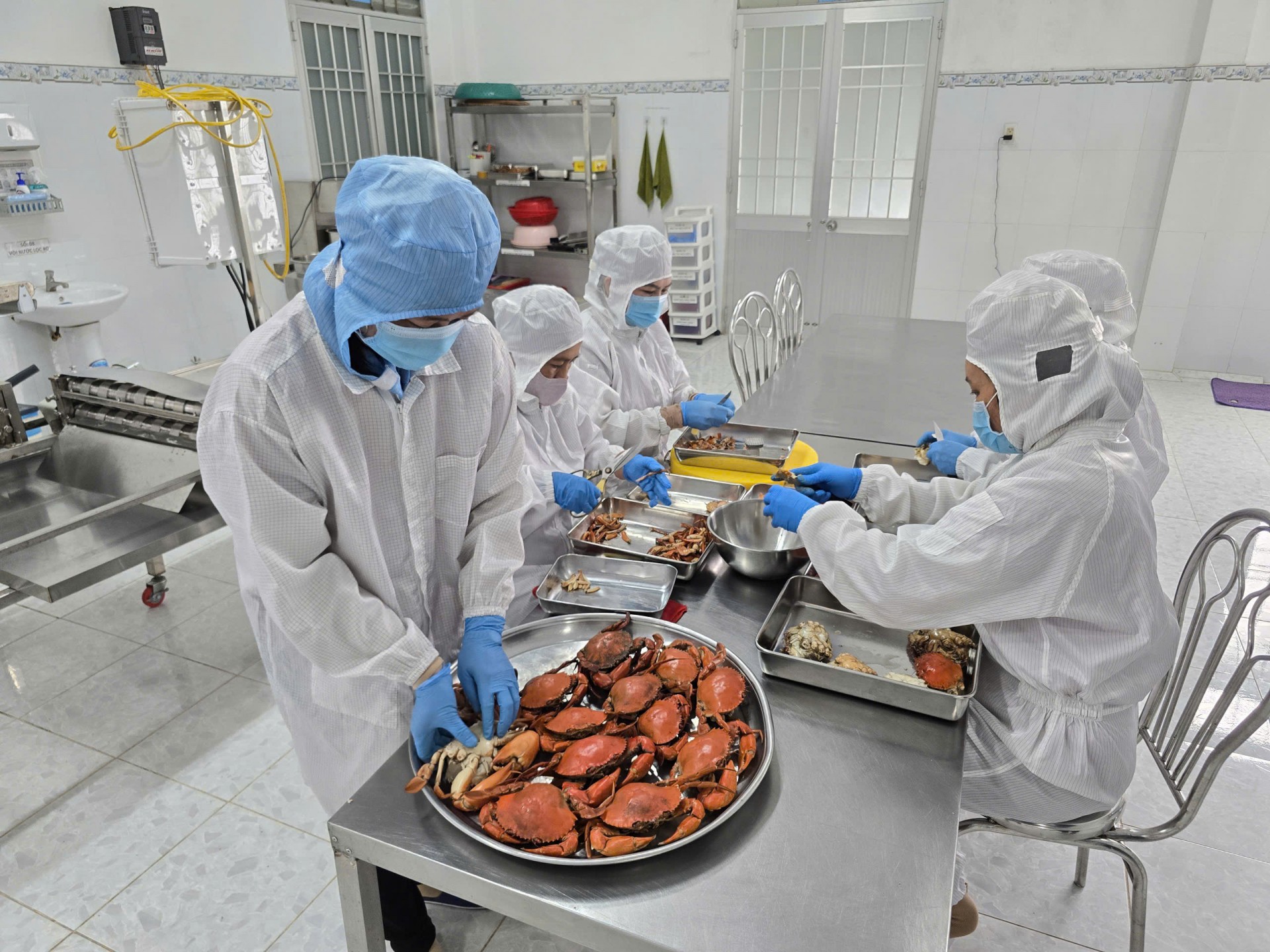 |
| Workers extracting crab meat at Tai Thinh Phat Cooperative. (Photo: Tai Thinh Phat Farm) |
According to Trang, local women have limited opportunities to access new knowledge. For newly established cooperatives, finding suitable mentors is not easy, particularly in areas with difficult transport conditions. She hopes VCCI-HCM and Oxfam in Vietnam will continue providing support so that members can gain further knowledge of management and production and improve product quality.
According to the programme’s final review, the collaboration between Oxfam in Vietnam and VCCI-HCM helped connect more than 30 shrimp and rice cooperatives with business networking activities. The cooperatives also received guidance on packaging, labelling and food safety requirements, among other areas.
Bui Thi Ninh, Deputy Director of VCCI-HCM, said that implementation had revealed that many small and medium-sized enterprises faced similar challenges. International market requirements were constantly changing, while businesses lacked information. Some enterprises knew where improvements were needed but lacked the funding, technical expertise or personnel to implement them. Finding experts who understood the specific characteristics of each business was also far from straightforward.
Oxfam’s funding enabled VCCI-HCM to organise training courses, invite experts to visit businesses and assess their actual circumstances, and recommend appropriate solutions. However, Ninh stressed that experts could not do the work on behalf of businesses.
“We can only offer them solutions,” Ninh said. After receiving consultancy, businesses must take the initiative to adjust their policies, allocate funding and improve technical processes at their factories.
As the collaborative component entered its final review stage, Ninh expressed her hope that Oxfam in Vietnam would continue working alongside businesses and cooperatives in the shrimp and rice value chains. VCCI-HCM would seek additional partners, connect businesses with other sources of support, and encourage them to make use of government programmes at both central and local levels.
A representative of Oxfam in Vietnam also expressed the organisation’s desire to continue working with VCCI-HCM and other partners to improve working conditions and promote responsible business practices.
 Promoting Gender Equality, Social Inclusion in Water Resource Governance in Mekong River Basin Funded by the Australian Government and the Swiss Agency for Development and Cooperation, this project is a commitment to safeguarding livelihoods against the impacts of climate change in the cities of Hanoi, Hue, Can Tho, and Ca Mau province. |
 Learning to Livestream Agricultural Products Farmers from groups and cooperatives in Ca Mau, An Giang, Can Tho and other localities are learning to promote their products on social media by introducing their local rice, dried fish and other specialties directly in front of a phone camera. Their first livestreaming sessions have helped build confidence, but there is still much for them to learn and organise to sustain the activity once they return to their local communities. |

Most read


Related Stories
 Vietnamese Culture
Learning to Livestream Agricultural Products
 Vietnamese Culture
Eight More Sets of Martyrs’ Remains Found at Le Thi Rieng Park
 National
Viet Nam News Today (Oct. 14): Vietnam, Cambodia Sign Defense Cooperation Plan for 2027
 Friendship
Strengthening People-to-People Exchanges, Nurturing Viet Nam-RoK Friendship
Popular article
 Economy
Tay Ninh and Thanh Hoa Seek Investment Partners and Market Expansion Opportunities in Bulgaria
 Economy
India converts gas-fuelled plant for green ammonia
 Economy
India’s Startups Are Srengthening the Country’s Space Tech Boom
 Economy