
Learning to Livestream Agricultural Products
| US to Promote Agricultural Exports to Vietnam IESC Supports Vietnam in Modernizing Agriculture and Promoting Digital Transformation |
Putting Their Skills to the Test on Camera
At the Ca Mau booth, Nguyen Nhu Y, who lives in Ly Van Lam Ward, Ca Mau Province, takes turns holding up packages of purple brown rice, BL9 rice, ST25 rice and other varieties in front of the camera. She turns each package towards the phone camera and introduces the product. On a table covered with a red cloth are bags of rice, shrimp crackers, dried fish and other local agricultural products. After presenting one item, she picks up another and holds it up for viewers.
This is the first time Nhu Y has personally livestreamed to introduce products. Joining her is Nguyen Minh Chau, who lives in Luong The Tran Commune, Ca Mau Province. Chau uses her personal Facebook account to broadcast live, while Nhu Y stands in front of the phone to introduce each item.
Before the livestream, Nhu Y only briefly reviewed information about the products before beginning to speak. Asked whether she felt nervous, she laughs and replies, “It's not an exam, so why should I be nervous?”
She says that more than a year ago, she took part in an online sales training programme supported by Oxfam in Viet Nam. During the course, participants were taught how to introduce products and interact with customers, and took turns practising these skills.
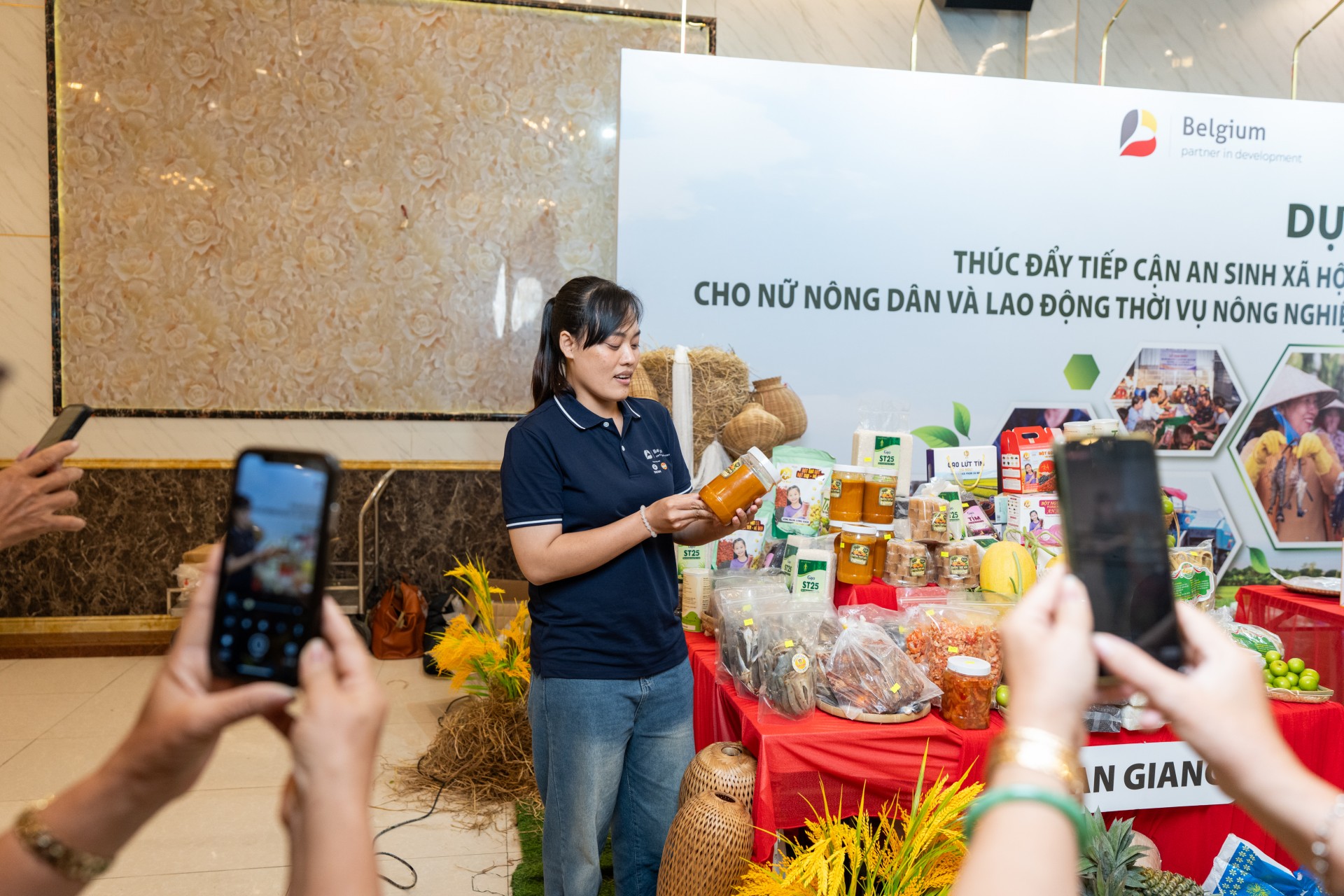 |
| Nguyen Thi Tuyet Ngan (Co To Commune Farmers’ Union, An Giang Province) livestreams to introduce agricultural products from her hometown. (Photo: Oxfam in Viet Nam) |
The lesson she remembers most clearly is the importance of thoroughly understanding a product before presenting it. For a particular type of rice, for example, one needs to know the rice variety, where it is produced and the cultivation methods used. When discussing rice grown in rice-shrimp farming systems, she explains that farmers limit their use of pesticides to avoid affecting the subsequent shrimp farming season.
Although she had practised in the classroom, it was not until October 15, 2026, in Can Tho, that Nhu Y had the opportunity to introduce agricultural products from her hometown in an actual livestreaming session.
The livestream took place as part of the Social Welfare and Occupational Safety and Health Networking Night - Farmers Component, organised by the Project Management Board of the Central Committee of the Viet Nam Farmers' Union in collaboration with the Can Tho Farmers' Union and Oxfam in Viet Nam.
At the An Giang booth, Nguyen Thi Tuyet Ngan, a member of the Farmers' Union in Co To Commune, An Giang Province, also introduced products through a livestream for the first time.
Holding a product box, Ngan turns towards the camera and says, “You can take a close-up shot of the product. The box is very beautiful. Let me open it and show you what's inside!” She opens the box and presents information about the product, its manufacturer and distributor, as well as the contact phone number printed on the packaging.
The livestream was broadcast on the personal Facebook account of a group member and attracted 1,100 views.
Before that day, Ngan says, she had never attended any livestreaming training course. She had mainly taught herself by watching sales livestreams on TikTok and Facebook, observing how other people presented products and chatted with customers. What impressed her most was the confidence of those appearing in front of the camera.
However, when it was her turn to do the same, Ngan realised that speaking continuously was not easy. After introducing the different types of dried fish, she had to think immediately about which product to present next and how to introduce it appropriately. At times, she struggled to find the right words to connect one part of the presentation to the next.
“I have to think really quickly to keep the livestream going without interruption. But I still feel very nervous,” Ngan says.
She does not carry out the work alone. Before the livestream, the group members jointly selected products and learned about each item's features. During the broadcast, one person prepared the goods, another operated the camera, and others helped answer questions about information she was not fully familiar with.
She says the group secured several orders, while some customers also purchased products directly at the booth. After this first attempt, she hopes to learn more about how to guide a conversation, introduce products and interact with viewers.
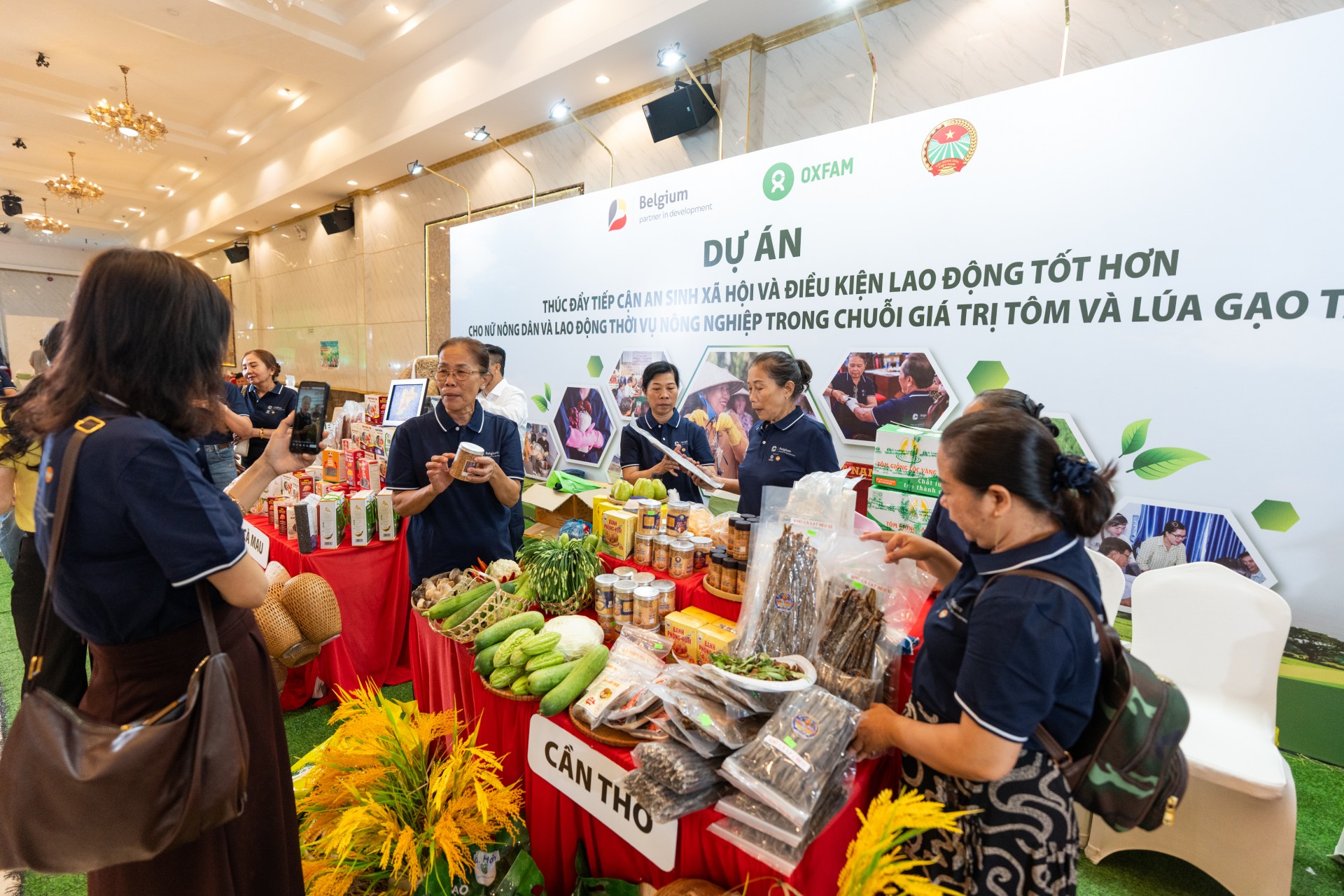 |
| The Can Tho Farmers' Union booth. (Photo: Provided by Oxfam in Viet Nam) |
According to Vu Minh Huyen, a project officer at Oxfam in Viet Nam, while working with cooperatives, cooperative groups and farming households involved in the shrimp and rice value chains in Ca Mau, An Giang and Can Tho, Oxfam found that many farmers had extensive production experience but were not yet accustomed to using digital tools to promote their products.
Some women farmers are still hesitant to appear in front of a camera and do not yet know how to take photographs, develop content or present their products. Their responsibilities for both agricultural production and family care also leave many women with limited opportunities to attend courses on technology, communications and business.
In response to these challenges, Oxfam has worked with the Central Committee of the Viet Nam Farmers' Union and local Farmers' Unions to implement activities aimed at strengthening digital commerce skills. These activities form part of the project component entitled “Promoting Access to Social Welfare and Better Working Conditions for Women Farmers and Seasonal Agricultural Workers in Viet Nam's Shrimp and Rice Value Chains”.
Participants receive guidance on developing social media content, taking photographs, recording videos, designing product visuals, practising livestreaming and using artificial intelligence (AI) tools to support promotional activities.
| From September to December 2025, the project organised three training courses for 102 participants in Ca Mau, An Giang and Can Tho, of whom 32.4% were women. Five cooperatives were selected for more intensive training, during which participants practised these skills using actual products and developed digital communication channels. According to the end-of-course survey results provided by Oxfam, more than 95% of participants said they felt more confident marketing and introducing products online. |
Vu Minh Huyen says the support activities focus on equipping farmers with the knowledge and skills needed to promote their own products. They do not directly connect farmers with sales outlets or provide assistance in selling their goods. The project does not yet have sufficient data to determine whether the training has increased the number of customers, orders or sales revenue.
As an initial outcome, Oxfam has observed that participants are using additional digital tools to introduce their products. Many women farmers have also become more confident in front of the camera, explaining product characteristics and sharing stories about the production methods used by their groups and cooperatives.
Sustaining and Strengthening the Effort
Ngan and her fellow group members have considered setting up their own sales channel. However, when asked whether they were certain they would continue livestreaming after the event, she admitted that she could not yet give a definite answer.
Ngan's group has been together for several months but has yet to adopt an official name or establish a dedicated sales channel. To continue, the members will need to discuss and agree on how to proceed, as each has their own work commitments.
This is also a concern for Nguyen Thi Thuy Linh, who works at the An Giang Provincial Farmers' Union, as she observes the practical activities.
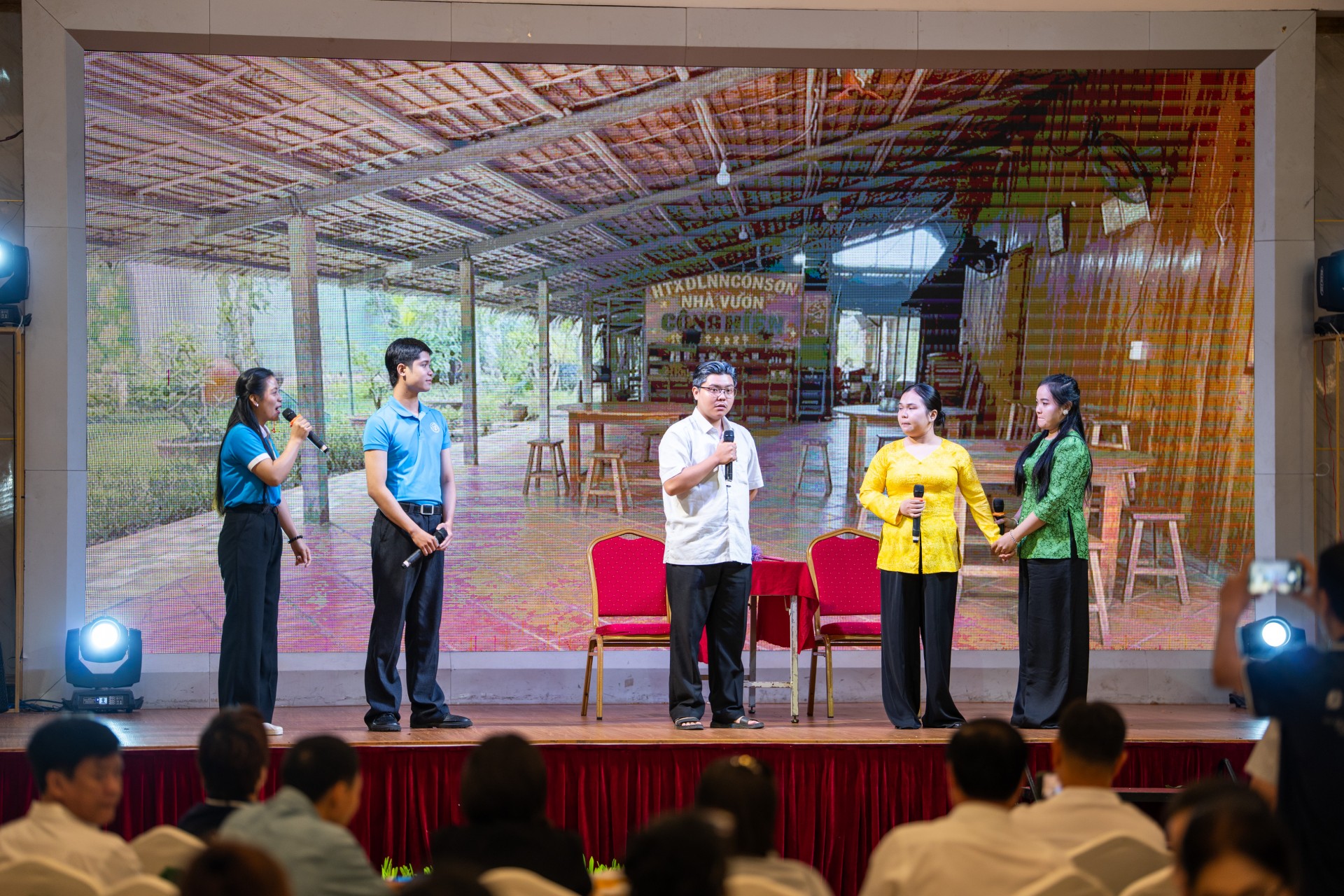 |
| Winning farmer teams from An Giang, Ca Mau and Can Tho perform skits promoting social welfare and occupational safety and health. (Photo: Provided by Oxfam in Viet Nam) |
According to Linh, some members of farmer groups have received livestreaming training, but most have only acquired basic knowledge. Organising a complete online sales session requires not only someone to introduce the products, but also people to monitor comments, contact customers, take orders, pack goods and arrange delivery.
The person appearing in front of the camera must also understand the products, know how to present them and handle questions as they arise. Not everyone who is familiar with the goods can confidently introduce them on camera.
Linh says the An Giang Provincial Farmers' Union has worked with relevant organisations to provide guidance on helping farmers participate in e-commerce platforms. However, livestreaming for sales has not yet been widely implemented, with participation so far largely limited to a number of groups involved in the project.
In light of this situation, she hopes Oxfam in Viet Nam and the project management board will continue providing training in livestreaming, order closing and the tasks involved after a sales session. Those who receive training could then return to their local communities and pass on their knowledge to other groups.
According to Vu Minh Huyen, a major obstacle to sustaining online activities lies not only in people's ability to use technology, but also in how cooperatives and farmer groups organise their work. Through project implementation, Oxfam has found that many groups do not have dedicated members responsible for regularly creating content, taking photographs, livestreaming or responding to customers. These tasks are often handled by just a few active members. When they become busy with agricultural production or family responsibilities, activities can easily be interrupted.
For women farmers, managing their time is even more challenging. In addition to agricultural production, many are also responsible for unpaid family care work. To livestream regularly, they need time to prepare content, record videos, communicate with customers and coordinate with other members.
Huyen also highlights limitations relating to equipment, internet connectivity, image quality and filming space. If groups move towards regular online sales, they will also need to ensure a reliable supply of products, packaging, delivery and order fulfilment.
According to the Oxfam project representative, digital skills training is only the first step. To sustain these activities, cooperatives and farmer groups need to allocate tasks appropriately, develop feasible plans and create conditions that enable members, particularly women, to participate over the long term.
During the remaining period of the project, Oxfam and its partners will continue providing training courses, topic-based coaching and technical support for women farmers and cooperative members. The project also places emphasis on communication, presentation, negotiation and leadership skills, helping women become more confident in production and business activities and in discussions about issues affecting their groups.
The project is scheduled to conclude in December 2026. According to Vu Minh Huyen, Oxfam will compile lessons learned and effective models from the implementation process to share with other cooperatives and cooperative groups. This will also provide an opportunity to review practical approaches that can help local people continue applying the skills they have learned in their work.
 Overseas Vietnamese Help Boost Vietnam’s Agricultural Exports On the morning of April 27, in Khanh Hoa Province, a conference was held to review five years of implementing the project “Mobilizing Overseas Vietnamese to Participate in Promoting and Distributing Vietnamese Products Abroad for the 2020–2024 Period,” under Decision No. 1797/QD-TTg dated December 12, 2019, by the Prime Minister. |
 Vietnam Promotes Sustainable Trade in Agricultural Products and Spices at Anuga 2025 The forum aimed to strengthen trade connections and expand cooperation between Vietnamese exporters of pepper, spices, and agricultural products and importers, distributors, and partners in Germany and Europe. |



Related Stories
 National
Vietnam News Today (Aug. 20): Vietnam, Mexico Seek to Step Up Theoretical Exchanges, Personnel Training Cooperation
 Friendship
IESC Supports Vietnam in Modernizing Agriculture and Promoting Digital Transformation
 Economy
US to Promote Agricultural Exports to Vietnam
 Viets Home
Promoting Gender Equality, Social Inclusion in Water Resource Governance in Mekong River Basin
Popular article
 Viets Home
Italian Ambassador to Viet Nam: Culture Brings Peoples of Two Countries Closer Together
 Viets Home
The Joy of Work for Agent Orange Victims
 Expats in Vietnam
Football and Friendship Unite 20 International Teams in Hanoi
 Viets Home