
Promoting Quantum Technology Development Cooperation In Southeast Asia
| Strengthening People-to-People Diplomacy in Science and Technology in Vietnam Vietnam Hosts First Summer School on Artificial Intelligence and Quantum Computing |
Recently, at the International Centre for Interdisciplinary Science and Education (ICISE), the Department of Science and Technology of Gia Lai province in collaboration with the National Innovation Center (NIC), Vietnam Quantum Technology Network (VNQuantum), and the International Centre for Interdisciplinary Science and Education (ICISE) organised the SEA+ Quantum Coordinator Meeting.
As one of the key activities of Gia Lai Quantum Year 2026, the Meeting brought together leading researchers, representatives of organisations, and programme coordinators (science and diplomacy) from across the region and neighbouring countries to build an integrated quantum science and technology ecosystem in Southeast Asia and neighbouring countries.
Delivering the opening speech, Deputy Director of the Department of Science and Technology of Gia Lai province Nguyen Huu Ha said that in the context that science, technology, innovation, and digital transformation had become important drivers of economic growth, quantum technology is regarded as one of the strategic fields capable of bringing about breakthrough changes in various economic sectors and areas of social life in the future.
According to Nguyen Huu Ha, the development of quantum technology depends not only on the research capabilities of each country but also on knowledge connectivity, resource sharing, and international cooperation. Networks linking government agencies, research institutes, universities, businesses, and scientific organisations will provide a foundation for quantum technology to develop more rapidly and effectively while serving the sustainable development goals of each country, as well as the region.
In the context that quantum technology moves from laboratories into practical applications, Southeast Asian countries face common opportunities and challenges in human resources, research infrastructure, cooperation with businesses, and policy framework completion. This meeting is expected to help align regional efforts, enabling Southeast Asia to participate more deeply in and benefit from the global quantum technology revolution.
“For Gia Lai, hosting the meeting is not only an opportunity to expand international cooperation but also a way for the province to participate more deeply in global science and technology networks and realise its goal for science, technology, innovation, and digital transformation in the new development period”, Deputy Director of the Department of Science and Technology of Gia Lai province Nguyen Huu Ha said.
According to the Organizing Committee, the conference was held under the Chatham House rule, delegates were free to use the information received but were not permitted to disclose the identity or affiliation of any speaker or other delegate. The meeting created a specialised forum for coordinators to share national-level updates on quantum research programmes, funding initiatives, and strategic roadmaps; identify opportunities for regional cooperation in education, human resource development and joint research projects; discuss mechanisms for resource sharing, researcher mobility and cross-border access to quantum infrastructure; lay the groundwork for sustainable coordination among Southeast Asian quantum communities.
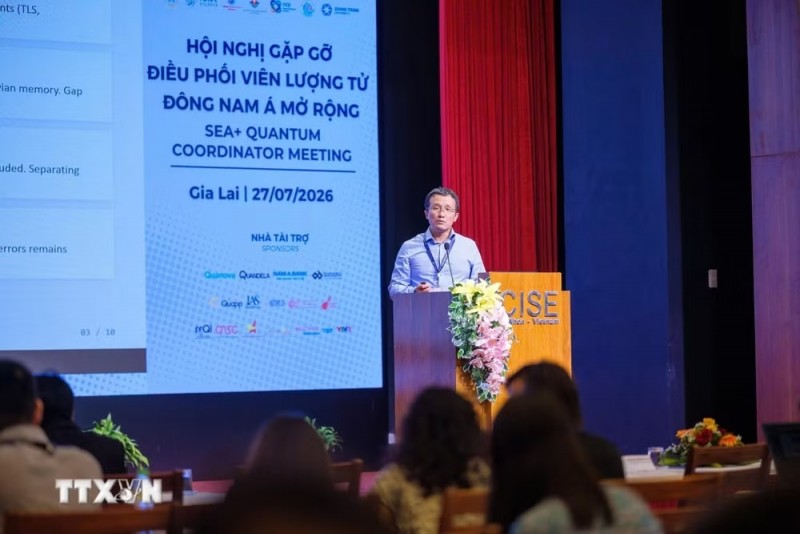 |
| Delegates spoke at the meeting. (Photo: VNA) |
The meeting opened with a keynote presentation entitled “Challenges in quantum technology development” by Associate Professor Nguyen Quoc Hung (Vietnam National University, VNQuantum), which examined the development of quantum technology, its potential applications and the challenges for the sector.
Following, delegates joined three roundtable discussions on national and regional quantum technology policies; human resource development and quantum talent-training systems; quantum infrastructure in relation to national sovereignty and shared-use mechanisms.
The sessions were moderated and featured international experts, including Tim Smith (Open Quantum Institute), Sako Hayashi (Kavli Institute for the Physics and Mathematics of the Universe), and Bobby Corpus (Quantum Computing Society of the Philippines).
 Conference on Sustainable Resilience through Future Technology and Design Conference on Sustainable Resilience through Future Technology and Design On July 15, the University of Economics Ho Chi Minh City (UEH) in coordination with international partners held the 2026 Resilience by Technology and Design Conference (RTD 2026) themed “FutureScape - Designing the Future”. |
 Vietnam Academy of Science and Technology Ramps up Scientific Diplomacy Vietnam Academy of Science and Technology Ramps up Scientific Diplomacy From July 19-23, during their working visit to the Republic of Austria, the delegation from the Vietnam Academy of Science and Technology carried out scientific and people-to-people diplomacy activities with an aim to expand international cooperation and connect the Vietnamese scientific community and intellectuals abroad. |


Most read


Related Stories
 Viets Home
Vietnam to Host Its First International Olympiad in AI
 Economy
Conference on Sustainable Resilience through Future Technology and Design
 Viets Home
Vietnam-Japan Deepen Cooperation in Strategic Tech Talent Training
 Economy
Da Nang, Chemnitz Boost Cooperation in Semiconductors, AI, Mechanics
Popular article
 Viets Home
Cao Bang Receives Over VND 64 Billion in Donations for Social Welfare Programs
 Viets Home
What Ensures Fairness Behind Every “Scratch & Win Instantly” Promotional Code?
 Viets Home
Nghe An Targets Gathering of 180 Martyrs’ Remains in 2026-2027 Dry Season
 Viets Home