
Semiconductor Training Must Keep Pace With Market Demand
| Gia Lai: Open Quantum, Semiconductor and Superconductor Technology Exhibition AI, Semiconductors, Quantum Technology: New Areas of Vietnam-Singapore Cooperation |
Practical Barriers
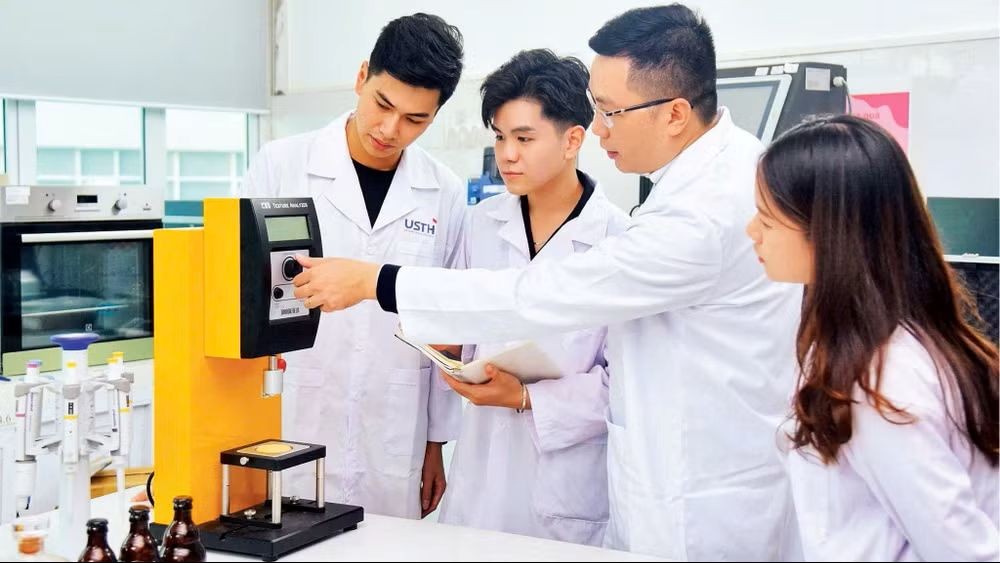 |
| Guiding students in assembling technology products at Hanoi University of Science and Technology. (Photo: Ngoc Hien/Nhan Dan Newspaper) |
Human resources are a central factor determining a country’s capacity for innovation and its ability to master science and technology. This role is even more important in the semiconductor industry, as semiconductors are a foundational technology that drives the development of artificial intelligence (AI), the Internet of Things, automation, biomedical electronics, national defense, and other fields.
Viet Nam needs at least 50,000 university graduates and above with relevant qualifications by 2030 to gradually participate more deeply in the global supply chain. At present, the available workforce meets only about 20% of actual demand. Associate Professor, PhD Nguyen Huu Hieu, Rector of the University of Science and Technology, The University of Danang, said the shortage is not only quantitative but also qualitative, particularly in personnel capable of participating in the entire value chain, from design and manufacturing to testing. As demand from businesses continues to rise, the number of students receiving specialized training remains small, while the gap between training programs and actual production remains considerable. These limitations stem from various causes, most notably the shortage of lecturers with extensive practical experience and modern facilities and equipment for training.
Viet Nam needs at least 50,000 university graduates and above with relevant qualifications by 2030 to gradually participate more deeply in the global supply chain. At present, the available workforce meets only about 20% of actual demand.
According to Professor, PhD Tran Dai Lam, Director of the Institute of Materials Science under the Vietnam Academy of Science and Technology, the biggest challenge at present is not a lack of students but a shortage of internationally qualified lecturers capable of providing leadership. Semiconductor technology requires in-depth knowledge of integrated circuit design, manufacturing technologies, and new materials, all closely connected with actual production as well as cutting-edge research around the world. Moreover, professors and scientists working in Viet Nam’s public-sector system currently earn only about US$500-800 per month, far below the levels in Singapore (about US$7,000), South Korea (US$5,000), and Germany and the United States (about US$12,000 per month). This gap makes it increasingly difficult to attract and retain leading experts and top talent, as well as to invite Vietnamese experts working overseas and international specialists to work in Viet Nam for the long term.
In addition, semiconductor workforce training currently remains heavily theory-based, with insufficient links to businesses and actual production. Associate Professor, PhD Nguyen Tan Tran Minh Khang, Rector of the University of Information Technology under Viet Nam National University Ho Chi Minh City, pointed out that the semiconductor industry has three important stages: chip design, chip manufacturing, and chip packaging and testing. In chip design, the gap between training and industrial demand has narrowed considerably. However, in manufacturing, packaging, and testing, workforce training remains heavily theoretical and has limited connections with businesses and actual production.
Training Innovation
Over the next five years, Viet Nam is forecast to need between 20,000 and 50,000 integrated circuit and semiconductor engineers, requiring training institutions to undergo major changes. They can no longer continue operating under a linear, closed model but must adopt a more flexible approach. Associate Professor, PhD Nguyen Van Dang, Rector of the University of Sciences under Thai Nguyen University, said each training institution needs to determine its own direction and priority fields based on its existing strengths.
Universities need to expand substantive cooperation with major technology corporations through co-designing curricula, linking training with internships at factories, and establishing learning outcomes based on businesses’ requirements. They should also standardize textbooks in accordance with international standards and improve students’ capacity for international integration. In particular, students and lecturers should be given mechanisms to directly participate in solving technology problems arising from actual orders placed by high-tech companies. The University of Sciences is implementing this approach through training models aligned with international standards and market demand.
In addition, training programs are designed to closely follow the workforce needs of major industrial complexes in the region, notably the US$260 million prefabricated module manufacturing project of Sunny Opotech Group in Thai Nguyen and Samsung’s manufacturing ecosystem in Viet Nam. Close cooperation between universities and businesses enables training programs to remain up to date with real-world practices, producing a workforce capable of immediately joining high-tech production lines and narrowing the gap between training and market demand.
From another perspective, Associate Professor, PhD Le My Ha, Dean of the Faculty of Electrical and Electronics Engineering at Ho Chi Minh City University of Technology (HUTECH), said the university provides training for various stages of the semiconductor value chain, from integrated circuit design to chip testing and packaging. It has established a cooperation network with more than 1,600 businesses and diversified activities through business seminars, field trips, internships, research cooperation, equipment and software sponsorships, and the co-organization of academic competitions. This model helps students gain early exposure to actual production environments and better meet the requirements of the semiconductor industry.
According to Associate Professor, PhD Nguyen Van Quynh, Dean of the Faculty of Advanced Materials Science and Nanotechnology at Hanoi University of Science and Technology, in the current context, universities must not only serve as institutions for training human resources but also become centers of innovation and technology transfer. To achieve this, it is necessary to strongly promote the “State-University-Enterprise-Research Institute” cooperation model, in which businesses become deeply involved in developing training curricula, supporting research, and developing students’ professional skills.
Associate Professor, PhD Ngo Nhu Khoa, Rector of the University of Industrial Engineering under Thai Nguyen University, said the State needs to establish a mechanism for commissioning training programs, with strict criteria for managing the quality of learning outcomes, ensuring “clear people, clear tasks, clear results, clear responsibilities, clear products, and clear authority.”
 Vietnam Introduces Incentives of Initial Costs for Semiconductor and AI R&D Projects Vietnam Introduces Incentives of Initial Costs for Semiconductor and AI R&D Projects |
 PM Urges Qualcomm to Deepen Investment in Core Tech, Semiconductors PM Urges Qualcomm to Deepen Investment in Core Tech, Semiconductors |


Most read


Related Stories
 National
Vietnam News Today (Oct. 6): Viet Nam Prepares For Signing Trade Deal With European Free Trade Area
 National
AI, Semiconductors, Quantum Technology: New Areas of Vietnam-Singapore Cooperation
 National
Vietnam News Today (Aug. 26): Vietnam, France Boost Defense Cooperation Across Multiple Areas
 National
Vietnam News Today (Aug. 10): Vietnam – One of Most Attractive Destinations for Leading US Semiconductor Companies
Recommended
 Economy
India set to rank as world’s fourth-largest economy in 2027: IMF
 Economy
Viet Nam, US Seek Higher-Quality Economic Ties
 Economy
India is powering Nielsen’s AI push from GCC to global innovation engine:
 Economy
Sprite Expands Global Basketball Footprint with NBA’s Nikola Jokić and New "Never Stop Refreshing The Game" Platform
Popular article
 Economy
Media OutReach Newswire Founder & CEO Jennifer Kok Named Top Nominee in the Woman Entrepreneur Category for EY Entrepreneur Of The Year™ 2026 Malaysia
 Economy
India announced steel policy with a target of 604 million tons capacity by 2047
 Economy
KPLASS Singapore Officially Launches Its Far-Infrared Patches in Vietnam
 Economy