
Viet Nam Unveils Its First Secure Semiconductor Chip and Platform
| Vietnam, Switzerland Cooperate in Training AI, Semiconductor Chip Human Resources Vietnamese-designed Chip Makes Waves in The Market |
The product is the result of cooperation between the Government Cipher Committee and Viettel, marking the successful integration of a national cryptographic algorithm into a semiconductor chip designed by Vietnamese engineers. This contributes to strengthening the country's capacity for technological self-reliance in security technologies.
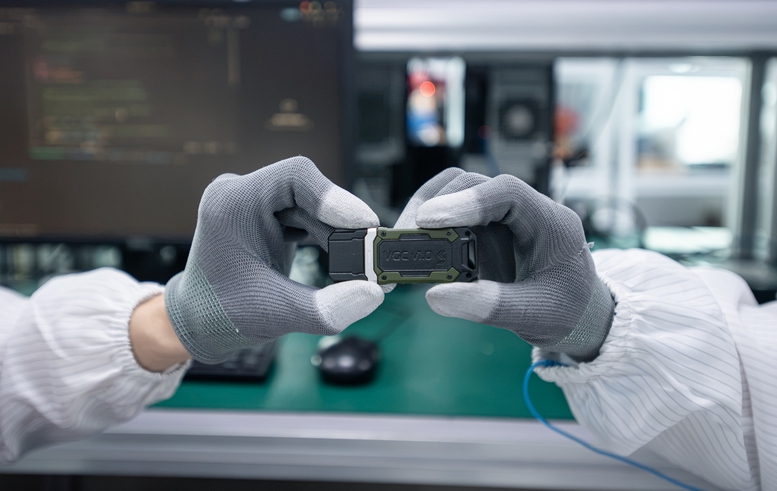 |
| The VGC v1.0 secure chip. (Photo: Government Electronic Newspaper). |
The VGC v1.0 chip integrates the national MKV block cipher algorithm. It measures 10 × 10 mm in package size, contains approximately 300 million transistors and is manufactured using a 28 nm CMOS process. Test results show that its encryption and decryption speeds are approximately 15 times faster than those of a purely software-based solution when performing the same tasks.
During the development process, the M2 Factory under the Government Cipher Committee was responsible for establishing security requirements, algorithms and evaluation criteria, while Viettel's Semiconductor Centre undertook microchip design. The product uses the open RISC-V instruction set architecture, enabling Vietnam to independently modify designs and develop subsequent generations of chips.
In the first quarter of 2026, the first batch of VGC v1.0 chips passed technical testing and was granted certification for use in socio-economic activities.
Speaking at the event, General Phan Van Giang, Politburo member, Deputy Prime Minister and Minister of National Defence, acknowledged and commended the efforts made by the units involved in researching and developing the product. He emphasised that semiconductor chips had become a strategic resource and an instrument of competition among nations. Mastering secure semiconductor technology is significant not only in terms of science and technology but also in helping protect national sovereignty in cyberspace.
The VGC v1.0 chip is initially being used in secure USB storage devices serving Party, State and defence agencies. The product is intended for further development to support the national digital signature authentication system, protect data in the finance and banking sectors, secure connected devices and safeguard critical information infrastructure.
General Phan Van Giang called on the Government Cipher Committee and Viettel to continue refining testing, verification and quality assessment procedures, with a view to moving towards mass production and putting the product into practical use. He also stressed the importance of developing dual-use technologies to meet national defence, security and digital transformation requirements; training highly qualified human resources; and promoting the domestic application of secure semiconductor products.
At the event, the Government Cipher Committee and Viettel signed a cooperation agreement focusing on four areas: implementing plans for mass production of the VGC v1.0 chip; developing a multi-core secure microchip platform; training specialised personnel in microchip design, cryptography and hardware security; and testing and verifying products on actual devices.
According to Lieutenant General Tao Duc Thang, Chairman and General Director of Viettel, the VGC v1.0 is only the beginning. This achievement provides a foundation for Vietnam to continue developing new generations of chips and gradually master strategic semiconductor technologies.
The unveiling of the VGC v1.0 chip and secure semiconductor platform represents a tangible outcome of the implementation of the Politburo's Resolution No. 57-NQ/TW and Vietnam's Semiconductor Industry Development Strategy. It contributes to strengthening technological self-reliance, ensuring information security and developing the domestic semiconductor industry.
 AI, Semiconductors, Quantum Technology: New Areas of Vietnam-Singapore Cooperation |
 Semiconductor Training Must Keep Pace With Market Demand |


Most read

“Anna Karenina” Translated Directly from Russian into Vietnamese For the First Time


Numerous Proposals to Promote People-to-People Exchanges between Viet Nam and Algeria


Related Stories
 National
Viet Nam News Today (Oct. 18): Viet Nam, Switzerland Outline Priorities to Deepen Comprehensive Partnership
 National
Vietnam News Today (Sep. 7): Top Vietnamese Leader’s Visit to France to Deepen Ties
 Economy
Semiconductor Training Must Keep Pace With Market Demand
 National
Vietnam News Today (Aug. 10): Vietnam – One of Most Attractive Destinations for Leading US Semiconductor Companies
Recommended
Handbook
“Anna Karenina” Translated Directly from Russian into Vietnamese For the First Time
Popular article
 Handbook
Viet Nam, US Strengthen Technological Cooperation and Use of Archival Records to Search for Fallen Soldiers’ Remains
 Handbook
Hanoi Audiences to Enjoy Six Italian Films for Free
 Handbook
Viet Nam Trade Office in Argentina Promotes Trade and Investment Cooperation with Western Argentine Provinces
 Handbook