
Viet Nam, US Strengthen Technological Cooperation and Use of Archival Records to Search for Fallen Soldiers’ Remains
| Viet Nam, US mark 147th repatriation of US soldiers’ remains Viet Nam, US Seek Higher-Quality Economic Ties |
At a dialogue on war legacies in Southeast Asia organized by the Stimson Center and the War Legacies Working Group, Ambassador Nguyen Quoc Dung briefed representatives of US government agencies, non-governmental organizations and experts on Viet Nam’s efforts to address the consequences of war. He also called on international partners to continue supporting urgent humanitarian tasks.
The ambassador said that, over the years, Viet Nam has cooperated fully and in good faith with the US in seeking information about missing US service members and remains committed to this humanitarian mission. At the same time, Viet Nam is mobilizing resources nationwide to step up the search for, recovery and identification of fallen soldiers’ remains through a campaign launched in April 2026.
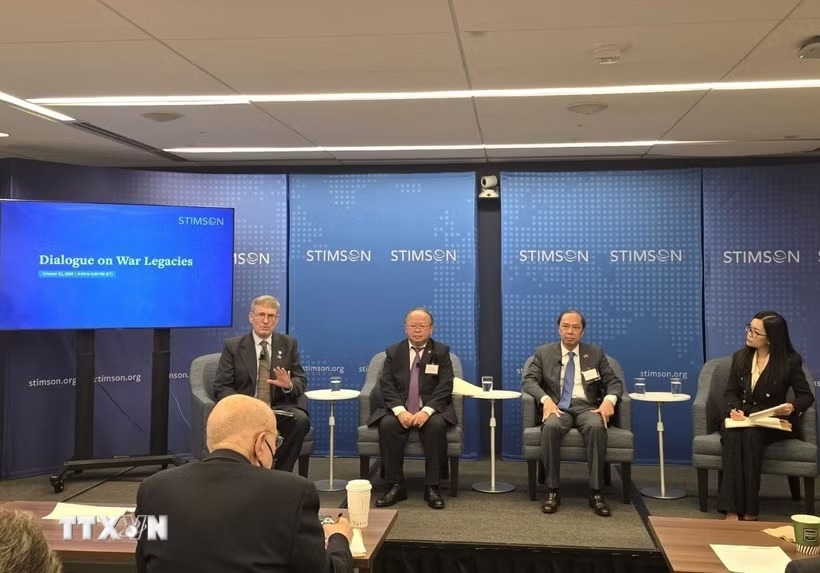 |
| Vietnamese Ambassador to the US Nguyen Quoc Dung (second from left) at the dialogue on war legacies in Southeast Asia organized by the Stimson Center in Washington on October 21. (Photo: VNA) |
Examining 2-3 million pages of records to support the search for fallen soldiers’ remains
According to Ambassador Nguyen Quoc Dung, the “500 Days and Nights Campaign” aims to locate and recover approximately 7,000 sets of fallen soldiers’ remains, while advancing identification through a centralized DNA database of their relatives and clearing unexploded ordnance from key former battlefields.
To date, the campaign has cleared more than 18,000 hectares of land contaminated by unexploded ordnance, achieving over 81% of its target; located and recovered more than 3,600 sets of fallen soldiers’ remains; and collected over 122,000 biological samples for identification.
One important area of cooperation between Viet Nam and the US involves examining wartime records held by the US National Archives and Records Administration (NARA). An estimated 2-3 million pages of records may contain information relevant to the search for Vietnamese fallen soldiers’ remains.
These records could provide important clues, including coordinates recorded in military reports, temporary burial locations, information on unit movements, old maps and aerial photographs.
Ambassador Nguyen Quoc Dung said that, in the coming weeks, Vietnamese experts would join colleagues from Texas Tech University in returning to NARA’s facility in College Park, Maryland, to continue researching and examining records that could assist the search.
According to the ambassador, the participation of universities, veterans, historians, archivists and technology experts is important to this mission. Artificial intelligence (AI) can help search, analyze and cross-reference information across millions of pages of records, but it cannot replace human memories.
Combining Vietnamese battlefield records and oral histories with US wartime records, forensic anthropology methods and advanced DNA technology is considered necessary to improve the effectiveness of efforts to locate and identify fallen soldiers’ remains.
The ambassador also emphasized the urgency of the task, as many former battlefields have become residential areas, roads, farms and industrial parks, causing physical traces to gradually disappear. Meanwhile, veterans and historical witnesses are growing older, narrowing the window for collecting firsthand information.
Expanding scientific and technological cooperation to address the consequences of war
Earlier, on October 19, at a meeting in Washington with faculty members and students from the University of Georgia’s Department of International Affairs, Ambassador Nguyen Quoc Dung discussed the objectives and significance of the “500 Days and Nights Campaign” and cooperation with US partners in its implementation.
The University of Georgia is an active partner in providing training in the use of remote sensing technology to locate graves with no visible traces; researching and analyzing environmental DNA to detect unidentified graves; developing field sampling methods; and handling cases involving commingled remains.
The two sides are also working to establish a “Joint research and working group” for the DNA laboratory in Hanoi, thereby strengthening professional coordination in identifying fallen soldiers’ remains.
Ambassador Nguyen Quoc Dung said that Viet Nam is working closely with US partners to access and examine archival materials at NARA, including information relating to mass graves.
Alongside the search for fallen soldiers’ remains, cooperation between Viet Nam and the US in addressing the consequences of war continues across a range of areas.
According to Ambassador Nguyen Quoc Dung, the two countries have signed new cooperation agreements, under which the US will provide approximately US$130 million in additional funding for the dioxin remediation project at Bien Hoa Airport, bringing total grant assistance to approximately US$430 million.
Another agreement allocates approximately US$91 million to help improve the quality of life of persons with disabilities in priority localities, with initial implementation in Ca Mau and Quang Ngai.
Reflecting on bilateral cooperation, Ambassador Nguyen Quoc Dung affirmed that addressing the consequences of war has played an important role in transforming Viet Nam-US relations from former adversaries into Comprehensive Strategic Partners.
According to the ambassador, the profound significance of these efforts lies not only in cooperation programs or resources, but also in children being able to travel safely to school, persons with disabilities leading more independent lives, and families having the opportunity to bring their loved ones home after decades of waiting.
Cooperation in sharing military operational data, providing DNA identification technology and supporting the search for Vietnamese fallen soldiers’ remains demonstrates both responsibility and profound humanitarian significance, showing that the two countries can work together to overcome historical legacies on the basis of respect and empathy.
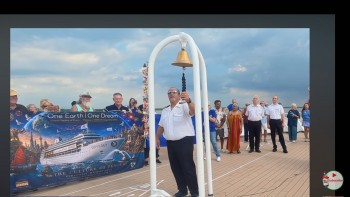 Five Bells for Peace Aboard the Odyssey Five bells rang aboard the Odyssey in Ho Chi Minh City, carrying the peace wishes of international friends sharing the journey. The activity took place one day after members of the Villa Vie Odyssey cruise community gathered at the War Remnants Museum. |
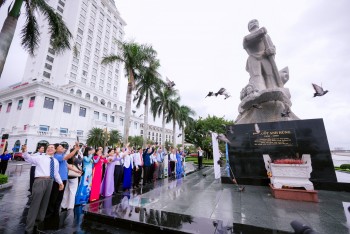 Quang Tri: Where War Memory Grows into Peace On September 25, 2026, on the banks of the Nhat Le River in Dong Hoi Ward, Quang Tri Province, hundreds of doves were released from the foot of the Mother Suot Monument by domestic and international delegates, including former officials, diplomats, scholars, veterans and representatives of non-governmental organizations. Earlier, they had signed a panel bearing a Message of Peace, which will be sent to the Secretary-General of the United Nations. The international symposium “From memory to the future: The value of peace,” held as part of the 2026 For Peace Festival, continued Quang Tri’s efforts to preserve memories of war, address its consequences and move toward building a cultural space for peace. |


Most read

Viet Nam, US Strengthen Technological Cooperation and Use of Archival Records to Search for Fallen Soldiers’ Remains

Deputy Minister Ho An Phong Elected President of Viet Nam-Belarus Friendship Association for 2026-2031


Related Stories
 National
An Giang Collects DNA Samples to Identify Fallen Soldiers
 National
DNA Collection Offers Hope to Families of Fallen Soldiers
 National
Viet Nam News Today (Oct. 15): Viet Nam, US Seek to Deepen Economic Ties, Promote High-Tech Investment
 Vietnamese Culture
Eight Additional Remains of Fallen Soldiers Discovered at Le Thi Rieng Park
Popular article
 Handbook
Hanoi Audiences to Enjoy Six Italian Films for Free
 Handbook
Viet Nam Trade Office in Argentina Promotes Trade and Investment Cooperation with Western Argentine Provinces
 Handbook
SAP-VN Provides Mobile Dental Care in Da Nang for the First Time
 Handbook