
Viet Nam in the Heart of Leader Fidel Castro
| Fidel Castro's Legacy and Enduring Strength of Vietnam-Cuba Solidarity Special Program Series “President Ho Chi Minh - Commander-in-Chief Fidel Castro: A Special, Steadfast Bond” Opens |
Originally published in Vietnamese and Spanish in 2020, the book has been republished in Vietnamese through a collaboration between the Viet Nam-Cuba Friendship Association, Thai Binh Duong Group and the Labour Publishing House. The republication marks the 100th anniversary of Fidel Castro’s birth (August 13, 2026 - August 13, 2026) and the 10th anniversary of his passing (November 25, 2016 - November 25, 2026).
In the foreword to this new edition, Vu Hai Ha, Member of the Party Central Committee and President of the Viet Nam-Cuba Friendship Association, writes: “The accounts preserved in this publication are not only valuable historical documents but also a bridge connecting generations, helping those who never met Fidel or set foot in Cuba better understand why Cuba and its people have always held a special place in the hearts of the Vietnamese people.”
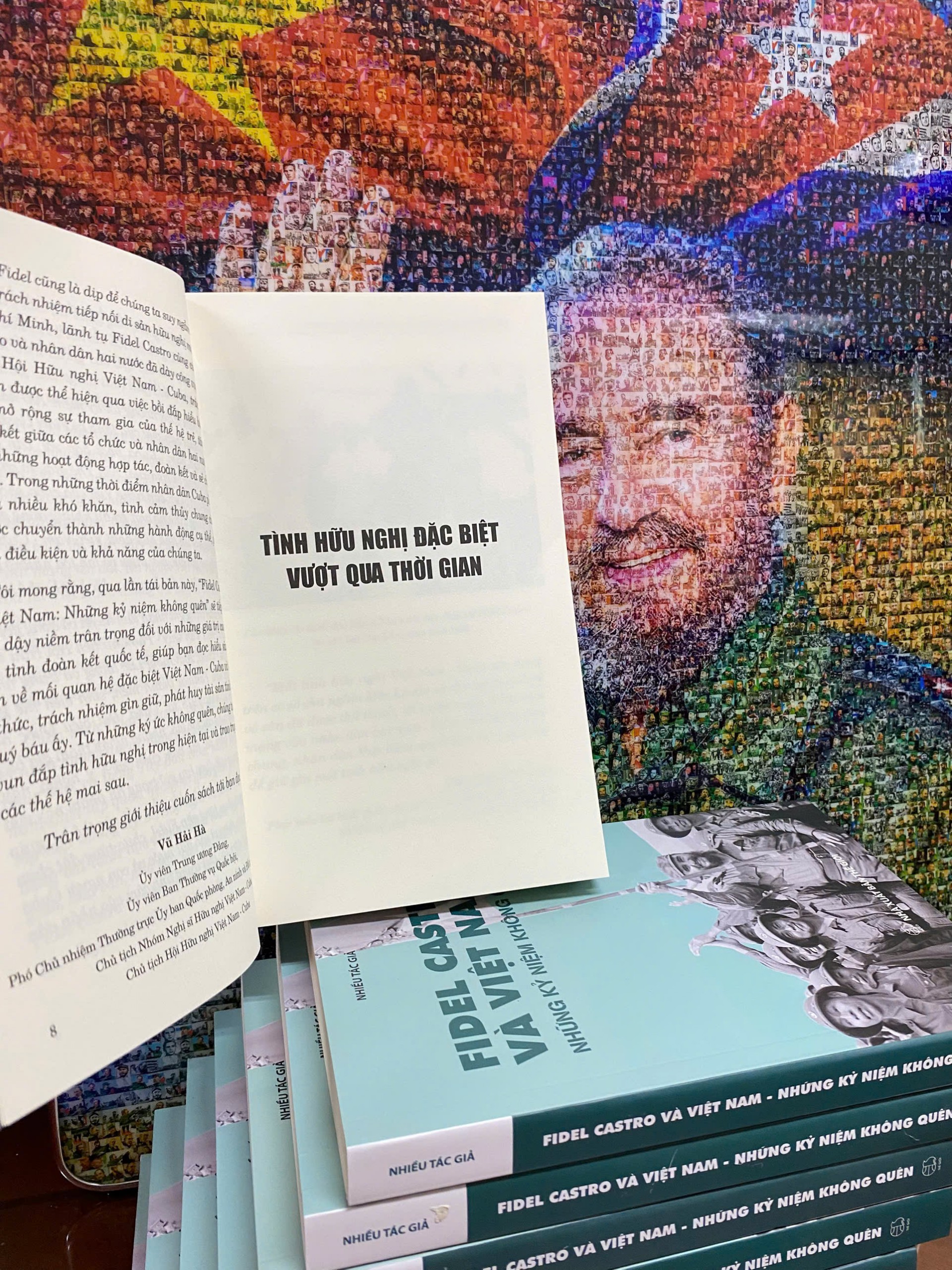 |
| The book Fidel Castro and Viet Nam - Unforgettable Memories was republished through a collaboration between the Viet Nam-Cuba Friendship Association, Thai Binh Duong Group and the Labour Publishing House. |
Admiration for the Vietnamese people
In his article “I Think Often of South Viet Nam”, published in Nhan Dan newspaper on March 4, 1962, and now included in the book Fidel Castro and Viet Nam - Unforgettable Memories, journalist Thep Moi recounts that during a meeting with a delegation of Vietnamese people in Havana in 1962, Cuban Revolutionary Leader Fidel Castro shared an interesting detail: “I have read a very good novel about a Vietnamese guerrilla fighter.” Despite the demanding responsibilities of leading a country that had just achieved revolutionary victory, Fidel still made time to read Vietnamese literature. The book he had read was the Spanish translation of the novel The Land Rises Up by writer Nguyen Ngoc.
Translated into Spanish under the title Nup, the Mountain Hero, the novel attracted considerable interest among Cuban and Latin American readers. An Indigenous man from Ecuador once told journalist Thep Moi: “Your book has made me believe even more in our mountains and forests, and believe even more in ourselves.”
Leader Fidel asked the Vietnamese delegates whether the area where Hero Nup had fought was in the North or the South. After hearing their introduction to the Central Highlands, he remarked: “If people fought so heroically against the French colonialists, imagine how courageously they must be fighting the US imperialists now!”
During that meeting, the Vietnamese delegation presented Fidel with an embroidered picture of a dragon, stitched in gold thread against a blue silk background. He personally unfolded the embroidery, examined it closely and gently ran his fingers over each stitch. He then reflected: “How can they not leave a nation as intelligent and talented as this in peace to engage in creative work, but instead shoot and kill, burn and destroy, concentrate the population and force people into settlements!”
Two years later, on the occasion of the 10th anniversary of the Dien Bien Phu Victory, the Cuban Party and State invited Hero Nup to visit the country.
In his article “‘The Younger Brother’ of Hero Nup - A Legendary Figure”, author Nguyen Van Toan recounts that Fidel asked Hero Nup about his age before declaring himself the younger brother, as he was 12 years younger. Hero Nup burst into laughter and replied: “Comrade, you may be younger, but you are the commander, so you are the elder brother.”
Fidel responded: “When we are brothers, we do not talk about ranks or positions. Whoever is older is the elder brother. Comrade Nup is the elder brother, indeed! The Cuban Revolution must learn from the experience of our brothers who came before us!”
Nearly three decades later, Leader Fidel still remembered the preferences of his sworn elder brother. According to journalist Lai Van Long’s recollections, around mid-1992, he and journalist and musician Vu Duc Sao Bien were assigned to deliver a gift from Fidel directly to Hero Nup in Stơr Village, Gia Lai Province. The gift was a box of Cuban cigars.
Viet Nam has always remembered Cuba’s assistance, while Leader Fidel repeatedly highlighted Viet Nam’s contributions to other peoples. At a reception in Hanoi on December 8, 1995, he affirmed: “But I believe that Viet Nam itself has supported and helped other peoples, especially countries of the Third World, through the unforgettable pages of its own history. That is Vietnam’s great contribution to humanity.”
Concern for Viet Nam’s Future
Just over five months after the two countries established diplomatic relations, Leader Fidel was already thinking about helping Viet Nam train personnel for foreign affairs work in Latin America.
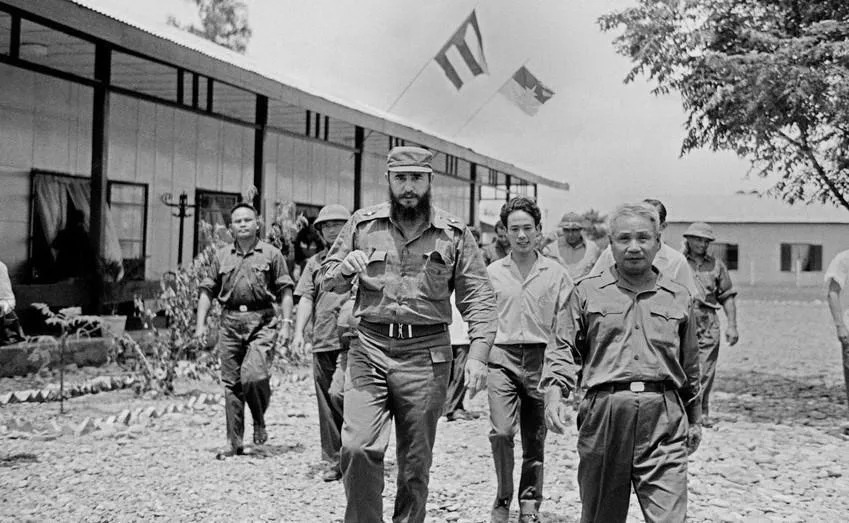 |
| On September 15, 1973, Fidel Castro, First Secretary of the Central Committee of the Communist Party of Cuba and Prime Minister of the Revolutionary Government of Cuba, visited the Quang Tri Provincial Revolutionary People’s Committee in the liberated area of South Viet Nam. |
In his article “Fifteen years of affection in brotherly Cuba”, journalist Vu Van Au, former head of the Viet Nam News Agency’s first bureau in Cuba, recounts that in May 1961, when Fidel received a Vietnamese Government delegation led by Minister of Culture Hoang Minh Giam, he noticed that the two sides had to communicate through two interpreters, translating from Vietnamese into English and then into Spanish, and vice versa.
Knowing that very few people in Viet Nam at the time were proficient in Spanish, Fidel suggested: “Then you should send your young people to Cuba to study Spanish so that they can later serve in foreign affairs work in this Latin American region, where more than 20 countries use Spanish…”
Nearly three months later, when he met Hoang Van Loi, Viet Nam’s Ambassador to Cuba, again, Fidel immediately asked: “When will you send your young people to Cuba to study?”
In late 1961, 23 Vietnamese officials from foreign affairs agencies, the press, publishing, education and other sectors were sent to Cuba to study Spanish. Journalist Vu Van Au was among them.
He recalled the first lessons, when neither the teacher nor the students knew the other’s language. The teacher had to hold up a pen, pronounce its name and have the students write it down.
Following that first group of officials, successive delegations of Vietnamese students went to Cuba to study. During the 1967-1970 period alone, as the resistance war against the US grew increasingly fierce, nearly 1,000 Vietnamese students were sent to Cuba to study architecture, construction, medicine, biology and other disciplines. Many of them later became senior officials, diplomats and journalists. By the beginning of the 21st century, three generations of Vu Van Au’s family had studied and worked in Cuba.
“Although Cuba was facing many difficulties due to the US blockade and embargo, during the years when our country was still at war, our Cuban friends unreservedly covered all the expenses of sending Vietnamese students to study in Cuba,” he wrote.
In the article “President Fidel Castro’s priceless gift”, authors Xuan Vui and Duy Tuong recount another act of generosity. In September 1973, after witnessing the devastation caused by the war and the shortage of facilities for treating wounded and sick soldiers in Quang Binh, Fidel decided to help Viet Nam build a modern hospital in Dong Hoi. On May 19, 1974, construction began on Dong Hoi Viet Nam-Cuba Friendship Hospital.
Like a member of the family
“He gave Huong a second life!” These were the words of Le Manh Ket about Fidel when he and his wife, Nguyen Thi Huong, welcomed author Xuan Vui to their home in Vinh Linh, Quang Tri, in 2019.
On September 15, 1973, while digging the soil in an area north of the Ben Hai River, Huong was seriously injured when a cluster bomb left behind by previous bombing raids exploded.
At that very moment, the delegation led by Leader Fidel Castro and Prime Minister Pham Van Dong was returning from a visit to the liberated area of Quang Tri. Upon learning that someone had been injured, Fidel instructed his personal doctor to provide first aid immediately. Huong was taken to Hospital A in the Vinh Linh Special Zone in critical condition.
In her article “The second father of a Vinh Linh daughter”, author Xuan Vui records Huong’s recollection: “One morning, as I was walking around the yard with difficulty, leaning on my crutches, officials from Vinh Thanh Commune and Hospital A came to visit, bringing a gift from President Fidel. When I opened the package, I was deeply moved to find that he had sent me many precious medicines, as well as sugar and milk.”
When Leader Fidel passed away in 2016, Ket set up an altar for him in the middle of their house, displaying fruit and ceremonial offerings in accordance with Vietnamese customs. The couple travelled to Hanoi to pay their respects to the Cuban Revolutionary Leader at the Cuban Embassy. According to author Xuan Vui’s account in 2019, every year on the anniversary of Fidel’s death, Huong’s family prepared an offering meal in his memory.
On September 15, 2018, exactly 45 years after the incident, Huong received a letter from Cuba. It was sent by Dr. Ariel Soler Muñoz, the female doctor who had personally provided emergency treatment to her in 1973.
After reading an article in Granma newspaper and learning that the Vinh Linh girl she had once treated was still in good health and now had many children and grandchildren, the doctor was delighted. She wrote: “I would very much like you to visit my country, if only so that I could greet you in person.”
Huong and her husband have three daughters. All three call Leader Fidel “maternal grandfather”. Huong often recounts the story of how Fidel saved her life in 1973 to her children and grandchildren.
During her visit to Huong’s family in 2019, author Xuan Vui noted one particular image: a photograph of Fidel hanging on the wall in the study corner of a child who was then in the third grade.
 Remembering Fidel Castro’s Enduring Affection for Viet Nam |
 Quang Tri Preserves Memories of Cuban Leader Fidel Castro |

Most read


Viet Nam News Today (Nov. 25): Viet Nam Culture Day 2026 Marked in Laos, Switzerland and Mozambique

Top Leader Sends Message on International Day of Solidarity with the Palestinian People


Related Stories
 National
Viet Nam News Today (Nov. 16): Viet Nam Eyes Opportunities in ASEAN’s US$2 Trillion Digital Economy Under DEFA
 Friendship
From Wartime Solidarity to Lasting Friendship
 Friendship
People-to-People Diplomacy to Strengthen the Hegemony of Internationalism: The Practical Example of the Solidarity Between Viet Nam and Cuba
 Friendship
Understanding Builds Deeper Trust
Popular article
Friendship
Top Leader Sends Message on International Day of Solidarity with the Palestinian People
 Friendship
Viet Nam and Brazil Strengthen People-to-People Ties and Cooperation
 Friendship
Japan Supports Construction of Disaster-Resilient Community Shelters in Dien Bien
 Friendship