
Quang Tri Preserves Memories of Cuban Leader Fidel Castro
| Students from Nguyen Du Lao-Vietnamese Bilingual School Learn about Vietnamese Culture and History Quang Tri Spreads Message of Dialogue and Peace from Historic Land |
Memories of a “great friend” in the land of fire
These days, Fidel Park on Tran Hung Dao Street in Dong Ha Ward is welcoming many local residents and visitors who come to pay tribute to Cuban leader Fidel Castro. Covering more than 16 hectares, the park features a statue of Fidel Castro at its center. At the foot of the statue is engraved a statement that has become a symbol of Vietnam-Cuba solidarity: “For Vietnam, Cuba is ready to shed even its blood.” The park is also home to nine Cuban royal palms, symbols of uprightness and indomitable spirit, representing Fidel Castro’s age of 90.
Quang Tri holds a special place in the history of Vietnam-Cuba relations. In September 1973, while the war was still raging, Fidel Castro became the first and only foreign head of state to visit the liberated area of southern Vietnam in Quang Tri. The visit became a landmark event, demonstrating Cuba’s solidarity with and strong support for the struggle of the Vietnamese people.
More than 50 years later, 70-year-old Nguyen Thi Huong, who now lives in Dong Ha Ward, still vividly remembers the afternoon of September 15, 1973 - the day Cuban leader Fidel Castro helped save her life.
At just 17 years old, Huong was a frontline civilian worker. Together with her fellow workers, she was filling bomb craters in Vinh Linh to clear the way. An unexploded cluster bomb suddenly detonated, seriously injuring her. Multiple fragments became embedded in her body, perforating eight sections of her intestines, severing her aorta and causing massive blood loss.
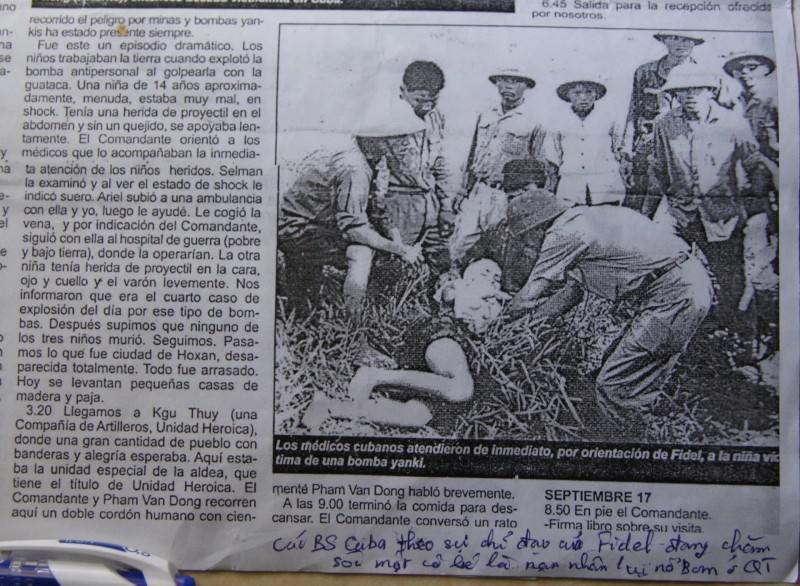 |
| A newspaper report recounts how President Fidel Castro instructed doctors in his delegation to provide emergency treatment to Nguyen Thi Huong and take her to hospital after she was injured in a bomb blast in 1973. (Photo: Dan Viet Newspaper) |
At that moment, Fidel Castro’s motorcade was passing through on its way from the liberated area of Quang Tri back to northern Vietnam. Upon seeing what had happened, the delegation stopped. Fidel Castro asked the doctors accompanying him to provide first aid to Huong. He also gave up a diplomatic vehicle to take her to the nearest hospital and sent another vehicle to Dong Hoi to collect stored blood for the emergency treatment.
For Huong, that decision gave her a chance to survive. After returning to Cuba, Fidel Castro continued to inquire about her through diplomatic delegations and sent medicines to support her recovery.
For more than half a century, the story has remained a special memory that Huong has always shared with her children and grandchildren. She regards the Cuban leader’s concern as a profound act of kindness and gratitude, as well as a source of spiritual strength that inspires her to live well and honor the second chance at life she was given.
Also on September 15, 1973, on his way from Dong Ha to northern Vietnam, Fidel Castro visited Vietnamese soldiers and civilians at Doc Mieu, a major US military base on the McNamara electronic barrier defense line. Among those who welcomed the delegation that year was female guerrilla sniper Hoang Thi Cham, who was awarded the title “US-killing hero” nine times during her years of fighting at Doc Mieu. Now in her 80s, Cham still keeps a photograph capturing the moment Fidel Castro shook her hand and asked about her.
According to Cham’s recollection, the visit was kept secret at the time. Officers, soldiers and guerrillas were only told to prepare for an “assignment.” It was not until about 15 minutes before the delegation arrived that they learned they were about to welcome the Cuban leader.
At Doc Mieu, Fidel Castro personally inspected the area and witnessed the remnants of the war, including tank wreckage, barbed wire and scattered bombs and ammunition. He spoke with and encouraged officers, soldiers and guerrillas. The Cuban leader’s closeness, together with his presence in an area still engulfed in the aftermath of war, became a source of encouragement for the people and armed forces of Quang Tri at the time.
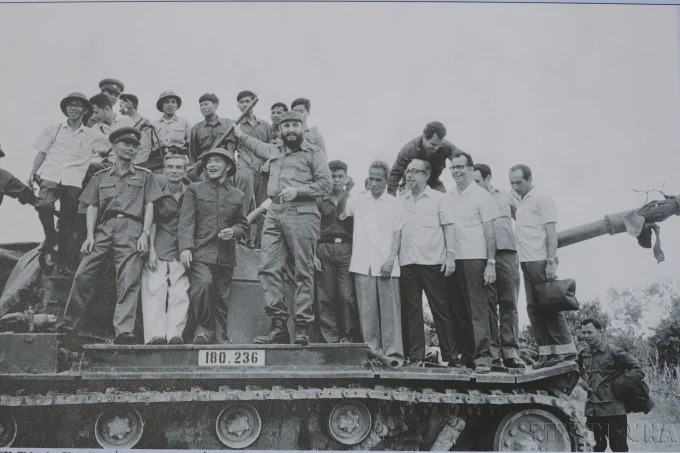 |
| President Fidel Castro inspects the Doc Mieu military base in Quang Tri Province on September 15, 1973. (File photo: Vietnam News Agency) |
Projects that carry the friendship forward
The affection Fidel Castro and the Cuban people held for Vietnam is remembered not only through his 1973 visit but also through concrete assistance during the war, the recovery from its consequences and the country's reconstruction. In Quang Tri, many projects still bear the imprint of that solidarity.
The Ben Tat suspension bridge on the upper reaches of the Ben Hai River was built in 1974 with Cuban assistance to ensure transportation and the delivery of goods, weapons and food supplies to the southern battlefield along the Ho Chi Minh Trail. After national reunification, the bridge continued to serve local livelihoods and socio-economic development. In 1986, the Ben Tat suspension bridge was recognized as a national historical site and is now part of the special national heritage site of the Ho Chi Minh Trail.
Another project that bears a strong imprint of the friendship between the two countries is Dong Hoi Vietnam-Cuba Friendship Hospital. Supported by Cuba, construction began in 1974, and the hospital was inaugurated and put into operation in 1981. Over 45 years of operation, the hospital has contributed to providing healthcare for people in the province and neighboring areas, becoming a symbol of Vietnam-Cuba solidarity.
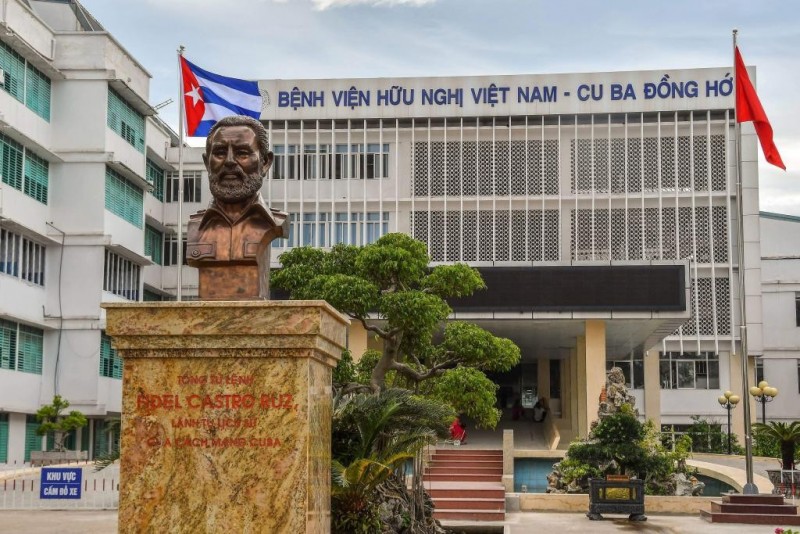 |
| Dong Hoi Vietnam-Cuba Friendship Hospital was built with Cuban assistance. (Photo: misiones.cubaminrex.cu) |
South of the Dakrong suspension bridge in Dakrong Commune, the “Vietnam-Cuba Friendship Road” also commemorates assistance from the Cuban Government and people. A memorial stele erected by the Truong Son Association records that the Dakrong-A Luoi section in Hue City of the East Truong Son Ho Chi Minh Trail was built by Truong Son soldiers with Cuban assistance following Fidel Castro’s visit to Vietnam in September 1973.
Meanwhile, sites associated with the Cuban leader’s journey through Quang Tri 53 years ago, including Tan Lam Base 241, the headquarters of the Provisional Revolutionary Government of the Republic of South Vietnam in Cam Lo Commune and the Ben Tat suspension bridge, have been restored and upgraded, helping preserve memories of the historic visit.
According to Le Duc Tien, Vice Chairman of the Quang Tri Provincial People’s Committee, Vietnam-Cuba friendship has been forged through numerous historic milestones, with Quang Tri being the land where Cuban leader Fidel Castro left his mark. In its new phase of development, with advantages in maritime resources, international border gates, seaports and airports, the East-West Economic Corridor, as well as potential in energy, industry, logistics, high-tech agriculture, the marine economy and tourism, Quang Tri views external relations and international integration not only as a task but also as a resource for development. With Cuba, the province hopes to further deepen cooperation in areas where both sides have strengths and needs.
More than half a century after the historic visit in September 1973, the image of Fidel Castro in the “land of fire” remains vividly remembered by generations of Quang Tri residents. From witnesses who once met him to friendship projects that still stand today, these memories continue to tell the story of Vietnam-Cuba relations, built on sharing, loyalty and solidarity through the most difficult moments in history.
 Special Program Series “President Ho Chi Minh - Commander-in-Chief Fidel Castro: A Special, Steadfast Bond” Opens Special Program Series “President Ho Chi Minh - Commander-in-Chief Fidel Castro: A Special, Steadfast Bond” Opens On August 4, the President Ho Chi Minh Relic Site at the Presidential Palace in Hanoi inaugurated the special program series “President Ho Chi Minh - Commander-in-Chief Fidel Castro: A Special, Steadfast Bond” to commemorate the 100th birth anniversary of the leader of the Cuban Revolution. The program is jointly organized by the Ministry of Culture, Sports and Tourism and the Embassy of Cuba in Vietnam. |
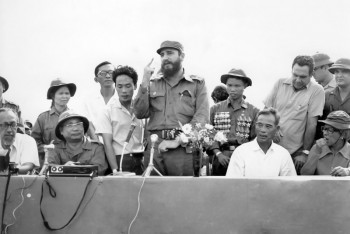 Memories of Fidel Castro - Great Friend of Vietnamese People Memories of Fidel Castro - Great Friend of Vietnamese People Having arrived in Cuba in 1963 and later serving as an interpreter and coordinator during President Fidel Castro’s historic visit to the liberated zone of Quang Tri in 1973, Nguyen Xuan Phong, former Director General of the Department of the Americas under the Vietnamese Ministry of Foreign Affairs, recalled enduring memories of a steadfast and devoted friend of the Vietnamese people. |


Related Stories
 Friendship
Memories of Fidel Castro - Great Friend of Vietnamese People
 Friendship
Special Program Series "President Ho Chi Minh - Commander-in-Chief Fidel Castro: A Special, Steadfast Bond" Opens
 Friendship
Fidel Castro in Quang Tri: Cuba’s Embrace Amid the Flames of War
 Handbook
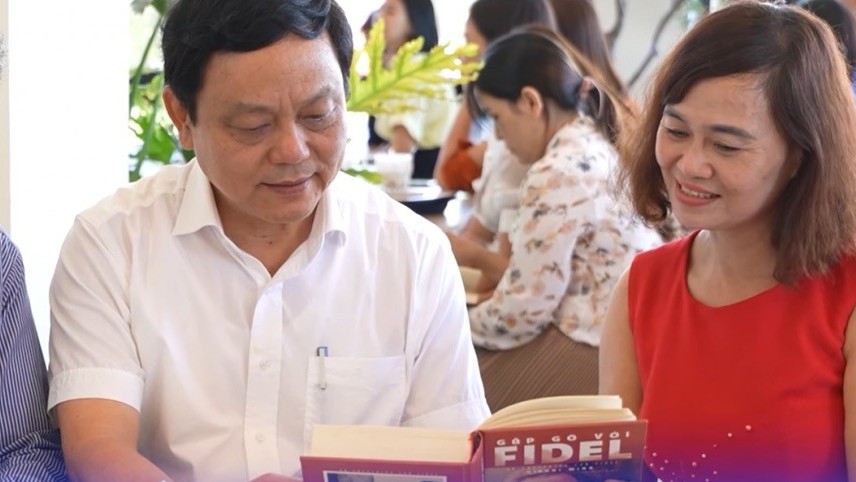
Phieu Cafe: A Space for Remembering Fidel Castro
Recommended
 Friendship
Viet Nam Union of Friendship Organizations Wins Seven Awards in Party Ideological Foundation Protection Contest
 Friendship
Spreading Responsibility for Safeguarding Party’s Ideological Foundation from Viet Nam to International Community
 Friendship
DAFO Launches Activities to Promote Responsible Business Practices
 Friendship
Seoul (Republic of Korea) Expands Employment Support for Vietnamese International Students
Popular article
 Friendship
NA President Meets with Chinese Friendship Figures in Beijing
 Friendship
A Misfortune Turned into Happiness
 Friendship
Hai Phong: Vietnamese and International Melodies Foster Friendship
 Friendship