
Memories of Fidel Castro - Great Friend of Vietnamese People
| Fidel Castro in Quang Tri: Cuba’s Embrace Amid the Flames of War Seminar in Cuba Commemorates the 60th Anniversary of Fidel Castro’s Historic Statement on Vietnam |
Speaking at the ministerial-level scientific seminar titled “Comrade Fidel Castro - Great leader of the Cuban revolution, resolute internationalist, and great friend of the Vietnamese people,” held by the Ho Chi Minh National Academy of Politics in Hanoi on August 3 to commemorate the 100th birth anniversary of President Fidel Castro Ruz, Nguyen Xuan Phong said he attended the event as a historical witness to Cuba-Vietnam relations.
He first arrived in Cuba in 1963, only a few years after the triumph of the Cuban Revolution in 1959. From then on, he remained closely connected with Cuba for many years, first as a foreign affairs official of the National Front for the Liberation of South Vietnam and later as a diplomat of reunified Vietnam.
Drawing on his own experiences, Nguyen Xuan Phong shared his memories of Fidel Castro - a leader whom he deeply respected and admired for his profound humanity, revolutionary stature, and unwavering affection for Vietnam.
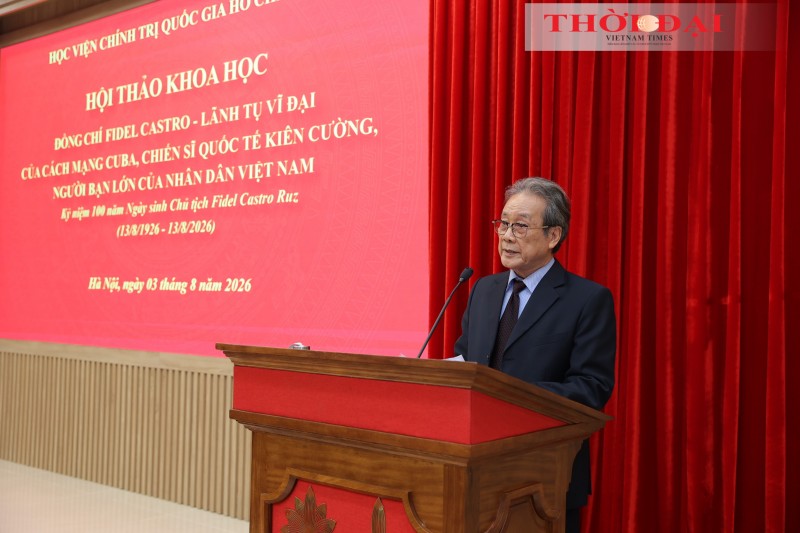 |
| Nguyen Xuan Phong, former Director General of the Department of the Americas under the Ministry of Foreign Affairs, speaks at the seminar in Hanoi on August 3, 2026. (Photo: Dinh Hoa) |
Fostering the Cuban people's affection for Vietnam
According to Nguyen Xuan Phong, Vietnam-Cuba relations have always been unique, “not only today, but from their very inception.” The foundation of this special relationship lies in the profound empathy between the two peoples, rooted in each nation's struggle for independence and freedom.
He emphasized that Fidel Castro played an indispensable role in forging this extraordinary bond. The Cuban leader deeply understood, fully appreciated, and highly valued the significance of the Vietnamese people's struggle, while also conveying that understanding and those sentiments to Cuba's leadership and its people.
About a decade ago, Nguyen Xuan Phong and his colleagues published a book compiling nearly 100 of Fidel Castro’s speeches on Vietnam, delivered between 1964 and 2005.
Through those speeches and his meetings with Vietnamese leaders and representatives from all walks of life, President Fidel consistently affirmed the historical significance of the Vietnamese people's struggle. He believed that the Vietnamese fought and sacrificed not only for their own independence and freedom, but also for the cause of national and social liberation for peoples around the world.
According to Nguyen Xuan Phong, President Fidel’s affection and Cuba’s solidarity with Vietnam embodied “both revolutionary conviction and faith, as well as profound respect for a heroic people sacrificing themselves for humanity.”
On many occasions, President Fidel told the Cuban people that Vietnam’s struggle against the United States served as a natural bulwark that helped safeguard the very survival of socialist Cuba from its earliest days.
“It is we who must thank Vietnam,” President Fidel said.
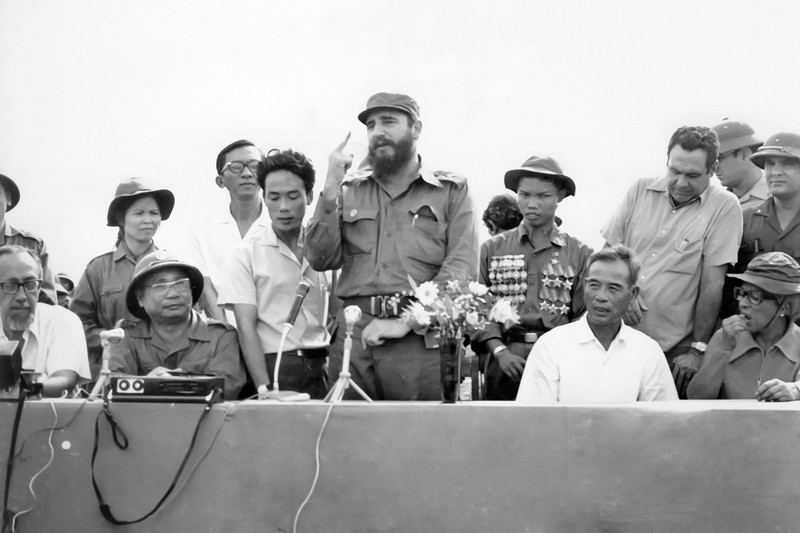 |
| Cuban President Fidel Castro addresses a rally on the morning of September 15, 1973, at Hill 241 in Cam Thanh Commune, Cam Lo District, former Ha Tinh Province. (Archive photo) |
Nguyen Xuan Phong vividly recalled the image of Fidel Castro leaning forward with one arm raised high in Havana’s Revolution Square, standing before the monument to Cuban national hero José Martí. Year after year, President Fidel spoke to the Cuban people about Vietnam, instilling in them deep affection and solidarity for the Vietnamese people.
That solidarity was translated into concrete action. Nguyen Xuan Phong recalled that Cuba was the first country in the world to recognize the National Front for the Liberation of South Vietnam. In 1962, Cuba accepted the establishment of the Front’s permanent representative office in Havana.
He described this as “a courageous step” that triggered a chain reaction: socialist and nationalist countries successively recognized the Front, helping to build an international front in support of the just struggle of the South Vietnamese people. Alongside victories on the battlefield, the flag of the National Front for the Liberation of South Vietnam gradually appeared across Asia, Europe, Africa, Latin America, and even the United States, at anti-war demonstrations and movements expressing solidarity with Vietnam.
Trusting Vietnam’s strategy of “fighting while negotiating”
Nguyen Xuan Phong also recalled Cuba’s response when Vietnam adopted the strategy of “fighting while negotiating” to bring the war to an end.
Vietnam’s decision to enter negotiations with the United States following the 1968 Spring General Offensive and Uprising initially caused disappointment, anxiety, and even skepticism among some Cuban officials and members of the public.
At the time, Cuba regarded Vietnam’s resistance against the United States as a distant shield protecting Cuba and as a powerful example of a nation's ability to fight and prevail in defense of its independence and sovereignty.
However, according to Nguyen Xuan Phong, the Cuban leadership, led by Fidel Castro, did not allow its own interests to shape its position. Instead, it “firmly supported Vietnam - selflessly and unwaveringly,” placing its trust in the wisdom and resolve of Vietnam’s leaders and people.
On April 19, 1968, President Fidel declared that Cuba had “complete and absolute confidence” in the Government of Vietnam, the Communist Party of Vietnam, and the National Front for the Liberation of South Vietnam.
Nguyen Xuan Phong described Cuba’s position as exceptionally courageous and invaluable at a time when some countries sought to prevent Vietnam from entering negotiations, while others urged Vietnam to abandon the battlefield and negotiate at any cost.
Another vivid memory for Nguyen Xuan Phong was Fidel Castro’s visit to Europe in the summer of 1972. At the time, the United States had intensified its bombing campaign against North Vietnam, attacked its dike system, and blockaded its seaports. Fierce fighting was underway at the Quang Tri Citadel and across South Vietnam in an effort to force the United States back to the negotiating table.
Cuban sailors stood shoulder to shoulder with Vietnamese workers defending Hai Phong Port against US air raids. During the same period, Fidel embarked on a European tour lasting more than a month. He met with political leaders, addressed factory workers, engaged with university students, and called on socialist countries to put aside their differences and unite in support of Vietnam.
Nguyen Xuan Phong likened Fidel at that time to “a revolutionary Don Quixote of the modern era, traveling tirelessly across Europe for more than a month, doing everything within his power to defend Vietnam.”
Following Fidel to the liberated zone of Quang Tri
In September 1973, Nguyen Xuan Phong personally accompanied President Fidel Castro and coordinated interpretation services during the Cuban leader’s visit to the liberated zone of Quang Tri.
According to him, the visit underscored Cuba’s pioneering role, as Fidel became the first and only foreign head of state to visit a liberated area of South Vietnam before the war had fully ended.
Fidel’s actions and remarks also demonstrated his keen understanding of, and timely support for, Vietnam’s political and diplomatic objectives following the signing of the Paris Peace Accords.
The visit affirmed before the international community the existence of a vast and secure liberated zone in South Vietnam, the authority and legitimacy of the Provisional Revolutionary Government of the Republic of South Vietnam, and refuted distortions and attempts to undermine the implementation of the Paris Peace Accords.
Nguyen Xuan Phong described the visit as “the pinnacle” and “Fidel’s summation of what the Vietnamese people had contributed to humanity through their blood and sacrifice.” At the same time, it served as a call for peace-loving and progressive forces around the world to strengthen their solidarity with and support for Vietnam.
More than half a century later, he still vividly remembers Fidel’s gentle gaze, his warm pats on the shoulder, and his heartfelt words whenever he met Vietnamese heroes, outstanding soldiers, and delegations visiting Cuba.
He also recalled the grief and sorrow on Fidel’s face when he came to the Vietnamese Embassy in Cuba on September 3, 1969, to pay tribute to President Ho Chi Minh, as well as Fidel’s radiant smile when he returned to the embassy on the night of April 30, 1975, to celebrate Vietnam’s victory.
“That was Fidel - a steadfast and devoted friend of the Vietnamese people,” Nguyen Xuan Phong said.
 Fidel Castro's Legacy and Enduring Strength of Vietnam-Cuba Solidarity Fidel Castro's Legacy and Enduring Strength of Vietnam-Cuba Solidarity On August 3 in Hanoi, the Ho Chi Minh National Academy of Politics held a ministerial-level scientific seminar titled “Comrade Fidel Castro - Great leader of the Cuban revolution, resolute internationalist, and great friend of the Vietnamese people” to commemorate the 100th anniversary of the birth of President Fidel Castro Ruz (August 13, 1926 - August 13, 2026). |
 Special Program Series “President Ho Chi Minh - Commander-in-Chief Fidel Castro: A Special, Steadfast Bond” Opens Special Program Series “President Ho Chi Minh - Commander-in-Chief Fidel Castro: A Special, Steadfast Bond” Opens On August 4, the President Ho Chi Minh Relic Site at the Presidential Palace in Hanoi inaugurated the special program series “President Ho Chi Minh - Commander-in-Chief Fidel Castro: A Special, Steadfast Bond” to commemorate the 100th birth anniversary of the leader of the Cuban Revolution. The program is jointly organized by the Ministry of Culture, Sports and Tourism and the Embassy of Cuba in Vietnam. |

Most read


Related Stories
 Friendship
Understanding Builds Deeper Trust
 Friendship
"Two Vietnamese Friends Devoted to Fostering Vietnam-Cuba Friendship"
 Friendship
Quang Tri Preserves Memories of Cuban Leader Fidel Castro
 National
Vietnam News Today (Aug. 13): Top Leader Begins NZ visit, Receives Acting President of NZ-VN Friendship Society
Recommended
 Friendship
A Misfortune Turned into Happiness
 Friendship
Hai Phong: Vietnamese and International Melodies Foster Friendship
 Friendship
I Was Never Just Passing Through Viet Nam
 Friendship
Strengthening People-to-People Exchanges, Nurturing Viet Nam-RoK Friendship
Popular article
 Friendship
More Than VND 1.46 Billion Supports School Meals for Children in Quang Tri
 Friendship
HCMC Promotes People-to-People Diplomacy to Mobilize International Resources
 Friendship
Some Volunteers Cannot Hold Back Their Tears When Saying Goodbye to Viet Nam
 Friendship