
Shangri-La 2026: International Experts Praise General Secretary and President To Lam’s Message
 | Vietnam’s Viewpoint on Strengthening National Defence Capacity Affirmed at Shangri-La Dialogue |
| Shangri-La Dialogue 22: Vietnam Highlights Some Issues of Ensuring Stability in a Competitive World |
Emphasizing the role of law and human development
According to Voice of Vietnam (VOV), on the sidelines of the conference, Australian Deputy Prime Minister and Minister for Defence Richard Marles described General Secretary and President To Lam’s speech as meaningful and rich in important messages. He particularly noted the emphasis placed by the Vietnamese leader on the importance of rules for his country, saying that this aligns closely with Australia’s own view of the importance of a rules-based order.
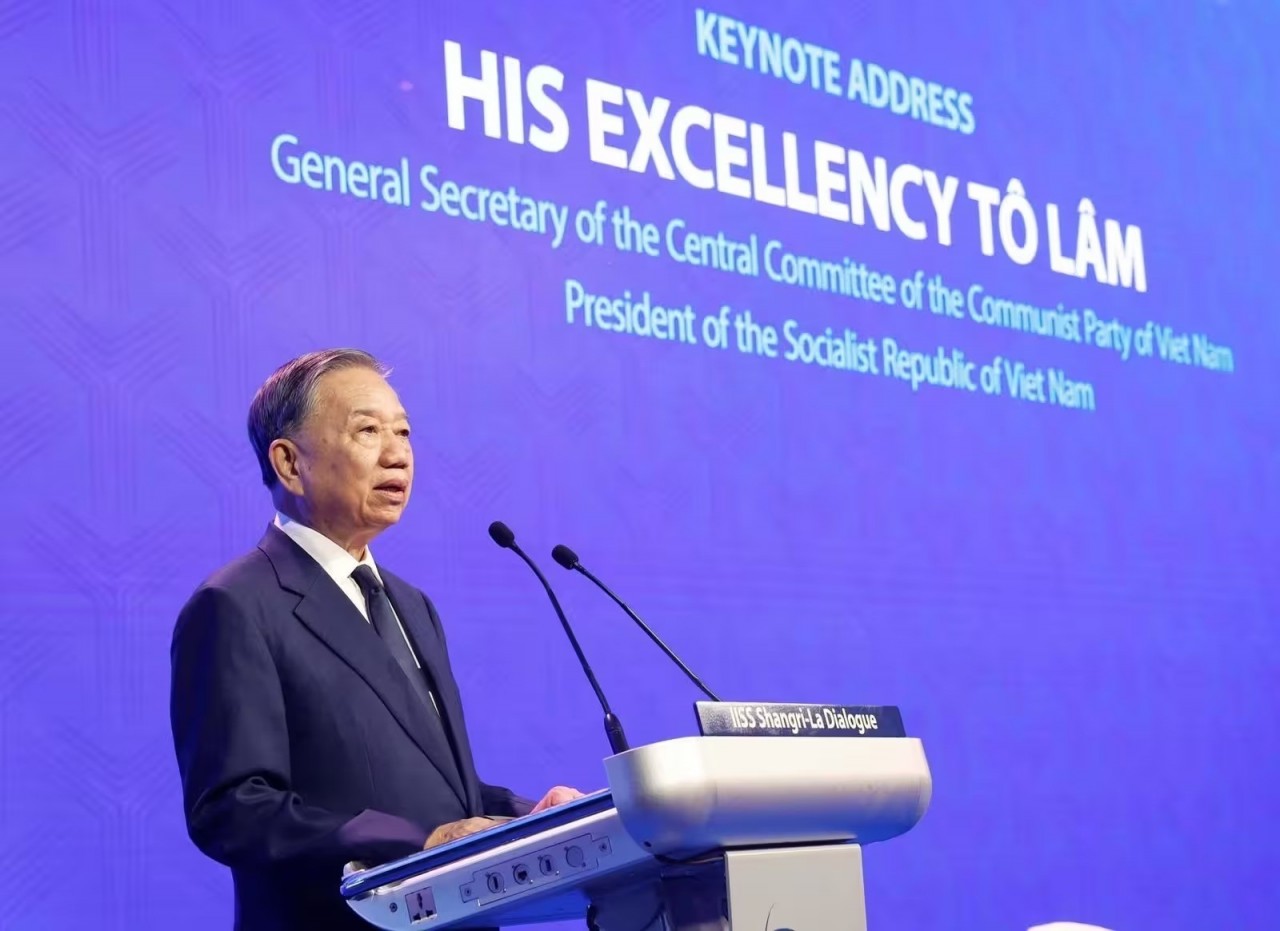 |
| General Secretary and President To Lam delivers the keynote address at the 23rd Shangri-La Dialogue. (Photo: Ministry of Foreign Affairs) |
“In that sense, we feel there is a growing strategic alignment between Australia and Vietnam. I held bilateral meetings with General Secretary and President To Lam and with Vietnam’s Deputy Prime Minister and Minister of National Defence, General Phan Van Giang, my counterpart, whom I have had the opportunity to meet and work with on many occasions. Australia has a growing defence partnership with Vietnam, which we greatly value,” Deputy Prime Minister and Minister for Defence Richard Marles said.
Richard Marles also praised the content of General Secretary and President To Lam’s speech concerning the importance of human development from a security perspective.
“We see this very clearly, for example, in the Pacific island countries, which are among the least developed nations in the world. Security is closely linked to development; where there is prosperity and human development, those factors themselves contribute to stability and peace. When these are called into question, that is when volatility and instability emerge. I believe General Secretary and President To Lam’s assessment of this issue is truly important. And it is absolutely correct.
It is a reminder that as we seek to build a peaceful and stable Indo-Pacific, we must also build a prosperous Indo-Pacific. Basic human prosperity is a fundamental contributor to human security as well as international security and peace. I think that is a truly important message at this year’s Shangri-La Dialogue,” Marles said.
A balanced voice for small and middle powers
According to the Vietnam News Agency (VNA), Associate Professor Dr. Neak Chandarith, Director of the Institute for International Studies and Public Policy (IISPP) at the Royal University of Phnom Penh (RUPP), described General Secretary and President To Lam’s keynote address as profound, practical, strategic, and reflective of a long-term vision for the region.
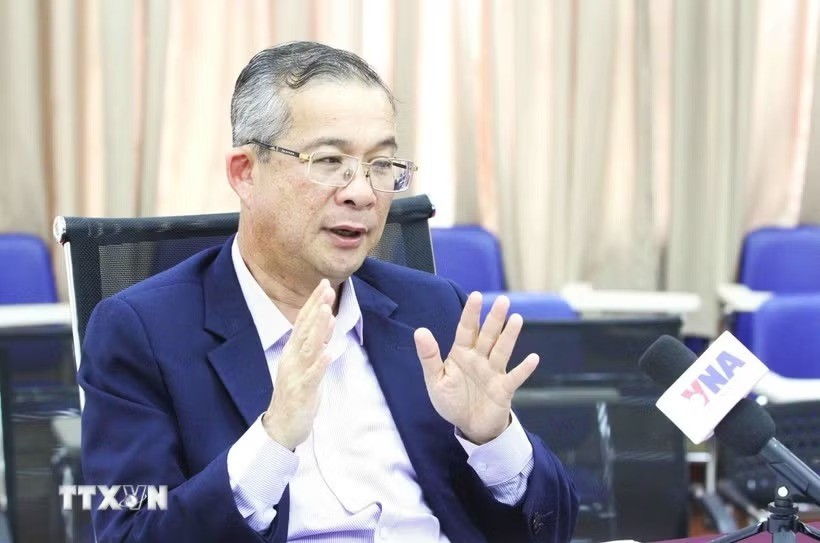 |
| Associate Professor Dr. Neak Chandarith, Director of the Institute for International Studies and Public Administration (IISPP), Royal University of Phnom Penh (RUPP). (Photo: VNA) |
He emphasized the significance of this being the first time that the head of Vietnam’s Party and State had been invited to deliver the keynote address at the opening session of the Shangri-La Dialogue, one of the leading security forums in the Asia-Pacific region and the world.
The Cambodian scholar noted that what made the speech particularly noteworthy was General Secretary and President To Lam’s position as a representative voice for small and middle-power countries. According to him, the Vietnamese leader not only has a deep understanding of global challenges but also offers a balanced perspective that safeguards the sovereignty and equal rights of small and medium-sized nations in an increasingly uncertain and turbulent world.
The head of the IISPP cited the Vietnamese leader’s remarks, highlighting that in today’s environment of intense competition among major powers, the weakening authority of international law, with principles interpreted through subjective imposition, applied inconsistently, or enforced through a preference for power politics, is posing a serious threat to global security.
In his view, such an environment places pressure on and leaves smaller countries such as Cambodia and other middle powers vulnerable to economic, technological, and security-related pressures.
Against this backdrop, General Secretary and President To Lam stressed that major powers must respect international law, particularly the Charter of the United Nations and the 1982 United Nations Convention on the Law of the Sea (UNCLOS).
Managing competition within a legal and predictable framework is regarded as an effective safeguard for smaller countries, ensuring that their interests and sovereignty are protected on an equal basis.
The Cambodian expert observed that General Secretary and President To Lam does not view the world through a self-interested lens but recognizes that competition cannot be entirely eliminated, as it is an inevitable reality of international relations.
In this context, Vietnam’s position focuses on “responsibly managing competition and preventing risks early and from afar,” while proposing concrete mechanisms such as early warning systems, emergency hotlines, and incident-management procedures. This principled approach is clearly reflected in issues related to the East Sea.
According to the Cambodian scholar, regarding the East Sea issue, Vietnam remains steadfast in resolving disputes through peaceful means based on international law, particularly the 1982 UNCLOS, while respecting the legitimate rights of other countries and safeguarding its own legitimate right to self-defence.
Relating Vietnam’s position to broader regional issues, Associate Professor Dr. Neak Chandarith stated that for countries such as Cambodia, Vietnam’s practical approach to promoting trust constitutes the right agenda, helping prevent minor misunderstandings from escalating into large-scale conflicts.
Affirming Vietnam’s standing and foreign policy orientation
Professor Carl Thayer of the Australian Defence Force Academy at the University of New South Wales assessed that Vietnam has effectively implemented its foreign policy of independence, self-reliance, diversification, and multilateralization, thereby enhancing its international standing and expanding its network of strategic partnerships.
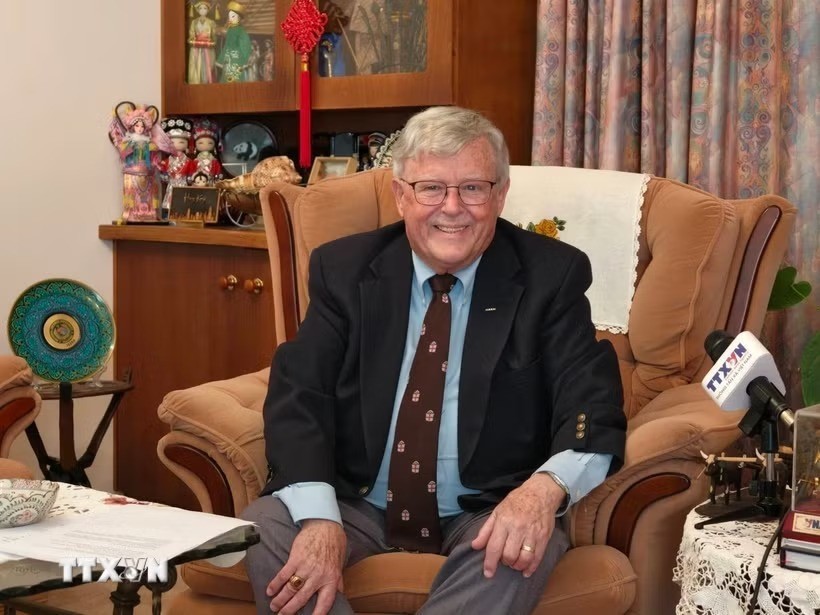 |
| Professor Carl Thayer, Australian Defence Force Academy, University of New South Wales. (Photo: VNA) |
“For a long time, Vietnam’s strength has rested on its ability to maintain strategic autonomy. Vietnam has Comprehensive Strategic Partnerships with all five permanent members of the United Nations Security Council. That is a diplomatic achievement few countries can claim. In particular, maintaining Comprehensive Strategic Partnerships with both the United States and China is perhaps the clearest demonstration of Vietnam’s diplomatic capability,” he said.
According to Professor Carl Thayer, although the current instability of the global security environment presents numerous challenges, it also offers Vietnam significant opportunities. With the fundamental pillars of diversification and multilateralization firmly established in its foreign policy, General Secretary and President To Lam’s renewed focus on economic development, national defence, and foreign relations requires deeper international cooperation to realize the goal of building an independent and self-reliant economy.
At the same time, the turbulence and uncertainty characterizing the current world order further reinforce the need to advance broader and more diversified international integration, highlighting the structural risks associated with excessive dependence on any single partner.
Professor Thayer emphasized that as its economic influence grows, Vietnam has strengthened its commitment to upholding international law and the fundamental principle of sovereign equality among states. These values are widely shared across the region and are reflected in the ASEAN Outlook on the Indo-Pacific (AOIP).
In his capacity as the country’s leader, General Secretary and President To Lam has actively translated these broad principles into concrete partnerships while overseeing the establishment or upgrading of new Comprehensive Strategic Partnerships, including those with Malaysia, New Zealand, Indonesia, Singapore, Thailand, the United Kingdom, and the European Union (EU) - all of which support the principles of the ASEAN Outlook on the Indo-Pacific and similar frameworks.
Professor Carl Thayer affirmed that Vietnam has an opportunity to further strengthen its leadership role within ASEAN, work closely with its partners, and demonstrate that it is, and will continue to be, “a friend, a reliable partner, and an active and responsible member of the international community.”
 | Keynote Address by General Secretary and President To Lam at Shangri-la Dialogue 2026 Below is the keynote address delivered by General Secretary and President To Lam at Shangri-la Dialogue 2026 in Singapore on May 29. |
 | Indonesian Media Praise General Secretary and State President To Lam’s Message Indonesia’s Antara News Agency and Tempo newspaper on May 30 published articles on the keynote address delivered by General Secretary of the Communist Party of ... |
Related Stories
 National
Party Central Committee’s Third Meeting Opens in Hanoi
 National
Top Leader Calls for Better Care for Invalids, Revolutionary Contributors
Recommended
 National
When Community Becomes an Anchor: Early Progress in Reducing HIV and TB Stigma in Champasak
 National
More Than 50 Records Provide New Leads for Identifying Fallen Soldiers
 National
Vietnam News Today (July 21): Standard Chartered Raises 2026 GDP Growth Forecast for Vietnam to 9.5%
 National
Vietnam News Today (July 20): Diplomacy Opens New Pathways for Vietnam’s Development
 National
Vietnam News Today (July 18): EVFTA Supports Strong Growth in Vietnam-Nordic Trade
 National
Vietnam News Today (July 16): Vietnam and Chile Mark 55 Years of Diplomatic Relations
 National
Vietnam News Today (July 14): Vietnam, Indonesia Chart New Strategic Cooperation Agenda
 National