
Transformative IMEC linking India and Europe with international trade
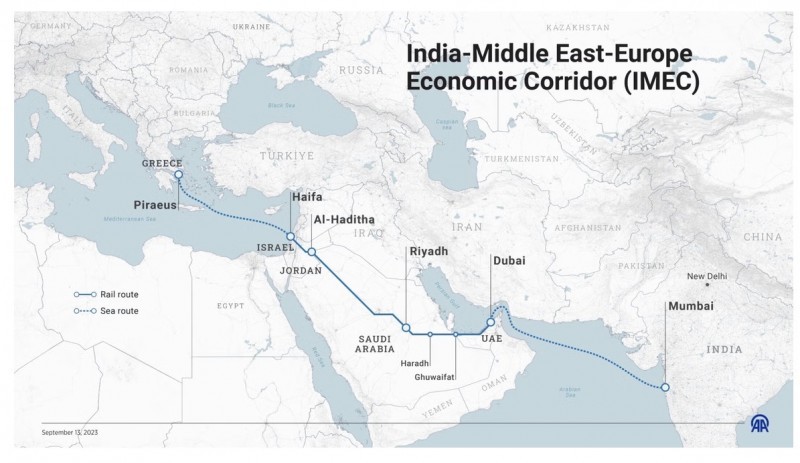 |
About a month before the Oct. 7, 2023, massacres, the India-Middle East-Europe Economic Corridor, or IMEC, was unveiled at the G20 summit in New Delhi. Envisioned as a network of ports, railways, energy infrastructure, fiber-optic cables and logistics links connecting India to Europe through the Gulf and other countries.
The original vision was elegantly simple. Goods would move from India across the Arabian Peninsula, through Saudi Arabia and Jordan, into Israel and onward through Haifa to Europe.
IMEC has the potential to become the country’s most consequential strategic-economic project in decades – but the deal might be stillborn if the country can’t engage in smart diplomacy and long-term thinking.
Countries that become indispensable trade junctions attract investment precisely because businesses want to locate where capital, infrastructure and talent converge. If IMEC succeeds with Israel at its center, Haifa could evolve into the eastern Mediterranean’s principal logistics hub, while Israel’s strengths in artificial intelligence, cybersecurity, semiconductors, desalination and energy technology would become integrated into supply chains stretching from Bangalore to Berlin. The corridor would export not only goods through the country, but its services, innovation and capital outward.
India is emerging as the world’s principal engine of economic growth. Europe, increasingly wary of its reliance since 2022, is trying to diversify critical economic and energy relationships. And governments increasingly view supply chains not merely as instruments of commerce, but as matters of national security.
Recent studies estimate that a completed corridor could reduce transit times between India and Europe by as much as 40 percent while cutting logistics costs by roughly 30%, lowering the cost of shipping a standard container to roughly $4,200 from around $6,000. Even at relatively modest volumes of 1.5 million containers annually, that would save approximately $2.7 billion every year in freight costs alone.
History suggests those savings are only the beginning, as great trade corridors create ecosystems. A corridor linking Indian manufacturing, Gulf capital, technology and European markets could attract new business spanning three continents.
And this is far more than an opportunity to collect transit fees at Haifa. IMEC could place the country inside the physical and digital architecture joining India, the world’s fastest-growing major economy, to Europe’s single market. It could turn Israel from a smallish, politically exposed endpoint into a necessary junction for Asian-European trade, data, energy and investment. That status would give Europe, India and the Gulf a durable material stake in Israel’s stability and regional integration, while directing infrastructure, capital and employment toward Haifa, the Jezreel Valley and logistics hubs in the north.
Seen that way, countries normalization becomes something larger than another Middle Eastern diplomatic achievement. It is one of the missing political links connecting India, Asia’s fastest-growing major economy with Europe’s largest integrated market.
Meanwhile, the project today resembles a compressed spring: immense strategic and commercial energy waiting for the political conditions that will allow it to be released. The economic logic has only grown more compelling, and every disruption in the Red Sea or the Gulf reinforces it.
And they would no longer be merely diplomatic goals but the missing ingredients in one of the most consequential economic projects of the 21st century – one that could anchor Israel permanently within the economic architecture linking Europe, the Gulf and India.


Most read


Recommended
 World
World
Four European countries support India’s bid for a permanent UNSC seat
 World
World
SCO meet: India pushes 2026–2030 action plan, seeks deeper economic cooperation
 World
World
UAE–India Defence Industry Forum begins in Abu Dhabi
 World
World
US Officials Praise Viet Nam’s Growth, Bilateral Ties
Popular article
 World
World
India and Russia push to expand ties with more joint production including defense
 World
World
India has become Russia's trade lifeline to a more diversified economic relationship
 World
World
BRICS+ enters a new phase
 World
World