
Vietnam News Today (Jan. 28): Lao Leader’s Vietnam Visit Further Nurtures Special Ties
 | Vietnam News Today (Jan. 25): Vietnam Enters New Era With Bold Leadership and Bigger Ambitions |
| Vietnam News Today (Jan. 26): Vietnamese, Indian Peoples Strengthen Friendship |
| Vietnam News Today (Jan. 28) notable headlines Lao leader’s Vietnam visit further nurtures special ties: Lao media Vietnam backs all peace initiatives in line with int’l law, UN Charter: official Cuban scholar highlights turning point in Vietnam’s development process UNFPA Regional Director concludes visit to Vietnam Vietnam on high alert amid Nipah virus surge in India Vietnam’s 14th Party Congress seen as landmark by foreign ambassadors Ho Chi Minh City eyes free trade zone as new growth engine Russian arrivals to Vietnam surged 200% in 2025 Piano Land brings 1,022 cruise passengers to Khanh Hoa |
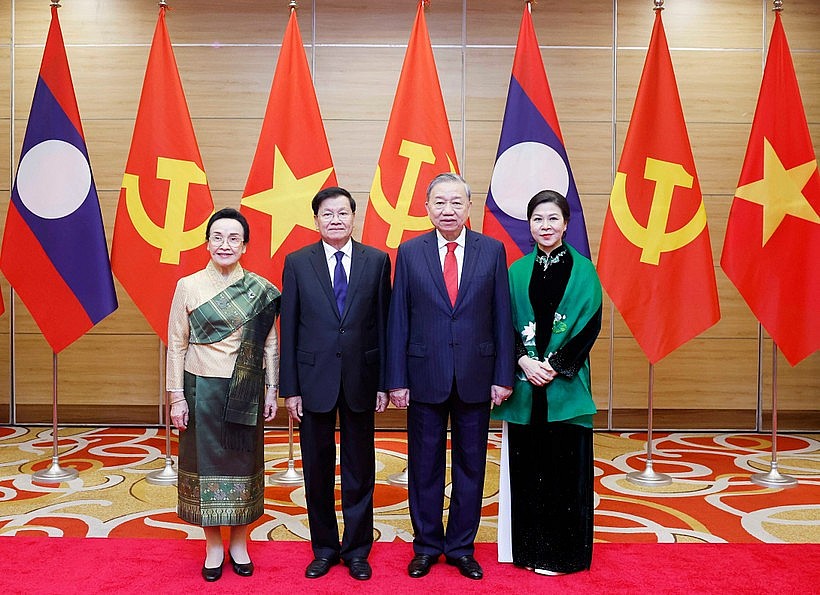 |
| Party General Secretary To Lam and his spouse pose with Lao Party General Secretary and President Thongloun Sisoulith and his spouse in Hanoi on January 26, 2026. (Photo: VNA) |
Lao leader’s Vietnam visit further nurtures special ties: Lao media
Major Lao official media outlets on January 27 continued to publish numerous articles affirming that the state visit to Vietnam by Lao Party General Secretary and President Thongloun Sisoulith was a political event of historical significance, making an important contribution to further deepening and advancing bilateral cooperation.
The articles run by Pasaxon - the mouthpiece of the Central Committee of the Lao People’s Revolutionary Party (LPRP), and Pathet Lao - the official newspaper of the Lao News Agency emphasised that the January 26-27 visit, his first since being elected General Secretary of the 12th LPRP Central Committee, clearly demonstrated that despite increasingly complex and unpredictable regional and international developments, the great friendship, special solidarity, comprehensive cooperation, and strategic cohesion between the two nations continue to be nurtured and strengthened across all fields.
Lao media also provided extensive coverage of high-level bilateral meetings between the leaders of the two countries. During meetings between Lao Party General Secretary and President Thongloun Sisoulith and General Secretary of the Communist Party of Vietnam Central Committee To Lam, State President Luong Cuong, Prime Minister Pham Minh Chinh, and National Assembly Chairman Tran Thanh Man, both sides agreed that political cooperation between Laos and Vietnam continues to be built on the highest level of mutual trust. Diplomacy, defense, and security remain solid pillars of bilateral relations, cited VNA.
The two sides also reaffirmed their commitment to further nurturing the “great friendship, special solidarity, comprehensive cooperation, and strategic cohesion” between Laos and Vietnam, tightening and closely coordinating in defense and security cooperation, and advancing collaboration in trade, investment, economic integration, culture, society, and education to achieve new qualitative progress.
Vietnam backs all peace initiatives in line with int’l law, UN Charter: official
Vietnam supports all initiatives to resolve conflicts and build peace based on the rule of law and in conformity with the United Nations (UN) Charter, Minister-Counselor Nguyen Hoang Nguyen, Chargé d'Affaires ad interim of the Permanent Mission of Vietnam to the UN, has affirmed.
Addressing a high-level open debate on “Reaffirming international rule of law: Pathways to reinvigorating peace, justice, and multilateralism,” held by the UN Security Council (UNSC) on January 26, Nguyen shared the concerns expressed by UN leaders and many countries over unprecedented challenges facing multilateralism and international law. These include heightened geopolitical tensions, armed conflicts in numerous regions, violations and selective application of international law, as well as the use or threat of use of force in international relations.
Such challenges, he noted, are eroding trust in multilateral mechanisms and disrupting the modern legal order based on the UN Charter that the international community has jointly built.
In this context, the Vietnamese representative reaffirmed that respect for and compliance with international law, particularly the UN Charter, are prerequisites for ensuring international peace and security. All states, regardless of size or power, must fully implement their obligations under treaties to which they are parties, address disputes by peaceful means, refrain from the use or threat of use of force, and respect diplomatic and legal processes, according to VOV.
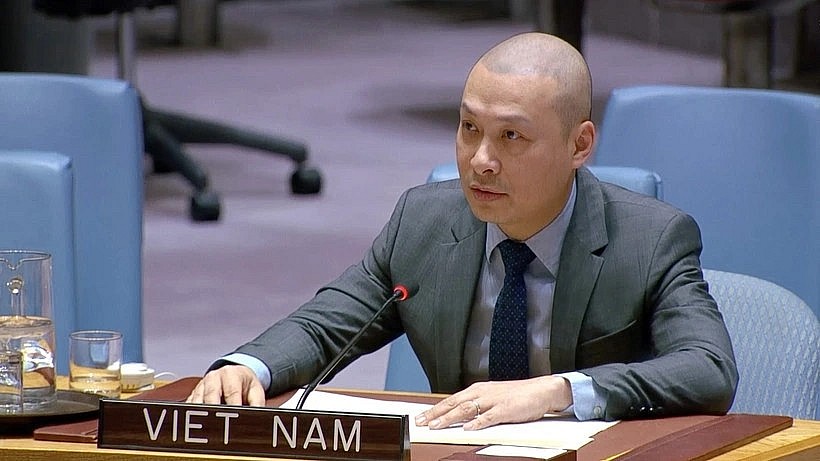 |
| Minister-Counselor Nguyen Hoang Nguyen, Chargé d'Affaires ad interim of the Permanent Mission of Vietnam to the UN (Photo: VNA) |
He reaffirmed Vietnam’s strong commitment to multilateralism, the rule of international law, and the central role of the United Nations in addressing global challenges.
The Vietnamese representative further underscored that strengthening the rule of law at all levels also requires key organs of the UN system, including the UNSC, the General Assembly, international courts and tribunals, as well as political and peacekeeping missions, to carry out their mandated functions.
Nguyen called for closer coordination and cooperation among these bodies, as well as with relevant regional organizations and national stakeholders, to ensure the feasibility and inclusiveness of efforts to promote peace and security.
As a responsible UN member state, Vietnam stands ready to work together with other members and partners to build and strive for a more just, stable and prosperous world for all nations and peoples, he added.
Cuban scholar highlights turning point in Vietnam’s development process
The 14th National Congress of the Communist Party of Vietnam (CPV) demonstrated the stability and continuity of political leadership in advancing the Party’s set goals, according to Dr Ruvislei González Saez, senior researcher at the Cuban Center for International Policy Research (CIPI), in a recent article published on reporteasia.com.
In the article, the Cuban scholar stressed that the congress showed Vietnam’s ability to ensure personnel and leadership work alongside a vigorous anti-corruption campaign, thereby maintaining not only political stability but also the Party’s historical legacy. He noted that a key factor distinguishing Vietnam’s political process is its collective leadership and generational succession based on the principles laid down by the late President Ho Chi Minh. According to him, at the 14th Congress, delegates unanimously adopted its Resolution, reaffirming the core contents of the review of the implementation of the 13th National Party Congress Resolution, assessing several theoretical and practical issues related to the socialist-oriented Doi Moi (renewal) process over the past 40 years, and evaluating 15 years of implementation of the Party Statutes (2011–2025).
Marking the 40th anniversary of this important process, Vietnam has demonstrated that reform must be continuous and uninterrupted, advancing through successive new stages. At the same time, the transition from a highly centralised and bureaucratic model to a socialist-oriented market economy has been comprehensive, closely linking key elements of the economy, diplomacy, security, and national defense toward a single goal of promoting national development, VNA reported.
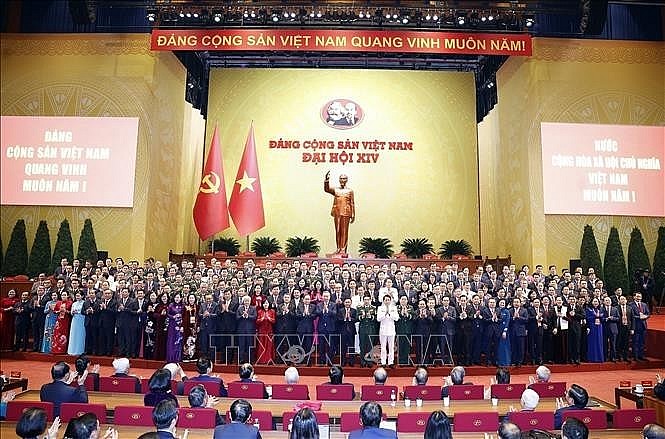 |
| The 14th-tenure Party Central Committee makes its debut at the 14th National Congress of the Communist Party of Vietnam (Photo: VNA) |
From theory to practice, Vietnam’s transformations have demonstrated the existence and necessity of socio-economic diversity as a vital process, combined with the dynamism of the market economy oriented toward socialism, in which the State plays a pivotal role as a regulatory lever of economic mechanisms. It is therefore no coincidence that in this new phase, all economic sectors, including the private sector, are prioritised as key drivers for achieving the development goals set for 2030 and 2045.
In reviewing the country’s current development stage, the 14th Congress set the objective of transforming Vietnam into a developing country with modern industry and upper-middle income by 2030, and realising the vision of becoming a developed, high-income country by 2045. In other words, Vietnam aspires to reach its highest level of development by the centenary of its independence.
Ruvislei praised key development indicators established by the 14th Congress for the 2026–2030 period, which include an average annual GDP growth rate of 10%, GDP per capita of around 8,500 USD by 2030, manufacturing and processing industries accounting for about 28% of GDP, and the digital economy contributing approximately 30% of GDP.
According to the scholar, the Congress reflects the country’s determination to move into a new stage of development amid a complex and unstable international environment. Through this event, Vietnam reaffirmed the importance of continuous transformation and the necessary pragmatism not only in its foreign relations strategy but also in governance, management, and national leadership.
UNFPA Regional Director concludes visit to Vietnam
UNFPA, the United Nations Population Fund, on January 27 concluded an official visit to Vietnam by Dr. Aleksandar (Sasha) Bodiroza, Regional Director for Asia and the Pacific ad interim.
The visit reaffirmed UNFPA’s strong partnership with the Government of Vietnam and underscored shared commitments to advancing sexual and reproductive health and rights (SRHR), gender equality, and leaving no one behind, particularly women, young people and ethnic minority communities.
Over three days in Hanoi and Phu Tho Province, Dr. Bodiroza engaged with senior government counterparts, development partners and local communities as well as UN leadership and UNFPA in Vietnam staff to review progress, deepen collaboration and align efforts with government priorities, national strategies and global commitments, including the Programme of Action of the International Conference on Population and Development (ICPD) and the 2030 Agenda for Sustainable Development.
A key highlight of the visit was a field mission to the One-Stop Service Center (OSSC) in Phu Tho province, also known as “Ngoi Nha Anh Duong,” where UNFPA works with provincial authorities to provide integrated, survivor-centered services for women and girls affected by domestic violence and gender-based violence.
Dr. Bodiroza met with provincial leaders, service providers and women from local ethnic minority communities. He acknowledged the center’s role in expanding access to protection, health and social services in hard-to-reach settings and congratulated OSSC staff for their diligent hard work, reported VNA.
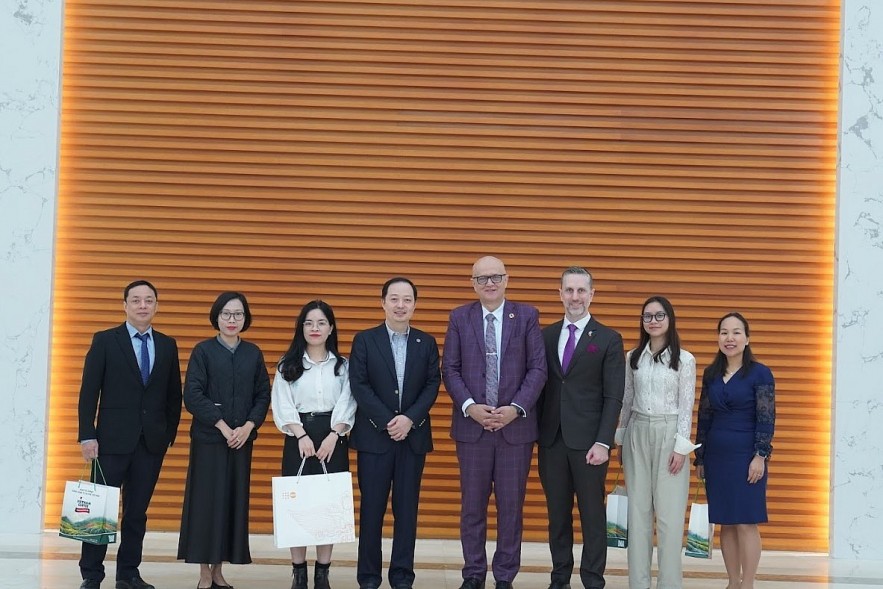 |
| Dr. Aleksandar (Sasha) Bodiroza, UNFPA Regional Director for Asia and the Pacific ad interim (fifth from left) concludes visit to Vietnam on January 27. (Photo: UNFPA) |
In Hanoi, Dr. Bodiroza held high-level meetings with the Ministry of Foreign Affairs, Ministry of Finance and Ministry of Health to discuss continued cooperation on population issues including Vietnam’s rapidly ageing population, championing maternal health and youth empowerment, gender-based violence prevention and response, responding to climate-induced disasters and sustainable financing for social sectors. He also met with Ms. Pauline Tamesis, UN Resident Coordinator in Vietnam, to exchange views on UN system coherence and collective impact.
Speaking after the visit, Dr. Bodiroza commended Vietnam’s progress while emphasizing the importance of sustained, rights-based investments.
“Vietnam has made important strides in improving health outcomes and advancing gender equality. UNFPA remains committed to working alongside the Government and partners to ensure that every woman and young person, regardless of where they live, can exercise their rights, make informed choices, and access quality services,” he said.
Dr. Bodiroza also addressed all UNFPA staff in Vietnam, recognising their dedication and encouraging continued innovation and partnership to deliver high-impact results at national and sub-national levels.
UNFPA’s Asia and the Pacific Regional Office, based in Bangkok, provides strategic leadership and technical support to 36 countries across the region, advancing efforts to end unmet need for family planning, prevent maternal deaths, eliminate gender-based violence and harmful practices, and respond to humanitarian emergencies.
The visit reinforced the Regional Office’s role in supporting Vietnam to translate evidence, policy, and partnerships into tangible gains for women, girls, and young people.
Vietnam on high alert amid Nipah virus surge in India
With cases confirmed in India, Vietnam’s health authorities urge self-monitoring for travelers from outbreak zones.
As India confirms new cases of the Nipah virus, Vietnam’s Ministry of Health has issued a public advisory urging people returning from outbreak regions to monitor their health for 14 days. Although Vietnam has yet to record any infections, heightened vigilance is being applied at national borders and within local healthcare systems.
According to surveillance data, five suspected cases of Nipah virus infection were reported in India between December 27, 2025, and January 26, 2026. Of these, two cases were confirmed through laboratory testing at a hospital in West Bengal. The local government in India has since traced and isolated nearly 100 close contacts in efforts to contain the spread.
As of January 26, no cases have been reported in Vietnam. However, given the high fatality rate and potential for human-to-human transmission, Vietnamese health authorities are proactively strengthening disease surveillance at border checkpoints, medical facilities, and community levels.
The Ministry of Health has advised against non-essential travel to areas with active outbreaks. Individuals returning from such regions are urged to self-monitor their health for two weeks. If symptoms like headache, muscle pain, nausea, sore throat, dizziness, drowsiness, confusion, or seizures occur, they should immediately report to the nearest medical facility, avoid contact with others, and inform healthcare providers of their travel history.
In Ho Chi Minh City, the Center for Disease Control (HCDC) announced on January 26 that it is closely tracking global developments and implementing preventive protocols. Enhanced screening is in place at international entry points, with particular focus on travelers arriving from high-risk areas. Anyone showing signs of fever or other symptoms of a potentially dangerous infectious disease will be promptly isolated and evaluated.
HCDC emphasized the absence of a vaccine or specific treatment for the Nipah virus. As such, preventive hygiene remains crucial. Travelers are advised to wash hands regularly with soap, avoid contact with fruit bats or sick pigs, and stay away from areas where bats roost. Consuming raw or contaminated fruit and plant sap, such as fresh date palm juice or unprocessed coconut water, should be avoided.
Infected individuals may initially show symptoms within 4 to 14 days of exposure. The illness often begins with fever, headache, cough, and sore throat. In severe cases, it can rapidly progress to encephalitis, marked by drowsiness, confusion, mental disturbances, and coma - sometimes within just 24 to 48 hours, cited VNN.
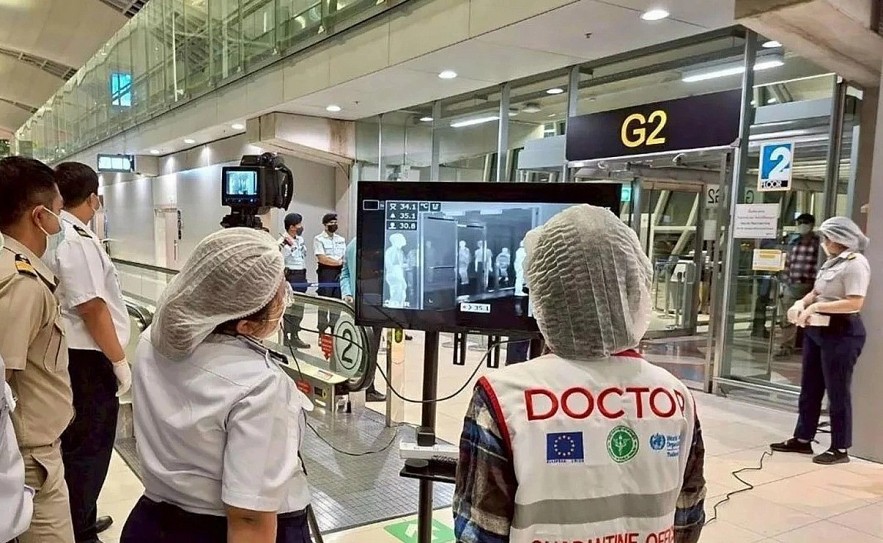 |
| Travelers at risk of Nipah virus are screened at airports in India and Thailand. Photo: Thailand Government |
The virus primarily spreads from animals to humans, especially through contact with infected bats or pigs, or consumption of contaminated food. However, person-to-person transmission is also possible through close contact with bodily fluids, making early detection and isolation vital.
Nipah virus has a mortality rate estimated between 40% and 75%, depending on outbreak conditions and access to medical care. Even survivors may face long-term effects such as persistent seizures or changes in personality.
Health authorities in Vietnam stress the importance of food safety - consuming only well-cooked food and clean, peeled fruits. Citizens are also advised to use masks, gloves, and personal protective equipment when caring for suspected or confirmed patients and to maintain strict hygiene practices during and after contact.
Though no local cases have emerged, Vietnam continues to monitor the situation closely and stands ready to implement further measures if the outbreak spreads.
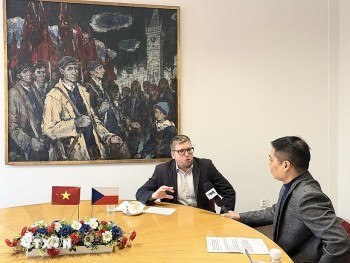 | Vietnam News Today (Jan. 23): 14th National Party Congress – milestone shaping brighter future for Vietnam; Vietnam supports UN Security Council’s substantive reform; Phu Quoc ... |
 | Vietnam News Today (Jan. 24): Vietnam ready to play active role in global affairs, says Party chief To Lam; Int’l friends show confidence in Vietnam’s ... |
Recommended
 National
Vietnam News Today (July 12): Vietnam Ready to Share Digital Transformation Experience with Timor-Leste
 National
Vietnam News Today (July 11): Vietnam and Laos Agree to Enhance Defense Cooperation
 National
Vietnam News Today (July 10): Third Vietnam-Laos Border Defense Friendship Exchange Gets Underway
 National
Vietnam Looks Forward to New Breakthroughs in Cooperation with the US
 National
Vietnam News Today (July 13): Vietnam, France Seek to Deepen Comprehensive Strategic Partnership
 National
Vietnam News Today (July 9): Vietnam, Japan Seek New Strides in Defense Cooperation
 National
Celebrating French National Day in Ho Chi Minh City
 National