Vietnam, Canada agree on economic cooperation priorities for next period
The third meeting of the Vietnam-Canada Joint Economic Committee (JEC 3) took place in Ottawa on June 5, co-chaired by Vietnamese Deputy Minister of Industry and Trade Phan Thi Thang and Canada’s Deputy Minister of Global Affairs Arun Thangaraj.
The meeting was attended by representatives from ministries, agencies and businesses of both countries to review bilateral economic cooperation and discuss priorities for the coming period.
In the context of continued global economic uncertainty, ongoing supply chain restructuring and growing demands for economic growth, energy security and sustainable development, both sides reaffirmed the increasingly important role of the Joint Economic Committee in stepping up bilateral cooperation and deepening the Vietnam-Canada Comprehensive Partnership established in 2017.
At the meeting, Deputy Minister Phan Thi Thang said Vietnam-Canada economic relations have continued to develop in a positive and substantive manner. Bilateral trade reached nearly US$8.6 billion in 2025, maintaining strong growth since the Comprehensive and Progressive Agreement for Trans-Pacific Partnership (CPTPP) entered into force.
Vietnam’s exports to Canada rose 18.2% to US$7.5 billion in 2025 and increased a further 25% during the four month of 2026. Canada’s exports to Vietnam grew 24% in 2025 and surged 62% compared with the same period a year earlier. According to the Vietnamese side, these figures reflect the increasingly complementary nature of the two economies and the effectiveness of efforts to promote trade and investment cooperation.
Deputy Minister Arun Thangaraj shared the assessment of the positive momentum in bilateral economic relations, noting that Vietnam is Canada’s largest trading partner and fastest-growing trading partner in Southeast Asia.
He said Canada hopes to further expand cooperation with Vietnam in trade, investment, supply chains, critical minerals, clean energy, innovation and infrastructure, and reaffirmed Canada’s commitment to working closely with Vietnam to implement the outcomes of the meeting.
Both sides consented to focus on three priority areas: diversifying trade and investment, making effective use of the CPTPP, supporting an open trading system and accelerating negotiations on the ASEAN-Canada Free Trade Agreement (ACAFTA); strengthening cooperation in strategic industries such as critical minerals, high technology, innovation, digital transformation and strategic supply chains; and expanding cooperation in energy, infrastructure and green growth, including clean energy, liquefied natural gas (LNG), logistics, digital infrastructure and sustainable development.
One of the key outcomes of the third meeting was the transition of the Joint Economic Committee mechanism towards a more action-oriented and substantive phase of cooperation. Two working groups completed and agreed on an Action Plan for 2026-2028, setting out cooperation priorities and implementation mechanisms to support bilateral initiatives.
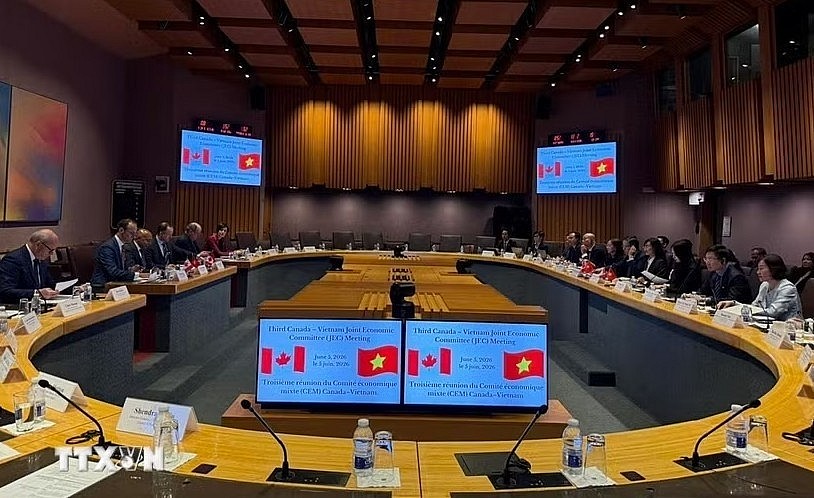 |
| The third meeting of the Vietnam-Canada Joint Economic Committee (JEC 3) Photo: VNA |
Both sides also highlighted the role of the working groups in maintaining technical dialogue and promoting cooperation in priority areas, while agreeing to continue making effective use of the mechanism to ensure the practical implementation of meeting outcomes.
At the conclusion of the meeting, Deputy Minister Phan Thi Thang and Deputy Minister Arun Thangaraj signed a Joint Statement, adopted the 2026-2028 Action Plans and agreed to hold the fourth meeting in Vietnam in 2028.
The meeting reaffirmed the commitment of Vietnam and Canada to augmenting economic cooperation, deepening the Comprehensive Partnership and creating a foundation for further development of bilateral relations in the period ahead, reported VOV.
On the sidelines of the meeting, the Trade Promotion Agency under Vietnam’s Ministry of Industry and Trade and Trade Facilitation Office Canada (TFO Canada) signed project documents for the Trade Support for Inclusive, Sustainable and Resilient Economic Growth (TRISEG) project in Vietnam for 2026-2030.
Under the arrangement, the Trade Promotion Agency will serve as TFO Canada’s sole strategic partner in Vietnam in carrying out the project.
The initiative aims to support Vietnamese small and medium-sized enterprises, particularly women-led businesses, in enhancing production and export capacity in key agricultural product sectors, thereby promoting inclusive and sustainable economic growth that is more resilient to fluctuations in international markets.
Vietnam and Laos promote strategic linkage
The Lao–Vietnam railway project, with a total length of approximately 562 km, is a strategic project supported by the governments of both countries and prioritised in bilateral cooperation.
With Vung Ang Port (Vietnam) as its gateway to the sea, this project also aligns with the plan to connect the East–West Economic Corridor, in line with the policy of transforming Laos from a landlocked country into an integrated and connected nation in transportation, logistics, and trade in the region and the world. This is not simply a transportation route, but also an economic lifeline that will enhance Laos's position on the international stage.
The Lao government and the Lao–Vietnam Railway Company Limited have officially signed a design–construction–capitalization–operation and maintenance concession agreement for the railway project connecting Thakhek Town in Khammuon Province, Central Laos, to Mu Gia (in Quang Tri Province) in the border area between the two countries. This is an important starting point towards the early realisation of the construction of a railway line connecting Laos and Vietnam.
Lao Minister of Public Works and Transport Leklay Sivilay emphasised that, in the future, the Lao–Vietnam railway line will be a symbol of cooperation in the new era.
With an investment of approximately 600 million USD, Star Telecom (Unitel) — a joint venture between Vietnam’s Viettel Military Industry and Telecoms Group and Lao Asia Telecom, a subsidiary of the Lao Ministry of Defence — has officially launched Unitel Logistics.
The establishment of Unitel Logistics lays the foundation for Unitel to become a multi-service industrial group in Laos, significantly impacting all aspects of the country’s economy and social life, cited NDO.
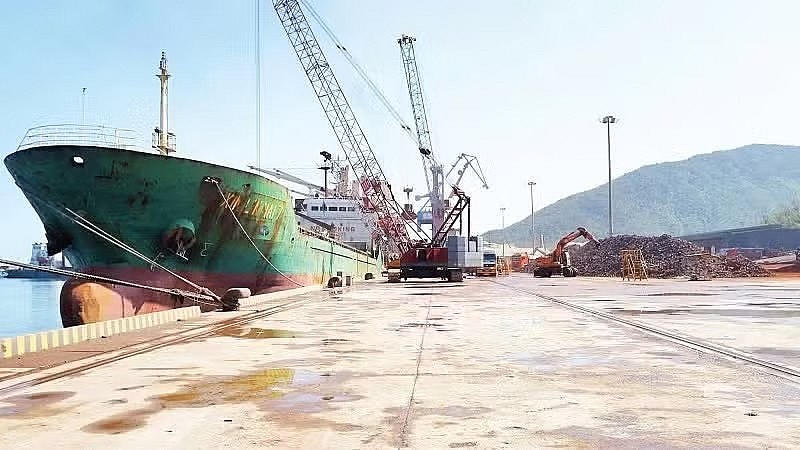 |
| Berth No. 3 at Vung Ang Port is managed and operated by the Lao-Viet International Port Joint Stock Company. |
Notably, Unitel Logistics’ infrastructure will be deployed on an unprecedented scale in Laos, with the construction of three “Mega Hubs” in Oudomxay (3 ha), Vientiane (7.2 ha), and Savannakhet (5 ha) Provinces; and the development of six bonded warehouses at strategic border crossings with Vietnam, Thailand, and China.
In addition, Unitel Logistics will establish a network of 1,500 transaction points covering all 18 provinces of Laos, ensuring connectivity even to the most remote villages. According to Unitel’s General Director, Tran Trung Hung, Unitel’s goal is to contribute to Laos’ development of a modern telecommunications and information technology infrastructure, ensuring seamless connectivity with countries in the region and around the world.
The development of logistics infrastructure will create a competitive advantage, helping to reduce costs and shorten the time for transporting goods between Vietnam and Laos. Thanks to Unitel’s network covering Laos, goods can be delivered directly to consumers. This also enhances the competitiveness of Vietnamese businesses operating in Laos, while simultaneously expanding opportunities for Lao businesses to access the Vietnamese market.
Bounmi Malavong, a Lao investor currently operating services at Vung Ang International Port, believes that Unitel’s launch of its logistics services will act as a bridge in transporting goods from Laos to countries in the region and internationally. This is also considered a significant strength contributing to the promotion of cooperation and support between Unitel and Vung Ang International Port in the future.
The potential for logistics cooperation between Vietnam and Laos is still very large, as Vietnam has advantages in its seaport system, logistics network, and international connectivity, while Laos has a strategic location in the Greater Mekong Subregion, playing a crucial role as a bridge between the Association of Southeast Asian Nations (ASEAN) and the Asian interior.
If effectively connected, the Vietnamese and Lao economies will strongly complement each other in developing regional supply chains, not only meeting the needs for transporting and circulating goods between the two countries but also attracting goods from third countries, bringing higher added value to the logistics activities of businesses in both countries.
Deputy Director of the Import–Export Department, Ministry of Industry and Trade, Tran Thanh Hai, believed that in the context of global trade shifting strongly towards digitalisation, greening, and increased resilience to supply chain disruptions, Vietnam–Lao logistics cooperation needs to be further promoted in a more modern, synchronised, and sustainable direction.
Both sides need to strengthen coordination in developing logistics infrastructure and multimodal transport, promote digital transformation in logistics, and create a more favourable environment for investment, import–export, and business connections between the two countries.
Unlocking cross-border logistics “lifelines” enhances the competitiveness of each country’s economy and serves as a strategic leverage to achieve the goal of exceeding 4 billion USD in bilateral trade by 2026 and reaching 10 billion USD by 2030.
Phong Nha – Ke Bang earns UNESCO World Biosphere Reserve status
Phong Nha–Ke Bang National Park has been recognised as a UNESCO World Biosphere Reserve after the decision was approved on June 5 at the 38th session of the International Coordinating Council of UNESCO’s Man and the Biosphere (MAB) Programme in Hernandarias, Paraguay.
The recognition marks the third UNESCO accolade for Phong Nha – Ke Bang, which was inscribed as a World Natural Heritage Site in 2003 and again in 2015. The latest designation highlights the park's global ecological significance while opening new prospects for conservation and sustainable development.
Pham Hong Thai, Director of the Phong Nha–Ke Bang National Park Management Board, described the recognition as a landmark achievement for both Quang Tri province and Vietnam. He said the designation acknowledges the park’s rich biodiversity, unique limestone rainforest ecosystems, striking natural scenery, and exceptional geological and geomorphological values.
According to Thai, the recognition also reflects international appreciation for Vietnam’s ongoing efforts to preserve natural resources, safeguard biodiversity and pursue sustainable development. It is expected to strengthen conservation work, improve resource management and support community-based and sustainable tourism initiatives.
The UNESCO-approved biosphere reserve spans 515,830 hectares, comprising a core zone of 123,326 hectares, a buffer zone of 220,055 hectares, and a transition zone of 172,449 hectares. The area is home to more than 159,300 residents, reported VNA.
 |
| Inside Hung Thoong Cave in the Phong Nha – Ke Bang National Park. (Photo published by VNA) |
Phong Nha – Ke Bang joins UNESCO’s World Network of Biosphere Reserves, which includes 759 sites across 136 countries. The addition brings the total number of UNESCO-recognised biosphere reserves in Vietnam to 11.
The new status is expected to boost socio-economic development in Quang Tri, particularly in the tourism sector, while raising the province’s international profile in nature conservation and sustainable tourism and contributing to Vietnam’s broader green growth objectives.
 | Vietnam News Today (Jun. 2): Vietnam-Philippines Economic Cooperation Should Move to New Level Vietnam News Today (Jun. 2): Vietnam-Philippines economic cooperation should move to a new level; Vietnam, US step up humanitarian cooperation on war legacy issues; Bilingual ... |
 | Vietnam News Today (Jun. 4): Vietnam, Philippines enhance defense cooperation following upgraded partnership; Vietnam seen as ASEAN’s resilient growth bright spot; Vietnamese cuisine and handicrafts ... |