Vietnam's Engineering Unit Rotation 4 marks new milestone in Abyei
During the recent handover ceremony of the 37km-long Abyei – Agok road, hundreds of local residents lined both sides, waving to members of Vietnam's Engineering Unit Rotation 4, who had upgraded it as part of their ongoing services for the United Nations peacekeeping mission.
According to the Vietnam Department of Peacekeeping Operations under the Ministry of National Defense, the Abyei – Agok road holds special strategic significance for the United Nations Interim Security Force for Abyei (UNISFA) as local authorities and residents have always longed for convenient transportation links between the North and the South. The only vital transportation route serving patrol, humanitarian relief, and public travel had severely deteriorated after many years of use due to the soil conditions and prolonged heavy rainfall.
Immediately after receiving the assignment from the mission and at the request of the local authorities, the Vietnamese team promptly developed a plan, mobilised maximum manpower and equipment, and implemented a comprehensive approach to accelerate the upgrade.
After 85 days of continuous construction, a large volume of work was completed, with nearly 300,000 cubic meters of black soil and approximately 70,000 cubic meters of sand excavated and filled; the roadbed was widened from 10 to 14 meters, with some sections reaching 20–25 meters; over 31,700 cubic meters of murram was laid; and a drainage system was installed.
The road was completed 35 days ahead of schedule, ensuring smooth traffic flow for even heavy vehicles.
At the handover ceremony, UNISFA Acting Head of Mission and Force Commander Major General Ganesh Kumar Shrestha assessed that since the mission was established in 2011, this is the first project of such significant importance and scale for the people of the region, according to VNA.
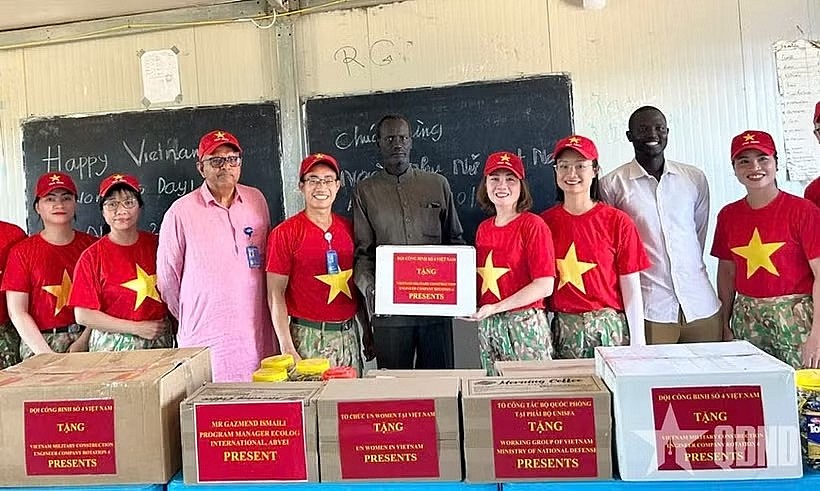 |
| Representatives of Vietnam's Engineering Unit Rotation 4 present gifts to pupils at the Abyei secondary school. (Photo: qdnd.vn) |
He stressed that the completion of the road is an unprecedented achievement, opening up opportunities for infrastructure connectivity and enhancing security in the area. The Vietnamese team’s efforts deserve recognition.
Chief of Mission Support Division of UNISFA Uchenna Odenigbo said that opening the road before the rainy season brings a double benefit of improving travel conditions for locals and enhancing the logistical support capacity of the mission.
Arop Deng Kuol, Deputy Chief Administrator of the Abyei Special Administrative Area, expressed his sincere gratitude for the contributions ofVietnam's Engineering Unit Rotation 4. He stated that the previously severely dilapidated road has now become one of the best quality ones in the area, contributing to improving the local landscape and improving the life quality of its people.
Lieutenant Colonel Trinh Van Cuong, head of Engineering Unit Rotation 4 and Commander of the Vietnamese Forces at UNISFA, affirmed that the unit always strives to bring the best values to the local community.
The team also received a letter of commendation from the Chief Administrator of the Abyei Special Administrative Area. The letter acknowledged the unit’s effective coordination with local authorities and UNISFA, its professional, disciplined, and highly efficient performance, its completion of the road ahead of schedule before the rainy season, and its implementation of several important projects such as repairing Banton Bridge and improving key roads serving the mission's operations and the life of the local population.
The letter requested that UNISFA consider recognising the team as an outstanding unit and expressed a desire for continued cooperation in the future.
Along with completing the construction project, the team also carried out practical humanitarian support activities. On this occasion, hundreds of essential supplies and school supplies were handed directly to needy families, bringing joy to the children of Abyei. A highlight of the program was the transportation of 10 standard hospital beds from Vietnam to support the local health sector.
Vietnam enhances ASEAN-EU economic integration and links
The adoption of the 2026 work plan marks an important step, laying the foundation for the SCOPE Trade project to move into a substantive implementation phase, delivering concrete and practical results for ASEAN member states.
The first meeting of the Project Steering Committee of the ASEAN-EU Sustainable Connectivity Package on Trade (SCOPE Trade) took place on April 29 at the ASEAN Secretariat headquarters in Jakarta, Indonesia. Nguyen Anh Duc, Counsellor and Head of the Permanent Economic Mission of Vietnam to ASEAN, and Jerome Pons, Head of Cooperation at the EU Delegation to ASEAN, co-chaired the meeting.
The meeting was described as a key milestone, formally moving the SCOPE Trade project into a substantive implementation phase.
With a total budget of around 20 million EUR (approximately VND530 billion) for 2025-2029, SCOPE Trade is one of the core initiatives under the ASEAN–EU Sustainable Connectivity Package, aimed at strengthening ASEAN economic integration and strengthening economic links between the two regions. The project focuses on three main pillars: policy improvement and trade facilitation; digital connectivity; and sustainable value chains.
At the meeting, ASEAN member states noted positive results in the first year of the project. SCOPE Trade focused on building analytical and institutional groundwork while carrying out initial technical activities directly supporting ASEAN integration processes, reported VOV.
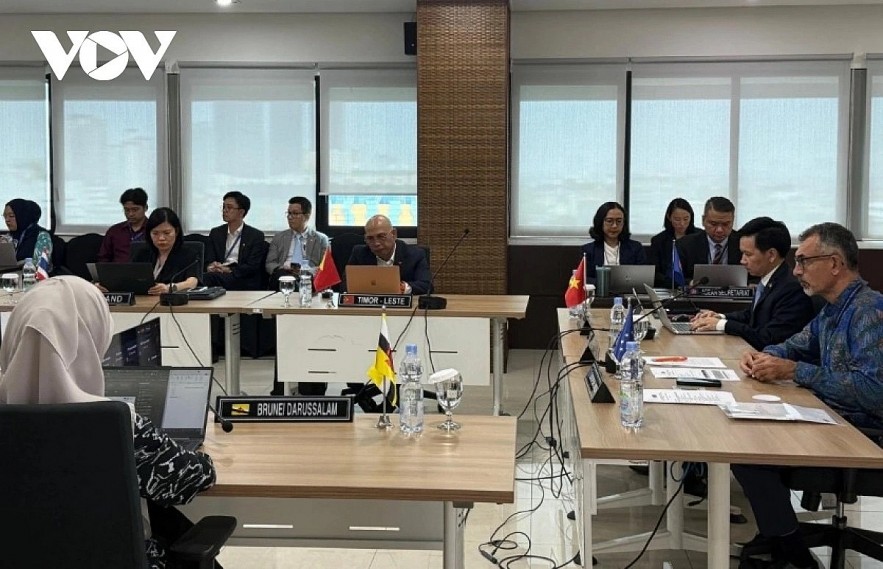 |
| The first meeting of the Project Steering Committee of the ASEAN-EU Sustainable Connectivity Package on Trade (SCOPE Trade) |
Notably, the project has begun implementing support activities at the national level, enhancing the project’s substantive nature.
Specifically, it has supported Brunei, Indonesia, Malaysia, Thailand and Singapore in reviewing service commitments under the ASEAN Trade in Services Agreement (ATISA); supported Laos in piloting railway transport under the ASEAN Customs Transit System (ACTS); supported Cambodia in reviewing legal frameworks on competition policy; and supported the Philippines in strengthening capacity to implement service commitments.
In Vietnam, the project has supported the review of investment commitments under the ASEAN Comprehensive Investment Agreement (ACIA) and organised capacity-building activities to support negotiations on the Digital Economy Framework Agreement (DEFA). These activities are of practical significance, contributing to strengthening capacity for international economic integration and preparing for the implementation of regional commitments in the coming period.
At the first meeting, ASEAN member states and the EU agreed to adopt the project’s 2026 action plan.
Nguyen Anh Duc, Counsellor and Head of the Permanent Economic Mission of Vietnam to ASEAN, said: “The adoption of the 2026 work plan is an important step, laying the foundation for the SCOPE Trade project to move into a substantive implementation phase, delivering concrete and practical results for ASEAN members. In its role as coordinator of ASEAN-EU economic cooperation, Vietnam continues to play a proactive role in steering and guiding cooperation between the two regions. The successful co-chairing of the first Steering Committee meeting not only contributes to the effective implementation of the SCOPE Trade project, but also reinforces Vietnam’s position in leading regional economic cooperation initiatives.”
The project’s 2026 action plan continues to follow the three main pillars while strengthening activities focused on implementation aimed at achieving concrete and measurable results, particularly at the national level. The second-year work program is expected to further expand national-level activities to ensure that project support translates into direct benefits for each member state, while helping narrow development gaps within the region.
Vietnam steps up efforts to improve disaster resilience
In recent years, Vietnam’s meteorological, hydrological and disaster prevention systems have made significant strides. High-resolution numerical models, operated on CRAY supercomputers, are now capable of delivering detailed weather forecasts on a 3km by 3km grid.
Alongside this, the integration of multi-source data—from satellites, radar, and automated observation stations to lightning detection systems—has enabled the development of real-time weather monitoring. As a result, hazardous phenomena such as thunderstorms, whirlwinds and hail can now be forecast between 30 minutes and three hours in advance, with steadily improving accuracy.
A particularly noteworthy development is the application of artificial intelligence (AI). AI models not only assist in automatically identifying the location and intensity of storms, but can also learn from historical data to enhance forecasting. In the short term, storm intensity forecasting has improved by 10–20%.
In hydrology, flood and saltwater intrusion forecasting models based on river basins, combined with international data—especially for the Mekong River basin—have extended warning lead times to several days, enabling local authorities to respond more proactively. At present, real-time flash flood and landslide warning systems, updated hourly and down to commune level, are gradually bringing technology closer to the public.
Despite these advances, a considerable gap remains between practical demands and forecasting capacity. First, the scientific and technological workforce has yet to keep pace with development needs. Observation networks remain inconsistent, data lacks interoperability, and open data standards are not fully established. Investment in research is still limited, financial mechanisms lack flexibility, and socialisation remains difficult. Moreover, there is a shortage of policies to encourage and attract scientists and research organisations, as well as support mechanisms for testing and applying new technologies under real-world conditions.
From a technical perspective, while storm track forecasting has seen some improvement, errors remain significant; meanwhile, storm intensity forecasting has shown little clear progress over the past 15 years. Rainfall forecasting by even the most advanced numerical models continues to exhibit low accuracy. For 1–3 day forecasts involving rainfall thresholds exceeding 50 mm per 24 hours, accuracy rates stand at only 15–20%, cited NDO.
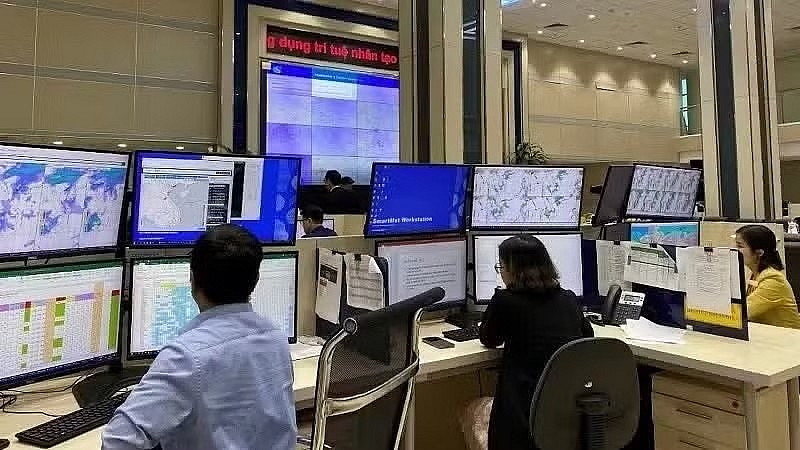 |
| Forecasters analyse data on the SmartMet system to produce forecasting bulletins and early disaster warnings at the National Centre for Hydro-Meteorological Forecasting. (Photo: Hoai Linh) |
Early forecasting of flood peaks on rivers in the northern and central regions also remains limited. It is not yet possible to provide detailed warnings of flash floods and landslides at specific residential or infrastructure locations due to the lack of real-time geological and topographical observation data.
Accordingly, to improve the effectiveness of forecasting and early warning, Nguyen Xuan Hien, Deputy Director of the National Centre for Hydro-Meteorological Forecasting, emphasised the need to focus on the four key pillars: mastering core technologies, especially AI and ensemble forecasting models; developing intelligent real-time observation systems; strengthening big data processing capacity; and improving the dissemination of warning information to the public. Priority should be given to improving storm intensity forecasting accuracy, striving to reduce errors to below 7 m/s, while enhancing the capability to identify and forecast sudden storm intensification in the East Sea/South China Sea.
At the same time, quantitative rainfall forecasting needs to be significantly improved, aiming for accuracy rates exceeding 60% for common rainfall thresholds and over 40% for dangerous heavy rainfall thresholds, thereby enhancing the effectiveness of flood and inundation warnings. A fundamental task is to develop a detailed and synchronised training data system, combining meteorological grid data with actual observations, to support the development and application of AI models in forecasting storms and heavy rainfall in Vietnam.
Efforts should be intensified to apply AI in identifying, analysing and issuing early warnings of major floods across river basins 2–5 days in advance, based on hazardous rainfall scenarios; and to closely integrate hydrological–hydraulic models with AI technologies to improve short- and very short-term flood forecasting.
Efforts should be intensified to apply AI in identifying, analysing and issuing early warnings of major floods across river basins 2–5 days in advance, based on hazardous rainfall scenarios; and to closely integrate hydrological–hydraulic models with AI technologies to improve short- and very short-term flood forecasting.
In addition to technological factors, according to Le Cong Thanh, Deputy Minister of Agriculture and Environment, one key direction is to ensure that disaster forecast and warning information reaches the public as quickly and accessibly as possible, through digital platforms, mobile applications and multi-channel communication systems.
Hanoi, Ho Chi Minh City among world’s top 100 walkable cities
Hanoi and Ho Chi Minh City have been named among the world’s top 100 most attractive cities for walking exploration in 2026, according to a rankings recently released by travel platform GuruWalk.
The list also features Hoi An in Da Nang, further highlighting Vietnam’s growing appeal as a destination for immersive on-foot travel experiences.
The rankings evaluate destinations based on walkability, density of attractions, accessibility and the overall experience for visitors who prefer to explore cities on foot. Hanoi and Ho Chi Minh City were recognised for their distinctive urban character, closely clustered landmarks and vibrant street life.
This year’s list continues to be dominated by well-known European cities, with Rome taking the top spot. The Italian capital stands out for its rich concentration of heritage sites such as the Colosseum, Trevi Fountain and Pantheon, all easily explored within a single walking route. It is followed by Madrid, Budapest and Prague, known for compact city centres and pedestrian-friendly layouts.
Beyond Europe, the list includes prominent cities from Asia and the Americas such as Tokyo, Kyoto and New York City.
The presence of Hanoi and Ho Chi Minh City underscores the rising appeal of Southeast Asian urban destinations on the global tourism map, VNA reported.
 |
| The Vietnam Happy Fest 2025 takes place in the pedestrian zone around Hoan Kiem Lake in Hanoi from December 5 to 7. (Photo: VNA) |
Experts note that Hanoi’s strength lies in its Old Quarter, with its dense network of narrow streets, cultural sites and traditional spaces – ideal for leisurely, exploratory walking. Meanwhile, Ho Chi Minh City attracts visitors with its dynamic pace, blend of historic and modern architecture, and rich street food culture.
The inclusion of Vietnam’s two largest cities in the rankings not only reflects their urban tourism potential but also highlights a broader shift towards sustainable travel trends that prioritize slower, environmentally friendly and experience-driven journeys.
GuruWalk’s list is regarded as a valuable source of reference for international travelers, particularly those seeking to discover local culture through walking – an approach that is both cost-effective and offers deeper insight into everyday life.
 | Vietnam News Today (Apr. 27): Can Tho seeks to deepen cooperation with Korean businesses; Vietnam supports UNESCO's people-centered approach, multilateral cooperation; Vietnamese nationwide pay tribute ... |
 | Vietnam News Today (Apr. 28): Vietnam, Bulgaria Step Up Tourism Promotion, Business Connectivity Vietnam News Today (Apr. 28): Vietnam, Bulgaria step up tourism promotion, business connectivity; Vietnam urges stronger nuclear disarmament ahead of NPT review conference; Can Tho ... |