| Vietnam News Today (May 3) notable headlines Vietnam, Japan push for more substantive, effective ties Vietnam calls for solidarity with Cuba at Non-Aligned Movement meeting International Financial Center - Vietnam's strategic move in global race: Expert Ho Chi Minh City attracts significant investment from France Phu Quoc becomes leading resort destination for RoK travelers Vietnam continues to contribute effectively to multilateral mechanisms: Ambassador Takaichi's visit gives fresh impetus to Vietnam-Japan ties: PM Hung Ho Chi Minh City, Da Nang lead search trends among Thai travelers SIAL Canada supports Vietnamese firms’ entry into North American market |
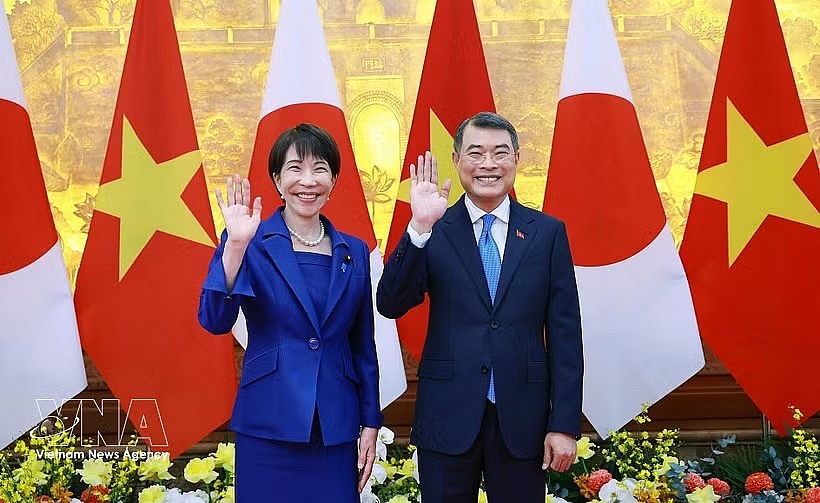 |
| Prime Minister Le Minh Hung and Japanese Prime Minister Takaichi Sanae pose for a photo at the official welcome ceremony on May 2, 2026. (Photo: VNA) |
Vietnam, Japan push for more substantive, effective ties
Prime Minister Le Minh Hung and Japanese Prime Minister Takaichi Sanae held talks in Hanoi on May 2 following an official welcome ceremony.
During the meeting, PM Hung noted that the selection of Vietnam as PM Takaichi’s first Asian destination after her re-election underscores the high priority Japan places on relations with the country.
He also congratulated Japan on the successful organization of the expanded Asia Zero Emission Community (AZEC) Summit, highlighting its leadership in addressing global energy security challenges. The Vietnamese leader affirmed that Japan remains one of Vietnam’s top strategic partners and a trusted, sincere companion in pursuing sustainable development goals.
PM Hung said he expects the visit to create fresh impetus for the Comprehensive Strategic Partnership between the two countries, driving broader and more profound, substantive and effective cooperation across key areas, including trade, investment, ODA, digital and green transformation, science and technology, food security and sustainable energy - pillars critical to growth of both countries, as well as the region and the world at large.
For her part, PM Takaichi congratulated PM Hung on his election and expressed confidence in the Vietnamese government’s continued progress under his leadership.
She commended Vietnam’s robust development and rising global profile, pointing to its key role in regional supply chains and its foreign policy of self-reliance and intensive and extensive international integration. PM Takaichi reaffirmed Japan’s support for Vietnam’s development agenda and its readiness to expand cooperation, particularly in strengthening economic resilience and self-reliance.
Noting the strong momentum in bilateral ties, built on solid political trust, extensive economic cooperation and growing people-to-people exchanges, PM Hung called for closer coordination to take the partnership to new heights and broaden collaboration across all sectors.
The two PMs agreed to further bolster political trust by maintaining annual high-level visits and exchanges, and effectively follow ministerial-level cooperation mechanisms across key sectors, including diplomacy, trade, industry and energy, and agriculture, cited VOV.
They also vowed to enhance substantive cooperation in national defence-security, particularly in maritime affairs, post-war recovery, cybersecurity, United Nations peacekeeping operations (PKO), military medicine, training, and the fight against transnational crime.
On economic cooperation, the leaders concurred on deepening economic ties as a central pillar of their relationship through expanded trade, investment, and official development assistance (ODA), thereby contributing to economic and energy security, and sustainable agriculture.
They reached consensus on ways to raise Japan’s investment in Vietnam to 5 billion USD per year and push bilateral trade to 60 billion USD by 2030. Both sides will work toward early market access for Vietnam’s green-skinned pomelo and Japanese grapes. They also promised to launch ODA-funded projects in climate change response and advance cooperation under Japan-led regional initiatives such as the Asia Zero Emission Community and the Partnership on Wide Energy and Resources Resilience (POWERR Asia), while stepping up discussions on energy projects, including nuclear and gas-fired power.
Japan will support crude oil supplies for the Nghi Son Refinery and Petrochemical Complex. PM Takaichi reaffirmed Japan’s continued support for Vietnam’s one-million-ha low-emission rice project in the Mekong Delta.
PM Hung outlined the Vietnamese Government’s efforts to improve business climate and cut red tape to better leverage the private sector and develop the foreign-invested sector as an integral part of the economy.
He also commended the operations of Japanese banks and financial institutions in Vietnam, calling them vital bridges between the two countries’ business communities. He proposed establishing mechanisms for mergers and acquisitions among small and medium-sized enterprises of both countries, encouraging Japanese investment in hi-tech projects with higher local content, and assisting Vietnamese firms in Japanese Government-funded projects and expanding their presence in Japan.
In sci-tech, the leaders agreed to reconvene the Vietnam - Japan Joint Committee on Science and Technology Cooperation this year and soon hold a public–private event on high technology.
PM Takaichi said Japan wishes to continue supporting Vietnam’s technological self-reliance in artificial intelligence (AI), semiconductors, and space, considering them priority areas for future cooperation. She also spotlighted workforce upskilling in advanced technology sectors through scholarships for Vietnamese students and researchers, along with co-funded joint research projects under the Networked Exchange, United Strength for Stronger Partnerships between Japan and ASEAN (NEXUS) and the Sakura Science Exchange Program.
Reaffirming the importance of linking the two countries’ human resources, the two PMs agreed to further promote cooperation in labour, local-level ties, people-to-people exchanges, culture and tourism, and to hold the second Vietnam-Japan Local Cooperation Forum in 2026.
PM Hung called on the Japanese government to simplify visa procedures for Vietnamese citizens, helping facilitate the goal of doubling two-way tourist arrivals by 2030.The two leaders also consented to cooperate closely on the Vietnam-Japan University project and to soon sign an agreement on the university between the two countries.
On regional and international issues, they agreed to continue close coordination at regional and global forums such as ASEAN, the Mekong subregion and the United Nations, as well as within the Comprehensive and Progressive Agreement for Trans-Pacific Partnership in 2026, when Vietnam holds the chairmanship.
The two sides affirmed the importance of resolving disputes in the East Sea through peaceful means in accordance with international law, particularly the 1982 United Nations Convention on the Law of the Sea.
PM Hung invited PM Takaichi to attend the 2027 APEC Economic Leaders’ Week in Phu Quoc and said Vietnam would participate in the 2027 GREEN EXPO in Yokohama, Japan.
PM Takaichi pledged to work closely with Vietnam to help ensure a successful APEC year.
Vietnam calls for solidarity with Cuba at Non-Aligned Movement meeting
An ambassador-level meeting of the Non-Aligned Movement was held on May 1 at United Nations Headquarters to hear updates and exchange views on key developments within the movement and the United Nations.
Discussions covered preparations for the 20th NAM Summit, progress toward an international convention on the right to development, the ongoing 11th Review Conference of the Treaty on the Non-Proliferation of Nuclear Weapons (NPT), and other issues of interest to member states.
Regarding the situation in Cuba, Ambassador Ernesto Soberon, Permanent Representative of Cuba to the United Nations, said the United States continues to tighten sanctions, particularly in energy, trade and tourism, severely affecting Cuba’s socio-economic conditions and the daily lives of its people, especially in essential areas such as food and healthcare.
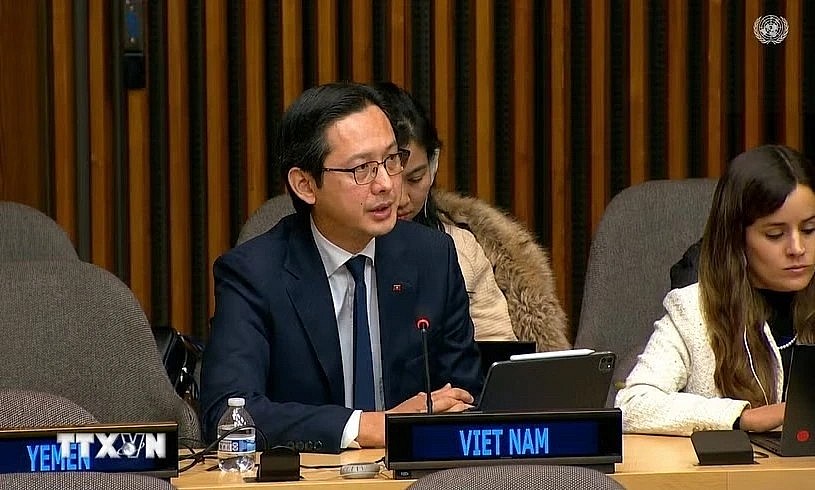 |
| Ambassador Do Hung Viet speaks at the meeting (Photo: VNA) |
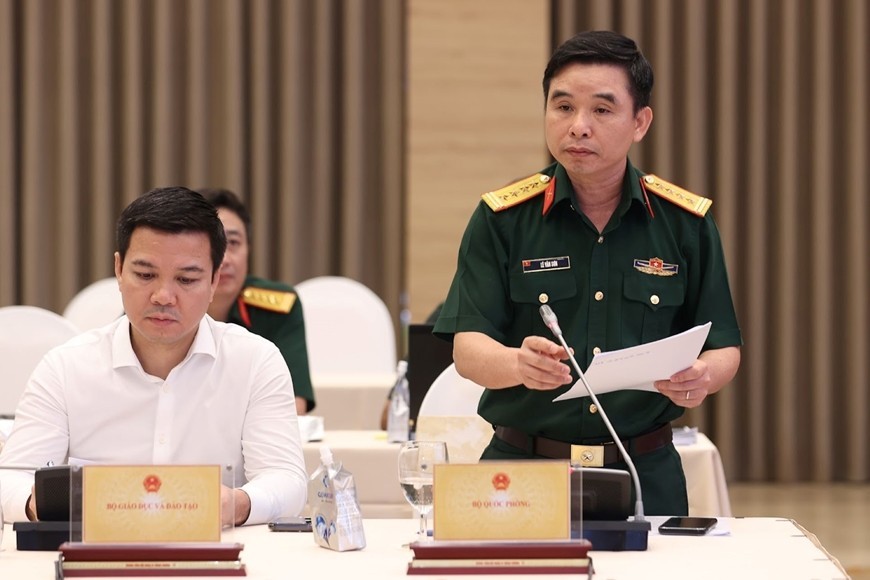
In response, Ambassador Do Hung Viet, Permanent Representative of Vietnam to the United Nations, expressed deep sympathy with the challenges facing Cuba and said Vietnam has been providing practical support in agriculture and energy to help ease difficulties for the Cuban people. He called on NAM member states to uphold solidarity, continue supporting Cuba and oppose unilateral embargoes and sanctions, while also backing dialogue between Cuba and the United States on the basis of mutual respect, for peace, stability and the interests of the people.
As the meeting coincided with the 51st anniversary of Vietnam’s reunification, the ambassador expressed appreciation for the solidarity and support extended by the Non-Aligned Movement to Vietnam during its struggles for independence and in post-war national reconstruction and development. He particularly highlighted Cuba’s steadfast support, recalling the statement by Fidel Castro: “For Vietnam, Cuba is willing to give its own blood.”
Also at the meeting, in his capacity as president of the 11th NPT Review Conference, Ambassador Do Hung Viet briefed NAM member states on recent developments, noting a complex international environment and challenges in building consensus, according to VNA.
He urged NAM members to continue playing an active role, engage in constructive dialogue and coordinate efforts to ensure the conference achieves balanced and substantive outcomes, thereby strengthening confidence in the nuclear non-proliferation mechanism.
"The Ambassador urged NAM member states to continue playing an active role, engage in constructive dialogue, and coordinate efforts to ensure the Conference achieves balanced and substantive outcomes, thereby strengthening confidence in the nuclear non-proliferation mechanism."
International Financial Center - Vietnam's strategic move in global race: Expert
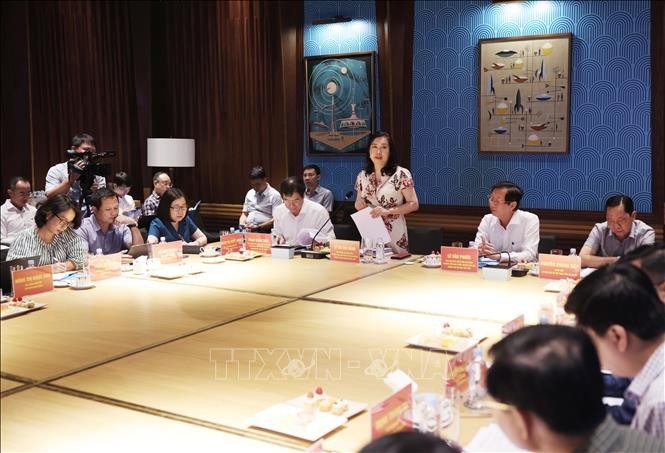
Vietnam’s decision to establish a Vietnam International Financial Center (VIFC) in Ho Chi Minh City and Da Nang marks not merely an economic project, but a significant shift in institutional reform thinking, according to Do Gia Thang, Secretary-General of the Vietnam Business Association in Australia (VBAA) and Chairman of the Vietnam–Australia Young Entrepreneurs Club.
This is an inevitable step for the country to move beyond the “middle-income trap”, and shift its growth model from processing and manufacturing toward capital flow management, financial services, and higher value-added services.
With the National Assembly’s adoption of Resolution No. 222/2025/QH15 on the VIFC, establishing special mechanisms on taxation, investment, foreign exchange, immigration and residency for investors and experts, Vietnam has sent a clear signal that it is moving beyond discussion to actively building a competitive legal framework. The VIFC could thus serve as an “institutional laboratory”, piloting breakthrough mechanisms before refining and scaling them nationwide, VNA reported.
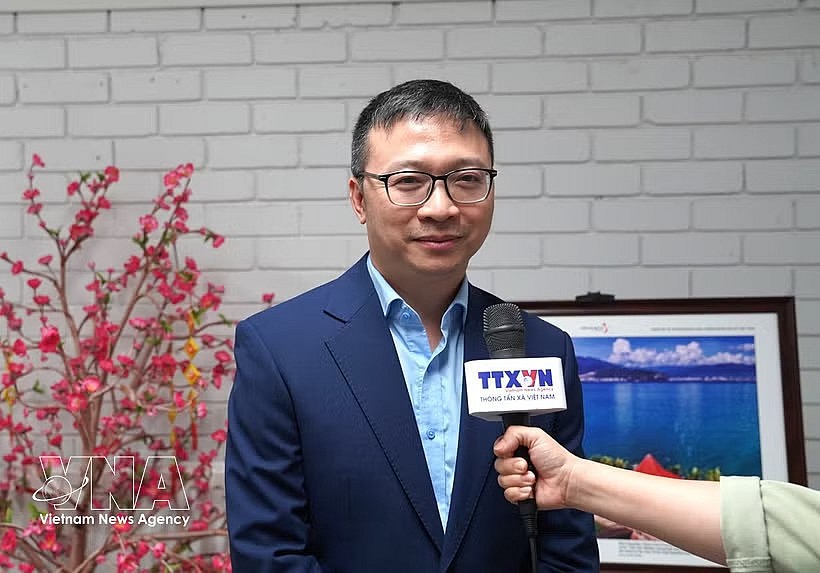 |
| Do Gia Thang, Secretary-General of the Vietnam Business Association in Australia (VBAA) and Chairman of the Vietnam–Australia Young Entrepreneurs Club (Photo: VNA) |
According to Thang, amid a global financial order increasingly reshaped by artificial intelligence, blockchain and green finance, failure to proactively engage risks relegating Vietnam to lower tiers of the value chain. Remaining on the sidelines is no longer an option; the country must help shape the rules of the game or remain confined to manufacturing and low-cost labour supply roles.
He noted that Vietnam possesses several distinctive advantages that traditional financial centers do not have.
First, in terms of geopolitical positioning and integration, Vietnam has signed 17 free trade agreements, including multiple new-generation FTAs, creating substantial opportunities in trade finance, insurance, logistics and global supply chain services.
Second, Vietnam is pursuing a “one center – two destinations” model. Ho Chi Minh City is envisioned as a comprehensive financial hub linked with a free trade zone, while Da Nang will focus on innovation, fintech, digital assets and serve as a testing ground for new financial models. This complementary structure allows Vietnam to develop a tailored approach rather than replicate existing financial centers.
Third, the country is shaping a “Seaport – Aviation – Finance” ecosystem along the Thu Thiem – Long Thanh – Cai Mep axis. The connectivity between the VIFC in Thu Thiem, Long Thanh International Airport and the Cai Mep–Thi Vai deep-water port cluster, integrated with the Cai Mep Ha free trade zone, is expected to optimise flows of capital, goods and people. This could create a strong “digital gravity”, attracting multinational financial institutions, investment funds and professional service firms to Vietnam, said the expert. However, Thang emphasised that Vietnam’s greatest challenge lies not in physical infrastructure but in the “soft infrastructure of trust”. While hard infrastructure can be built within years, investor confidence in legal, judicial and enforcement systems requires sustained effort and discipline.
He held that institutional bottlenecks remain a key constraint. Although Resolution 222/2025/QH15 provides a framework for advanced mechanisms, the broader legal system still reflects traditional regulatory thinking and has yet to fully align with international standards in complex areas such as maritime insurance, ship financing, derivatives and structured financial products. Without accelerated legal harmonisation, it will be difficult to attract global financial institutions to relocate core operations to Vietnam.
The expert also pointed to challenges in high quality human resources, adding that fragmented governance also poses risks. Overlapping mandates among ministries and local authorities could slow decision-making, a critical factor in attracting major financial investors. A strong, centralised coordination mechanism with clear accountability will be essential to ensure the VIFC’s success, he explained.
Thang noted that Vietnam is at a pivotal juncture, completing previous development goals while entering a new growth cycle. On the global financial map, the country is no longer merely an observer but an emerging contender, provided it seizes the current “window of opportunity”.
Thang highlighted three priorities: developing a regulatory sandbox for new financial models; strengthening investor protection through internationally aligned legal mechanisms; and prioritising human capital development, including attracting overseas Vietnamese and global experts.
He expressed his confidence that with appropriate policies, institutional breakthroughs and broad-based support, Vietnam has the potential to emerge as a leading aviation–finance–maritime hub in the region in the coming years.
Ho Chi Minh City attracts significant investment from France
Ho Chi Minh City is emerging as an attractive destination for French investors, particularly in infrastructure, sustainable urban development and green transition.
French investment of more than 2.2 billion USD is contributing to economic growth and opening up broader prospects for long-term cooperation.
In 2025, bilateral trade between Ho Chi Minh City and France exceeded 723 million USD. France currently has 433 projects in the city. The French business community plays a key role in innovation, high-quality services and sustainable development.
At the “Build to Last” 2026 conference, Standing Vice Chairman of the municipal People’s Committee Nguyen Loc Ha highlighted the city’s integrated and multi-sector development approach.
Priorities include resilient urban development and green transition, targeting 100% clean-energy public transport by 2030, and breakthroughs in transport and logistics infrastructure.
French Ambassador to Vietnam Olivier Brochet noted that since the two countries upgraded ties to a Comprehensive Strategic Partnership in October 2024, bilateral cooperation has deepened significantly, especially connections between Ho Chi Minh City and French partners.
French firms are active in healthcare, energy and urban solutions. Projects include a vaccine plant under a MoU signed between VNVC Vaccination Centre and France's Sanofi. Companies such as Bureau Veritas and Schneider Electric are also contributing technologies for climate resilience and smart energy systems.
City leaders reaffirmed their commitment to expanding cooperation with France in infrastructure, green finance, digital transformation and education, with a focus on metro systems, clean energy and smart urban development.
In the healthcare sector, the two sides are implementing a project to build a vaccine and biological products plant, under a memorandum of understanding between Vietnam's VNVC Vaccine Centre and France's Sanofi.
Assessing the investment environment, Ambassador Olivier Brochet noted that Ho Chi Minh City is a major destination for French businesses and a highly promising market.In the coming period, France will continue working with the business community to explore further cooperation opportunities, particularly in infrastructure, green finance, and carbon credit market development, as well as railway transport projects, especially metro systems.
Ambassador Olivier Brochet emphasised that the transition toward sustainable urban development requires participation from multiple stakeholders, including government agencies, businesses, investors, and international organizations, VNA reported.
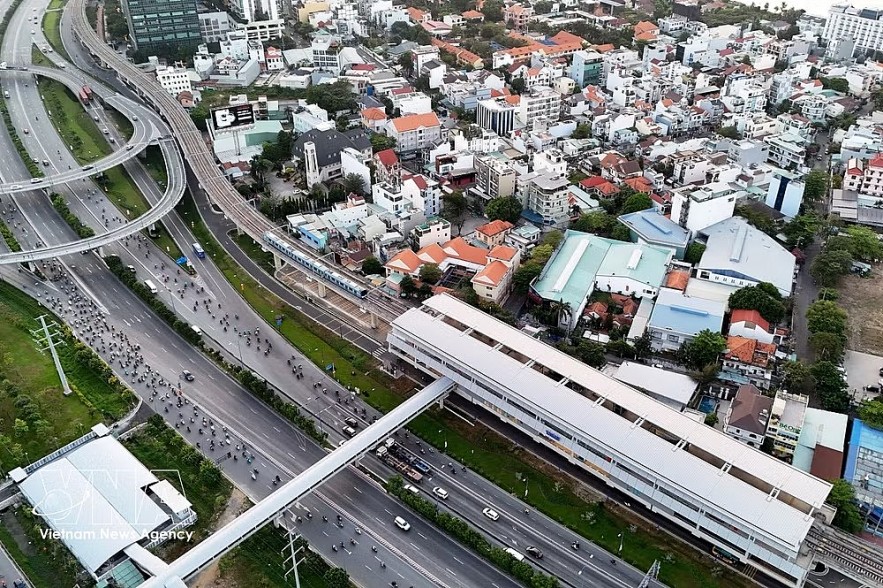 |
| A metro train arrives at Rach Chiec Station on Metro Line No. 1 (Ben Thanh – Suoi Tien). (Photo: VNA) |
France is currently supporting Vietnam through various programmes in green finance, climate adaptation, and energy infrastructure modernisation.In practice, many French companies have proactively proposed initiatives and technological solutions for sustainable urban development.
Notably, Bureau Veritas has introduced the Building Resilience Index (BRI), a tool that helps assess climate risks and recommend solutions to improve the resilience of infrastructure.In the energy sector, a representative of Schneider Electric noted that energy demand in Vietnam’s urban areas is becoming increasingly complex, requiring a transition to digital power grids capable of flexible, real-time operation.
The company reaffirmed its long-term commitment to supporting Vietnam in developing smart and sustainable energy infrastructure.
Chairman of the Ho Chi Minh City People’s Committee Nguyen Van Duoc stressed that Ho Chi Minh City aims to further strengthen cooperation with France in infrastructure, finance, high technology, digital transformation, education, and culture.
The city is particularly focused on attracting investment in key projects such as urban railways (metro systems), an international financial centre, smart urban development, and clean energy, he said, adding it also prioritises cooperation in training high-quality human resources and enhancing climate change resilience.
Building on a foundation of the longstanding friendship and the Comprehensive Strategic Partnership, along with complementary strengths and development needs, cooperation between Ho Chi Minh City and French partners as well as investment flows from France are expected to remain a key driver in transforming the city into a modern and livable metropolis.
Phu Quoc becomes leading resort destination for RoK travelers
Vietnam’s Phu Quoc island is becoming an attractive resort destination for travelers from the Republic of Korea (RoK), as visitor numbers from this market continue to rise and play an increasingly important role in the local tourism sector.
RoK media on May 2 noted that Phu Quoc, once regarded as a “hidden gem” two decades ago, is now changing rapidly, with tourism infrastructure development and the emergence of high-end resorts.
According to statistics, the RoK remains one of Vietnam’s largest sources of international visitors, with millions of arrivals each year. While Da Nang was previously a familiar destination for RoK travelers, the trend is gradually shifting southward, with Phu Quoc often described as the “Jeju of Vietnam.”
Korean cultural influences are increasingly visible on the island, from K-pop music such as Gangnam Style by Psy and “APT” by Rosé, to Korean-language signage, menus and services at many establishments.
The island’s rapid development is linked to large-scale projects by major groups such as Vingroup and Sun Group. Tourism infrastructure has been developed in a coordinated manner, including dozens of five-star hotels, entertainment complexes and a sea-crossing cable car system, contributing to improved visitor experience, cited VOV.
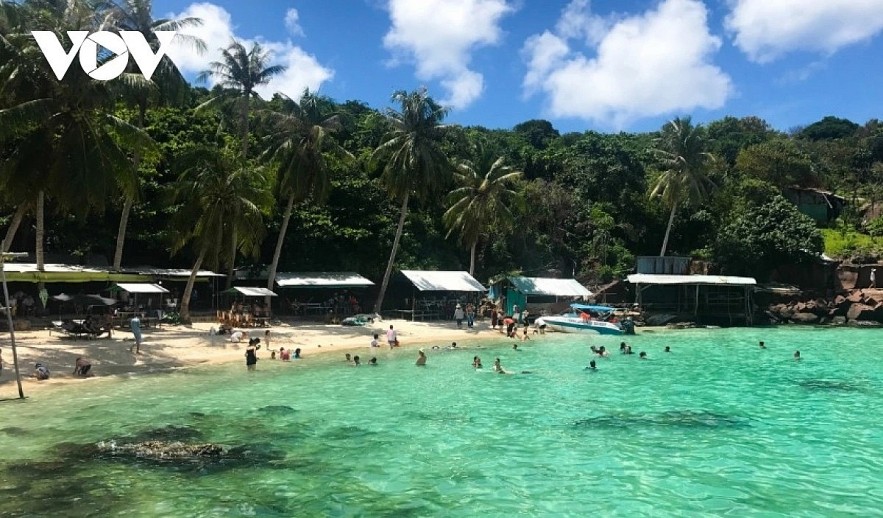 |
| Photo: VOV |
Kim Eun Jung, a tourist from the RoK visiting Phu Quoc with her husband and two children, said this was her family’s second trip to Vietnam after Nha Trang. She travelled with two former classmates, each with their own families. They chose Phu Quoc as it is considered safe and convenient for children. She added that most people she knows have already visited the island or are planning trips there this summer.
Experts in the RoK said the growth of this market plays an important role in the island’s transformation. Phu Quoc is gradually establishing itself as one of the leading resort destinations in Southeast Asia and continues to attract travelers from the RoK.
 | Vietnam News Today (Apr. 28): Vietnam, Bulgaria Step Up Tourism Promotion, Business Connectivity Vietnam News Today (Apr. 28): Vietnam, Bulgaria step up tourism promotion, business connectivity; Vietnam urges stronger nuclear disarmament ahead of NPT review conference; Can Tho ... |
 | Vietnam News Today (Apr. 29): Mongolia Always Values Ties With Vietnam Vietnam News Today (Apr. 29): Mongolia always values ties with Vietnam; Japanese PM’s Vietnam visit to elevate bilateral ties to new height; Vietnam calls for ... |