
Vietnam’s Transformation Through International Eyes
| Digital Transformation in Agriculture Requires Strength of Multi-Stakeholder Cooperation IESC Supports Vietnam in Modernizing Agriculture and Promoting Digital Transformation |
A very different Vietnam after nearly half a century
Speaking to Vietnam News Agency (VNA), Hélène Luc, Honorary President of the France-Vietnam Friendship Association (AAFV), said Vietnam entered her life when she was just 15 years old.
Born into a family with a strong anti-invasion spirit, she developed an early admiration for the Vietnamese people's struggle for independence. While participating in the French Youth Women's Union, she and other young women raised money to buy milk for Vietnamese children and knitted scarves and sweaters to send to Vietnam. In the years that followed, her bond with Vietnam continued through her political activities.
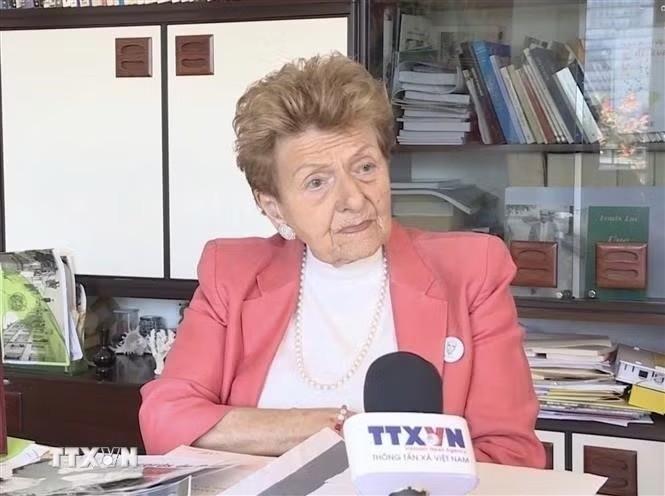 |
| Hélène Luc, Honorary Senator and Honorary President of the France-Vietnam Friendship Association (AAFV). (Photo: VNA) |
It was not until 1978 that she saw for the first time, with her own eyes, the country she had spent many years supporting. Vietnam had just emerged from war and was still facing shortages of food, medical equipment and many essential goods. She recalls that meat was transported by bicycle, ballpoint pens were refilled with ink for continued use, clothing was scarce, and bicycles were the main means of transportation for much of the population. At an orphanage whose reconstruction was supported by the city of Choisy-le-Roi, the children were kept clean and well cared for, but each meal consisted of only a small piece of meat.
When she returned to Vietnam in 2013 and 2015, she felt as though she was no longer visiting the same country she had once known. The small military airport in her memories had been replaced by a modern airport, connected to the city center by a broad boulevard. By 2023, she was once again surprised by changes in people's daily lives and the abundance of goods.
What also impressed her was the dynamic spirit and entrepreneurial drive of Vietnamese people, both among the younger generation and older people. She also regarded the high proportion of people connected to the Internet as a sign of progress in technology and digital life.
According to VOV, at a ceremony marking Vietnam's 81st National Day in Sydney, Australia, on August 26, Associate Professor Quan Vuong of the University of Technology Sydney said that, through his work with Vietnamese universities and colleagues, he had observed that Vietnam was changing rapidly, with research capabilities and infrastructure continuously improving. In his view, the growing bilateral relationship, underpinned by the Comprehensive Strategic Partnership, was also opening up new opportunities that would benefit the people of both countries.
Ben Franklin, President of the Legislative Council of New South Wales, spoke highly of the changes and achievements Vietnam has made after 40 years of Doi Moi (Renewal), adding that Australia was proud to have accompanied Vietnam along part of this journey.
Research, technology and new opportunities for cooperation
Having followed Vietnam for many decades, Hélène Luc said she regularly reads the Vietnamese press and takes an interest in the country's development goals. She described the achievements made as highly impressive and said that science, high technology and digital technology would play an important role in achieving development objectives and improving people's living standards. In her view, France has an interest in strengthening cooperation with Vietnam in science, economics, culture, healthcare and defense, while also recognizing Vietnam in line with its current position.
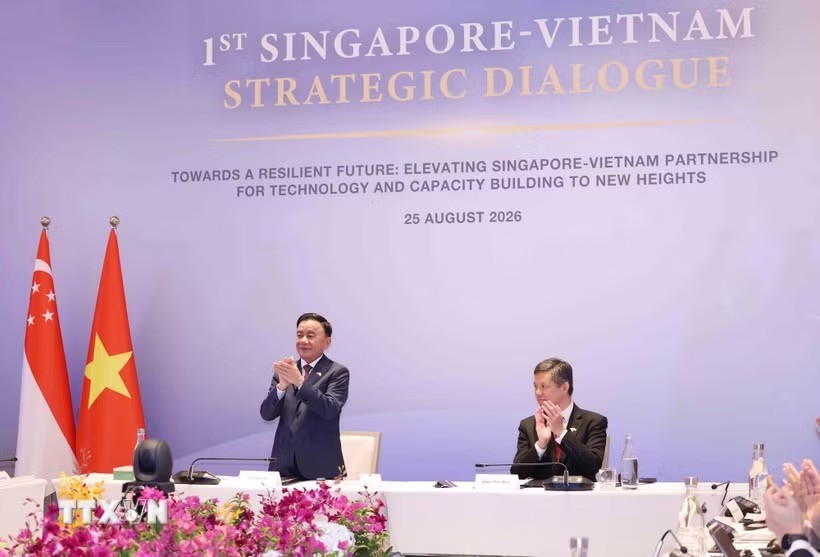 |
| Politburo member and Permanent Member of the Party Central Committee's Secretariat Tran Cam Tu and Chan Chun Sing, Deputy Secretary-General of Singapore's People's Action Party, Minister for Defence and Minister-in-charge of Public Services, co-chaired the first Vietnam-Singapore Strategic Dialogue. (Photo: VNA) |
These areas are also becoming increasingly prominent in cooperation between Vietnam and its partners.
At a ceremony marking Vietnam's National Day in Singapore on August 24, Chan Chun Sing, Deputy Secretary-General of Singapore's People's Action Party, Minister for Defence and Minister-in-charge of Public Services, said Vietnam-Singapore cooperation was expanding to include supply chain resilience, food security and advanced manufacturing.
The year 2026 marks the 30th anniversary of the Vietnam-Singapore Industrial Park (VSIP) initiative. According to Chan Chun Sing, the VSIP 2.0 model aims to develop green and smart industrial parks and is expected to attract investment in science and technology, innovation and digital transformation.
 Vietnam Targets Breakthroughs in Strategic Technology Development Vietnam Targets Breakthroughs in Strategic Technology Development After more than one year and eight months of implementing Resolution No. 57-NQ/TW of the Politburo, science and technology, innovation, and digital transformation have seen clear changes in awareness, institutions, and implementation. The Ministry of Science and Technology has identified its key focus through the end of 2026 as making a strong shift from institutional development to creating concrete products, technologies, and results. |
 New Financial Mechanism to Unlock Strategic Technology Breakthroughs New Financial Mechanism to Unlock Strategic Technology Breakthroughs The new financial mechanism for strategic technology research and development allows the Chief Engineer to receive remuneration of up to VND 300 million per month. It also provides for funding management based on work packages and evaluation milestones, while granting greater autonomy to implementing organizations. |

Most read


Related Stories
 Handbook
Science and Technology Key to Viet Nam’s Sustainable Growth
 Friendship
Viet Nam’s Key Strength Lies in Its People
 Friendship
Digital Transformation to Enhance Cooperation with International Organisations
 National
Vietnam News Today (Sep. 9): Prime Minister Le Minh Hung to Attend 18th BRICS Summit in India
Recommended
 Friendship
A Misfortune Turned into Happiness
 Friendship
Hai Phong: Vietnamese and International Melodies Foster Friendship
 Friendship
I Was Never Just Passing Through Viet Nam
 Friendship
Strengthening People-to-People Exchanges, Nurturing Viet Nam-RoK Friendship
Popular article
 Friendship
More Than VND 1.46 Billion Supports School Meals for Children in Quang Tri
 Friendship
HCMC Promotes People-to-People Diplomacy to Mobilize International Resources
 Friendship
Some Volunteers Cannot Hold Back Their Tears When Saying Goodbye to Viet Nam
 Friendship