
51 Years of National Reunification: From Aspiration for Peace to Responsible Nation
 | Vietnam’s 50-year Reunification Celebration Garners Argentine Press’s Attention |
| Global Vietnamese Community Celebrates 50 Years of Reunification with Pride |
A New Role
Nearly four decades after reunification, Vietnam has taken on a new role: participating in United Nations peacekeeping operations.
In 2014, Vietnam’s first officers were deployed to UN missions. More than a decade later, that presence has expanded in both scale and scope. According to the Vietnam News Agency, Major General Pham Manh Thang, Director of the Vietnam Department of Peacekeeping Operations, stated that from May 2014 to the present, the Ministry of National Defence has deployed more than 1,300 officers and professional soldiers to UN peacekeeping missions, both as individuals and as formed units.
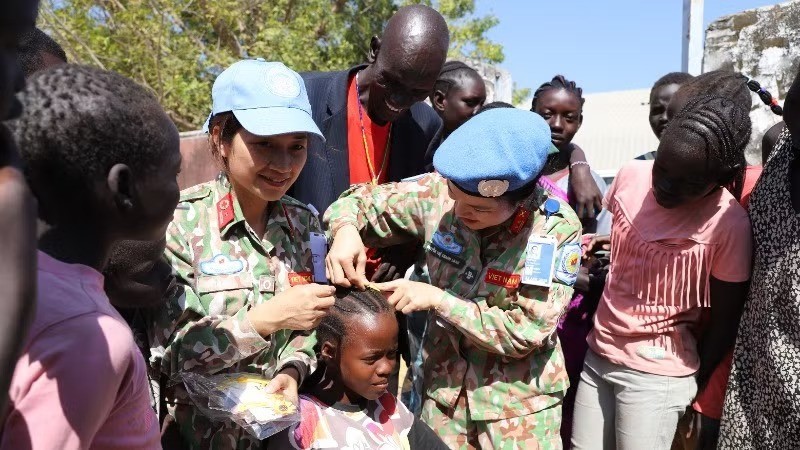 |
| Vietnamese “blue helmets” are consistently friendly, approachable, and well-regarded by local communities. (Photo: Engineering Unit) |
According to statistics from the Vietnam Department of Peacekeeping Operations, 149 military officers have been deployed to three UN peacekeeping missions (UNMISS, MINUSCA, UNISFA), as well as to the United Nations Headquarters in the United States, the UN Liaison Office in Belgium, and the European Union Training Mission.
At the unit level, Vietnam has deployed seven Level-2 Field Hospitals to South Sudan and four Engineering Units to Abyei.
Despite difficult conditions, Vietnam’s “blue helmet” forces have upheld the qualities of “Uncle Ho’s soldiers,” building and maintaining strong relationships with local communities and authorities. They have earned goodwill, trust, and respect through practical support activities that improve people’s lives, such as road construction, teaching, agricultural guidance, building school furniture, constructing homes and classrooms, drilling wells, donating generators, providing medical examinations and treatment, distributing face masks for disease prevention, and offering free medicines. This humane, community-oriented approach by the Vietnam People’s Army has been recognized by mission commanders and UN leaders as an innovative and exemplary model, described as a “breath of fresh air” in UN peacekeeping operations.
Nhan Dan Newspaper quoted Jean-Pierre Lacroix, United Nations Under-Secretary-General, as saying: “In recent years, Vietnam’s participation in peacekeeping operations has increased. I am very proud to witness and contribute to this development.”
He affirmed that Vietnam has demonstrated a strong commitment to the United Nations in general and to peacekeeping operations in particular. Vietnamese officers possess the skills, adaptability, and capability to perform effectively, even in extremely challenging environments.
Aspiration for Development
After reunification, Vietnam faced countless difficulties: severely damaged infrastructure, an exhausted economy, and extremely challenging living conditions for its people. Yet from these hardships, Vietnam chose a path of reconciliation, unity, self-reliance, and aspiration for advancement.
A major turning point came with the launch of the Doi Moi reforms in 1986, opening up new space for economic development. According to the Vietnam News Agency, from a GDP of less than USD 2 billion in the mid-1980s, Vietnam has now reached over USD 514 billion, ranking 32nd in the world. GDP per capita has reached USD 5,026, more than 1.4 times higher than in 2020, placing Vietnam among upper-middle-income countries.
For many consecutive years, Vietnam has maintained stable GDP growth at an average rate of 6-7% annually, despite major global economic fluctuations.
Even during challenging periods such as the 2008 financial crisis and the COVID-19 pandemic, Vietnam’s economy demonstrated strong resilience. In 2025, GDP grew by 8.02%, placing Vietnam among the fastest-growing economies in the region and the world.
Vietnam has become a major exporting nation, with total trade turnover in 2025 reaching a record of over USD 930 billion and a trade surplus of USD 20.03 billion, marking the tenth consecutive year of trade surplus.
Vietnam has also become an attractive destination for foreign investors. As of December 31, 2025, the country had 45,416 valid foreign direct investment (FDI) projects with total registered capital of approximately USD 529.6 billion. Tourism has strongly recovered, welcoming more than 21 million international visitors in 2025.
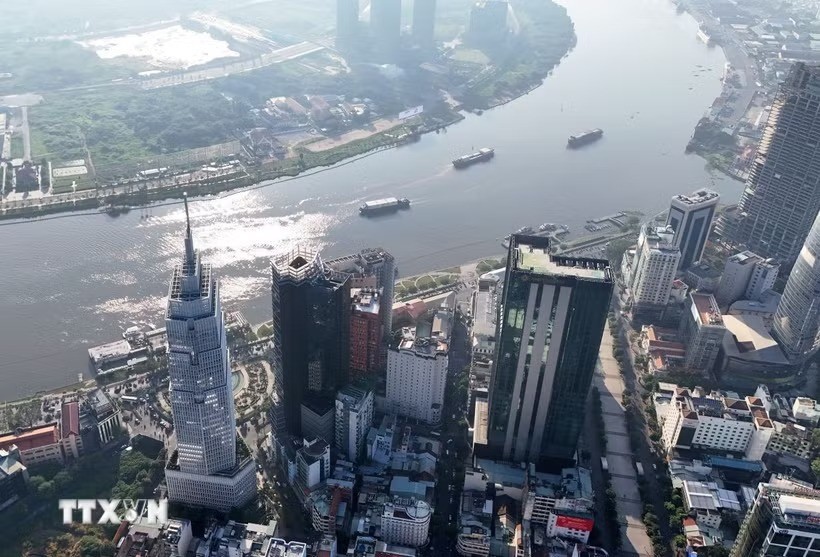 |
| Financial buildings in central Ho Chi Minh City along the Saigon River, opposite the Thu Thiem Peninsula, An Khanh Ward. (Photo: VNA) |
Alongside economic development, Vietnam has promoted international integration. It is among the few countries in the world that have established diplomatic relations with all United Nations member states. Vietnam maintains trade relations with more than 200 countries and has signed over 100 trade agreements, including CPTPP, EVFTA, and RCEP, contributing to economic growth, trade expansion, and foreign investment attraction.
At the multilateral level, Vietnam is currently a member of more than 70 major international organizations and forums, such as the United Nations, ASEAN, APEC, and the WTO. Participation in these organizations not only helps Vietnam access international standards but also enables it to contribute to shaping global policies, particularly in areas such as peace, security, sustainable development, and climate change. Through this, Vietnam has gradually built the image of a proactive, active, and highly responsible member of the international community.
Notably, Vietnam-US relations are widely recognized by the international community as a typical model of post-war reconciliation and relationship-building. Since normalization in 1995, the two countries established a Comprehensive Partnership in 2013 and upgraded to a Comprehensive Strategic Partnership in 2023. The US is now one of Vietnam’s largest trading partners, with export turnover exceeding USD 100 billion. Political and diplomatic cooperation continues to be strengthened, while cooperation in defense and security, science and technology, education and training, healthcare, culture, and tourism has seen remarkable progress.
These developments reflect a consistent principle in Vietnam’s foreign policy: putting the past behind, respecting differences, and striving toward cooperation and development.
 | Festive Hanoi: Dynamic Blend of Culture, Heritage, and Travel Experiences Awaits Visitors With a diverse lineup of events and innovative travel products, the capital’s tourism sector is striving to reinforce its image as a safe, friendly, and ... |
 | Foreign Diplomatic Missions in Vietnam Extend Congratulations on 51st Anniversary of Liberation of the South and National Reunification On the occasion of the 51st anniversary of the Liberation of the South and National Reunification (April 30, 1975 - April 30, 2026), numerous foreign ... |
Related Stories
 National
Vietnam News Today (May 7): Vietnam Commits to ASEAN Community-Building Process
 National
Foreign Diplomatic Missions in Vietnam Extend Congratulations on 51st Anniversary of Liberation of the South and National Reunification
Recommended
 Viet's Home
Vietnam Allocates VND 50 Billion to Lai Chau for Post-Flood Recovery
 Viet's Home
Da Nang Contributes VND 1 Billion to Quang Tri's Gratitude Fund
 Viet's Home
Vietnamese Intellect Showcased at International Economics Olympiad 2026
 Viet's Home
Hanoi Steps Up Care for People with Meritorious Service
 Viet's Home
Lai Chau Calls for Support to Help Residents Recover from Flood Damage
 Viet's Home
Vietnam to Host Its First International Olympiad in AI
 Viet's Home
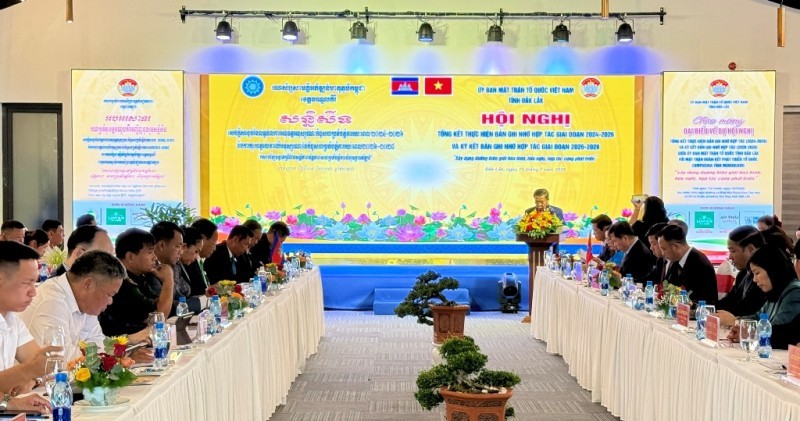
Dak Lak, Mondulkiri Sign Memorandum of Understanding for Cooperation
 Viet's Home