
Homes Rebuilt After the Natural Disaster
 | US's NGO Builds Climate Resilient Homes in Tra Vinh Province |
| Japanese Investors Learn More About Vietnamese Property Market |
These days, the family of Tran Van Khanh, 75, from Phu Huu Hamlet, Hoa Thinh Commune, has gradually settled into their newly rebuilt home after the floods late last year. Essential household items such as a gas stove, refrigerator, tables, and chairs have also been repurchased.
Only a few months ago, the area was still covered in mud, debris, and broken bricks following the floods in late November 2025. Khanh recalled that afternoon when river waters rose rapidly, surging violently into the house amid howling winds and relentless waves crashing against the walls. “Before we could react, the house shook violently and then collapsed. It only took a few minutes… everything was gone,” he said. Many belongings accumulated over years, along with the family’s savings, were swept away by the floodwaters. “We could not even bring out the ancestral altar,” he added.
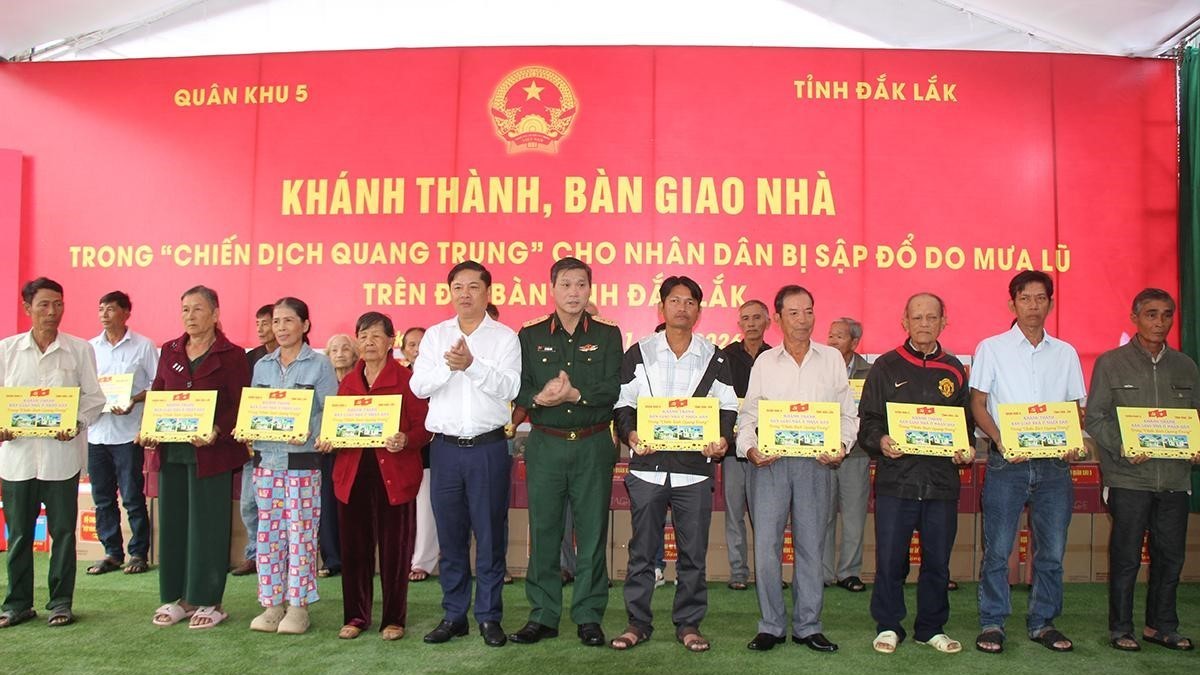 |
| Tran Van Khanh (fourth from right) at the inauguration and handover ceremony of houses under the “Quang Trung Campaign” for households whose homes collapsed or were destroyed by floods on January 4, 2026. (Photo: Dak Lak Newspaper) |
What worried Khanh most after the floods was not knowing where the money would come from to rebuild the house, especially as his health had declined and his family was already facing financial hardship. At one point, the family even considered staying temporarily with relatives through the Lunar New Year holiday.
After the “Quang Trung Campaign” was launched, military forces directly participated in the construction work, while local authorities assisted in surveying and arranging land plots. Social resources were also mobilized to purchase construction materials and rebuild homes for affected residents.
Just over a month later, Khanh’s new house was completed. During the Lunar New Year of Binh Ngo 2026, his family was able to move into the new home in time to make banh chung, rearrange the ancestral altar, and welcome the new year.
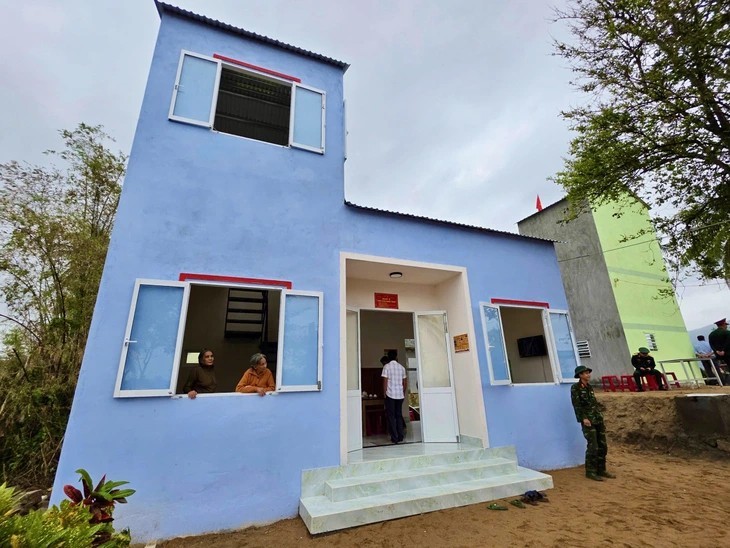 |
| Newly built sturdy houses in Hoa Thinh Commune, Dak Lak Province. (Photo: Tuoi Tre Newspaper) |
According to Le Chi Hoai, Chairman of the People’s Committee of Hoa Thinh Commune, the floods at the end of 2025 caused 28 houses in the locality to collapse completely or be swept away. Each newly built house cost approximately VND 170 million, of which the State provided VND 60 million, while the remainder was raised from various social contributions.
To ensure long-term safety for residents in disaster-prone areas, the Dak Lak Department of Construction designed three flood-resistant house models with an area of around 44 square meters each. All houses were built with elevated flood-resistant floors raised between 0.2 and 0.5 meters above expected flood levels. Many houses were also equipped with attic shelters where residents could move their belongings when necessary.
With new homes in place, many families later used additional support funds to repurchase household items, restore worship spaces, and gradually stabilize their lives after the disaster.
For the houses to be completed in just over a month, damage assessments, relief mobilization, and resource allocation were carried out almost simultaneously from the grassroots level. At the conference reviewing the “Quang Trung Campaign” in January 2026, leaders of the Central Committee of the Vietnam Fatherland Front stated that immediately after the campaign was launched, the Vietnam Fatherland Front directed and coordinated with socio-political organizations and mass associations to establish volunteer task forces to help residents evacuate, repair, and rebuild homes, while also supporting the forces participating in the campaign.
At the same time, the Standing Board of the Central Committee of the Vietnam Fatherland Front instructed Front committees in provinces, especially those heavily affected by storms and floods, to urgently coordinate with local authorities and relevant agencies to review and accurately compile statistics on households whose homes had been damaged or destroyed. The Front also exercised effective supervisory functions during the construction and repair process, while proactively mobilizing, receiving, and distributing relief resources in a transparent, public, and targeted manner.
From November 21, 2025 to January 10, 2026, through the Central Relief Mobilization Committee, the Front received more than VND 700 billion in donations to support residents in the Central and Central Highlands regions in overcoming the consequences of storms and floods. These resources were later allocated to localities to support house construction and repairs, as well as help stabilize the lives of affected residents.
According to the Vietnam Fatherland Front, the review and cross-checking of support beneficiary lists were conducted simultaneously in order to minimize duplication or the omission of households facing hardship.
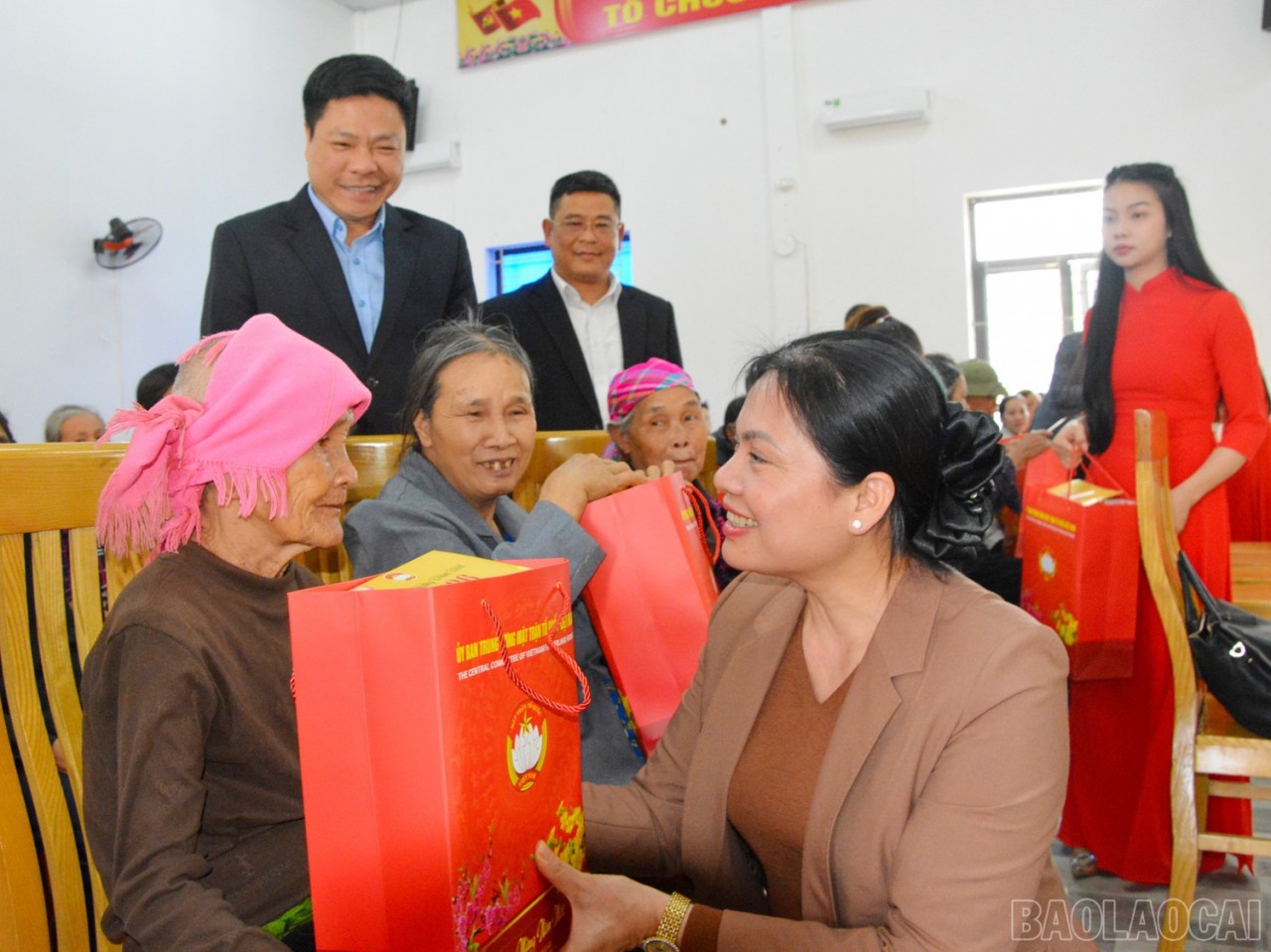 |
| Ha Thi Nga, member of the Party Central Committee and Vice President-General Secretary of the Central Committee of the Vietnam Fatherland Front, visited and presented Lunar New Year gifts in Chau Que Commune on the occasion of the Binh Ngo Lunar New Year 2026. (Photo: Lao Cai Newspaper) |
The Vietnam Fatherland Front has also consistently carried out social welfare activities through various programs aimed at supporting poor people, vulnerable groups, and disadvantaged individuals.
During the Binh Ngo Lunar New Year 2026, the Standing Board of the Central Committee of the Vietnam Fatherland Front implemented a program to visit and present gifts to poor and disadvantaged people in many localities, distributing approximately 30,000 gift packages.
According to Cao Xuan Thao, member of the Presidium and Head of the Social Affairs Department of the Central Committee of the Vietnam Fatherland Front, as natural disasters become increasingly complex, social welfare efforts must be practical, effective, and measurable. The Front is currently studying the development and operation of a digital social welfare map to update support needs and risk levels in each locality, thereby enabling faster mobilization and coordination of assistance in emergency situations.
| Some social welfare achievements of the Vietnam Fatherland Front In 2024, more than VND 5.3 trillion was mobilized to support people affected by Typhoon No. 3 (Yagi). In 2025, more than VND 4.2 trillion was mobilized to support people affected by Typhoon No. 10 (Bualoi) and flooding in Central Vietnam. Together with the Government, ministries, sectors, and local authorities, the Front contributed to completing the elimination of temporary and dilapidated housing nationwide four months ahead of schedule, removing 334,234 makeshift and deteriorated houses while mobilizing more than VND 24.7 trillion and over 2.7 million working days in support. The target of building 5,500 “Great national solidarity” houses for ethnic minority communities and poor households in Dien Bien Province and several Northwestern provinces was completed ahead of schedule. |
 | Prime Minister Allocates 4.56 Trillion VND to Eradicate Dilapidated Homes The Prime Minister has decided to allocate 4.557,773 trillion VND for localities to implement a program to eliminate temporary and dilapidated houses for poor and ... |
 | Rebuilding Homes in Storm-hit Areas to be Completed Before January 15, 2026 Along with repairing and rebuilding houses, Prime Minister Pham Minh Chinh requested support to ensure the provision of essential services and basic necessities for households ... |



Most read

Related Stories
 National
Party Committee of the Viet Nam Fatherland Front and Central Mass Organizations: Accelerate Organizational Streamlining and Digital Transformation in Second Half of Year
 National
Vietnam Fatherland Front Launches “Month of Listening to the People”
 National
President of Vietnam Fatherland Front Central Committee Extends Vesak 2026 Greetings
 Viet's Home
Oldest and Youngest Delegates Share Expectations for the Vietnam Fatherland Front Congress
Recommended
 Viet's Home
Portugal Crowned Champion of 2026 Da Nang International Fireworks Festival
 Viet's Home
Ca Mau Enhances Capacity of Officials to Effectively Mobilize International Aid
 Viet's Home
Over 50 Calls and Messages Help Search for Fallen Soldiers at Tan Son Nhat Airport
 Viet's Home
Palestinian Ambassador Saadi Salama Awarded "For the Cause of Culture, Sports and Tourism" Medal
Popular article
 Viet's Home
Nghe An's 500-Day and Night Campaign Collects 17,831 DNA Samples
 Viet's Home
GNI Supports Housing Improvements for Five Sponsored Children in Tuyen Quang
 Viet's Home
More than 1,300 Fallen Soldiers' Remains Recovered After 111 Days of Campaign
 Viet's Home