
Amendments and Supplements to the Charter of the Viet Nam Union of Friendship Organizations
| Ensuring French Resources Continue to Contribute to Viet Nam Continuing Tradition, Writing Next Chapter of Success in Nation’s New Era of Development |
Presenting the report on the amendments and supplements to the Charter, Vice President of the Viet Nam Union of Friendship Organizations Dong Huy Cuong said the current Charter, adopted by the 6th National Congress in 2019 and approved by the Prime Minister in 2021, has provided an important basis for the Viet Nam Union of Friendship Organizations to effectively fulfill its tasks during the past term. Against the backdrop of a rapidly changing world and important policy decisions adopted by the 14th National Party Congress, the Viet Nam Union of Friendship Organizations and its member organizations at the central and local levels have been given greater room for development while also facing increasingly demanding requirements.
According to Dong Huy Cuong, the names of, and election procedures for, several leadership bodies of the Viet Nam Union of Friendship Organizations are no longer consistent with the new regulations of the Party and State. Therefore, amendments and supplements to the Charter of the Viet Nam Union of Friendship Organizations are necessary.
The amended and supplemented Charter retains its nine chapters and adds two articles compared with the current Charter, increasing the total number of articles from 32 to 34.
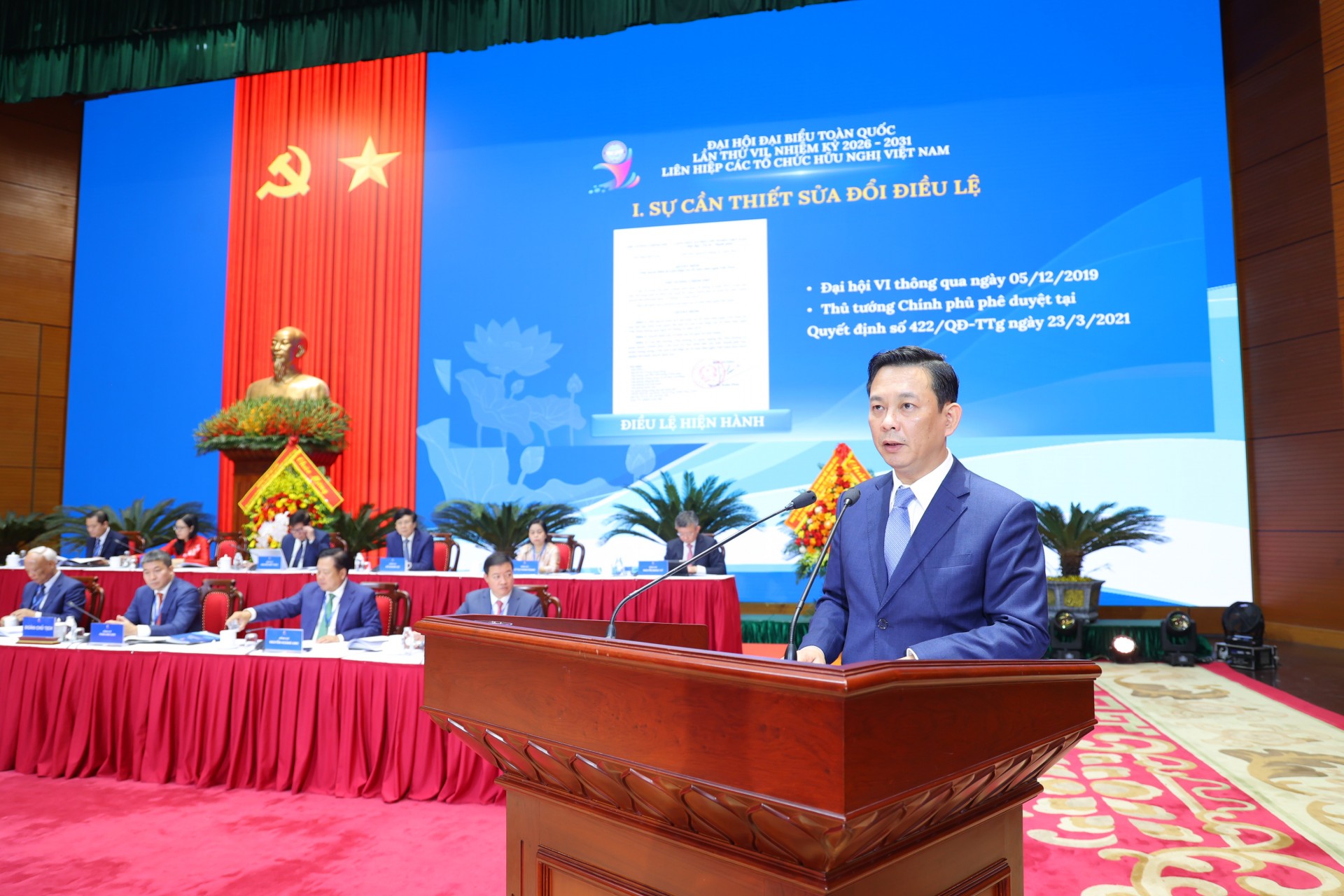 |
| Vice President of the Viet Nam Union of Friendship Organizations Dong Huy Cuong presents the report on amendments and supplements to the Charter. (Photo: Dinh Hoa) |
The first notable change concerns the name of the leadership body of the Viet Nam Union of Friendship Organizations between two congresses, which is changed from the “Presidium” to the “Executive Committee.” The functions and powers of the Executive Committee are also revised to align with the new provisions of Decree No. 126/2024/ND-CP.
The draft Charter also removes the position of “Vice President and Secretary General.”
The election procedures for the Inspection Committee and its Head are also revised. Instead of the Inspection Committee being elected by the National Congress and its Head being elected by the Inspection Committee, as is currently the case, the draft stipulates that both the Inspection Committee and its Head shall be elected by the Executive Committee.
These changes are intended to align the terminology, organizational model, and personnel procedures with current regulations.
The draft also increases the limit on the number of additional members that may be elected to the Executive Committee and Inspection Committee during a term, from no more than one-third to no more than one-half of the total number of members approved by the Congress. This will enhance the ability to consolidate personnel when required by practical circumstances.
Another new provision concerns the establishment of standing units for member organizations at the central level. Accordingly, regional departments under the Office of the Viet Nam Union of Friendship Organizations will perform standing functions, assisting the Standing Committee of the Viet Nam Union of Friendship Organizations in guiding, monitoring, and supporting the activities of member organizations at the central level.
The draft also adds provisions on the Office of the provincial and municipal Union of Friendship Organizations, which will serve as a specialized body headed by the President of the respective provincial or municipal Union of Friendship Organizations. Its organizational structure will be determined by the competent local authorities in accordance with the law and local circumstances.
These two provisions provide greater clarity on the focal points responsible for supporting member organizations at the central level and establish the basis for specialized organizational structures at the local level.
More flexible and responsive day-to-day operations
The draft Charter increases the frequency of meetings of the leadership bodies. Accordingly, the Executive Committee will hold regular meetings twice a year, instead of once a year as stipulated in the current Charter. The Standing Committee will hold regular meetings every three months, instead of every six months.
The increased meeting frequency will enable the Executive Committee and Standing Committee to review and address regular matters more promptly and effectively.
The draft also adds provisions allowing meetings to be held in person, online, or in a combination of both formats. This will make working methods more flexible and better suited to the requirements of digital transformation and actual operating conditions.
The introductory section of the Charter is revised and supplemented in line with the spirit of the Resolution of the 14th National Party Congress and requirements arising from the new context. At the same time, the heading “Introduction” is removed, following the presentation adopted in the Charter of the Communist Party of Viet Nam, the Charter of the Viet Nam Fatherland Front, and those of several socio-political organizations.
In addition, the draft contains a number of detailed amendments to ensure consistency with Decree No. 126/2024/ND-CP.
 7th National Congress of Viet Nam Union of Friendship Organizations Opens Today 7th National Congress of Viet Nam Union of Friendship Organizations Opens Today |
 Sharing Common Goal, Taking Initiative Sharing Common Goal, Taking Initiative |

Most read


Related Stories
 Friendship
65 Years of the Agent Orange Disaster: Dialogue to Spur Action
 Friendship
Viet Nam Union of Friendship Organizations Wins Seven Awards in Party Ideological Foundation Protection Contest
 Friendship
Expanding Viet Nam-India Partnership Network
 Friendship
Viet Nam Union of Friendship Organizations Pays Tribute to Fallen Kazakh Military Personnel
Recommended
 Friendship
First Congress of the Dong Thap Union of Friendship Organizations for the 2026-2031 Term
 Friendship
Promoting People-to-People Diplomacy to Build a Solid Foundation Rooted in “the People’s Hearts”
 Friendship
American Friends Help Ease the Pain of Agent Orange
 Friendship
Aris Alip: The Filipino Friend Who Helped Build the TYM Fund
Popular article
 Friendship
Spreading Responsibility for Safeguarding Party’s Ideological Foundation from Viet Nam to International Community
 Friendship
DAFO Launches Activities to Promote Responsible Business Practices
 Friendship
Seoul (Republic of Korea) Expands Employment Support for Vietnamese International Students
 Friendship