Chasing rare “Ring of Fire” annular solar eclipse in Africa and Asia
Astronomy lovers in Africa, Arabian Peninsula, India, and southern China grasped moments of the most magnificent “Ring of Fire” annular solar eclipse in years this Sunday.
Among four kinds of solar eclipse namely annular, total, partial, and hybrid, the annular solar eclipse may be considered as the most exciting one. It happens when the Moon is farthest away from Earth in its orbit, and therefore it does not quite cover the sun’s disk completely, according to the Science Alert. Annular eclipses occur every year or two, and can only be seen from certain regions across the planet.
Sunday’s annular eclipse coincides with the northern hemisphere’s summer solstice when Earth’s north pole is tilted most directly toward the sun. Photograph: Ferdinand Cabrera/AFP via Getty Images
Amazingly, the eclipse on Sunday emerged on the northern hemisphere’s longest day of the year, the summer solstice, when Earth’s north pole is tilted most directly toward the sun, according to the Guardian. “The annular eclipse is visible from about 2% of the Earth’s surface,” Florent Delefie, an astronomer and the Paris Observatory, said. “It’s a bit like switching from a 500-watt to a 30-watt light bulb.”
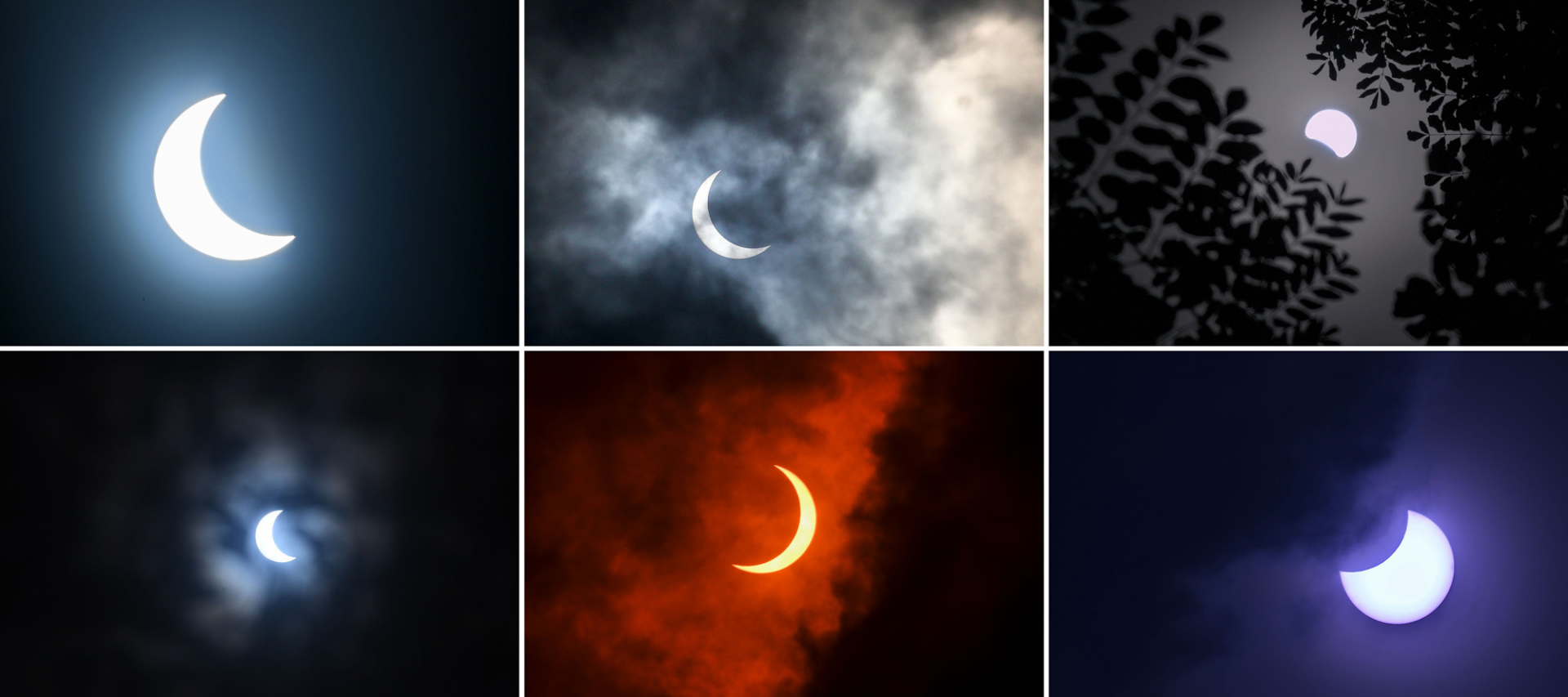
This combination of pictures created on June 21, 2020, shows the moon moving in front of the sun during an annular solar eclipse (Image credit: Jewel Samad, Manjunath Kiran, Sanjay Kanojia, Dibyangshu Sarkar, Sajjad Hussain/AFP)
On June 21, beginning in the Central African Republic, the eclipse would be visible in Congo, Ethiopia, Pakistan, and India, before crossing into China in Tibet, traversing Sichuan, Guizhou, Hunan, Jiangxi and Fujian provinces, concluding in Taiwan and the southwest Pacific Ocean, informed the Nanjinger. In Vietnam, people only can see the partial solar eclipse.
Even if the day has darkened, looking at a solar eclipse with the naked eye is dangerous [Martin Bernetti/AFP]
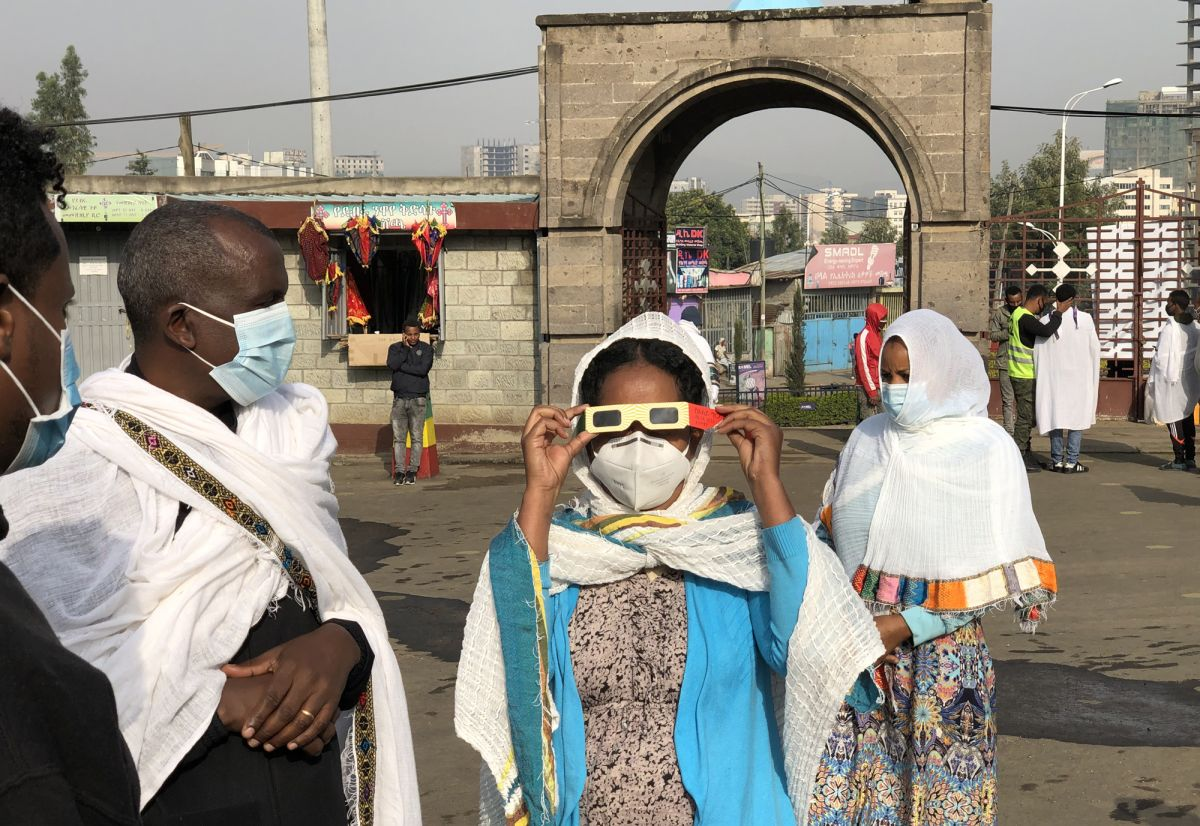
Even if the day has darkened, looking directly at a solar eclipse with naked eyes is dangerous. Sunglasses, which do not filter out ultraviolet rays, do not offer any protection, Delefie said. “The sun is so bright that even when there’s only a tiny portion visible, it is still dangerous for the eyes,” he said.
As revealed by the Space, the eclipse will appear twice in 2020. The next total eclipse will be visible throughout South America on December 15. However, until 10 June 2021, astronomy lovers around the world have chances to see the annular solar eclipse again.
People observe the annular solar eclipse with special goggles in Addis Ababa, Ethiopia on June 21, 2020. (Image credit: Minasse Wondimu Hailu/Anadolu Agency via Getty Images)
The moon moves in front of the sun during an annular solar eclipse as seen through clouds from New Delhi, India on June 21, 2020. (Image credit: Jewel Samad/AFP via Getty Images)
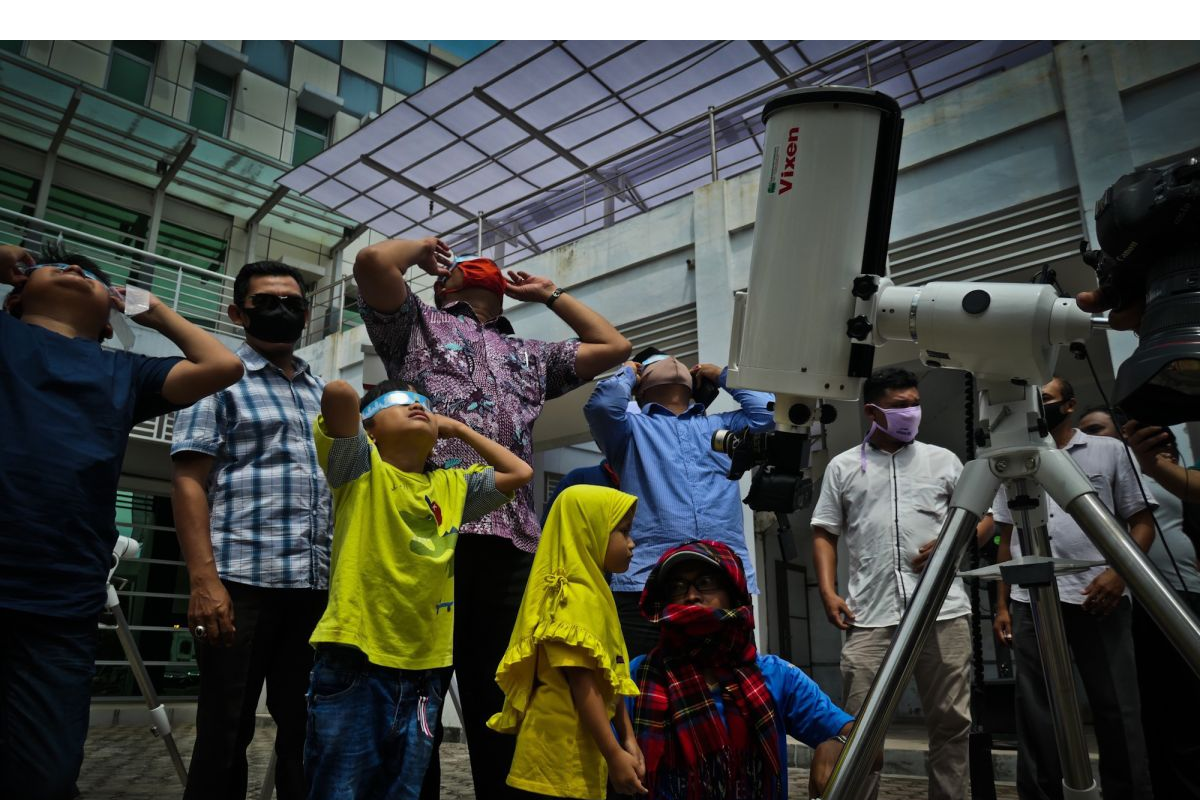
People watch an annular solar eclipse in Banda Aceh in Indonesia on June 21, 2020. (Image credit: Riska Munawarah/AFP via Getty Images)
The partial solar eclipse in Nairobi, Kenya Photo: Reuters
The solar eclipse at a Clifton beach in Karachi, Pakistan Photo: Reuters
The solar eclipse in Gandhinagar, India Photo: Reuters
In Vietnam, the moments of airplanes in front of the crescent of a solar eclipse were also captured that have astounded the netizens so far.
The natural phenomenon occurred on Sunday afternoon in Hanoi and lasted for around 2 hours. Photos were taken by Tien Tuan from To Quoc Newspaper capturing the scenes of airplanes taking off from Noi Bai International Airport and flying through the eclipse.
World news today May 7 sees athletes from 14 professional sports leagues across the globe dedicate their jerseys and uniforms to a special health care hero. Meanwhile, ...
World news today: A road bridge has collapsed in Aulla, northern Italy but fortunately, no one dies. The NHS is scrambling to get foreign-made ventilators into hospital ...
The Minister of Finance has issued Circular No. 84/2026/TT-BTC stipulating value-added tax (VAT) refunds for goods purchased in Vietnam by foreigners and overseas Vietnamese and carried with them upon exit.
On behalf of the Secretariat, Tran Cam Tu, Politburo Member and Standing Member of the Secretariat, signed and promulgated Conclusion No. 57-KL/TW, dated June 24, 2026, on the organization of activities in preparation for the 80th Anniversary of War Invalids and Martyrs Day (July 27, 1947 - July 27, 2027).
Deputy Prime Minister Pham Thi Thanh Tra has signed Decision No. 1116/QĐ-TTg dated June 22, 2026, issued by the Prime Minister, which amends and supplements Decision No. 1579/QĐ-TTg dated October 13, 2020, approving the Program on Elderly Care to 2030.
Twelve historical-cultural relics and scenic sites located in Chuong My Ward, Phuc Loc Commune, Ung Hoa Commune, and Vat Lai Commune have been officially recognized. This marks the second time this year that new heritage sites in the capital have been granted official status.
Deputy Prime Minister Pham Thi Thanh Tra signed Decision No. 1111/QD-TTg dated June 19, 2026, issued by the Prime Minister, promulgating the Plan for Organizing “Vietnam Culture Day” for the 2026-2030 period.
As part of the Hue Festival, three French photographers - Daniel Roussel, Gilbert Bertrand, and Lily Franey - will present a photo exhibition on Vietnam and its people entitled Vietnam Crossroads at the wall surrounding the University of Education, Hue University (32-36 Le Loi Street, Hue).
A free film week celebrating International Children's Day 2026 is being held nationwide from May 31 to June 7, featuring a wide range of animated and live-action films for young audiences.
Vietnam’s Ministry of Health has issued new “Guidelines on Professional Content for Periodic Health Checkups for Children Under 6 Years Old,” stipulating that children in this age group will receive health examinations at least once a year across multiple medical specialties to help detect physical, mental, and developmental issues early.


















 Viet's Home
 World
World
 Handbook
 Handbook
 Handbook
 Handbook
 Handbook
 Handbook
 Handbook
 Handbook