
Different Way to Experience Hue
| Vietnam Tourism Accelerates Towards Annual Target After Reaching 56% Ninh Binh Nominated for “Asia’s Leading Emerging Tourism Destination 2026” |
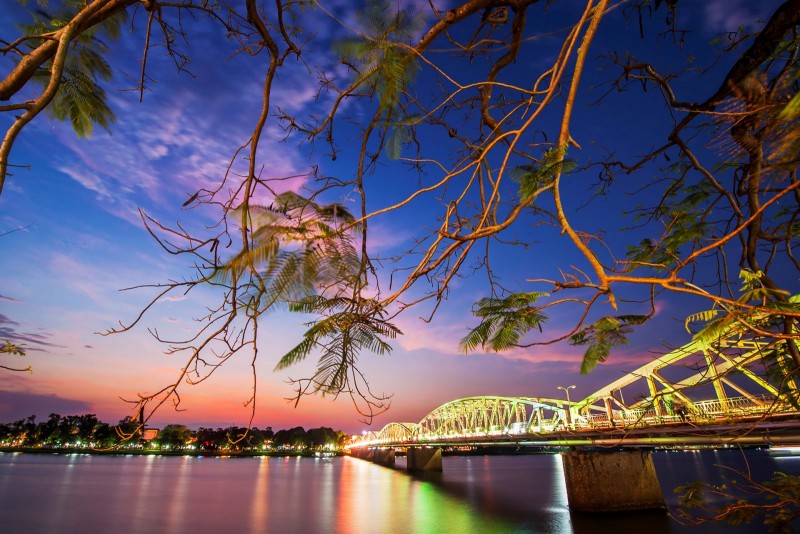 |
| The charming of Huong river. (Photo: Department of Culture, Sports and Tourism of Hue City) |
On an afternoon when the sunlight has softened, visitors can experience two contrasting moods of the Ancient capital: the tranquility at Thien Mu Pagoda and the sense of freedom while stand-up paddleboarding (SUP) on the Huong river. It is a short journey, but enough for people to understand why Hue always makes visitors want to return.
Around 3:30 p.m is an ideal time to visit one of Hue’s most famous ancient pagodas before visiting hours end. Located on Ha Khe hill, on the left bank of Huong river, the pagoda was built in 1601 during the reign of Lord Nguyen Hoang and is one of the oldest cultural and spiritual symbols of the Ancient capital.
Passing through the three-entrance gate, time seems to slow down. The seven-storey Phuoc Duyen tower - the pagoda’s most prominent architecture - rises majestically against the blue sky. From the pagoda’s yard, visitors can look down on the Huong river winding gently around the foot of the hill, flowing quietly as it has for centuries.
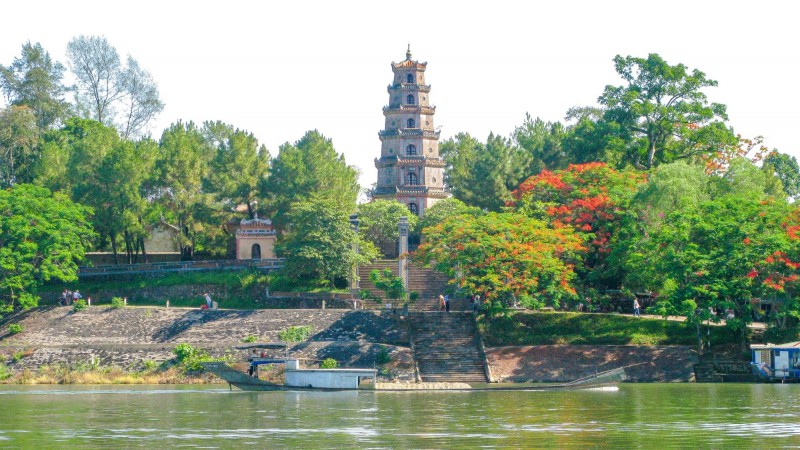 |
| Thien Mu Pagoda. (Photo: Seatimes) |
Many visitors spend nearly an hour walking through the campus, admiring the Dai Hong Chung, Dai Hung, old bonsai trees, and shaded yard. Thien Mu Pagoda is not merely a sightseeing destination but also a place to find a moment of calm amid modern life. That tranquility provides a gentle beginning to an afternoon.
At around 4:30 p.m, when the pagoda prepares to close to visitors, travellers can leave the campus and go to a nearby SUP boarding point. Within just a few minutes, the scenery changes completely. Paddle blades lightly touch the water, groups of friends laugh as they prepare their boards, and the Huong river begins to glow golden in the afternoon.
This is one of the calmest stretches of the river. With little surface disturbance and a gentle current, it is suitable even for first-time stand-up paddleboarders. After a few minutes of instruction, the board glides away from the bank, carrying paddlers into an open space surrounded by green trees, calm water, and a sky gradually turning pale orange.
The most interesting part of the experience is not covering a long distance, but in seeing Hue from an entirely different perspective. From the middle of the Huong river, Phuoc Duyen tower can be seen rising above Ha Khe hill, partly hidden behind the greenery.
As the sun gradually disappears, the Huong river surface begins to shimmer. Each paddle stroke creates small ripples that spread outward before quickly fading away. In the distance, several dragon boats drift slowly downstream, while old trees along both banks cast their shadow onto the still water. Many paddlers choose to stop for a few minutes, allowing their boards to drift gently with the current and watch the sunset - the most beautiful moment of the day on the Huong river.
 |
| People do stand-up paddleboarding on Huong river. (Photo: Lao Dong Newspaper) |
Unlike many SUP destinations that focus on challenge or physical exertion, paddleboarding on the Huong river is more about emotion and scenery. It combines gentle exercise with sightseeing. Paddlers are not only exploring the river but also experiencing Hue’s distinctive rhythm of life - slow, contemplative, but far from dull.
In recent years, stand-up paddleboarding has emerged as a new tourism product in Hue, attracting young people and visitors who enjoy outdoor experiences. Instead of simply viewing the Huong river from Truong Tien bridge or taking a boat ride while listening to Hue folk songs, many travellers now choose to stand on a small board and experience the river up close. It is also a way to discover a younger and more dynamic Hue, one that still retains the gentle charm for which the city has long been known.
 Which Vietnam’s Tourism Hotspot Are Most Searched by European Travellers? Which Vietnam’s Tourism Hotspot Are Most Searched by European Travellers? From traditional markets to emerging markets, European travellers are showing a strong preference for Da Nang and Nha Trang - two of the three most popular destinations highlighting Vietnam’s strengths in beach tourism. |
 Turning Cultural Heritage into Driver of Local Tourism and Growth Turning Cultural Heritage into Driver of Local Tourism and Growth Many localities across Vietnam have translated Resolution No. 80-NQ/TW into concrete activities to preserve and promote heritage values while linking culture tourism and economic development. |
Most read


Related Stories
 Travel
Greeting Sunrise from Thoi Loi Mountain - Unmissable Moment on Ly Son
 Travel
Reasons Behind Indian Tourists’ Shift Toward Vietnam
 Viets Home
Turning Cultural Heritage into Driver of Local Tourism and Growth
 Travel
Vietnam and Japan Promote Two-way Tourist Exchanges
Recommended
 Travel
Phu Quoc Tops Asia’s Most Beloved Islands List for 2026
 Travel
A Colorful Celebration of South Korea and Vietnam Cultures in Phu Quoc
 Travel
Routard (France) Hails Ha Long Bay’s Timeless Beauty
 Travel
Viet Nam Welcomes More Than 17.7 Million International Visitors in First Nine Months
Popular article
 Travel
Viet Nam’s Imprint at 2026 World Travel Awards
 Travel
Vietnam Welcomes 6.5 Million Tourists During National Day Holiday
 Travel
Turning Vietnamese Cuisine into Tourism Asset
 Travel