
“Extended Arms” in HIV/AIDS Prevention and Control
 | USAID, PATH Work Together to End AIDS in Vietnam |
| Vietnam to Share PrEP Treatment Experience at International AIDS Conference |
Those searching for and connecting HIV patients
Since becoming a community outreach worker and later the leader of the Hat Giong CBO group in Binh Duong Province (now part of Ho Chi Minh City following the administrative merger), Nguyen Van Thanh has grown accustomed to receiving late-night phone calls. These are often the moments when people at high risk of HIV infection, especially men who have sex with men (MSM), begin sharing their concerns after engaging in unsafe behaviors.
The Hat Giong CBO group reaches clients through social media and applications such as Blued, Facebook, Zalo, and TikTok, while also providing counseling and connecting them to HIV testing, ARV treatment, and pre-exposure prophylaxis (PrEP). Speaking to the press, Thanh said that on average, the group identifies around six HIV-positive cases each month and refers about 10 people for PrEP services.
 |
| Nguyen Cao Thanh, Head of the Hat Giong CBO Group. (Photo: VNA) |
The operating environment of community groups today is also very different from before. Instead of waiting for at-risk individuals to seek out healthcare facilities, many outreach workers now have to “search” for clients through social media platforms, dating apps, or private online groups where many young people, migrant workers, and MSM commonly connect with one another.
The “Step Into the Light” project, implemented by the Hat Giong CBO group since 2022, has organized numerous communication activities for students and young people in Ho Chi Minh City. Following these communication sessions, many participants proactively sought information about PrEP, HIV testing, and preventive treatment.
Many people only seek support after enduring prolonged stress or when unusual health symptoms begin to appear. According to community groups, the greatest challenge today is not necessarily the lack of healthcare services, but rather helping at-risk individuals overcome the fear of being judged so that they are willing to get tested or seek treatment.
Statistics from the Ministry of Health show that in 2024 alone, more than 13,300 new HIV cases were detected nationwide. HIV/AIDS is no longer concentrated mainly within a few groups as it was in the early stages, but is increasingly appearing in closed groups, hard-to-reach populations, or communities that primarily operate online.
This has made traditional mass communication approaches or waiting for people to voluntarily visit healthcare facilities less effective than before. Meanwhile, community groups have advantages in terms of closeness, confidentiality, and understanding the psychology of at-risk populations.
Many tasks once considered solely the responsibility of the healthcare system are now also being carried out with the participation of these groups, including HIV testing counseling, connecting patients to ARV treatment, supporting PrEP use, tracing people who have discontinued treatment to encourage them to return to healthcare facilities, and providing harm reduction interventions.
According to estimates by the Department of Disease Prevention, community organizations may contribute between 25% and 50% of certain HIV/AIDS prevention and control services in Vietnam.
Purchasing HIV/AIDS prevention and control services from social organizations
In Dien Bien Province, the role of community groups has been clearly demonstrated through a pilot model for procuring HIV/AIDS prevention and control services provided by social organizations.
According to the Department of Disease Prevention, Dien Bien was one of nine provinces participating in the pilot project on procuring HIV/AIDS prevention and control services from social organizations from June 2022 to November 2023. The Dien Bien Provincial Center for Disease Control (CDC Dien Bien) signed contracts with three CBO groups - Hoa Ban Trang, Huong Duong, and Binh Minh - to provide HIV/AIDS prevention and control services across the province.
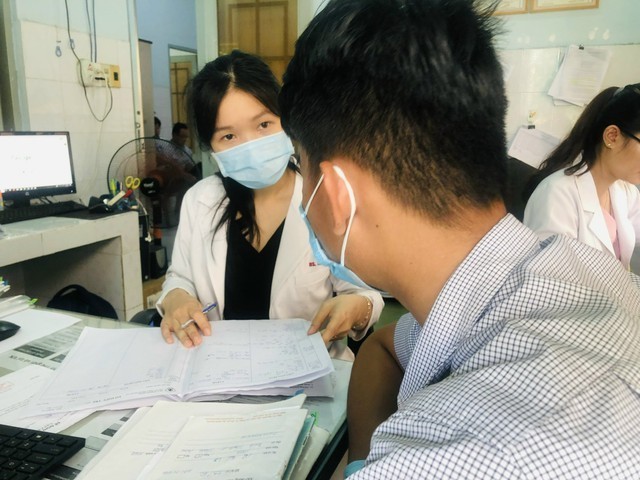 |
| Providing HIV treatment counseling for patients. (Photo: KT) |
These groups participated in community outreach, communication activities, and community-based HIV testing counseling; distributed harm reduction supplies such as clean needles and syringes, condoms, and lubricants; and referred people in need to Methadone treatment, confirmatory HIV testing, and ARV treatment services. The target groups included people who inject drugs, female sex workers, men who have sex with men, and partners of people living with HIV or people who inject drugs.
According to a report presented at the project review workshop, as of November 2023, Dien Bien had recorded a cumulative total of 7,775 people living with HIV, of whom 3,399 were still alive. HIV/AIDS cases had been reported in 121 out of the province’s 129 communes, wards, and townships. The province is also considered a key hotspot for drug use and HIV/AIDS.
Previously, most community groups operated on short-term donor-funded projects. Once those projects ended, many groups had to struggle to maintain personnel and support activities in local areas. The pilot implementation of procuring HIV/AIDS prevention and control services from social organizations demonstrates that the approach is gradually changing: communities are no longer standing outside the support network but are beginning to directly participate in service delivery at the grassroots level.
As many international funding sources for HIV/AIDS continue to shrink, mobilizing additional community resources is considered a necessary direction to reduce pressure on grassroots healthcare systems and expand access to at-risk populations.
However, the implementation process has also revealed numerous challenges. According to reports from CDC Dien Bien, many community groups lack legal status, have limited management capacity, and do not have stable sources of income to sustain operations. Reaching target populations and collecting client information also remains difficult.
Experts believe that for community groups to sustain their role in the long term, more stable financial mechanisms are needed for activities that have proven effective, such as outreach to at-risk groups, HIV testing counseling, and referrals for ARV treatment and PrEP services. At the same time, there should be greater training in professional skills, standardized information confidentiality procedures, stronger coordination with grassroots healthcare systems, and continued efforts to reduce stigma in accessing HIV/AIDS services.
 | Vietnam Leads Asia-Pacific in HIV Pre-exposure Prophylaxis Pre-exposure prophylaxis (PrEP) in Vietnam officially started in 2020, and just after three years, the cumulative number of PrEP clients has already reached 67,000, with ... |
 | Innovating Approaches to HIV/AIDS Prevention and Control Community-based HIV testing, pre-exposure prophylaxis (PrEP), multi-day Methadone dispensing, and the involvement of community groups are helping HIV/AIDS prevention and control efforts reach at-risk populations ... |
Related Stories
 Friendship
UN Women Reaffirms Cooperation with Dien Bien Province
 Viet's Home
Continuing "Journey of Sowing Green Seeds of Hope" for Children with Disabilities in Dien Bien
Recommended
 Viet's Home
Over 50 Calls and Messages Help Search for Fallen Soldiers at Tan Son Nhat Airport
 Viet's Home
Palestinian Ambassador Saadi Salama Awarded "For the Cause of Culture, Sports and Tourism" Medal
 Viet's Home
Nghe An's 500-Day and Night Campaign Collects 17,831 DNA Samples
 Viet's Home
GNI Supports Housing Improvements for Five Sponsored Children in Tuyen Quang
 Viet's Home
More than 1,300 Fallen Soldiers' Remains Recovered After 111 Days of Campaign
 Viet's Home
Integrating Local Cultural Values Into Tourism Activities
 Viet's Home
Champasak Proposes Expanded Cooperation with Can Tho Across Multiple Sectors
 Viet's Home