
India seeks 150 aircraft to replace Hawk Mk-132
 |
The requirement is for Stage-III (F) trainers, the final aircraft in the IAF’s flying-training pipeline before pilots move to operational fighters.
The new aircraft will have to bridge the gap between training and frontline operations, preparing pilots for systems such as airborne radar, electronic warfare, advanced weapons and networked combat before they transition to aircraft including the Rafale, Tejas and, eventually, the Advanced Medium Combat Aircraft (AMCA).
The IAF’s Request for Information (RFI) has been issued to Indian and overseas manufacturers, with responses due by 5 October. Trials will be conducted in India on a no-cost, no-commitment basis.
The programme is still some way from a contract. The RFI is intended to establish what aircraft are available, what manufacturers can offer in terms of technology transfer and local production, and how quickly they can deliver.
The formal Request for Proposal is tentatively planned for December 2027, followed by trials and evaluation. Deliveries are expected to be completed within 60 months of the contract taking effect.
That timetable means the successor is unlikely to enter IAF service before the mid-2030s.
Why the Indian Air Force needs a Hawk Mk-132 replacement
The Hawk Mk-132 has occupied the IAF’s advanced training slot since 2008. India contracted for 106 aircraft, with the first 66-aircraft deal signed in 2004 and a further 40 aircraft contracted from Hindustan Aeronautics Ltd (HAL) in 2010.
The Hawk became particularly important because it gave the IAF a dedicated platform between intermediate training and frontline fighters. Before its introduction, pilots faced a more abrupt transition from older trainers to high-performance aircraft.
That history is part of why the new requirement is significant.
A recent analysis by retired Air Vice Marshal Arjun Subramaniam, published by the Observer Research Foundation, traced repeated gaps in India’s indigenous training system to delays in developing replacement aircraft. He argued that instability in the availability of indigenous trainers had repeatedly disrupted the IAF’s training pipeline and increased its dependence on imported platforms.
The problem has appeared at several levels.
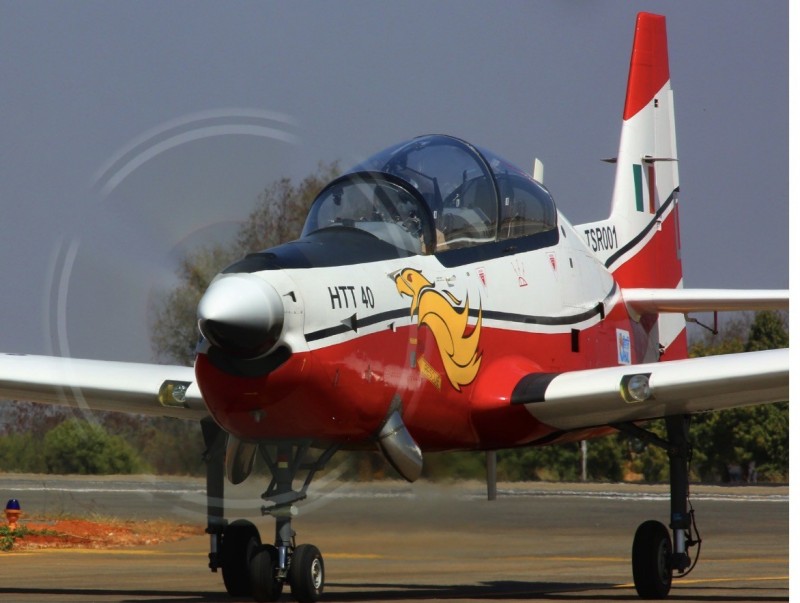
At the intermediate level, the HJT-36, originally known as Sitara and later renamed Yashas, has had an even longer development history. Subramaniam notes that the programme had accumulated more than INR40 billion ($420 million) in development expenditure while its intended role changed as the IAF’s training structure evolved.
The RFI points to a significant change in what the IAF expects an advanced trainer to do.
The aircraft is required to have fly-by-wire controls, a glass cockpit and configurable hands-on-throttle-and-stick controls. Navigation must integrate India’s NavIC satellite navigation system with GPS and GLONASS.
The aircraft must also have zero-zero ejection seats and be designed to resist departures from controlled flight, with an automatic recovery capability if the pilot releases the controls.
The more interesting requirements concern simulation.
The IAF wants embedded virtual avionics and an embedded electronic suite, allowing trainees to experience systems and threats without every training scenario requiring dedicated operational equipment. The aircraft must also be capable of simulating missile seeker heads during flight.
The trainer is expected to connect through a secure data link to a 360-degree full-motion dome simulator and scenario generator as part of a Live-Virtual-Constructive training environment. Holographic debriefing is also specified.
The intention is to make the aircraft itself part of a wider training system rather than simply a jet on which pilots practise flying.
Operational requirements are similarly demanding. The IAF wants hot refuelling and rearming in less than 30 minutes, an engine change in under an hour, AI-based predictive maintenance and an open architecture that allows future hardware and software upgrades from sources other than the original manufacturer.
India’s search also comes as the global advanced-trainer market begins to move into a new replacement cycle.


Most read


Recommended
 Economy
Dutch chipmaker Nexperia partners with India's Tata
 Economy
Viet Nam Leads Growth Projections for Major ASEAN Economies
 Economy
Strengthening Domestic Capabilities, Expanding Growth Opportunities for Vietnamese Businesses
 Economy
Viet Nam, India to Increase Trade Turnover of US $25 Billion
Popular article
 Economy
Why Climate Disaster Risk Belong in Defense Agreement
 Economy
India’s airlift power takes off with IAF’s transport modernisation
 Make in Vietnam
PCI 2.0: When Reform Is Measured by Business Growth
 Economy