
New Opportunities for Breakthroughs In Viet Nam - Canada Science and Technology Cooperation
| From Memory to the Future: Nurturing Peace, Friendship and Cooperation Expanding Opportunities for Cooperation with Foreign NGOs |
Viet Nam and Canada diplomatic ties is now upgraded to strategic partnership. It is opening up new avenues for cooperation in science, technology, and innovation, with many areas having the potential to soon transform from potential into concrete cooperation programs and projects.
According to the correspondent of the Vietnam News Agency (VNA) in Canada, after his meeting with General Secretary and President To Lam, Chairman of the Network of Vietnamese Scientists and Experts in Canada (CVSEA), Associate Professor Vu Viet Hung ((currently teaching at the Royal Canadian Military Academy) stressed that the most prominent message was the high-level leadership's appreciation for the intellectual resources of overseas Vietnamese. Vu Viet Hung believed that the guiding principle affirmed how crucial the team of Vietnamese experts and scientists abroad is. It is a resource for the development of science and technology and the process of socio-economic reform in Viet Nam.
With this orientation, CVSEA is expected to develop into a stronger network, acting as “science and technology ambassadors” in Canada, while supporting and mentoring young Vietnamese people to maintain a long-term successor workforce.
At the meeting with General Secretary and President To Lam, the need to strengthen cooperation among experts, scientists, and businesses to jointly address Viet Nam's major challenges, especially those related to strategic technologies with the potential for breakthroughs was also highlighted, Vu Viet Hung said.
Besides long-term orientations, cooperation also needs to be concretized through projects with clear results and value for all participating parties. Vu Viet Hung suggested that opportunities for this type of cooperation are present within the framework of the Viet Nam-Canada strategic partnership, where science and technology is one of the pillars of cooperation and has the potential to support many other fields such as energy, transportation, trade, investment, culture, and education.
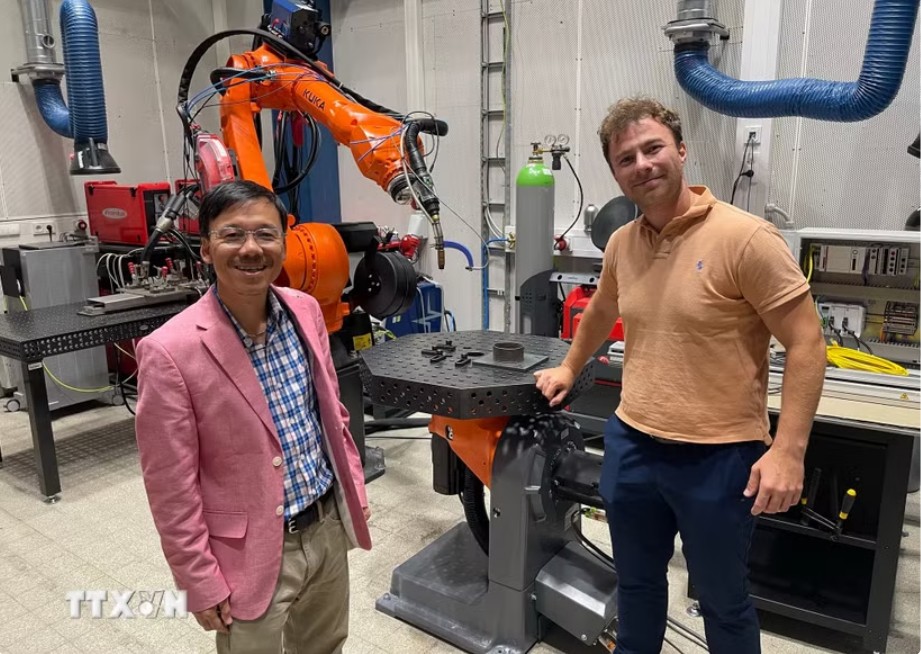 |
| The upgrading of the Viet Nam – Canada Strategic Partnership opens up new avenues for science and technology cooperation that can make breakthroughs in areas ranging from energy and digital transformation to strategic technologies (Photo: TTXVN). |
Regarding to practical implementation possibilities, Vu Viet Hung pointed out three key areas of cooperation.
Firstly, there is the issue of energy, environment, and sustainable development. Canada's significant strengths in energy, combined with Viet Nam's need to ensure energy security, provide a basis for cooperation between businesses, universities, and research institutes from both sides in developing and transferring technology in the extraction, conversion, and storage of liquefied natural gas (LNG) and hydrogen, as well as the processing and transportation of key minerals while protecting the environment.
Secondly, there is digital technology, artificial intelligence (AI), and innovation. Canada's in-depth research base, combined with Viet Nam's advantages in human resources, market, and rapid application capabilities, will help solve national problems while supporting small and medium-sized enterprises (SMEs) in innovating production and accessing the international innovation ecosystem. Innovation is also a promising area for cooperation, especially for Vietnamese universities, professional associations, and businesses seeking to access Canada's experience, models, and innovation ecosystem.
Thirdly, there are dual-use technologies related to defense and security in the aerospace sector. Potential areas of cooperation include airspace security control, maritime and island communications, aircraft manufacturing technology, low-orbit satellites, and pilot training simulation models.
In these areas, CVSEA can assume various roles, from consulting and connecting universities, research institutes, and businesses in both countries to directly participating as a partner in specific projects.
Assessing the development prospects, Vu Viet Hung noted that Canada's implementation of the Indo-Pacific Strategy and the new strategic partnership framework is creating a very favorable foundation. However, to realize the commitments, he suggested that Viet Nam needs to be more proactive in terms of financial mechanisms, create favorable conditions for businesses to participate in promoting technology commercialization, and flexibly apply the “problem-solving” mechanism based on actual needs to attract scientists and businesses from both countries to collaborate in addressing issues.
This approach can be applied to everything from scientific research and technology transfer to business collaboration. If such mechanisms are established, the scientific and technological potential within the framework of the Viet Nam-Canada strategic partnership can gradually be transformed into concrete programs, projects, and results.
 Vietnam’s AI Law to Require User Notification before AI Interactions Vietnam’s AI Law to Require User Notification before AI Interactions Internet users in Vietnam will be clearly informed before interacting with artificial intelligence (AI) systems. This is one of the important provisions in the draft Law on Artificial Intelligence by the Ministry of Science and Technology. It is expected to be submitted to the National Assembly by the end of 2025. |
 New Financial Mechanism to Unlock Strategic Technology Breakthroughs New Financial Mechanism to Unlock Strategic Technology Breakthroughs The new financial mechanism for strategic technology research and development allows the Chief Engineer to receive remuneration of up to VND 300 million per month. It also provides for funding management based on work packages and evaluation milestones, while granting greater autonomy to implementing organizations. |


Most read


Related Stories
 Economy
Viet Nam, US Seek Higher-Quality Economic Ties
 National
Viet Nam News Today (Oct. 13): EU-Vietnam Partnership Set for Deeper Cooperation and Tangible Results
 Economy
Several Factors Bolster Viet Nam's Economic Growth Prospects in 2026
 National
Vietnam News Today (Sep. 14): PM Le Minh Hung Outlines Three Major Orientations For BRICS at 18th Summit
Recommended
 Economy
PETRONAS Lubricants International and UM Motorcycles Announce Strategic Global Partnership to Power the Future of Riding
 Economy
India’s manufacturing ecosystem is undergoing a transformation
 Economy
Oxfam and VCCI-HCM Help Businesses Improve Management and Connect with Markets
 Economy
Tay Ninh and Thanh Hoa Seek Investment Partners and Market Expansion Opportunities in Bulgaria
Popular article
 Economy
Seven decades of the India-UNDP partnership
 Economy
India converts gas-fuelled plant for green ammonia
 Economy
India’s Startups Are Srengthening the Country’s Space Tech Boom
 Economy