
Overseas Vietnamese Experts and Intellectuals Join Efforts to Address Major Science and Technology Challenges
| Overseas Vietnamese in Germany Hold Ceremony Honoring Fallen Heroes and Martyrs Building Bridges Connecting Overseas Vietnamese with the Homeland |
The workshop was attended by representatives of leaders from Party committees, ministries, sectors and localities, Vietnamese representative missions abroad, research institutes, universities and businesses, as well as a large number of overseas Vietnamese experts and intellectuals and overseas Vietnamese associations and networks of experts and intellectuals, both in person and online.
Speaking at the workshop, Deputy Minister of Foreign Affairs Le Thi Thu Hang briefed participants on Politburo Resolution No. 23-NQ/TW, issued on August 2, 2026, on work concerning overseas Vietnamese. Resolution No. 23 affirms that overseas Vietnamese are not only an inseparable part of the Vietnamese ethnic community, but also one of the country’s important strategic resources, contributing to enhancing national comprehensive strength, serving as a bridge between Vietnam and the world, and accompanying and directly participating in the cause of building, developing and safeguarding the Fatherland. At the same time, the approach to work concerning overseas Vietnamese has been elevated from “mobilising, bringing together and caring for” them to “accompanying and creating mechanisms” to enable overseas Vietnamese to participate more deeply in the country’s process of integration, construction and development.
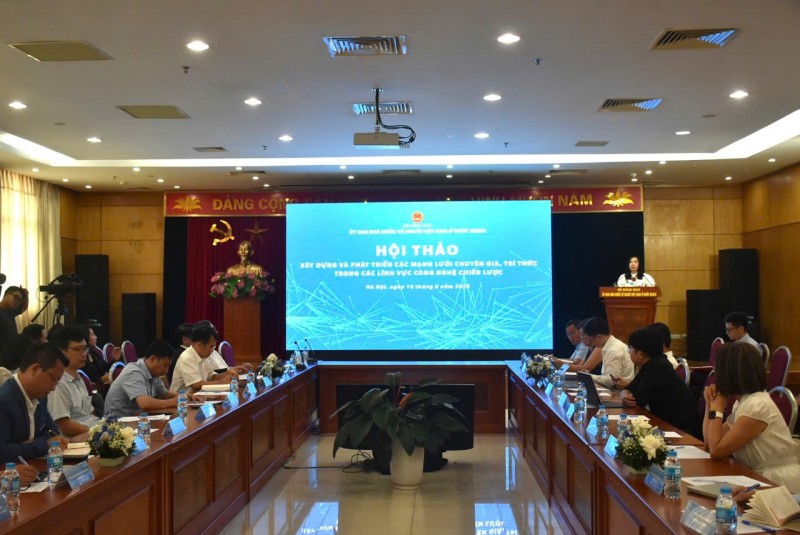 |
| Deputy Minister of Foreign Affairs Le Thi Thu Hang speaks at the workshop. (Photo: Tieu Duong) |
Deputy Minister Le Thi Thu Hang affirmed that the workshop provided a valuable opportunity for relevant parties to exchange views and seek solutions to improve the effectiveness of networks of overseas Vietnamese experts and intellectuals, with the aim of not only connecting resources but also creating concrete projects, products and collaborative outcomes to serve the country’s development.
The Deputy Minister expressed her confidence that, with the participation of state management agencies, research institutes, universities, businesses and experts from both Vietnam and abroad, the workshop’s outcomes would provide an important basis for the Ministry of Foreign Affairs and relevant ministries and sectors to effectively carry out the task of building a database and developing networks of experts and intellectuals in strategic technology fields, as directed by the Government.
The workshop featured nearly 20 presentations and contributions from delegates at home and abroad. Participants unanimously agreed that, with their extensive professional knowledge, rigorous training and rich experience working in international environments, overseas Vietnamese intellectuals constitute an important resource for the country’s development.
Delegates called for further improvements to mechanisms and policies to create more favourable conditions for the participation of overseas Vietnamese experts and intellectuals in addressing major challenges and undertaking science and technology tasks in the country. At the same time, domestic agencies and businesses need to formulate specific tasks and establish effective mechanisms for connection and commissioning so that “supply can meet demand” and “the right people can be connected with the right tasks.”
Some participants emphasised that a sustainable innovation ecosystem is often built around people who possess three characteristics: genuine professional competence, a spirit of cooperation, and a desire to create value for the community. This is particularly important for the younger generation of intellectuals. Many young scientists today are not drawn to organisations because of titles or organisational structures, but because they find in them a community that shares the same values and an open environment for learning, cooperation and creating real-world impact. It is this alignment of values, rather than administrative structures, that serves as the most sustainable bond within a knowledge network.
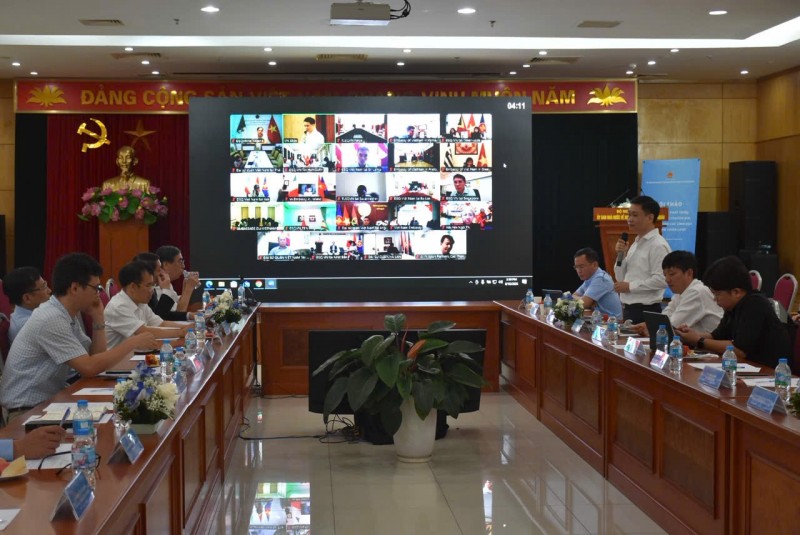 |
| Overview of the workshop. (Photo: Tieu Duong) |
Accordingly, the establishment of a network could begin with groups of leading experts in specific fields such as AI, data, quantum technology, biotechnology and cloud computing, identified based on national needs. More importantly, each network should be linked to specific tasks facing the country. When Vietnam has a problem to solve, it must know who the best Vietnamese expert in the world is in that particular field and where they are; how they can contribute; and who is responsible for connecting them with the right agency, business or project in Vietnam.
Nguyen Phuc Binh, Chairman of the Vietnam Innovation Network in Australia, said that the value of an expert network does not lie in the length of its membership list. A network of only 100 members that can mobilise 30 people to address specific challenges may be far more valuable than a list of thousands of members that fails to generate substantive activities. Therefore, the development of expert networks should not pursue quantity, but focus on finding the right people.
Binh proposed expanding joint research programmes between Vietnam and international partners in strategic technologies. Through these programmes, Vietnamese scientists living abroad could also make practical contributions to their homeland.
Through the workshop, the State Committee for Overseas Vietnamese Affairs under the Ministry of Foreign Affairs aims to further promote and strengthen the role of networks of overseas Vietnamese experts and intellectuals; create bridges for connecting and sharing information and practical experience among ministries, sectors, localities, research institutes, universities and businesses and overseas Vietnamese experts and intellectuals, in order to jointly find solutions to address some of the current “bottlenecks.” This, in turn, would create new momentum to promote the connection, attraction and mobilisation of the expertise and contributions of overseas Vietnamese experts and intellectuals to the country’s development and nation-building efforts in the new era of development.
| Each representative mission should become a hub connecting Vietnamese resources in its host country Also on the afternoon of August 10, Ngo Trinh Ha, Deputy Chairman of the State Committee for Overseas Vietnamese Affairs, chaired a press briefing on Resolution No. 23-NQ/TW. At the briefing, Ngo Trinh Ha said that building a sustainable ecosystem for overseas Vietnamese intellectuals, experts, entrepreneurs, scientists, artists and younger generations was a major new feature of Resolution No. 23. Accordingly, four main networks will be established. The first is a network of intellectuals and experts in key fields that meet the country’s development needs, based on the 10 strategic technology sectors that have been identified. The second is a network of overseas Vietnamese entrepreneurs and investors linked to the country’s development opportunities. The third is a network of artists, influencers and prominent individuals within overseas Vietnamese communities, contributing to strengthening national soft power and promoting Vietnam’s image, culture and people to the world. The fourth is a network connecting young overseas Vietnamese, who represent the future of overseas Vietnamese communities. Deputy Chairman Ngo Trinh Ha said that, in the coming period, a Government resolution and a Ministry of Foreign Affairs decision promulgating an action programme to implement Resolution No. 23 would be developed. “Representative missions will disseminate the contents of Resolution No. 23 to the community, monitor and assess public opinion and the community’s responses to the Resolution. Each representative mission should become a hub connecting Vietnamese resources in its host country. Every foreign affairs official should serve as a connector for cooperation opportunities, knowledge, technology, investment and development resources for the country. We need to shift from organising individual activities to building sustainable cooperation networks,” he said. |
 Overseas Vietnamese Support Disadvantaged People in the Czech Republic Overseas Vietnamese Support Disadvantaged People in the Czech Republic On the morning of July 31, at Giac Dao Pagoda in Cheb, the Czech Republic, the Association of Vietnamese People - Asia Dragon trade center - Cheb City and surrounding areas, in coordination with the Buddhist Association of Giac Dao Pagoda, organized the handover of the first batch of relief supplies under a charitable program supporting disadvantaged people in the Karlovy Vary Region. |
 Politburo Issues Resolution on Overseas Vietnamese Affairs Politburo Issues Resolution on Overseas Vietnamese Affairs On behalf of the Politburo, General Secretary and State President To Lam has signed the Politburo's Resolution on Overseas Vietnamese Affairs (Resolution No. 23-NQ/TW, dated August 2, 2026). |



Related Stories
 Overseas Vietnamese
Vietnamese Community Becomes Japan’s Second-Largest Foreign Community
 Overseas Vietnamese
Pho and the Bridges That Lead Back Home
 Overseas Vietnamese
Harnessing Strengths of Overseas Vietnamese to Drive New Momentum in Viet Nam-Russia People-to-People Diplomacy
 Overseas Vietnamese
Promoting Important Role of Vietnamese Youth in Japan
Recommended
 Overseas Vietnamese
“Honorary Citizen of Seoul” Tran Ngoc Lam Appointed Prosecutor of Seoul Migrant Network
 Overseas Vietnamese
Vietnamese Community Makes Positive Contributions to Host Society
 Multimedia
Vibrant Vietnamese Community Football Tournament Held in Chubu Region (Japan)
 Overseas Vietnamese
Vietnamese Account for Majority of Highly Skilled Foreign Workers in Japan
Popular article
 Overseas Vietnamese
Vietnamese Oratory for Young Generation in RoK
 Overseas Vietnamese
Mid-Autumn Festival Brings Vietnamese Youth Together in Japan
 Overseas Vietnamese
National Day Celebrations Abroad: Remembering History, Strengthening Community and Friendship
 Overseas Vietnamese