
Promoting Vietnamese Language Teaching, Learning, Cultural Exchanges and Connections with Homeland
| Promoting Vietnamese Language in Taiwan (China) Language Competition: Promoting Vietnamese Language in Land of Rising Sun |
The event was held in a hybrid format, with around 80 delegates attending the Hanoi venue and more than 100 participating from localities, Vietnamese representative missions abroad, Vietnamese associations, Vietnamese-language teaching institutions, teachers and overseas Vietnamese communities around the world.
The review ceremony took place shortly after the Politburo issued Resolution No. 23-NQ/TW dated August 2, 2026 on overseas Vietnamese affairs. The resolution aims to promote the role of overseas Vietnamese in preserving the Vietnamese language and national cultural identity, strengthening ties with the homeland, and encouraging every Vietnamese living abroad to serve as a “cultural ambassador” and “friendship ambassador” in introducing and promoting Vietnam, its people and culture. Maintaining and spreading the Vietnamese language and Vietnamese culture within overseas communities not only helps preserve their identity, but also strengthens affection, national pride and attachment to the homeland among generations of Vietnamese abroad. This lays an important foundation for further promoting Vietnamese-language teaching and learning, cultural exchanges and activities connecting overseas Vietnamese with their roots.
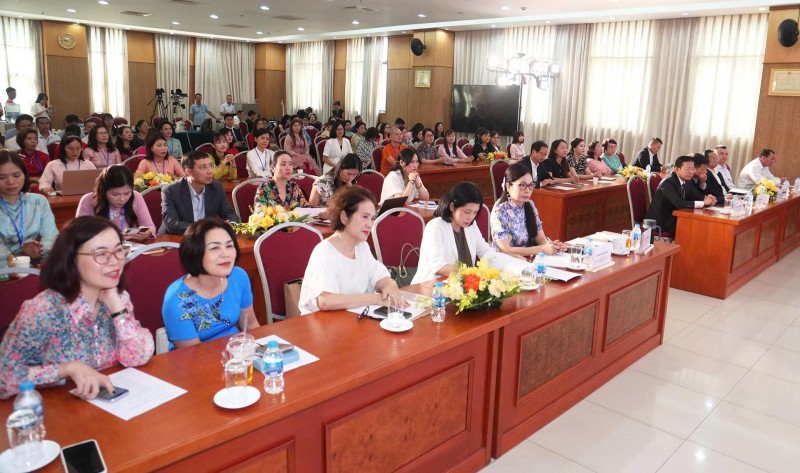 |
| Ceremony reviewing 2026 Vietnamese Language Honoring Day for the Vietnamese community abroad. (Photo: Duong Tieu) |
In her opening remarks, Deputy Minister of Foreign Affairs Le Thi Thu Hang affirmed that Vietnamese is both a means of preserving and passing on cultural values and a bond connecting generations of Vietnamese abroad with their homeland and country. She emphasized that Resolution No. 23-NQ/TW calls for renewed approaches and stronger international cooperation in Vietnamese-language research, teaching and promotion; encouraging countries with large Vietnamese communities to include Vietnamese in their education programs; supporting teacher training; and accelerating the application of digital technologies.
According to the Deputy Minister, after nearly four years of implementation, the Vietnamese Language Honoring Day Project for 2023–2030 is moving in the right direction. However, preserving the Vietnamese language must first become an intrinsic need and a source of pride for every family and community. The State should provide orientation, create favorable conditions and accompany these efforts, while families remain the place where Vietnamese is passed down most naturally and sustainably.
Reporting on implementation of the Project, Deputy Chairwoman of the State Committee for Overseas Vietnamese Affairs Nguyen Quynh Mai said that in 2026, the Committee organized a launch ceremony with 150 participating locations in Vietnam and abroad; revamped the Vietnamese Language Ambassador Search Program by introducing a dossier-based selection process, receiving 57 applications from 22 countries and territories; established four Vietnamese-language book collections in Thailand, Singapore, Brunei and Malaysia; and provided nearly 5,000 books and learning materials to overseas Vietnamese communities.
Deputy Chairwoman Nguyen Quynh Mai highlighted three major achievements: advisory, guidance and coordination efforts have become increasingly synchronized; the movement to preserve and promote the Vietnamese language has expanded across Asia, Europe, North America, the Middle East and Africa, with numerous initiatives emerging directly from community needs; and families, associations and younger generations have shown positive changes in awareness and action. At the same time, challenges remain, including limited resources, uneven development among different locations and difficulties in engaging younger generations. Five key priorities for the coming period are improving the quality of support for Vietnamese-language teaching and learning, promoting the community’s role as the driving force, mobilizing social resources, paying greater attention to younger generations and strengthening communications.
Presentations at the ceremony focused on professional standardization, the application of digital technologies and strengthening the community’s role as the main driving force. A representative of the Ministry of Education and Training said it was necessary to shift from individual support activities toward building an integrated ecosystem for Vietnamese-language teaching and learning. Two key tasks are to standardize curricula around a common framework while allowing flexible implementation, and to digitize learning materials and develop a shared digital repository.
Deputy Head of the External Television Department of Vietnam Television Nguyen Phuong Ha said that since 2018, the department has produced more than 400 Vietnamese-language teaching programs, connecting language learning with culture, tourism and everyday experiences. The programs have been distributed across digital platforms. She also proposed coordinating with the State Committee and Vietnamese associations to establish an online networking space where Vietnamese teachers worldwide can share lesson plans, teaching materials and classroom experience.
Dr. Vu Hoai Nam, representing the Posts and Telecommunications Institute of Technology, introduced Vietnamese TV version 2.0, a platform that uses artificial intelligence and natural language processing to assess language proficiency, personalize learning pathways and incorporate gamification to help learners maintain regular study habits.
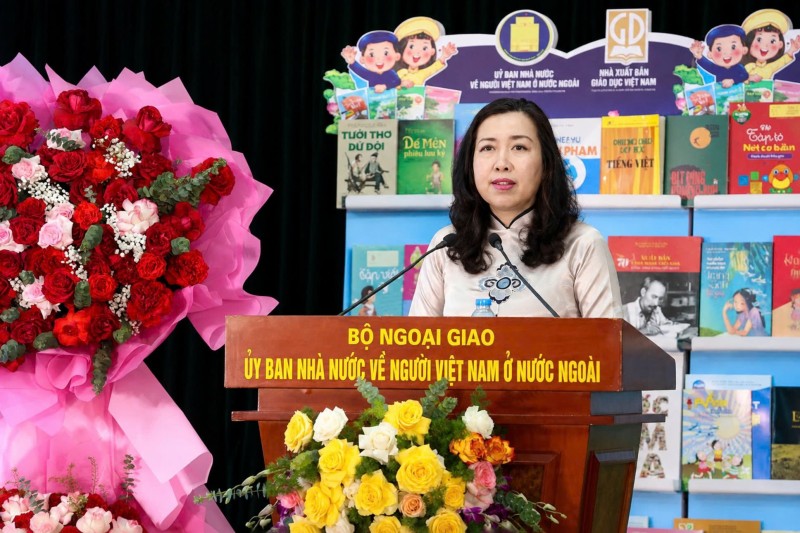 |
| Deputy Minister of Foreign Affairs Le Thi Thu Hang speaks at the ceremony. (Photo: Duong Tieu) |
Regarding outstanding community initiatives, 2026 Vietnamese Language Ambassador Nguyen Phuong Chung in the United States and 2024 Vietnamese Language Ambassador Thuy Le Scherello in Germany shared their experiences in organizing classes and community activities and in encouraging Vietnamese children abroad to take an interest in learning the language. Nguyen Duy Anh, representing the Forum for Preserving Vietnamese Language and Culture Abroad and the Network for Teaching Vietnamese Language and Culture Abroad, reported on efforts to connect Vietnamese teachers and share lesson plans and learning materials across different locations.
Sharing his experience from five years of activities by the Forum for Preserving Vietnamese Language and Culture Abroad, Le Xuan Lam affirmed: “Vietnamese must live in the family, at school and in the community; it must be present in grandparents’ stories, mothers’ lullabies, songs, Tet and Mid-Autumn Festival celebrations, and in love for the homeland and country.”
Chairwoman of the Vietnamese Language Cultural Heritage Club Nguyen Thi Thanh Tam proposed social mobilization measures, including making families the foundation, establishing communities dedicated to preserving Vietnamese, building a Global Vietnamese Language Ambassador Network and a Global Volunteer Teacher Network, developing a multi-platform shared digital learning repository, promoting the inclusion of Vietnamese in local schools and organizing creative content competitions in Vietnamese.
Le Bich Hong, a representative of the training course participants, an education specialist at the Institute for Research and Development of Human Potential (IPD) and director of a Vietnamese-language teaching center in South Korea, shared her experience in preserving Vietnamese within families and addressing a common situation in which many children can understand spoken Vietnamese but respond in the local language.
Concluding the ceremony, Deputy Minister of Foreign Affairs Le Thi Thu Hang emphasized the need to develop programs and textbooks suited to the specific characteristics of each location, as the needs and conditions for Vietnamese-language teaching and learning vary from one region to another. She called on overseas Vietnamese teachers to send their self-developed lesson plans to Vietnam, with the State Committee serving as a focal point to coordinate with the Ministry of Education and Training and universities to standardize them into sets of textbooks tailored to different locations.
The Deputy Minister also highly appreciated efforts to diversify approaches to learners through media programs, including Vietnamese-language teaching programs broadcast on VTV4, as well as the application of modern technologies, including artificial intelligence, to support teaching in online environments.
On this occasion, Deputy Minister of Foreign Affairs Le Thi Thu Hang presented commemorative medals to three individuals for their outstanding contributions to preserving and promoting the Vietnamese language within Vietnamese communities abroad.
 M.A. Nguyen Thuy Thien Huong: Flexibility and Creativity in Promoting Vietnamese Language in Malaysia M.A. Nguyen Thuy Thien Huong: Flexibility and Creativity in Promoting Vietnamese Language in Malaysia In Malaysia’s multilingual environment, M.A. Nguyen Thuy Thien Huong, Lecturer in Vietnamese Language and Vietnamese Culture at the Department of Asian and European Languages, Faculty of Languages and Linguistics, University of Malaya (Malaysia), has become a bridge connecting the Vietnamese language with diverse groups of learners. Through her flexible and creative teaching methods, she has helped nurture a love for Vietnamese among the overseas Vietnamese community and spark interest among many international students. |
 More and more foreigners have need to learn Vietnamese More and more foreigners have need to learn Vietnamese Not only expatriates in Vietnam but also foreign students in all over the world have a need to learn Vietnamese. |


Most read


Related Stories
 Overseas Vietnamese
Vietnamese Community in India Strengthen Community Ties and Preserve Language
 Travel
A Colorful Celebration of South Korea and Vietnam Cultures in Phu Quoc
 Viets Home
Foreigners Tell Vietnam’s Stories in Vietnamese
 Multimedia
Vietnamese and Korean Students Explore Mid-Autumn Traditions Together
Recommended
 Overseas Vietnamese
Japan Law Quiz Awards Presented to Vietnamese Community in Japan
 Overseas Vietnamese
Vietnamese Community Becomes Japan’s Second-Largest Foreign Community
 Overseas Vietnamese
“Honorary Citizen of Seoul” Tran Ngoc Lam Appointed Prosecutor of Seoul Migrant Network
 Overseas Vietnamese
Vietnamese Community Makes Positive Contributions to Host Society
Popular article
 Multimedia
Vibrant Vietnamese Community Football Tournament Held in Chubu Region (Japan)
 Overseas Vietnamese
Pho and the Bridges That Lead Back Home
 Overseas Vietnamese
Vietnamese Account for Majority of Highly Skilled Foreign Workers in Japan
 Overseas Vietnamese