
Shaping Future through Strategic Decisions: Vietnam’s Vision in New Era
 | Enhancing National Standing: Strength Drawn from Independent, Self-reliant, and Distinctive Foreign Policy |
| 40 Years of Doi Moi (Renewal): Journey from Poverty to Aspiration of National Strength |
“Four pillars” laying foundation for sustainable development
The first four resolutions, referred to by General Secretary To Lam as the “four pillars,” form a unified framework of strategic thinking and action. They include: Resolution No. 57-NQ/TW dated December 22, 2024, of the Politburo on breakthroughs in the development of science, technology, innovation, and national digital transformation; Resolution No. 59-NQ/TW dated January 24, 2025, of the Politburo on “International integration in the new context”; Resolution No. 66-NQ/TW on reforming the work of law-making and law enforcement to meet the requirements of national development in the new era; and Resolution No. 68-NQ/TW dated May 4, 2025, of the Politburo on the development of the private economy.
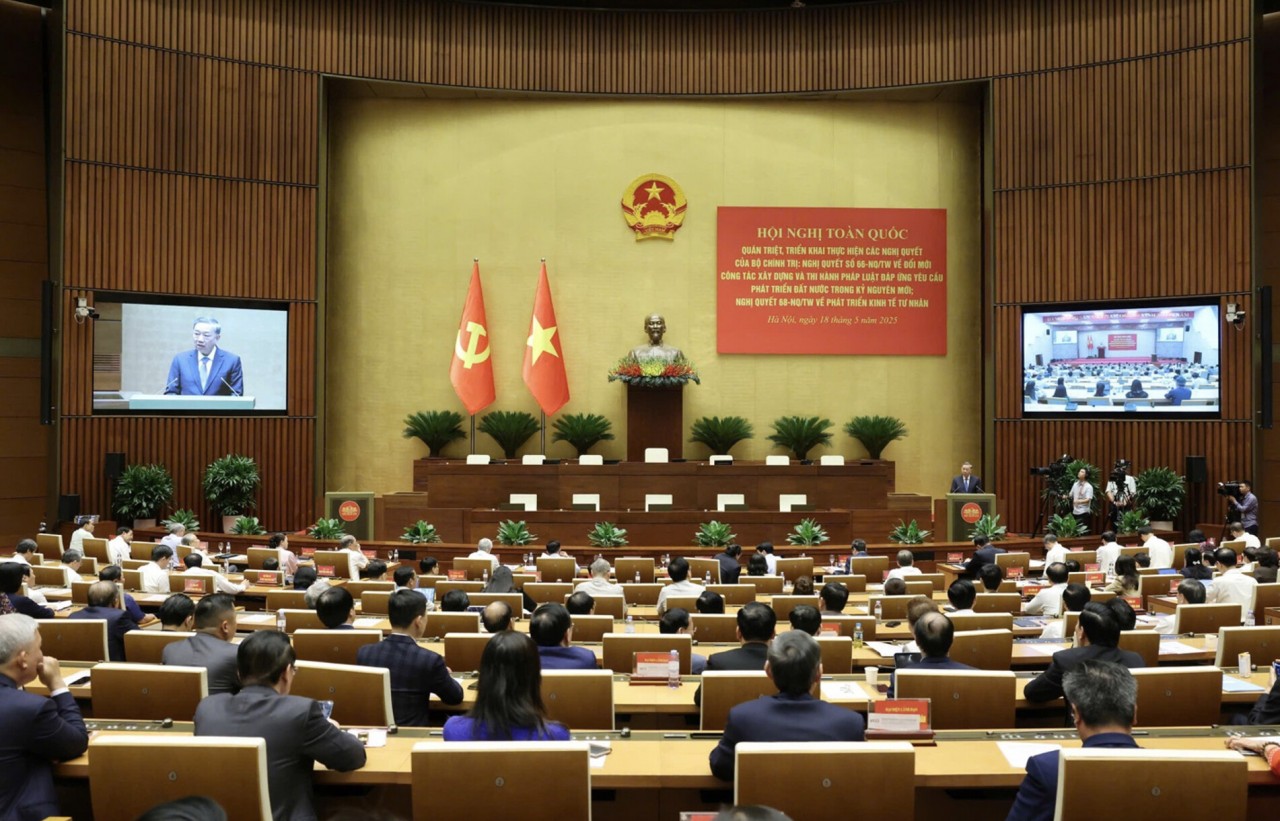 |
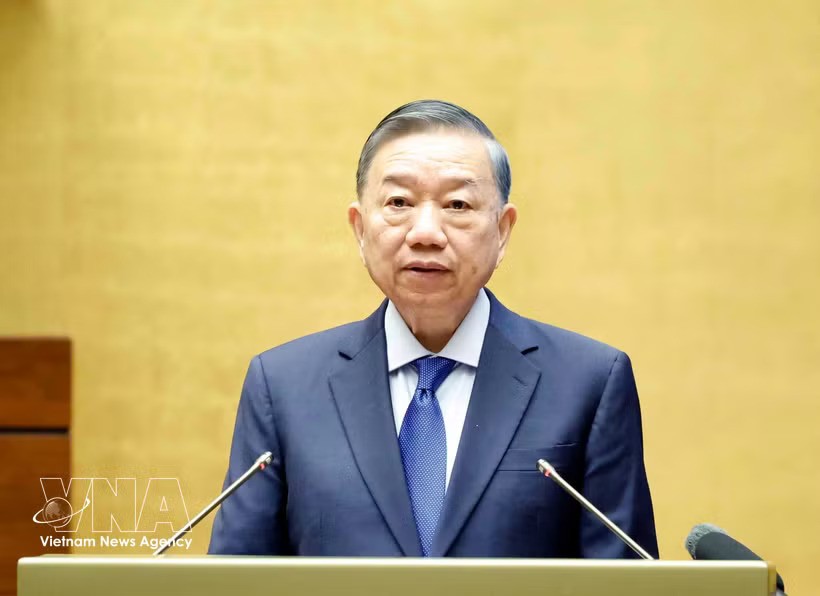
| General Secretary To Lam delivers a keynote address at the National Conference to disseminate and implement Politburo Resolution No. 66-NQ/TW and Resolution No. 68-NQ/TW. (Photo: VGP) |
Resolution No. 66-NQ/TW is regarded as a “breakthrough of breakthroughs,” identifying the task of building a transparent, equitable, feasible, and modern legal system that closely aligns with international standards. The objective is not only to create a secure legal corridor so that citizens and businesses can operate with confidence and invest for the long term, but also to establish a truly rule-of-law environment in which human rights, civil rights, property rights, and freedom of business are respected and protected. Dr. Nguyen Si Dung, former Vice Chairman of National Assembly Office, analyzed: “A transparent and predictable institutional framework helps minimize policy risks and build trust - an extremely important form of ‘development capital.’”
On this solid institutional foundation, Resolution No. 57-NQ/TW identifies science, technology, innovation, and digital transformation as the “foremost critical breakthroughs” and the main drivers of growth. In the context of the Fourth Industrial Revolution unfolding vigorously, Vietnam clearly recognizes that a growth model based on capital accumulation and low-cost labor is no longer sustainable. The resolution sets targets: by 2030, the digital economy will contribute at least 30% of GDP, and Vietnam will rank among the top three countries in Southeast Asia in digital competitiveness and artificial intelligence research. Speaking at the National Conference to disseminate and implement Resolutions No. 66 and No. 68, General Secretary To Lam emphasized that science and technology must serve as the “development foundation and primary driving force” for the cause of industrialization and modernization.
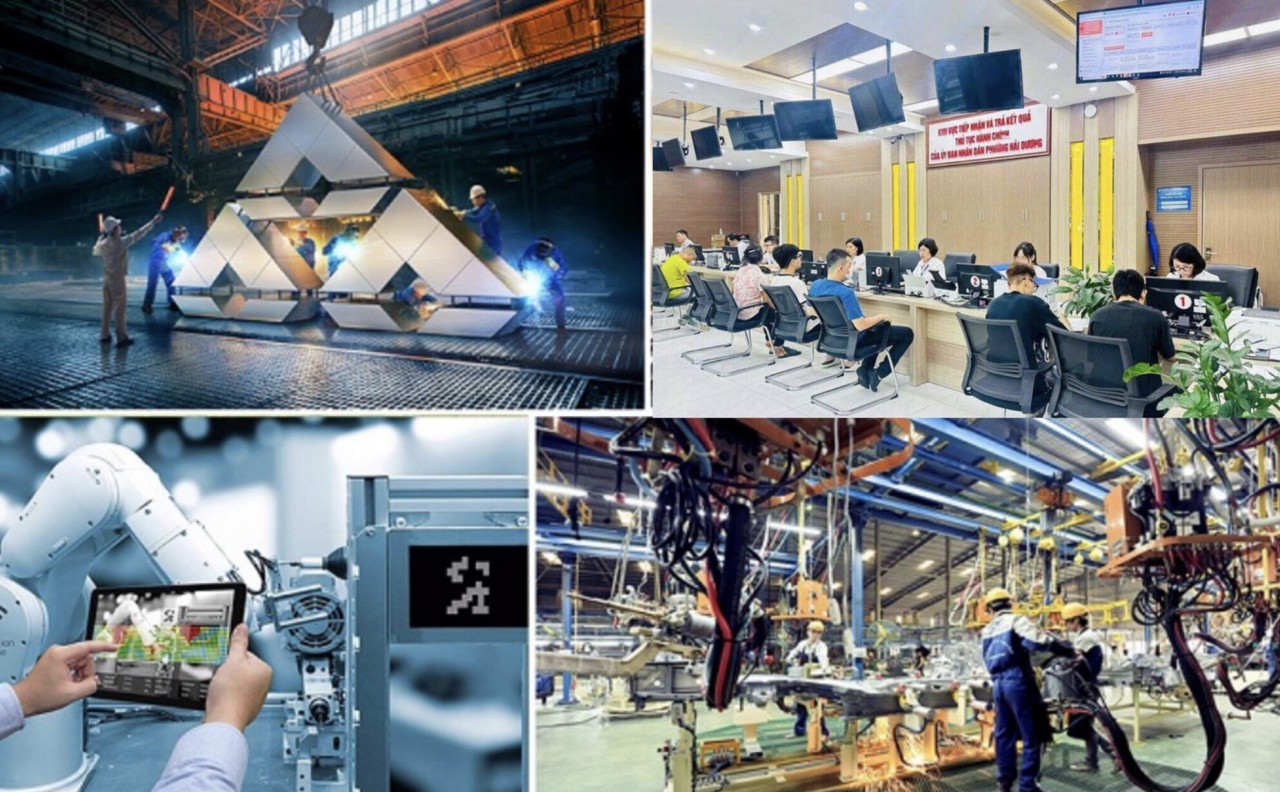 |
| Illustrative photo. (Source: Internet) |
The driving force for realizing technological breakthroughs is the private economic sector. Resolution No. 68-NQ/TW marks a historic advance by affirming that “the private economy is one of the most important drivers of the national economy.” The resolution calls for the removal of all prejudices and barriers, the creation of a truly equal and transparent business environment, and the elimination of the “ask-give” mechanism. By 2030, the country aims to have 2 million private enterprises contributing 55-58% of GDP. This represents a powerful institutional impetus, shifting from a mindset of merely “recognizing” to one of “protecting, encouraging, and promoting” this dynamic economic sector, thereby unleashing the creativity and entrepreneurial spirit of the people.
The final piece of the “four pillars” is Resolution No. 59-NQ/TW on international integration. The resolution defines international integration as a “strategic driver,” extending beyond the economic sphere to comprehensively cover politics, defense, security, culture, and society. In the new era, integration is no longer passive participation but proactive contribution, construction, and shaping of international “rules of the game.” With participation in 17 new-generation free trade agreements (FTA), Vietnam is opening up vast development space, enabling businesses to access global markets and integrate more deeply into global value chains.
Three pillars strengthening national internal capacity for happiness of people
If the “four pillars” provide the framework and momentum for development, then the three thematic resolutions on energy, education, and healthcare serve as firm pillars that strengthen national internal capacity and orient development toward the ultimate goal - the happiness of the people.
Resolution No. 70-NQ/TW on ensuring national energy security embodies a strategic vision, shifting from a mindset of merely “ensuring supply” to one of “firmly and proactively safeguarding energy security” with a long-term, multidimensional outlook. Energy security is identified as a vital component of national security. The resolution sets out objectives to develop the energy sector in a balanced and sustainable manner, increase the share of renewable energy to 25-30% by 2030, and build a competitive and transparent electricity market. A stable, green, and reasonably priced energy system is the lifeblood of the economy and a prerequisite for industrial production and the daily lives of the people.
Human beings are consistently identified as the center and the driving force of development. Resolution No. 71-NQ/TW on breakthroughs in the development of education and training represents the most important investment in the future. Speaking at the National Conference to disseminate and implement four Politburo resolutions, General Secretary To Lam emphasized that investment in education is “an investment in nurturing and enhancing the nation’s vital strength.” The resolution sets forth breakthrough targets: improving the quality of general education to reach advanced standards in Asia, and ensuring that at least eight higher education institutions rank among the top 200 universities in Asia by 2030. The core approach is a decisive shift from knowledge-based instruction to the comprehensive development of learners’ capacities and qualities, with “teachers as the driving force” and “learners at the center.” One particularly humane and far-reaching policy is the exemption of tuition fees for students from preschool through high school at public schools, beginning in the 2025-2026 academic year.
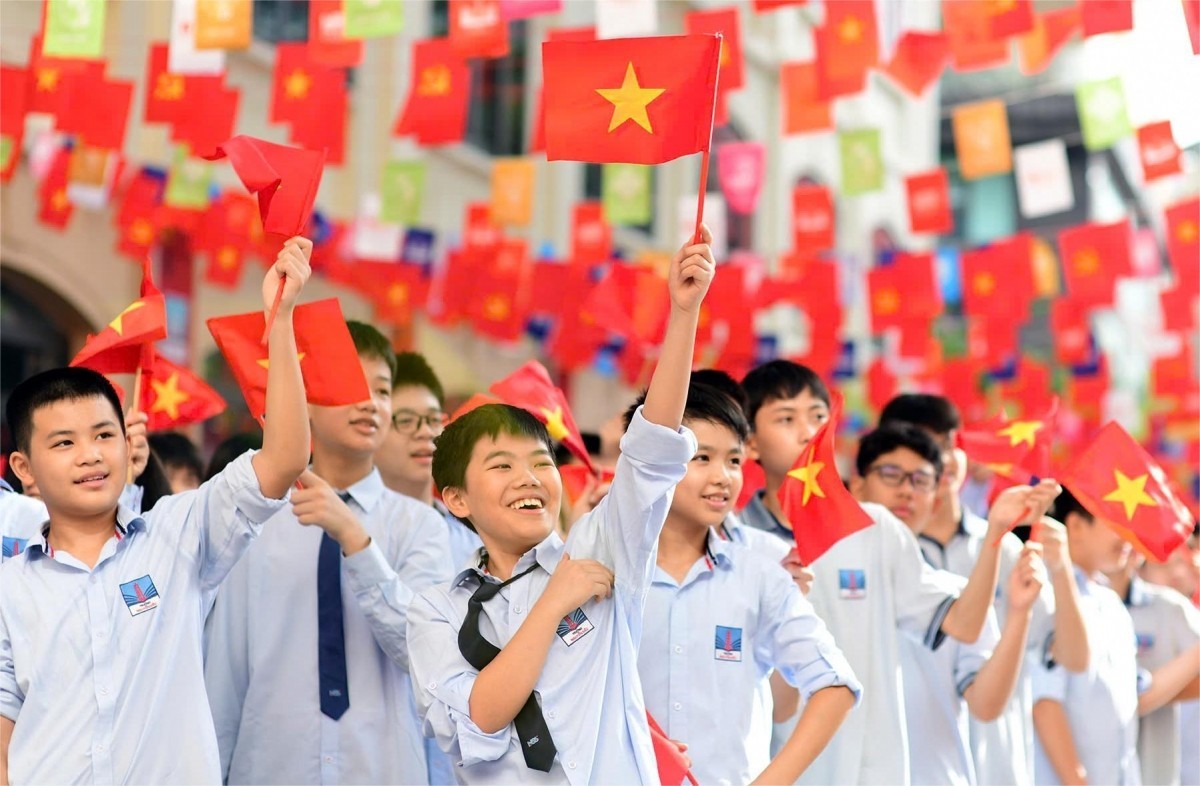 |
| The policy of tuition fee exemption for preschool children and high education students will be implemented from the 2025-2026 academic year. (Illustrative photo: Nguyen Sieu School) |
Alongside intellectual development is the care for the physical and mental health of the people. Resolution No. 72-NQ/TW on healthcare for the population is highly action-oriented and breakthrough in nature, guided by the principle: “Prevention as the key - the grassroots as the foundation - the people as the center.” The resolution sets out specific and humane goals: by 2030, average life expectancy is expected to reach 75.5 years, with healthy life expectancy of at least 68 years. Notably, from 2026 onward, citizens will receive free periodic health check-ups at least once a year, and by 2030 will benefit from basic-level free medical services within the scope of health insurance. These are outstanding social welfare policies that reflect the deep concern of the Party and the State for each individual, affirming the superior nature of the system.
It is evident that these seven strategic resolutions do not exist in isolation but are interconnected, forming what experts describe as a “developmental virtuous cycle.” A transparent legal and institutional framework lays the foundation for innovation and the breakthrough growth of the private sector. A stable energy system and a high-quality human resource base are necessary conditions for enterprises to expand production. A healthy workforce ensures the continuous functioning of the economy, while international integration opens doors to markets. As General Secretary To Lam has pointed out: “When each cog operates in perfect synchrony, the engine of national development will accelerate with sustained momentum.”
 | People’s Organizations and International Friends Express Confidence that 14th National Party Congress Will Open New Phase of Development for Vietnam On the occasion of the 14th National Congress of the Communist Party of Vietnam, numerous friendship organizations, associations, parliamentarians, and international friends have sent letters, ... |
 | International Partners Express Confidence in the 14th National Congress of the Communist Party of Vietnam Numerous friendship organizations, business communities, and friends and partners of the Viet Nam Union of Friendship Organizations (VUFO), together with its member organizations, have continued ... |
Related Stories
 National
Ho Chi Minh Thought Guides Development Path: Top Leader
 National
Breakthrough actions Required to Turn decisions into Results: Top Leader
 National
Brazilian Politicians and Scholars Honor the Historical Role of the Communist Party of Vietnam
 National
Canadian Friends Highlight Significance of 14th National Congress of Communist Party of Vietnam
Recommended
 National
Vietnam News Today (July 4): International Tourist Arrivals to Vietnam Rise Nearly 15% in First Half of 2026
 National
500-Day Campaign: Hope of Reunion Through DNA Evidence
 National
Ho Chi Minh City Marks 50 Years with 3D Mapping Light Show
 National
Full Remarks by General Secretary, President To Lam at 50th Anniversary of Sai Gon-Gia Dinh Named After President Ho Chi Minh
 National
New Advances in DNA Technology for Identifying Fallen Soldiers
 National
Foreign Affairs Should Better Serve National Development: Top Leader
 National
Vietnam News Today (July 1): Vietnam and UAE Sign Defense Industry Cooperation Memorandum
 National