
Vietnam Gains Growing Appeal on the Regional Tourism Map
 | Historical prisons on the tourism map in Vietnam |
| Vietnam Strengthens Its Presence On The Global Tourism Map |
One of the most attractive destinations in Southeast Asia
The Vietnam National Tourism Administration reported that Fortune magazine recently recognized Vietnam as emerging as one of the most attractive tourist destinations in Southeast Asia. The country impressed with its rapid growth in international visitor numbers, demonstrating its increasing appeal to key markets and its efforts to develop tourism in a quality and sustainable manner.
Amidst increasingly fierce competition among regional destinations, Vietnam's tourism brand is proving its growing appeal on the global tourism map. In Southeast Asia, Vietnam has surpassed Thailand to become the most popular destination for Chinese tourists, with nearly 5.3 million visitors from this market.
Fortune magazine notes that Vietnam's destinations that record impressive growth include not only major tourist centers like Hanoi and Ho Chi Minh City, but also many new destinations. For example, data from the travel platform Klook indicates that the number of visitors to Phu Quoc and Sa Pa in 2025 has more than doubled compared to the previous year.
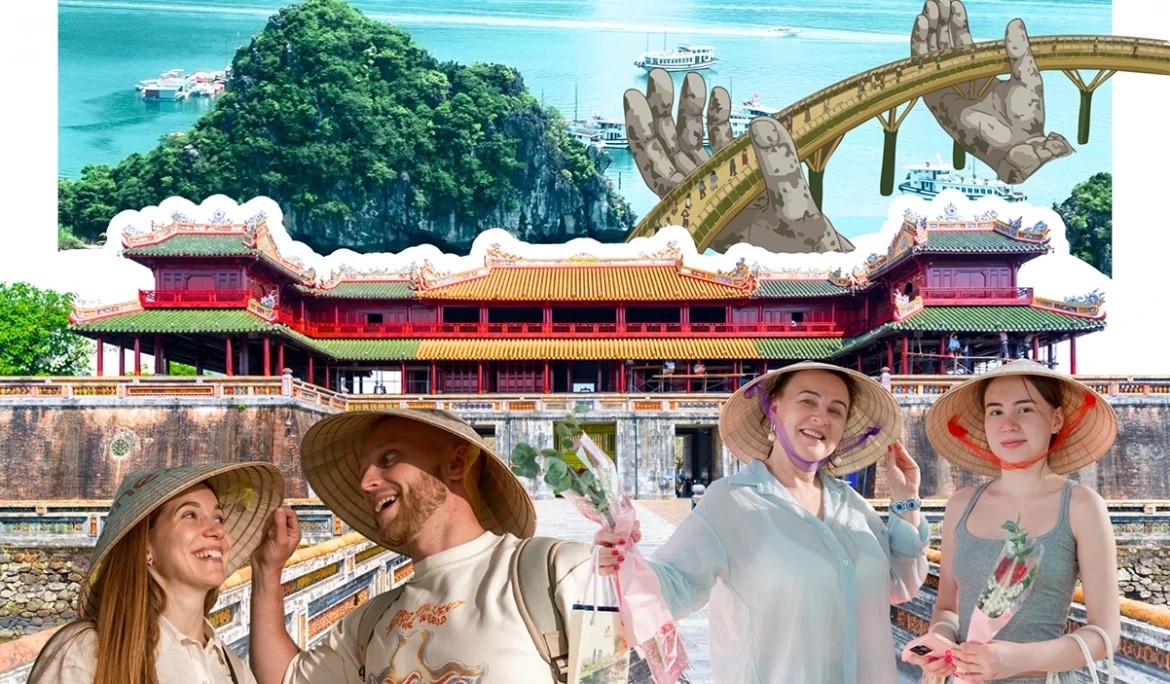 |
| According to Fortune magazine, international experts believe that Vietnam is shifting towards a high-quality tourism development model, targeting higher-spending tourists with longer stays (Photo: Vietnam National Tourism Administration). |
Klook's Vice President of Business Development Chuan Sheng Song commented on the current trend.
"Travelers are increasingly prioritizing destinations close to nature and rich in cultural identity, rather than focusing solely on large cities. This is also a significant advantage for Vietnam, possessing a diverse ecosystem of destinations stretching from mountainous regions and plains to coastal and island areas," he said.
Alongside improving the quality of products and services, Vietnam is also investing heavily in tourism infrastructure. One notable project is the expansion and development of infrastructure in Phu Quoc in preparation for the APEC 2027 High-Level Week. Many large domestic and international corporations are investing in large-scale airport, resort, and hotel projects at key destinations.
| Amidst increasingly fierce competition among regional destinations, Vietnam's tourism brand is proving its growing appeal on the global tourism map. |
Commenting on the rapid development of tourism infrastructure in Vietnam, Vice President and Regional Director for Southeast Asia at Hilton Group Alexandra Murray noted that the tourism infrastructure in Vietnam is developing at an incredible rate.
"This is unprecedented in any other country, including the Middle East. Investments in tourism infrastructure are being implemented strategically and effectively, contributing to enhancing Vietnam's competitiveness and strengthening its position as a leading destination in Southeast Asia," said the hospitality expert.
The increasing involvement of international hotel brands demonstrates investors' confidence in the long-term prospects of the Vietnamese tourism market.
Improve service quality to grasp tourists' attention
According to Fortune magazine, while Vietnam's economic potential is often highlighted through its manufacturing and export sectors such as electronics and textiles, the tourism industry, currently contributing nearly 10% of GDP, is also demonstrating Vietnam's strong competitiveness in the service sector.
The country is competing with Thailand and Malaysia to become a leading destination in the region. In reality, Southeast Asia is often perceived as a destination for budget-conscious mass travelers. However, experts agree that Vietnam is shifting towards a high-quality tourism development model, targeting higher-spending tourists and longer stays.
Vietnam needs to focus more on developing tourism types such as medical tourism, MICE tourism, and luxury resort tourism. Accordingly, one of the key factors driving the surge in tourism to Vietnam is the increasingly convenient access to destinations thanks to more open visa policies. Simplifying entry by allowing tourists from certain countries to travel without a visa and for longer stays is one example.
In 2025, Vietnam implemented a visa exemption policy for citizens of 12 European countries participating in a tourism stimulus program, allowing for stays of up to 45 days. It is easier for tourists to make their decisions, and the likelihood of choosing Vietnam for longer trips or multi-experience vacations is expected to be higher.
| Focusing on resource conservation, enhancing the quality of experiences, and developing integrated infrastructure are considered key factors in ensuring the long-term development of the tourism industry, said Professor Vu Minh Khuong, Lee Kuan Yew School of Public Policy (Singapore). |
In addition, Vietnamese airlines are actively expanding their presence in the international market by continuously launching new routes. VietJet is increasing flights from China, Japan, and Singapore and may expand to Europe.
Data from the online travel platform Klook indicates that the sources of international tourists to Vietnam are becoming increasingly diverse. Besides traditional markets like South Korea and Singapore, the number of visitors from the Philippines and India is growing strongly.
Long-haul markets such as the US, Australia, and New Zealand are also recording significant increases.
Currently, China and South Korea remain Vietnam's two largest source markets, far surpassing the third-largest market, Russia.
Still, Vietnam needs to focus on maintaining its growth momentum towards sustainable development. The important goal is not only to increase the number of tourists but also to improve the quality of services so that tourists stay longer, spend more, and return more often.
Professor Vu Minh Khuong from the Lee Kuan Yew School of Public Policy (Singapore) stated that Vietnam is proactively learning how to combat mass tourism issues, as seen in Bali (Indonesia) and Thailand. At the same time, the country is observing and learning to develop its own sustainable growth model.
According to the Vietnam National Tourism Administration, with its current strong growth momentum and a development strategy focused on quality and sustainability, Vietnam is demonstrating solid progress in improving destination quality, diversifying tourist markets, and perfecting tourism infrastructure, asserting its position as one of the most dynamic and promising tourism hubs in Southeast Asia.
 | Honoring President Ho Chi Minh’s Legacy in France On June 27, in Montreuil, France, the Ho Chi Minh Relic Site at the Presidential Palace, in coordination with the Embassy of Vietnam in France ... |
 | Developing Phong Nha-Ke Bang into a World-Class Tourist Destination Phong Nha-Ke Bang National Park in Quang Tri Province is emerging as the world's largest destination for cave adventure tourism. However, tourism development in Phong ... |
Related Stories
 Travel
Top Coral Reef Diving Destinations in Viet Nam for Summer 2026
 National
Vietnam News Today (July 12): Vietnam Ready to Share Digital Transformation Experience with Timor-Leste
Recommended
 Travel
Hanoi Ranks Among World’s Friendliest Destinations for International Tourists
 Travel
"Discover Moscow" - Tourism Information Ecosystem Launches Vietnamese Version Platform
 Travel
Leveraging Cuisine to Elevate Vietnam's Tourism Brand
 Travel
Ho Chi Minh City Boosts Tourism Revenue Through High-Value Visitor Strategy
 Travel
Vietnam Ranks First in Number of Foreigners with Long-Term Stays in RoK
 Travel
Bringing Essence of Vietnamese Cuisine Closer to Europe and the World
 Travel
French Magazine Highlights Must-Try Dishes of Vietnam Cuisine
Travel