| Vietnam News Today (July 23) notable headlines Vietnam pledges to advance ASEAN-Russia cooperation as new coordinator Vietnam promotes ties with Canada, New Zealand at AMM-59 Vietnam and Japan enhance political trust, Comprehensive Strategic Partnership Vietnam, Australia agree to deepen cooperation in priority areas Vietnam proposes priorities to deepen ASEAN-U.S. strategic partnership Vietnam Airlines launches self-service check-in at Noi Bai from July 20 Vietnam co-chairs ASEAN-New Zealand Post-Ministerial Conference Top legislator receives Executive Acting Secretary General of Japan’s Liberal Democratic Party Vietnam calls for deeper, more practical ASEAN-Russia strategic partnership |
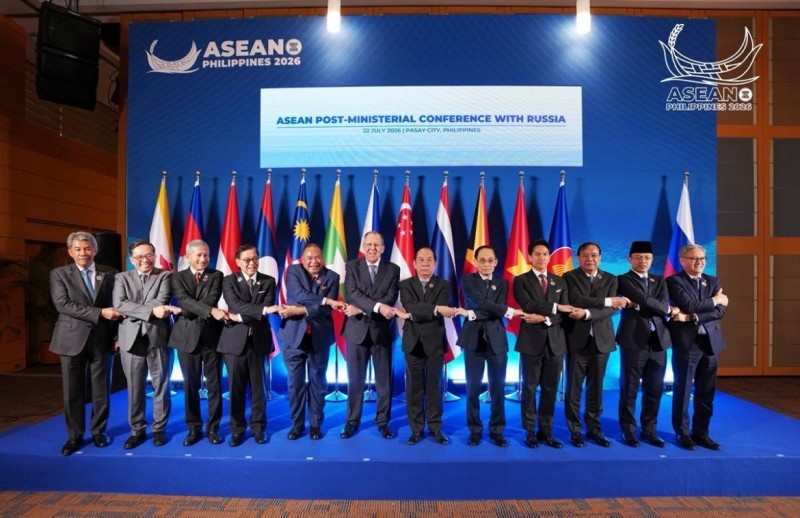 |
| Diplomats pose for a group photo at ASEAN Post-Ministerial Conference with Russia in Manila on July 22, the Philippines. |
Vietnam pledges to advance ASEAN-Russia cooperation as new coordinator
Vietnam has vowed to work closely with other ASEAN member states and Russia to deepen the ASEAN-Russia Strategic Partnership as it prepares to assume the role of country coordinator for ASEAN-Russia relations during the 2027-2030 period.
The commitment was made by Vietnamese Minister of Foreign Affairs Le Hoai Trung at the ASEAN Post-Ministerial Conference with Russia in Manila on July 22, the Philippines, as part of the 59th ASEAN Foreign Ministers' Meeting (AMM-59) and related meetings.
Trung described the recent ASEAN-Russia Commemorative Summit marking the 35th anniversary of dialogue relations in Kazan, Russia, as a significant milestone that reaffirmed the strategic value of the partnership while creating fresh momentum for expanding cooperation in the years ahead.
To translate high-level commitments into concrete outcomes, the minister proposed that ASEAN and Russia prioritise economic cooperation, aiming to raise their two-way trade to US$45 billion by 2035.
He also called for the early implementation of the ASEAN-Russia Joint Statement on Energy Cooperation, focusing on strategic fuel storage, liquefied natural gas (LNG) trade, renewable energy, civilian nuclear power and energy-efficient technologies.
Trung further proposed expanding collaboration in emerging sectors, including science and technology, innovation, joint research, startup ecosystems, digital transformation and cybersecurity.
He encouraged both sides to strengthen existing cybersecurity dialogue mechanisms, including cooperation in implementing the United Convention Against Cybercrime (Hanoi Convention).
On socio-cultural cooperation, the Vietnamese Foreign Ninister stressed the importance of enhancing people-to-people connectivity through tourism, direct air links, youth exchanges and cooperation among younger generations.
Vietnam also pledged to successfully host the Second ASEAN-Russia Young Diplomats Summit in 2027 to foster greater mutual understanding and long-term cooperation.
Addressing regional and international issues, Trung underscored the importance of maintaining peace and stability based on international law and the United Nations Charter.
He emphasised dialogue, confidence-building measures and the peaceful settlement of disputes, while welcoming Russia's continued constructive engagement in the region and its support for ASEAN centrality and ASEAN-led mechanisms.
At the meeting, ASEAN and Russian Foreign Ministers acknowledged the positive progress of the ASEAN-Russia Strategic Partnership and agreed to accelerate the implementation of high-level commitments through practical cooperation projects aligned with the ASEAN Community Vision 2045.
Russian Foreign Minister Sergei Lavrov reaffirmed the importance of ASEAN-Russia relations for regional peace, stability and cooperation. He proposed expanded collaboration in political-security affairs, trade, investment, energy, cybersecurity, digital transformation, artificial intelligence, education, culture and people-to-people exchanges.
Meanwhile, ASEAN member states also welcomed Russia’s continued support for ASEAN centrality and its active participation in ASEAN-led mechanisms, including the East Asia Summit (EAS), the ASEAN Regional Forum (ARF) and the ASEAN Defence Ministers' Meeting-Plus (ADMM-Plus).
With Vietnam set to coordinate ASEAN-Russia relations during 2027-2030, the country showed its determination to contribute actively to advancing practical, effective and mutually beneficial cooperation between ASEAN and Russia while supporting peace, stability and sustainable development across the region.
Vietnam promotes ties with Canada, New Zealand at AMM-59
Vietnamese Minister of Foreign Affairs Le Hoai Trung met separately with his Canadian and New Zealand counterparts on the sidelines of the 59th ASEAN Foreign Ministers' Meeting (AMM-59) and related meetings in Manila, the Philippines, on July 22, reaffirming Vietnam's commitment to strengthening bilateral partnerships and enhancing cooperation within the ASEAN framework.
Meeting Canadian Foreign Minister Anita Anand, Trung welcomed Canada's enduring commitment to ASEAN and its support for Vietnam and Vietnam-led initiatives within the bloc. He reaffirmed that Vietnam views Canada as an important partner and stands ready to deepen practical cooperation while working towards elevating the Vietnam-Canada Comprehensive Partnership, reflecting the growing political trust, cooperation potential and shared interests of the two countries.
Referring to the directions set by Prime Minister Le Minh Hung and Canadian Prime Minister Mark Carney during their July 21 phone talks, Trung called for closer coordination to translate those commitments into action. He proposed expanding delegation exchanges, making full use of existing dialogue mechanisms, and broadening cooperation in trade, investment, defence, security, high-quality workforce development, and coordination at regional and international forums.
Anand congratulated Vietnam on its development achievements and expressed confidence that the country would continue playing an increasingly important role in regional and global affairs. She reaffirmed Canada's support for ASEAN centrality and ASEAN-led mechanisms, describing Vietnam as a key partner in Canada's engagement with ASEAN and the Indo-Pacific, according to VNA.
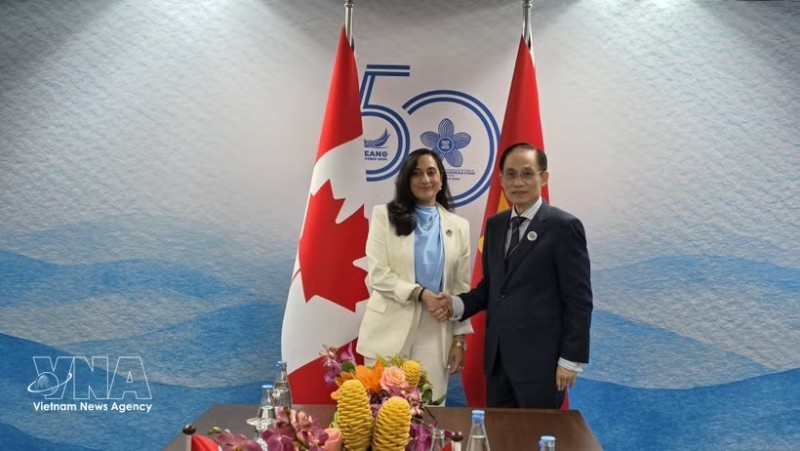 |
| Vietnamese Minister of Foreign Affairs Le Hoai Trung and Canadian Foreign Minister Anita Anand pose for a commemorative photo. (Photo: VNA) |
The two ministers agreed to work closely to prepare for future high-level visits, accelerate efforts to upgrade bilateral relations, and expand cooperation in sustainable development, energy, aerospace, agriculture, food safety, science and technology, education, training and people-to-people exchanges.
They also pledged to strengthen strategic consultations and coordination at multilateral forums, including ASEAN. Anand welcomed Vietnam's role as Chair of the Comprehensive and Progressive Agreement for Trans-Pacific Partnership (CPTPP) in 2026 and host of APEC 2027, expressing hope that Vietnam would continue facilitating progress towards a Canada-ASEAN Free Trade Agreement. Trung also invited Anand to visit Vietnam at a mutually convenient time.
In meeting with New Zealand Foreign Minister Winston Peters, both sides welcomed the strong momentum in bilateral relations and the continued expansion of ASEAN-New Zealand cooperation.
Peters commended Vietnam's proactive and effective role as ASEAN-New Zealand Country Coordinator for 2024-2027, saying it had helped deepen dialogue, strengthen mutual trust and drive more substantive cooperation. He also acknowledged Vietnam's contribution to upgrading ASEAN-New Zealand relations to a Comprehensive Strategic Partnership and shaping its future cooperation agenda.
Trung reaffirmed Vietnam's commitment to further serving as a bridge between ASEAN and New Zealand by working closely with both sides to effectively implement the ASEAN-New Zealand Plan of Action for 2026-2030, while contributing to translating the Comprehensive Strategic Partnership into tangible, sustainable results.
The two ministers agreed to maintain high-level exchanges, expand trade and investment cooperation, strengthen links between businesses, localities and people, and further consolidate the Vietnam-New Zealand Comprehensive Strategic Partnership.
On regional and international issues, they underscored the importance of ASEAN centrality in the evolving regional architecture, reaffirmed support for ASEAN Community-building and the implementation of the ASEAN Community Vision 2045, and agreed to continue close coordination on issues of mutual concern.
Vietnam and Japan enhance political trust, Comprehensive Strategic Partnership
Vietnamese National Assembly Chairman Tran Thanh Man has called for closer coordination with Japan's Liberal Democratic Party (LDP) to strengthen political trust and further advance the Vietnam-Japan Comprehensive Strategic Partnership in a more substantive and effective manner.
Receiving Hagiuda Koichi, Executive Acting Secretary-General of Japan’s ruling Liberal Democratic Party (LDP) in Hanoi on July 22, the National Assembly leader congratulated the LDP on its recent success in Japan's House of Representatives election and conveyed his regards to Japanese Prime Minister Takaichi Sanae as well as leaders of both houses of the Japanese parliament.
Vietnam consistently regards Japan as one of its most important and long-term strategic partners, he told his guest, appreciating the LDP's leading role in promoting bilateral relations over the years.
He expressed his hope that Vietnam and the LDP would continue strengthening exchanges to consolidate political trust and further develop the Vietnam-Japan Comprehensive Strategic Partnership in a practical and effective manner.
He stressed that both sides should closely coordinate to implement the outcomes of Prime Minister Takaichi Sanae's official visit to Vietnam in May 2026, ensuring that high-level agreements are translated into concrete cooperation.
The National Assembly of Vietnam, he said, would continue supporting and supervising the implementation of bilateral commitments while improving the legal framework to facilitate cooperation in various sectors.
Expanding cooperation in strategic areas
Highlighting the strong momentum in bilateral relations, Chairman Man said Vietnam and Japan still have significant potential to expand cooperation in areas that match the strengths and interests of both countries.
He thanked Japan for its long-standing support in Vietnam’s socio-economic development, infrastructure construction, legal and institutional reform, and human resource development, noting that many Japanese-funded official development assistance (ODA) projects have become enduring symbols of bilateral cooperation, reported VOV.
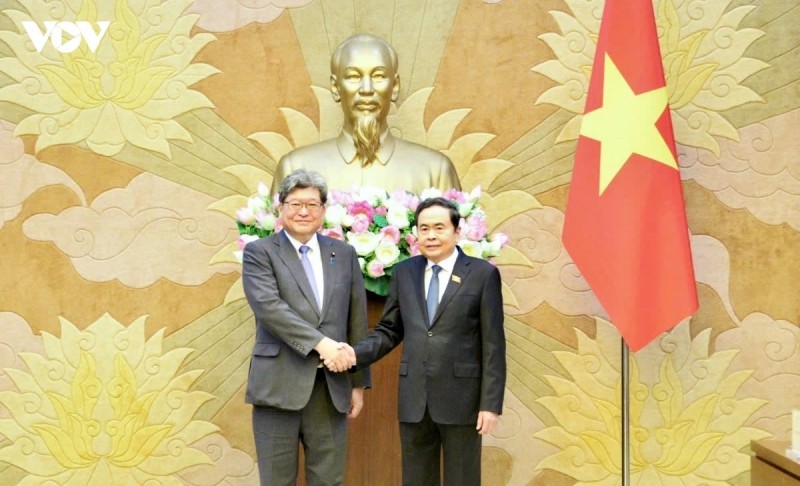 |
| Vietnamese National Assembly Chairman Tran Thanh Man (R) receives Hagiuda Koichi, Executive Acting Secretary-General of Japan’s ruling Liberal Democratic Party (LDP) in Hanoi on July 22 |
Chairman Man proposed maintaining regular high-level exchanges and expanding cooperation between lawmakers, particularly young and female parliamentarians, as well as members of the ruling LDP.
He also called for stronger collaboration on large-scale strategic projects involving digital transformation, green transition, artificial intelligence (AI), semiconductor development, and infrastructure.
In addition, Chairman Man encouraged continued support for people-to-people exchanges, cultural cooperation and local-to-local partnerships, including activities such as the Vietnam-Japan Festival held in both countries, the second Vietnam-Japan Local Cooperation Forum scheduled to take place in Hue in September 2026, and the Vietnam-Japan Cultural Exchange in Can Tho.
Japan reaffirms support for stronger bilateral ties
For his part, Hagiuda congratulated Vietnam on the successful organisation of the 14th National Congress of the Communist Party of Vietnam early this year and the formation of the country's new leadership following the congress.
He also thanked Vietnam for its warm reception of the multiparty Japan-Vietnam Parliamentary Friendship Alliance delegation led by Obuchi Yuko during its visit in August 2025.
Expressing his pleasure at returning to Vietnam after his previous visit in 2023 marking the 50th anniversary of diplomatic relations, Hagiuda reaffirmed that the LDP and the Japanese parliament strongly support expanding practical and comprehensive cooperation with Vietnam.
He emphasised Japan’s appreciation of bilateral ties and its readiness to accompany Vietnam in pursuing its strategic autonomy and long-term development goals.
Hagiuda also highlighted the important role of both countries' legislatures in promoting bilateral relations and proposed enhancing exchanges between parliamentary friendship groups, alongside establishing a mechanism for regular information sharing between the two ruling parties.
He further reaffirmed Japan’s support for implementing a new-generation ODA programme, expanding cooperation in economic security, green transition and AI, and continuing to create favourable conditions for the nearly 700,000 Vietnamese citizens living, studying and working in Japan.
Vietnam and Japan upgraded their relationship to a Comprehensive Strategic Partnership for Peace and Prosperity in Asia and the World in 2023. Since then, cooperation has expanded across politics, economics, investment, science and technology, digital transformation, green growth, education, labor, and people-to-people exchanges.
Japan is one of Vietnam's leading economic partners, ranking among the country's largest providers of ODA, major foreign investors and key trading partners. The two countries are also increasing cooperation in emerging sectors such as semiconductors, AI, digital transformation, supply chain resilience and high-quality human resource development, reflecting a shared commitment to building a more resilient and future-oriented partnership.
Vietnam, Australia agree to deepen cooperation in priority areas
Vietnamese Minister of Foreign Affairs Le Hoai Trung met with his Australian counterpart Penny Wong on the sidelines of the 59th ASEAN Foreign Ministers' Meeting (AMM-59) and Related Meetings on July 22 in Manila, the Philippines.
The two ministers expressed their satisfaction with the positive momentum and significant progress of the Vietnam - Australia Comprehensive Strategic Partnership.
Against the backdrop of the increasingly complex and unpredictable regional and global situation, they underscored the importance of maintaining regular high-level exchanges to enhance mutual understanding, share assessments, and coordinate positions and actions to strengthen peace, security and stability in the region.
The ministers agreed to closely coordinate preparations for upcoming high-level visits and meetings; deepen cooperation in priority areas, particularly science and technology, education and training, and economic resilience; and facilitate projects supporting development cooperation, reported VNA.
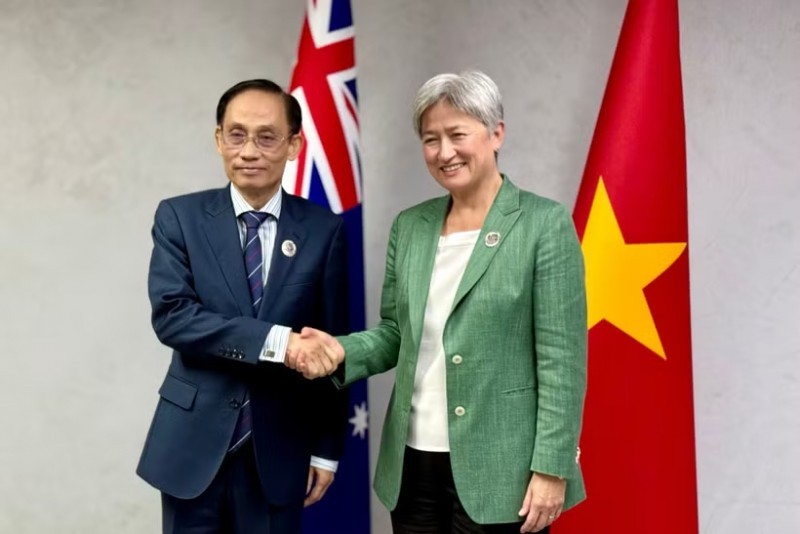 |
| Vietnamese Minister of Foreign Affairs Le Hoai Trung (L) and his Australian counterpart Penny Wong in their meeting in Manila on July 22. (Photo: Courtesy of the Ministry of Foreign Affairs) |
Both sides welcomed ongoing discussions between relevant agencies on the possibility of organising a Vietnam-proposed science and technology connectivity event, describing it as an opportunity to strengthen links among research institutions, universities and businesses from the two countries, while fostering innovation and practical cooperation.
On regional and multilateral issues, the two ministers agreed to step up coordination within ASEAN-led mechanisms and at the United Nations.
Wong praised the success of the ASEAN Future Forum, reaffirming Australia's strong support for ASEAN's efforts to strengthen solidarity, uphold its central role and enhance its capacity to contribute to regional peace, stability and cooperation. She also stressed the importance of conflict prevention amid growing regional and global challenges.
Discussing regional and international issues of mutual concern, the two ministers reaffirmed their support for ASEAN's common position and underscored the need to maintain peace, security, stability, safety, and freedom of navigation and overflight. They reiterated that disputes should be resolved through peaceful means in accordance with international law, particularly the 1982 United Nations Convention on the Law of the Sea (UNCLOS).
The ministers also expressed support for ASEAN's ongoing efforts to conclude an effective and substantive Code of Conduct (COC) in the East Sea that is consistent with international law, including the 1982 UNCLOS.
Vietnam proposes priorities to deepen ASEAN-U.S. strategic partnership
Vietnamese Foreign Minister Le Hoai Trung called for stronger and more practical cooperation between ASEAN and the U.S. at the ASEAN Post-Ministerial Conference with the U.S. in Manila, the Philippines, on July 22, held on the sidelines of the 59th ASEAN Foreign Ministers' Meeting (AMM-59) and related meetings.
The minister welcomed the U.S. continued commitment to peace, stability and development in the region and urged both sides to finalize and effectively implement a new comprehensive work program to realize the ASEAN-U.S. Leaders' Joint Vision Statement.
On economic cooperation, Le suggested the two sides promote open, transparent and mutually beneficial trade and investment while expanding collaboration in high-value sectors such as the digital economy, artificial intelligence, semiconductors, science and technology, innovation, energy transition and regional energy connectivity.
He also called for continued U.S. support for Mekong sub-regional cooperation, particularly in water resources management, climate change adaptation, sustainable infrastructure development and human resource training.
Regarding regional and international issues, the Vietnamese minister underscored the importance of maintaining peace, security and stability, settling disputes through peaceful means in accordance with international law, and safeguarding freedom of navigation, VGP reported.
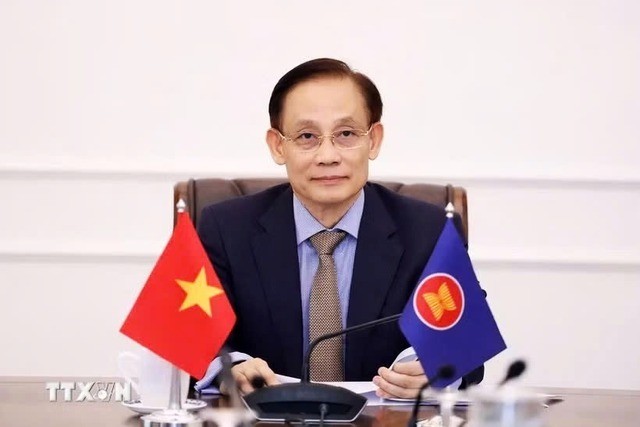 |
| Vietnamese Foreign Minister Le Hoai Trung. |
He welcomed continued U.S. support for ASEAN's principled position on the East Sea and called for closer cooperation in promoting an open, inclusive, transparent and rules-based regional architecture with ASEAN at its center.
On the Middle East situation, Le urged all parties to promote dialogue, restore the safety of maritime routes through the Strait of Hormuz, and ensure freedom of navigation in line with international law, particularly the 1982 United Nations Convention on the Law of the Sea (UNCLOS).
The ministers noted that the ASEAN-U.S. Comprehensive Strategic Partnership has continued to expand following the completion of the 2021–2025 Plan of Action. They agreed to finalize a new comprehensive work program and prepare activities to mark the 50th anniversary of ASEAN-U.S. dialogue relations in 2027, including the possibility of holding a commemorative summit.
Addressing the event, U.S. Secretary of State Marco Rubio reaffirmed Washington's support for ASEAN centrality, describing Southeast Asia as one of the world's key growth engines and a region of strategic importance to the U.S.
He said the U.S. would continue supporting ASEAN in strengthening resilient supply chains, advancing the digital economy, enhancing energy security, promoting energy transition, expanding regional power grid connectivity and developing civil nuclear energy cooperation.
The ministers also agreed to deepen cooperation in education, human resource development, healthcare and disaster management, while accelerating projects under the ASEAN Outlook on the Indo-Pacific (AOIP). They pledged to strengthen collaboration in addressing non-traditional security challenges, including terrorism, cybercrime, human trafficking, drug trafficking and online scams.
ASEAN welcomed continued U.S. engagement in ASEAN-led mechanisms and took note of a proposal to develop an ASEAN-U.S. leaders' statement on 10 public-private principles for combating online scams.