| Vietnam News Today (Mar. 26) notable headlines Vietnam pledges support for global firms in building resilient supply chains Vietnamese, Russian cities boost cooperation in urban infrastructure development Vietnam reinforces role as key regional electronics manufacturing hub Vietnam firms adapt to rising fuel costs with greener solutions Rising airfares drive travel shift ahead of peak holiday season Warmer, shorter Spring in northern Vietnam reflects changing climate trends Joint mechanism targets cross-border crime at Vietnam–China–Laos border PM’s Russia visit deepens political trust, expands comprehensive cooperation Photo exhibition highlights youth spirit in Vietnam’s maritime frontiers |
Vietnam pledges support for global firms in building resilient supply chains
Vietnam has reaffirmed its commitment to supporting international businesses and fostering a stable, transparent investment environment, as it seeks to play a more active role in building sustainable and resilient global supply chains.
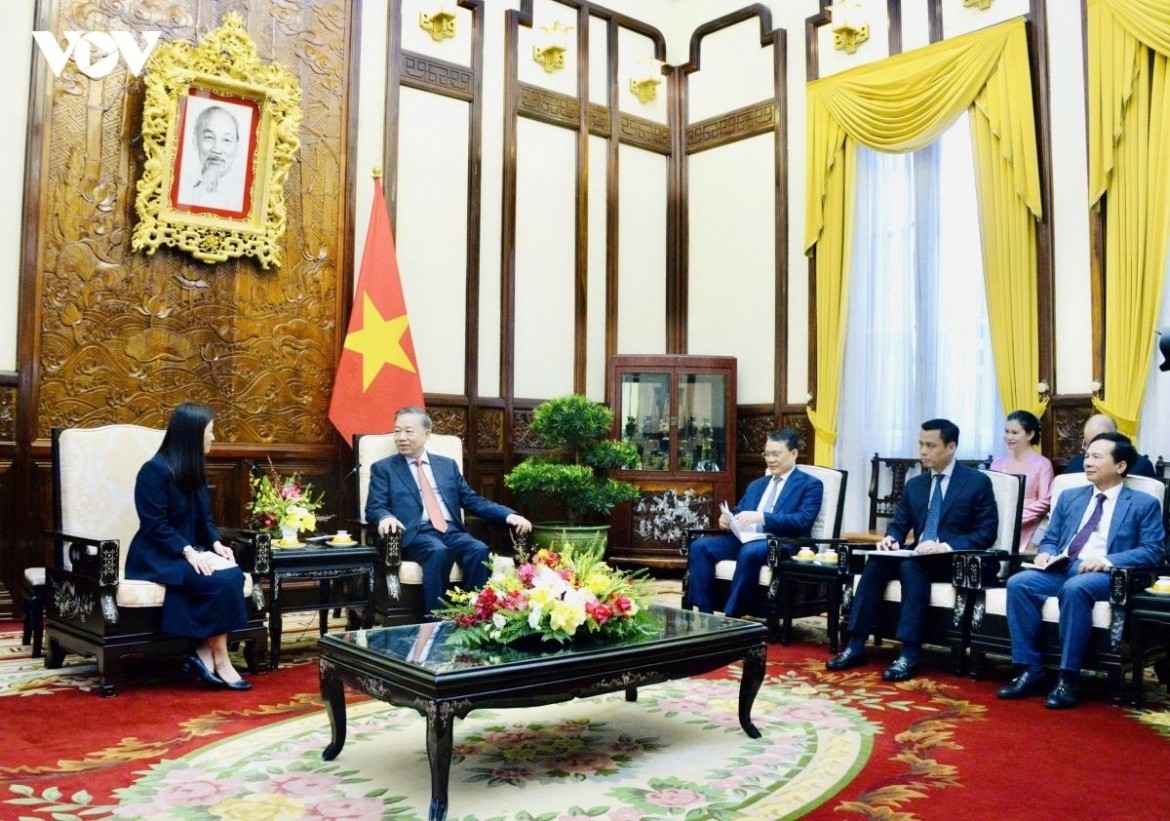
Party General Secretary To Lam made the statement during his reception in Hanoi on March 26 for leaders of major international corporations that are members of the Asia Business Council, including council chairman Arif Rachmat.
At the meeting, the Party chief expressed appreciation for the continued support and practical contributions of the international business community to Vietnam’s socio-economic development. He welcomed the Asia Business Council’s spring forum 2026 on the future of global supply chains held in Hanoi, noting that global supply chains are undergoing profound restructuring.
He highlighted that digital transformation and artificial intelligence are emerging as new foundational drivers of production and trade, while businesses play a central role in shaping new value chains, facilitating flows of trade, investment, technology and data, and enhancing economic connectivity in a more efficient, sustainable and resilient manner.
Emphasizing Vietnam’s development orientations, the Party leader said the country is committed to a socialist-oriented market economy under the leadership of the Communist Party and the management of the State. It is working to build a stable, transparent and adaptive business environment, positioning itself as a strategic destination for global investment flows and a hub for science, technology, innovation and digital transformation.
He outlined key strategic priorities, including improving institutions, developing modern infrastructure, enhancing high-quality human resources, promoting science and innovation, and advancing green and sustainable growth. These pillars are designed to support an open, deeply integrated economy capable of adapting to external shocks, VOV reported.
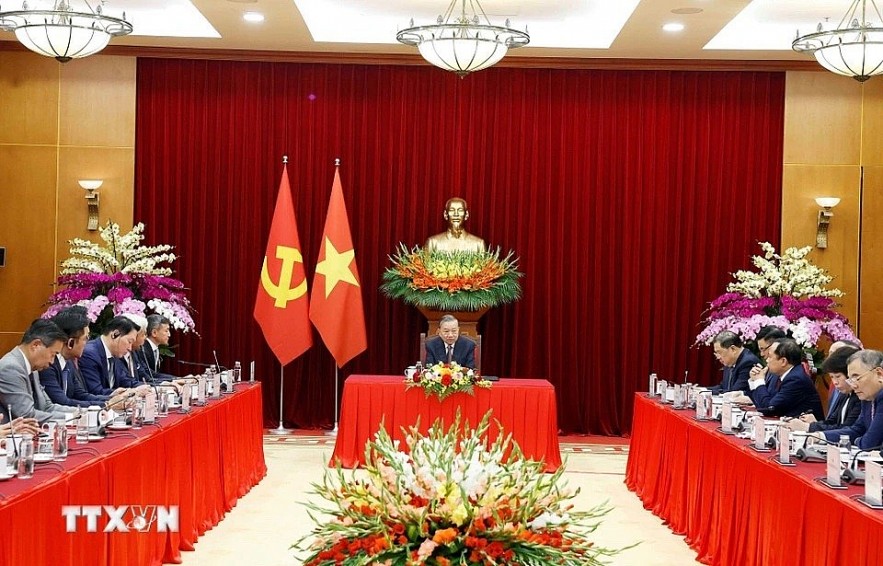 |
| Party General Secretary To Lam receives leaders of major international corporations that are members of the Asia Business Council in Hanoi on March 26. (Photo: VNA) |
According to the top leader, Vietnam considers the private sector a key growth driver, while the foreign-invested sector is regarded as an integral part of the economy and is encouraged to develop in a stable, long-term and competitive manner. The country stands ready to work alongside global enterprises to build supply chains that are more efficient, greener and more resilient amid global uncertainties.
The Party leader also welcomed constructive proposals from the business community, describing them as a reflection of strong interest and confidence in Vietnam’s market. He affirmed that Vietnam’s legislative, executive and judicial bodies, along with the broader political system, would continue to create the most favorable conditions for businesses to expand operations, strengthen international partnerships and integrate more deeply into global value chains.
Representing the business delegation, council chairman Rachmat and other corporate leaders expressed strong confidence in Vietnam’s development trajectory, praising its economic achievements and strategic vision. They reaffirmed their commitment to expanding investment in the country, particularly in infrastructure, artificial intelligence, green energy, smart agriculture, supporting industries, logistics, software and financial services.
These commitments are expected to contribute to enhancing Vietnam’s position in global supply chains and strengthening its long-term economic partnerships with international investors.
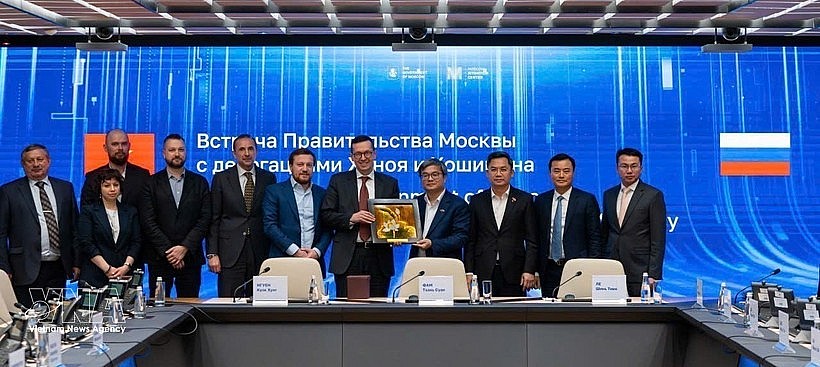 |
| Delegates of the two countries pose for a group photo at the meeting. (Photo: VNA) |
Vietnamese, Russian cities boost cooperation in urban infrastructure development
A trilateral working session between Moscow, Hanoi and Ho Chi Minh City has marked a new push to strengthen cooperation between the Vietnamese and Russian localities, particularly in developing sustainable urban transport infrastructure.
The meeting, held in Moscow within the framework of Prime Minister Pham Minh Chinh’s official visit to Russia from March 22 – 25, brought together officials from the three cities to exchange experience and explore collaboration opportunities, with a strong focus on the development of metro systems in the two largest urban centers of Vietnam.
Vyacheslav Manuilov, Acting Minister for External Economic and International Relations of Moscow, hosted the Vietnamese delegations and highlighted the Russian capital’s extensive expertise in building, managing and operating one of the world’s most advanced and heavily used metro networks.
He noted that Moscow has developed cutting-edge technological solutions across the entire process - from engineering design and construction in complex geological conditions to system management and operation, cited VNA.
Manuilov affirmed that the Moscow administration is ready to share its experience and cooperate with Hanoi and Ho Chi Minh City in developing metro systems.
Vice Chairman of the Hanoi municipal People’s Committee Truong Viet Dung, and Vice Chairman of the People’s Committee of Ho Chi Minh City Bui Xuan Cuong highly valued Russia’s achievements in smart urban transport infrastructure development.
They also expressed keen interest in gaining deeper insights into concrete cooperation models that could help accelerate the construction of metro lines currently under construction or in the planning stage in the Vietnamese cities.
The two sides discussed specific cooperation programmes to help strengthen collaboration in technical infrastructure and promote sustainable transport within the framework of the Vietnam–Russia Comprehensive Strategic Partnership.
Vietnam reinforces role as key regional electronics manufacturing hub
The Republic of Korea’s LG Group affiliates are accelerating production expansion in Vietnam alongside large-scale recruitment plans to meet rising global orders, particularly in high-tech sectors, further strengthening the Southeast Asian country’s position as a major electronics manufacturing hub in the region.
The new investment wave is expected to create tens of thousands of jobs while promoting technology transfer over the medium and long terms.
Local entities of LG Innotek and LG Display in Vietnam have proposed that Hai Phong authorities help with ensuring workforce supply for their production expansion plans. The move comes as Korean technology corporations intensify investment in Southeast Asia to diversify supply chains and leverage cost advantages, with Vietnam remaining a focal destination thanks to its strategic location and abundant labor force.
Park Hong Geun, Director of LG Innotek Vietnam, said the company’s V3 plant, specialising in camera modules for smartphones as well as optical solutions for AR/VR devices and smart vehicles, has officially commenced operations. To meet new orders, particularly next-generation camera modules, the company plans to recruit about 2,600 additional workers.
Alongside hiring efforts, the firm is preparing to build dormitories and expand employee welfare programmes to attract and retain workers amid increasing labor competition in major manufacturing centers, according to VNA.
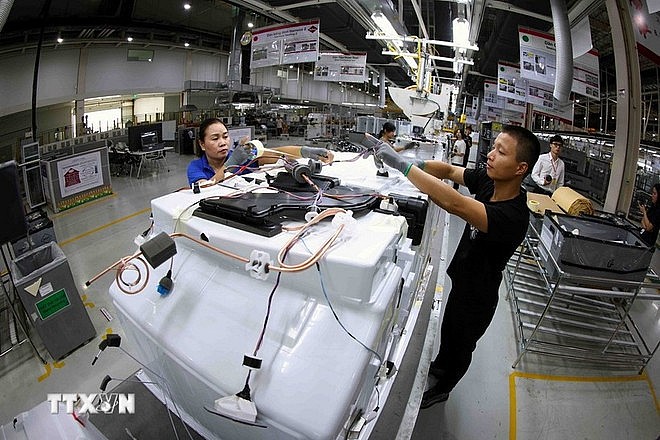 |
| An assembly line of the LG Electronics Vietnam Co. Ltd in Hai Phong city (Photo: VNA) |
Meanwhile, LG Display Vietnam announced plans to recruit up to 5,251 employees before June, driven mainly by production expansion at the Trang Due 3 Industrial Park to increase capacity for global orders.
Recruitment demand is expected to continue surging as expansion projects are completed, potentially requiring thousands of workers.
Earlier, representatives of LG companies operating in Vietnam, including LG Electronics, LG Display and LG Innotek, worked with the Hai Phong Economic Zone Authority to seek support in workforce development for production expansion and new product development.
Local authorities said Hai Phong is implementing multiple measures to address labor shortages, including strengthening vocational training, attracting workers from other provinces and organising large-scale job fairs to connect businesses with job seekers.
The city is also promoting closer cooperation between enterprises and educational institutions such as universities, colleges and vocational schools to develop a workforce aligned with increasingly advanced technical requirements in the electronics industry.
Experts noted that LG’s expansion and recruitment drive reflects not only growing market demand but also an accelerating shift in global supply chains as technology corporations diversify production locations to mitigate geopolitical risks and rising manufacturing costs.
Vietnam firms adapt to rising fuel costs with greener solutions
Rising fuel prices driven by tensions in the Middle East are pushing up production and transportation costs, prompting many businesses to accelerate energy-saving measures and shift towards electricity.
Businesses move to alternative energy
Speaking to VietNamNet, a representative of Hoa Phat Group said the upward trend in fuel prices amid Middle East tensions has directly impacted multiple sectors, including steel production. The company has seen clear effects in transporting raw materials and distributing products, as higher freight rates drive up input costs and final product prices.
According to Hoa Phat, developments in the Middle East remain complex and could affect market demand in the coming period. In response, the group is closely monitoring global economic and geopolitical fluctuations to adjust its production and business plans in a timely manner. At the same time, it is proactively diversifying raw material sources and consumption markets to mitigate risks.
Regarding energy-saving and optimisation solutions, Hoa Phat said it has implemented various measures at its steel production complexes. Notably, the company recovers waste heat generated during coke production and steelmaking to generate electricity, enabling it to meet around 90% of its power demand for production.
In addition, the group is expanding the use of alternative energy sources such as rooftop solar power at factories and industrial parks nationwide, VNN reported.
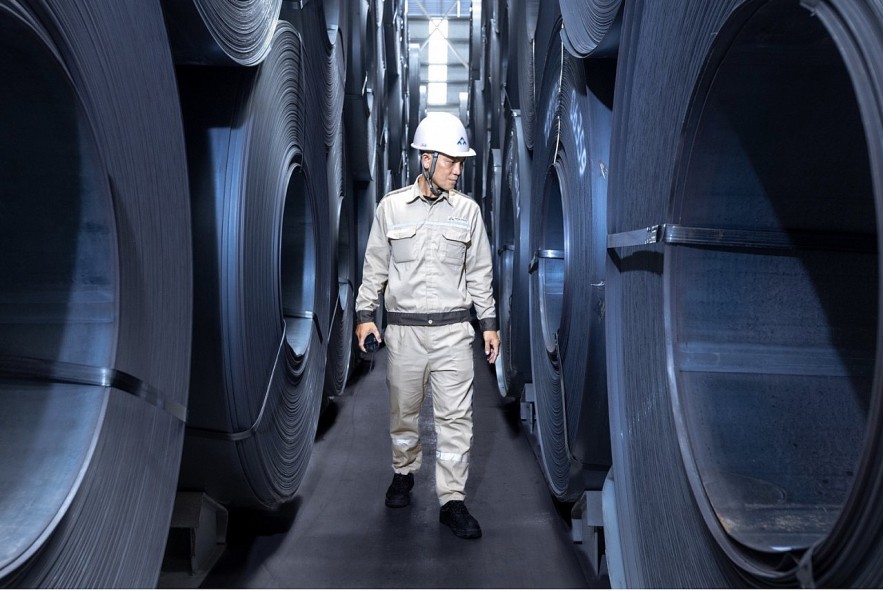 |
| Fluctuations in fuel prices are prompting businesses to take urgent response measures. |
Recently, Hoa Phat Dung Quat Steel Joint Stock Company, a subsidiary of the group based in Quang Ngai, began phase two of its rooftop solar project with a capacity of 22.5 MWp. The project is expected to supplement power supply for production, reduce energy costs and cut emissions, generating approximately 32.8 million kWh of clean electricity annually.
The group is also gradually converting vehicles powered by fossil fuels to electric alternatives, including forklifts, excavators, scrap processing equipment and internal transport trucks, in an effort to lower energy costs and emissions.
Need for additional support measures
The Department of Domestic Market Management and Development under the Ministry of Industry and Trade noted that fuel prices in Vietnam remain significantly lower than in many neighbouring countries, reflecting effective regulatory measures and price stabilisation tools.
However, current developments show that economies dependent on imported energy are vulnerable to geopolitical shocks. In the short term, the agency suggested prioritising supply security, maintaining flexible price management and strengthening market control. In the long term, it emphasised the need to increase strategic reserves, improve energy efficiency, expand renewable energy development and enhance regional cooperation to address disruptions at key chokepoints such as the Strait of Hormuz.
Nguyen Tu Anh, Director of Macroeconomic Policy Research at the Green-X Center under VinUni, said the situation in the Middle East and oil price movements are directly affecting all aspects of life and the economy.
According to the expert, the top priority at present is securing alternative supply sources to ensure energy security and maintain sufficient supply levels to prevent economic disruption.
Secondly, if supply is maintained but prices remain high, the government should introduce appropriate support policies to reduce the risk of stagflation - a combination of high inflation and slow growth. Rising prices increase production costs and consumer prices, fuelling inflation, while high costs can dampen demand and hinder production, potentially leading to economic slowdown.
He stressed that once an economy falls into stagflation, returning to normal conditions is extremely difficult, making preventive measures essential. If fuel supply remains stable despite high prices, targeted price support policies should be applied to sustain economic activity.
“In recent times, authorities have used the fuel price stabilisation fund and reduced import taxes on fuel products to zero, helping ease price pressures,” he said. However, if prices continue to rise, he supports the proposed reduction of environmental protection tax, along with possible cuts or temporary exemptions of special consumption tax and value-added tax on fuel.
In addition, the government could implement emergency support packages to subsidise businesses and households in response to price shocks. Measures may include supporting fuel retailers, providing guarantees or credit subsidies to offset rising costs, with repayment possible once business conditions stabilise and profitability returns.
He noted that such solutions would help mitigate stagflation risks, maintain market confidence, stabilise society and improve the investment environment. Once the crisis subsides, the economy would be better positioned for a faster recovery.
Rising airfares drive travel shift ahead of peak holiday season
Vietnam’s domestic tourism industry is facing mounting pressure from rising transport costs, particularly airfares, as demand for travel increases during the peak holiday season.
While travel demand has picked up, many holidaymakers are reconsidering their plans as ticket prices for flights, trains and buses continue to climb, directly affecting travel decisions.
Market observations show that domestic airfares tend to surge on weekends and ahead of public holidays, at times reaching 1.5 to 2 times higher than off-peak levels. One-way tickets that typically range from VND1.5 million to VND3.8 million can rise to VND4–5 million during peak periods.
Routes such as Hanoi–Da Nang have seen sharp increases, with fares climbing to nearly VND5 million per leg during peak times. As a result, some travelers are shifting to nearer destinations or choosing weekday departures to reduce costs.
Le Ngoc Diep, a resident of Hanoi, said her family had initially planned a beach holiday but decided to change their destination due to high airfare costs, noting that ticket prices could rival or even exceed accommodation expenses.
Similarly, Nguyen Phuong Lien, another resident from Hanoi, said travel planning has become more cost-sensitive, especially for families. She noted that round-trip airfare for a family of three to four could reach VND8–10 million during peak periods, prompting them to book early or adjust travel schedules.
The rise in airfares is not only affecting travelers but also reshaping strategies within the tourism industry, cited VOV.
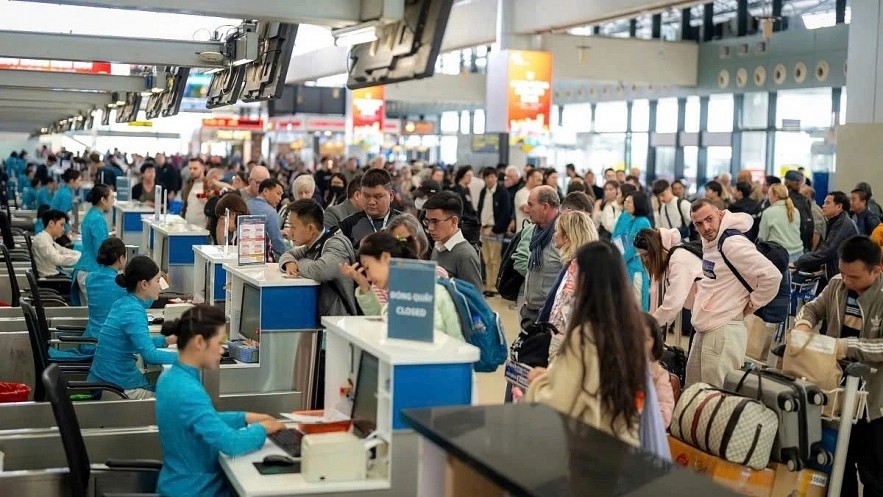 |
| Passengers complete check-in procedures at Noi Bai International Airport in Hanoi. |
Bui Thanh Tu, marketing director at BestPrice Travel, pointed out that while customer interest in tours remains strong, many hesitate to make bookings due to high ticket prices. In response, companies are designing tour packages to nearby destinations accessible by road or private vehicles to help reduce overall costs.
Travel firms are also working with airlines to secure fixed ticket allocations, allowing them to offer more stable and competitive pricing compared to flexible flight options, he added.
Nguyen Cong Hoan, general director of Flamingo Redtours and a representative of the Vietnam Tourism Association, shared rising airfare costs are accelerating a shift toward alternative transport, particularly rail travel, which is less sensitive to fuel price fluctuations.
He noted that railway tourism saw strong growth last year and is expected to remain a popular choice, while both travelers and tour operators are adjusting budgets by balancing transport costs with spending on accommodation and services.
Rising transport costs are driving noticeable changes in travel behaviour. Instead of relying primarily on air travel, more tourists are exploring alternative transport options and choosing closer destinations.
From a broader perspective, this shift presents an opportunity for Vietnam’s domestic tourism market to diversify. Road and rail travel, along with short-haul destinations, are regaining attention as the industry adapts to evolving cost structures and consumer preferences.
 | Vietnam News Today (Mar. 22): Vietnam Reaffirms Russia as Key Strategic Partner Vietnam News Today (Mar. 22): Vietnam and Indonesia to deepen strategic cooperation across key sectors; PM’s official visit to bolster Vietnam-Russia Comprehensive Strategic Partnership; PM ... |
 | Vietnam News Today (Mar. 23): Prime Minister Pham Minh Chinh Leaves for Official Visit to Russia Vietnam News Today (Mar. 23): Prime Minister Pham Minh Chinh leaves for official visit to Russia; Cambodian solidarity front delegation visits Ninh Binh to boost ... |