
High-Tech Exports Drive Vietnam’s Economic Acceleration
| Netherlands to Strengthens Economic Relations, High-tech Cooperation with Vietnam Hanoi Convention: Identifying and Combating High-Tech Fraud Crimes |
On October 6, the WB released its East Asia and Pacific Economic Update, raising its forecast for Viet Nam’s economic growth in 2026 by 1.1 percentage points to 7.4%, the highest rate in the region.
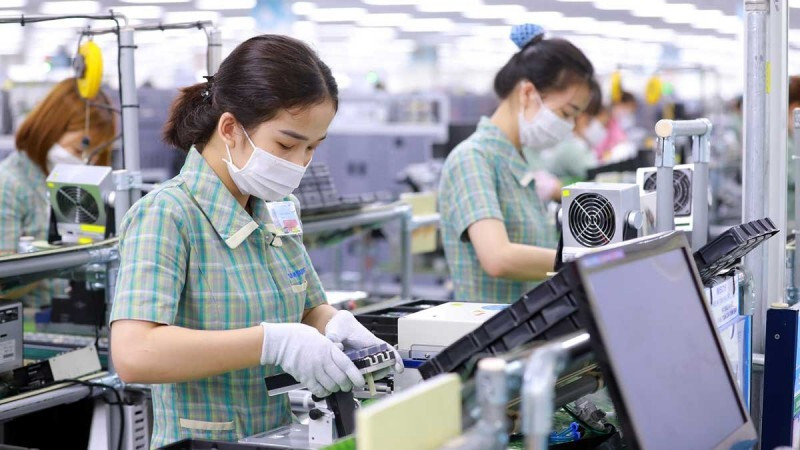 |
| Illustrative photo: The World Bank continues to identify Viet Nam as the fastest-growing economy in the East Asia and Pacific region. |
According to the WB, Viet Nam’s economy grew by 8.02% in 2025 and accelerated further to 8.3% in the first half of 2026, leading the EAP region. Manufacturing, exports and public investment were the main drivers of this growth.
In the first eight months of 2026, merchandise exports rose by 22% year on year, with electronics and machinery continuing to play a central role. In August alone, merchandise exports increased by 26% year on year.
The WB also noted that investment in the electronics and machinery sectors remained robust, while FDI inflows in the first half of 2026 reached their highest level in five years.
Notably, Viet Nam is becoming increasingly integrated into technology supply chains, with AI-related products making a significant contribution to export growth. This is also why Viet Nam received the largest upward revision to its 2026 export growth forecast among EAP economies.
According to the WB, the global AI investment boom is creating additional opportunities for economies participating in technology supply chains. China, Indonesia, Malaysia, the Philippines, Thailand and Viet Nam exported a combined total of approximately US$1.4 trillion in AI-related goods in the 12 months through April 2026.
Within these supply chains, Viet Nam holds a notable position in equipment assembly. Computers, servers and routers account for approximately 60% of the country’s exports of AI-related goods, a large proportion of which serves final demand in the US.
Alongside exports and manufacturing, public investment continues to be an important growth driver. The WB said Viet Nam’s public investment plan for the 2026-2030 period maintains an upward trajectory, focusing on critical infrastructure, including energy, transport and logistics, with the aim of raising total investment to 40% of GDP.
Nevertheless, the WB forecasts that Viet Nam’s economic growth will ease slightly to 7.3% in each of the following two years, 2027 and 2028. Even so, the 1.1-percentage-point upward revision to the 2026 forecast makes Vietnam the country with the largest upward adjustment in projected economic growth in the region.
Despite the improved growth outlook, WB experts have also warned of several pressures on Viet Nam’s economy, foremost among them inflation. According to the report, inflation rose from 2.53% in January 2026 to 4.89% in August, mainly due to rising fuel, housing and utility costs. The WB forecasts average inflation of 4.2% for the whole of 2026.
Meanwhile, imports are growing faster than exports. According to the WB, this partly reflects businesses building up inventories of electronic goods, alongside increases in chip and fuel prices.
Notably, Viet Nam’s petroleum import bill has risen sharply. Together with the increase in import costs, interventions to stabilize domestic fuel prices have contributed to a decline in foreign exchange reserves. The WB expects Vietnam’s foreign exchange reserves in 2026 to cover less than two months of imports. From a longer-term perspective, the WB noted that Viet Nam’s growing dependence on AI supply chains also introduces a new type of risk.
Franziska Ohnsorge, the WB’s Chief Economist for Asia, said whether Viet Nam’s target of achieving double-digit economic growth marks the beginning of a new phase of development or remains merely a short-term goal will depend heavily on shifts in the external environment.
According to Ohnsorge, Viet Nam is one of the world’s most open economies and is also heavily reliant on its participation in value chains that apply and develop AI technologies. Therefore, if the global growth momentum driven by the AI boom continues, Viet Nam will be well positioned to benefit. Conversely, the economy could be vulnerable if global economic activity slows.
Overall, the WB assesses that Viet Nam is clearly benefiting from its position in high-tech value chains and the wave of AI-related investment. Together with public investment and structural reforms, these factors are laying the foundation for a significant upward revision to the country’s growth outlook for 2026.
However, inflationary pressures, faster import growth, declining foreign exchange reserves and the risk of a reversal in global AI demand are all factors Viet Nam will need to monitor in the coming period.
 Vietnam, Italy Strengthen High-Tech Cooperation Vietnam, Italy Strengthen High-Tech Cooperation On the afternoon of July 29 in Hanoi, Minister of Public Security Luong Tam Quang received Daniele Tavano, Senior Vice President of Italy's Leonardo S.p.A., to discuss technological cooperation in support of security and public order. |
 Top Vietnamese Leader Highlights Strategic Mineral, High-tech Cooperation with Australian Firms Top Vietnamese Leader Highlights Strategic Mineral, High-tech Cooperation with Australian Firms General Secretary of the Communist Party of Vietnam (CPV) Central Committee and President To Lam received leaders of Australian businesses in Canberra on August 12 morning (local time), highlighting opportunities to expand cooperation in strategic mineral supply chains, high technology and innovation as the Comprehensive Strategic Partnership between the two nations enters a new phase. |


Most read


Related Stories
 National
Viet Nam News Today (Oct. 7): Viet Nam, Panama Highlight New Opportunities for Trade and Investment
 Economy
Viet Nam Leads Growth Projections for Major ASEAN Economies
 Economy
Viet Nam’s Push Toward Technology-Driven Growth
 Economy
Promoting Role of Private Economic Sector
Popular article
 Economy
Azbil to Present Automation Solutions as a Platinum Partner at Industrial Transformation ASIA-PACIFIC 2026
 Economy
New Opportunities for Breakthroughs In Viet Nam - Canada Science and Technology Cooperation
 Women in Business
Mai Kiều Liên: From a dairy engineer to one of Asia's 100 most powerful women
 Economy