
Viet Nam’s Push Toward Technology-Driven Growth
| Viet Nam’s National Day Spirit Reaches Communities and International Friends Viet Nam Sakha Highlight Labor Cooperation and Local Connectivity |
Against this backdrop, international organizations broadly agree that for Viet Nam, shifting the growth model from one heavily reliant on traditional factors toward technology and innovation is no longer an option but an imperative of the times.
According to the latest country classification by the World Bank Group, Viet Nam’s gross national income (GNI) per capita has reached US$4,970, surpassing the threshold required to officially enter the upper-middle-income group. This achievement ends the country’s 17-year period in the lower-middle-income category, which began in 2009. Yet behind this historic milestone lies a new chapter of development accompanied by major challenges.
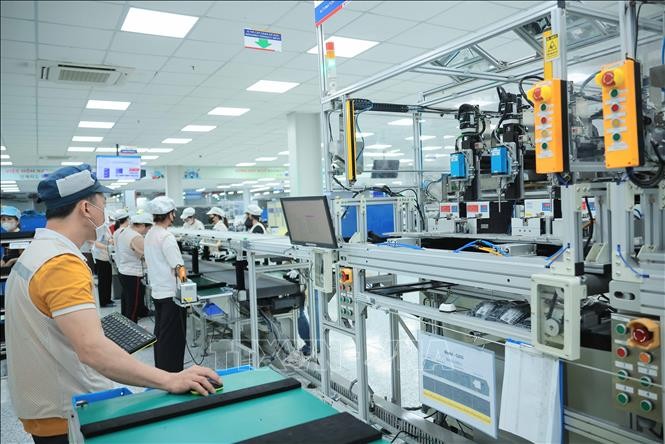 |
| Viet Nam's FDI continues to grow (Photo: VNA) |
To advance to high-income country status by 2045, Viet Nam’s GNI per capita will need to nearly triple from its current level. This is a formidable challenge, as global economic history since 1990 shows that only 27 economies have successfully escaped the middle-income trap. More than one-third of these economies benefited from special circumstances that are difficult to replicate, such as joining the European Union (EU) or possessing abundant natural resources.
Therefore, Shantanu Chakraborty, Country Director of the Asian Development Bank (ADB) in Viet Nam, said Vietnam’s real challenge is not achieving short-term growth milestones, but its ability to sustain high, resilient and high-quality growth consistently over many years.
Meanwhile, international experts share the view that Viet Nam’s previous extensive growth model has approached its limits. Shantanu Chakraborty said Vietnam can no longer continue to rely heavily on capital, low-cost labor and the foreign direct investment (FDI) sector as the main drivers of growth.
Echoing this view, Russian economist Irina Dezhina of the Institute of Sociology under the Russian Academy of Sciences noted in an article published on the website of the Russian International Affairs Council that although Viet Nam’s open-door policy has enabled major technological advances, domestic technological self-reliance remains a significant gap.
The expert noted that while FDI has made a major contribution to gross domestic product (GDP) growth, the transfer of technology and management skills to domestic enterprises remains limited. As a result, Viet Nam continues to focus primarily on lower-value-added stages and final product assembly.
According to Irina Dezhina, this limitation shows that Vietnam has succeeded in attracting and adopting technology but has yet to fully develop an ecosystem capable of generating technology domestically. Therefore, to avoid being left behind in the era of technology and automation, Viet Nam must transform its development model.
The urgency of this transformation has been further heightened by risks stemming from Viet Nam’s high degree of economic openness. Mariam J. Sherman, World Bank Country Director for Viet Nam, and Bui Minh Giap, ADB’s Chief Economist, have both placed particular emphasis on this issue. With total imports and exports equivalent to approximately 170% of GDP, Viet Nam is currently one of the world’s most open economies.
Bui Minh Giap explained that this characteristic makes the Vietnamese economy highly sensitive and vulnerable to any international “headwinds,” ranging from fluctuations in global trade and new tariff barriers to declining consumer demand in major export markets.
Therefore, Mariam J. Sherman recommended that Viet Nam diversify its growth drivers and shift toward a new development model to strengthen its own resilience rather than relying excessively on external factors.
In the process of transforming its growth model, Irina Dezhina identified four advantages that give Viet Nam strong potential for technological development: its proximity to major technology manufacturing hubs in Southeast Asia; its favorable location for accessing the Chinese and Indian markets; its possession of rare earth resources that are critical to semiconductor manufacturing; and its rapid restoration of market-economy mechanisms, creating favorable conditions for structural transformation toward technology-intensive sectors.
Faced with the need for transformation and these existing advantages, Viet Nam has in fact proactively introduced a series of strong policy measures to promote technology and innovation, with initial results showing tangible progress. Assessing Viet Nam’s technological advances, Dr. Irina Dezhina cited the 2025 Global Innovation Index, under which Viet Nam ranked 44th out of 139 economies in terms of technological development. Notably, Vietnam ranked 37th in overall innovation performance, significantly outperforming its 50th-place ranking for innovation inputs. The Russian expert also noted that Viet Nam has highly developed telecommunications infrastructure, with nationwide 5G coverage, and ranked 10th among 21 Asia-Pacific economies in the 2025 Digital Nations Index.
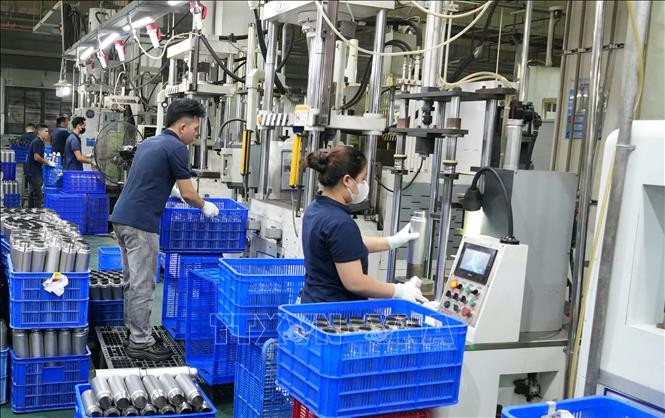 |
| The automated robot-assisted production line at CAYI Technology Vietnam Co., Ltd., Yen Phong II-C Industrial Park, Bac Ninh Province. (Photo: Dong Thuy/VNA) |
Viet Nam’s transformation is also reflected in actual figures from the global technology trade landscape. In the World Development Report 2026: The Promise of Artificial Intelligence, the World Bank Group noted that Vietnam has risen into the ranks of the world’s five leading developing-country exporters of products serving artificial intelligence (AI) systems, including semiconductors, electronic components, and data-center equipment. This breakthrough has also received high praise from India-based economic analysis website economicsperspective.com.
Experts from the website said that the surge in exports of AI-integrated products is providing a core impetus for Viet Nam to lead the shift from exporting traditional goods toward advanced technology products, enhancing its competitiveness and strengthening its position in global supply chains.
To truly master the new growth model, Viet Nam is focusing its resources on two core technologies of the new era: semiconductors and artificial intelligence (AI). Japan’s Nikkei Asia has noted that the rapid development of Vietnam’s semiconductor industry is creating an opportunity for the country to shift from a growth model heavily dependent on labor and manufacturing toward higher-value-added sectors, bringing it closer to its goal of joining the ranks of high-income economies.
Nikkei Asia has praised Viet Nam for moving beyond low-value-added activities at the end of the semiconductor value chain, such as assembly, packaging, and testing, and for proactively seeking to expand its participation in integrated-circuit design and wafer fabrication. Viet Nam’s determination is further reflected in its target of training more than 50,000 engineers and bachelor’s degree holders for the semiconductor industry by 2030.
Alongside semiconductors, AI is also being viewed as a lever that could enable Vietnam to achieve a breakthrough in its economy. Indermit Gill, Senior Vice President and Chief Economist of the World Bank Group, said AI presents a historic opportunity for developing countries to compress their development trajectories from a century or more to just a decade. He emphasized that countries do not necessarily need to possess large-scale AI models or massive data centers to benefit from AI. Instead, by adapting smaller, low-cost AI tools to local conditions, countries can deliver better-quality healthcare, education, justice, and agricultural extension services to millions of people.
By clearly recognizing the limitations of its previous growth model, proactively seizing opportunities presented by the two pillars of semiconductors and AI, and demonstrating strong political determination, Viet Nam is gradually transforming its growth model toward one driven by technology and innovation. This transformation will be key to helping the economy weather external “headwinds” and move toward its goal of becoming a high-income country by 2045.
 Pakistan Praises Viet Nam’s Development Achievements Pakistan Praises Viet Nam’s Development Achievements This was the assessment and remarks shared by Pakistani leaders at a ceremony marking the 81st anniversary of Viet Nam’s National Day on September 2, held at the premises of the Embassy of Viet Nam in Islamabad. |
 National Assembly President Meets Korean Friends in Seoul National Assembly President Meets Korean Friends in Seoul National Assembly (NA) President Tran Thanh Man stressed that Korean non-governmental organisations, associations, scientists and businesses have contributed significantly to major achievements recorded in Vietnam-RoK relations over the past years. |


Most read


Related Stories
 Economy
Viet Nam, US Seek Higher-Quality Economic Ties
 National
Viet Nam News Today (Oct. 13): EU-Vietnam Partnership Set for Deeper Cooperation and Tangible Results
 Economy
High-Tech Exports Drive Vietnam’s Economic Acceleration
 Economy
New Opportunities for Breakthroughs In Viet Nam - Canada Science and Technology Cooperation
Recommended
 Economy
India set to rank as world’s fourth-largest economy in 2027: IMF
 Economy
India is powering Nielsen’s AI push from GCC to global innovation engine:
 Economy
Sprite Expands Global Basketball Footprint with NBA’s Nikola Jokić and New "Never Stop Refreshing The Game" Platform
 Economy
Media OutReach Newswire Founder & CEO Jennifer Kok Named Top Nominee in the Woman Entrepreneur Category for EY Entrepreneur Of The Year™ 2026 Malaysia
Popular article
 Economy
India announced steel policy with a target of 604 million tons capacity by 2047
 Economy
KPLASS Singapore Officially Launches Its Far-Infrared Patches in Vietnam
 Economy
India expands its defence exports
 Economy