
Practical Livelihood Support for Poor and Near-Poor Households In Thai Nguyen
| VUFO Delegation Visits Historical Site in Thai NguyenOxfam Amplifies Indigenous Knowledge, Paving the Way for Sustainable Livelihoods |
In late August, as part of the livelihood support program, the Thai Nguyen Provincial Federation of Labor visited Phong Quang Commune to provide breeding livestock and agricultural machinery to four poor and near-poor households.
Under this round of support, Phung Xuan Phau of Na Pan Village and Nguyen Van Duong and Ha Dinh Chi of Na Di Village received assistance to purchase breeding buffaloes. Meanwhile, the household of Luong Thi Huyen of Phac Trang Village received a soil tiller to support agricultural production.
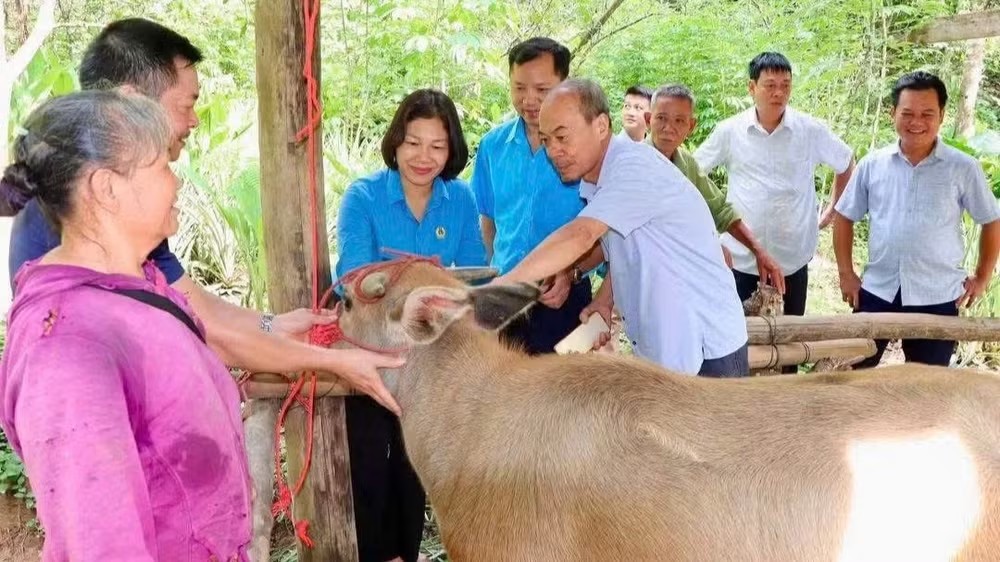 |
| The Thai Nguyen Provincial Federation of Labor presents a breeding buffalo to a poor household in Phong Quang Commune. (Photo: Thu Hue) |
At the same time, it is a practical approach to encouraging poor and near-poor households to become more self-reliant and determined to improve their circumstances. The program provides additional motivation for people to actively develop their livelihoods, increase their incomes, improve their living conditions, and gradually achieve sustainable poverty reduction.
Over recent months, political and social organizations at the provincial level, along with all Vietnam Fatherland Front Committees at the commune level in Thai Nguyen, have simultaneously implemented livelihood support initiatives for poor and near-poor households.
Rather than providing only cash or essential goods as short-term assistance, the livelihood support model focuses on supplying households directly with means of production, such as breeding animals, seedlings, labor tools, and production equipment.
Following the administrative boundary merger, Thai Nguyen still has a considerable number of poor and near-poor households, particularly in mountainous areas and regions inhabited by ethnic minority communities. This situation requires more fundamental and sustainable solutions.
Therefore, the development and implementation of the program carries practical significance, helping shift the approach from “relief-oriented support” to “giving people the means to make a living.” By providing the necessary means of production, the program enables people to take the initiative in developing their livelihoods and increasing their incomes. This approach represents an important innovation by the Viet Nam Fatherland Front Committee of Thai Nguyen Province and makes a significant contribution to the province's poverty-reduction efforts.
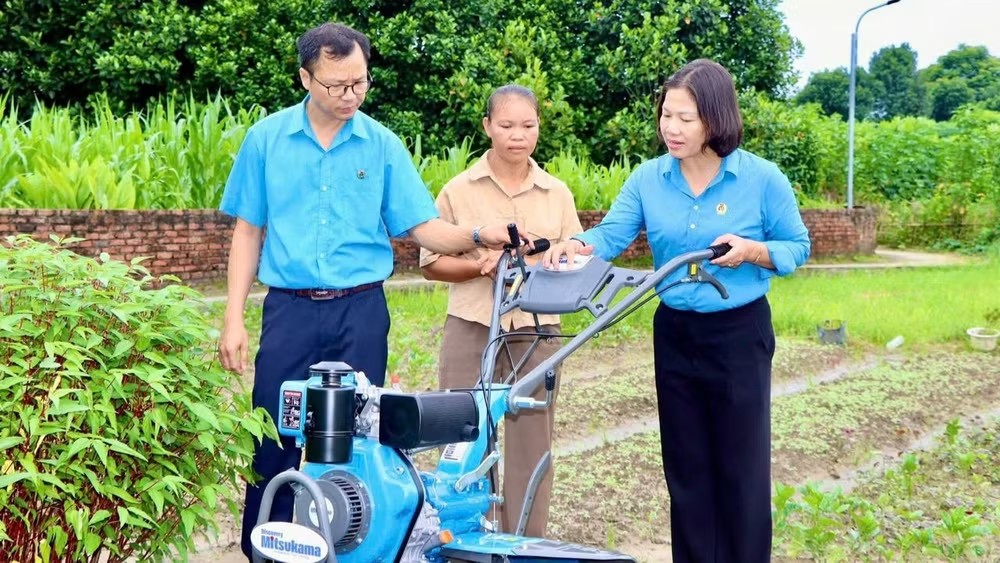 |
| The Thai Nguyen Provincial Federation of Labor provides a tiller to a poor household as livelihood support. (Photo: Thu Hue) |
The program aims to provide livelihood support to at least 1,000 poor and near-poor households during the 2026-2030 period, with a minimum level of VND 20 million per household. Support will be provided through production resources such as seedlings, breeding animals, agricultural inputs, and production equipment.
The program has set specific targets, including ensuring that 100% of beneficiary households receive training and technical guidance; 100% have access to preferential credit; at least 60% of participating households escape poverty after taking part in the program; and effective livelihood models with potential for replication are developed.
The program emphasizes the principle that support will not be provided directly in cash, but in the form of in-kind assistance linked to specific production plans. Implementation will be subject to regular monitoring and evaluation to ensure tangible and effective results.
To ensure effective implementation, each participating unit has been assigned specific targets and provided with detailed guidance on how to carry out the program.
Accordingly, the Thai Nguyen Provincial Viet Nam Fatherland Front Committee will support at least 50 households; each political-social organization will support at least seven households; 100% of other member organizations of the provincial Viet Nam Fatherland Front Committee will contribute resources and support at least eight households; all Viet Nam Fatherland Front Committees at the commune level will support at least one household; and Viet Nam Fatherland Front Committees at the ward level will support at least two households.
The initial level of support will be at least VND 20 million per household, to be used to purchase seedlings, breeding animals, agricultural inputs, and equipment for production and business activities. At least 65% of beneficiary households will be located in mountainous and highland communes and areas inhabited by ethnic minority communities.
The Thai Nguyen Provincial Viet Nam Fatherland Front Committee has also requested that Vietnam Fatherland Front Committees at all levels and political-social organizations take the lead in, or integrate into their activities, inspections and supervision of the program's implementation. All poor and near-poor households receiving livelihood support in 2026 will be monitored and evaluated to assess the results of the assistance.
According to Dam Quang Tuyen, Vice Chairman of the Thai Nguyen Provincial Vietnam Fatherland Front Committee, participating organizations will focus on training beneficiaries to improve their household economic management skills, transfer scientific and technical knowledge, and promote the application of information technology. These measures are intended to help beneficiaries use the assistance effectively, minimize risks, and improve their ability to maintain sustainable livelihoods over the long term.
Viet Nam Fatherland Front Committees at all levels will also mobilize businesses, cooperatives, and production and trading establishments to participate in the initiative to “accompany poor households” in developing livelihood models and establishing market linkages for their products. This will gradually improve the stability of market outlets, thereby enhancing the effectiveness and sustainability of the livelihood models.
 Coast Guard Region 2 Launches IUU Fishing Crackdown Coast Guard Region 2 Launches IUU Fishing Crackdown Coast Guard Region 2 Command on September 3 said that during the first days of the peak month for combating illegal, unreported and unregulated (IUU) fishing, Coast Guard Ship 4038 of Squadron 212, Coast Guard Flotilla 21, has intensified patrols and inspections in the southwestern waters, while combining these activities with legal awareness campaigns and guidance for fishermen to help prevent illegal fishing. |
 Pakistan Praises Viet Nam’s Development Achievements Pakistan Praises Viet Nam’s Development Achievements This was the assessment and remarks shared by Pakistani leaders at a ceremony marking the 81st anniversary of Viet Nam’s National Day on September 2, held at the premises of the Embassy of Viet Nam in Islamabad. |

Most read


Related Stories
 Overseas Vietnamese
Promoting Important Role of Vietnamese Youth in Japan
 Viets Home
Oxfam Amplifies Indigenous Knowledge, Paving the Way for Sustainable Livelihoods
 Focus
Focus
VUFO Delegation Visits Historical Site in Thai Nguyen
 Friendship
Thai Nguyen Keen On Fostering Business Opportunities With Thai Firms
Recommended
 Expats in Vietnam
Football and Friendship Unite 20 International Teams in Hanoi
 Viets Home
Over 2,300 Hai Phong Students Gain Access to STEAM Learning Spaces and Psychological Counseling
 Viets Home
260 Households in Lai Chau Receive Emergency Aid Following Floods and Landslides
 Viets Home
Bringing Disaster Preparedness Skills into Schools
Popular article
 Viets Home
Eight More Sets of Martyrs’ Remains Found at Le Thi Rieng Park
 Viets Home
International Resources Support Climate Education and Forest Restoration in Thanh Hoa
 Viets Home
Vietnamese and RoK Doctors Provide Free Surgery for Children with Birth Defects in HCMC
 Viets Home