
Small “Tips” for Teaching Vietnamese to Foreigners
 | Vietnamese Bookcases: Contributing to Preservation and Development of Vietnamese Language Around the World |
| Dr. Hoang Thi Hong Ha: Vietnamese Language Ambassador from Paris |
Unexpected Situations
“What does 'bu' mean? A: A type of lock, B: Mother, C: A style of singing, D: A type of spice.”
The contestant was unable to answer immediately and had to seek help from the studio audience. The results: 28% chose C, 26% chose B, 24% chose A, and 22% chose D.
“I believe this was a challenge set by the audience for a foreign participant in a Vietnamese-language game show. Therefore, I’m sorry, but I will not choose the majority answer and instead choose B. 'Bu' means mother.”
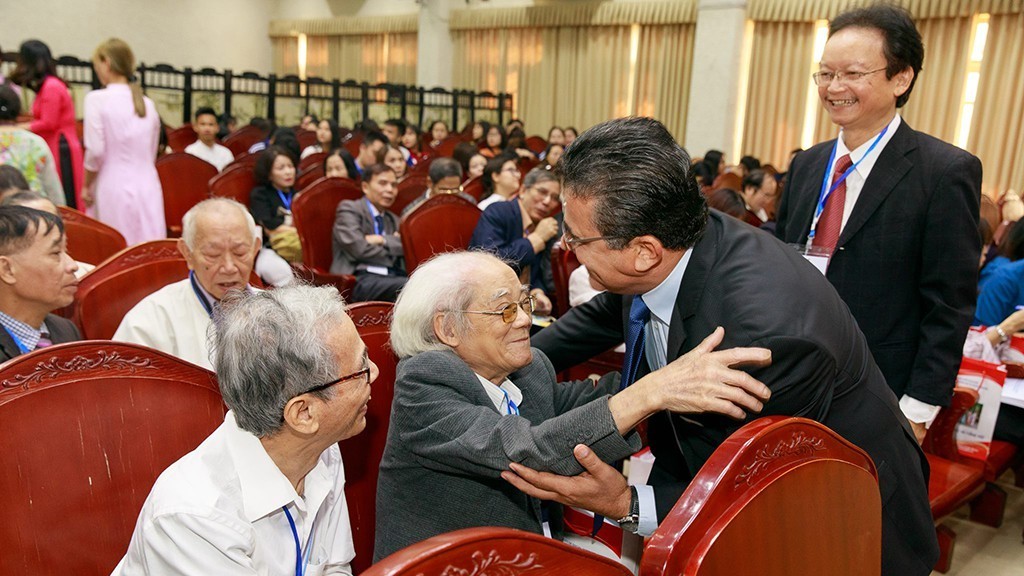 |
| Ambassador Saadi Salama, the Ambassador Extraordinary and Plenipotentiary of Palestine to Vietnam, and Professor Hoang Trong Phien. |
Ambassador Saadi Salama’s answer on the program "Who Wants to Be a Millionaire?" earned him a round of applause from the entire studio.
“Answer B comes from a memory of my visit to a rural village in Northern Vietnam, where local people explained that 'bu' and 'thầy' are used in place of ‘mother’ and ‘father’,” Ambassador Saadi Salama shared.
“Vietnamese is very hard” is a common phrase among most foreign students who embark on learning the language. Many have “surrendered” and given up after just a few weeks, or even a few months, of study. Yet many others have successfully mastered Vietnamese. Ambassador Saadi Salama of Palestine is one of those success stories.
However, in the process of teaching Vietnamese to foreign learners, every teacher must face unexpected situations. Chu Thi Phong Lan, a lecturer at the Faculty of Vietnamese and Southeast Asian Linguistics and Culture, University of Languages and International Studies, Vietnam National University, Hanoi, has experienced no shortage of such moments.
She recounted: “There was once a Japanese student who suddenly burst into tears when the teacher asked about her family, only later did we learn she had recently lost a loved one and had not yet recovered from the sorrow. Another student from the United States refused to continue studying because he felt ‘offended’ when teachers repeatedly corrected his pronunciation.”
In addition, Phong Lan noted that many foreign learners experience “linguistic-cultural shock” during their first lessons. They become confused when Vietnamese people “say one thing but mean another”; they do not understand why the word 'dạ' can express dozens of different nuances; or they are surprised when, upon first meeting, they are asked about their age, occupation, and even salary. Differences that may seem small can become major obstacles, leaving learners feeling awkward and struggling to adapt to Vietnamese communication norms.
For such cases, teachers begin the first lesson with lighthearted games and everyday stories to help learners feel comfortable and connected to the class. When students sense empathy and experience a friendly learning atmosphere, they become more willing to open up, share, and participate actively in classroom activities.
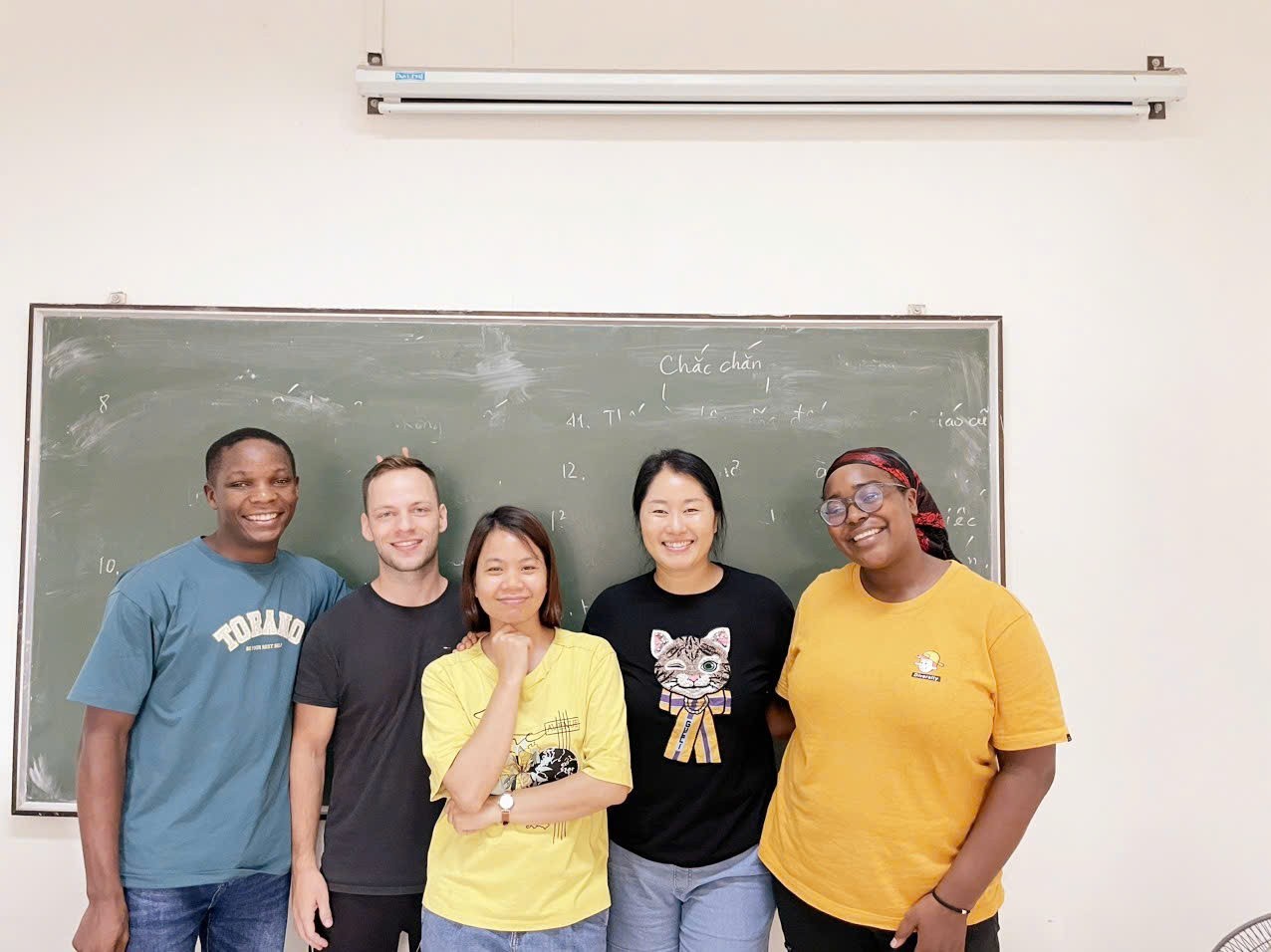 |
| Teacher Phong Lan (third from left) with foreign students. |
Experiences in Teaching Foreign Learners
Each learner carries a different linguistic, cultural, and psychological background. Therefore, according to Phong Lan, every teacher of Vietnamese as a foreign language needs to equip themselves with a system of essential experiences and skills, from the ability to understand learners’ psychology and cultural characteristics to choosing appropriate teaching methods. Only then can the process of teaching and learning Vietnamese truly become an exciting journey of discovery for both teachers and learners.
First, it is important to be flexible when handling classroom situations. When unexpected situations arise, what teachers need most is composure and sincerity. Teachers can tactfully pause the lesson and invite the learner outside for a private conversation. When learners feel respected and listened to, they will be ready to return to class and put in more effort.
Second, teachers must enhance their skills in recognizing learners’ psychological states. One of the most important skills for teachers of Vietnamese to foreigners is the ability to identify and understand learners’ emotions. Teachers should begin the first session with light activities such as ice-breaking games, everyday stories, or simple communication scenarios. These activities not only help learners relax but also create a sense of closeness and connection between the teacher and the class.
When learners sense empathy and a friendly learning environment, they will be more willing to open up, share, and participate actively in learning tasks. This establishes the foundation for building confidence, maintaining motivation, and ensuring an effective and sustainable Vietnamese learning process.
Third, teachers should focus on teaching skills. Today, the action-oriented approach in language teaching has narrowed the gap between classroom language and real-life language. This is done by having learners complete tasks assigned by the teacher using the target language. Based on this approach, teachers should center their teaching activities on practicality and applicability. This should be applied to all four skills: listening, speaking, reading, and writing.
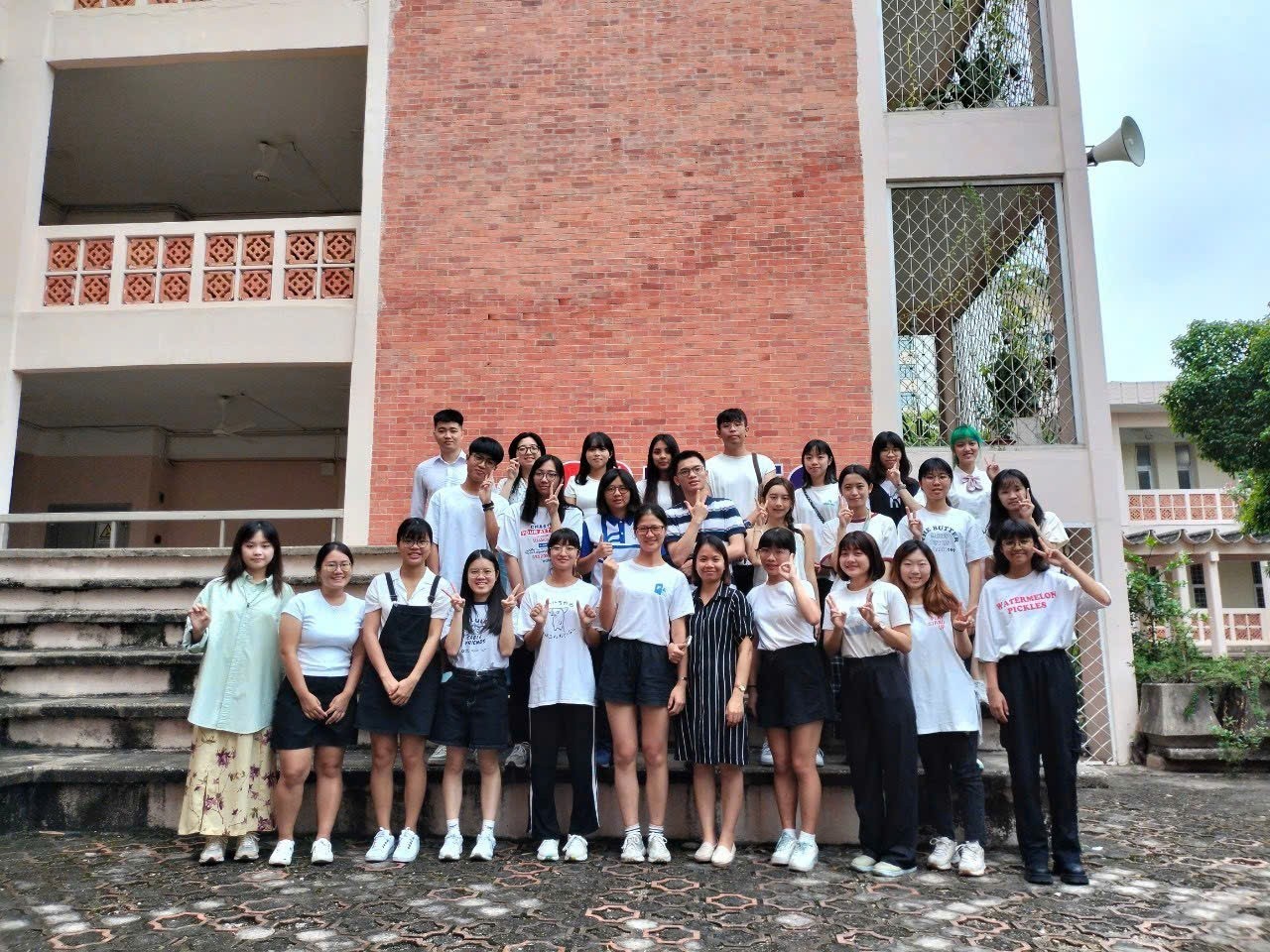 |
| Teacher Phong Lan with foreign students. |
For example, for listening and speaking skills, instead of learning only from textbooks, teachers can assign tasks linked to real-life contexts such as going to the market, entering a café, or visiting residential areas. Learners will practice ordering food, asking for prices, and chatting with local people. Through this, learning Vietnamese becomes lively, relatable, and meaningful.
For writing and reading comprehension skills, teachers can encourage learners to write diaries or comment on songs, films, or topics they enjoy. Writing skills should not only focus on “writing correctly” but also on “writing authentically”, expressing the learner’s genuine emotions and thoughts.
Fourth, it is necessary to help learners overcome cultural shock. To minimize this, teachers can organize periodic “cultural-sharing sessions,” invite Vietnamese speakers for exchanges, or design role-playing activities to practice typical communication situations. Providing detailed explanations of cultural metaphors and characteristic Vietnamese expressions helps learners not only understand the language but also understand the people and social context behind it. Once cultural barriers are eased, feelings of alienation diminish, and learners’ motivation rises significantly.
Teachers of Vietnamese as a foreign language are, therefore, not only transmitters of linguistic knowledge but also companions, cultural connectors, and bridges of understanding. Each class is a story; each learner is an individual journey. And through each of these journeys, teachers continue to observe, learn, refine themselves, and grow alongside their students.
| According to the Department of International Cooperation (Ministry of Education and Training), in the 2020-2021 academic year, there were 18,500 international students studying at Vietnamese universities; in 2021-2022, there were 16,000; in 2022-2023, 21,000; and in 2023-2024, approximately 22,000. |
 | Vietnamese Bookcases: Contributing to Preservation and Development of Vietnamese Language Around the World “The expansion of the Vietnamese Bookcase network not only helps bring official books and learning materials from Vietnam to overseas Vietnamese communities, but also promotes ... |
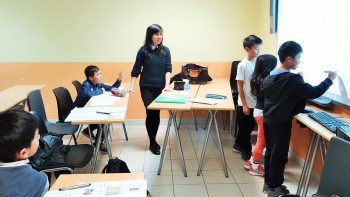 | Dr. Hoang Thi Hong Ha: Vietnamese Language Ambassador from Paris As one of the six outstanding honorees selected to receive the title “Overseas Vietnamese Language Ambassador 2025,” for Dr. Hoang Thi Hong Ha, the moment ... |

Most read


Related Stories
 National
Vietnam News Today (Sep. 16): Upgraded Bilateral Ties Open New Space for Vietnam-Slovakia Cooperation
 National
Vietnam News Today (Aug. 17): Vietnam, US Expand Cooperation to Tackle Agent Orange Impacts
 National
Vietnam News Today (Aug. 4): Vietnam Cultural Day Promotes Heritage, Deepen People-to-people Ties with Austria
 Overseas Vietnamese
Vietnamese Culture Introduced to International Public at Hong Kong Book Fair
In topics
 Expats in Vietnam
Three Foreign Writers Spreading Vietnamese Language
 Overseas Vietnamese
Dr. Tra My Reveals the Secret to Helping Her Child Become Fluent in Vietnamese
 Viets Home
Press and Media: Expanding Global Reach of Vietnamese Language
 Overseas Vietnamese
Vietnamese Language "Flourishes" in the Land of Tulips
Recommended
 Overseas Vietnamese
Mid-Autumn Festival Brings Vietnamese Youth Together in Japan
 Overseas Vietnamese
Promoting Important Role of Vietnamese Youth in Japan
 Overseas Vietnamese
Vietnamese Language Classes Held at Multiple Locations in Poland
 Overseas Vietnamese
Viet Nam’s National Day Spirit Reaches Communities and International Friends
Popular article
 Overseas Vietnamese
National Day Celebrations Abroad: Remembering History, Strengthening Community and Friendship
 Overseas Vietnamese
Resolution 23: Unlocking Potential of Overseas Vietnamese
 Overseas Vietnamese
Vietnamese Community Football Tournament in Japan Celebrates National Day
 Overseas Vietnamese