
UNFPA: 90% of Sri Lanka women endure sexual harassment on public transport
Ninety per cent of women in Sri Lanka have endured sexual harassment while taking public transport, a new study commissioned by UNFPA has found.
The findings released by UNFPA in late February offer a stark view into women’s vulnerability to violence and discrimination, issues that are poorly understood – both in Sri Lanka and globally – because of underreporting and lack of data.
Despite the absence of formal data, these issues are all too familiar to women and girls, the survey confirms.
“I have witnessed, on multiple occasions, male passengers inappropriately touching and leaning on small girls,” said Varuni Manel*, a 23-year-old study participant. “Bus conductors also unnecessarily touch small children when getting on to the bus.”
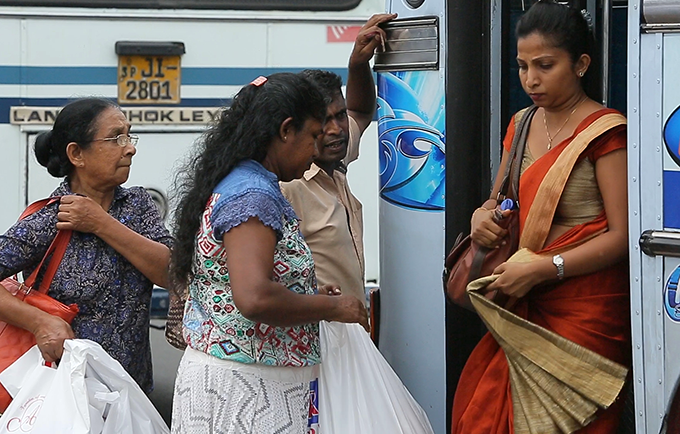
Sexual harassment is rampant on Sri Lanka's public transport system, with far-reaching effects on their jobs, educations and lives (source: UNFPA)
Humiliated and afraid
The study also shines a light on the far-reaching effects this harassment has on the lives of women and girls, from their educations and livelihoods to their place of residence and personal relationships.
Initiated in 2015, the study included 2,500 inpiduals between the ages of 15 and 35. Information was gathered through interviews, questionnaires and focus groups. Every administrative district in all of Sri Lanka’s nine provinces was represented.
Women reported experiencing a wide range of mistreatment on public transport, including leering, verbal abuse and unwelcome advances, but the majority of harassment was physical.
Women in the survey described feeling humiliated and afraid.
Pushing women from public life
There is evidence that harassment and the threat of harassment are limiting women’s mobility, participation in public life and overall well-being.Women in Sri Lanka – especially low-income women – rely heavily on public transport. Half of female study participants said they use it to go to work, and 28 per cent said it was how they travelled to pursue their educations.
A quarter of survey participants said harassment occurred monthly. About 12 per cent said it occurred daily. In some cases, women reported it was so frequent, and alternative modes of travel so scarce, that they moved residence to escape.
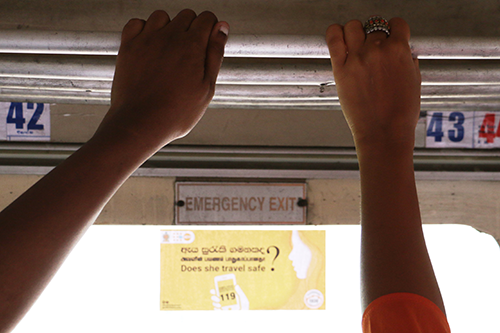 |
UNFPA is currently working with government officials to raise awareness of these matters, and to spread word about a hotline women can call to report abuses (source: UNFPA)
Forty-four per cent of women said that harassment on public transport affected their personal lives. Twenty-nine per cent said it had an impact on their school performance, and 37 per cent said it negatively affected their work performance.
“As a nurse I have to work late nights,” Gayanthi Thilini*, 31, said in a focus group. “On one occasion, after leaving work exhausted, I got onto a bus and noticed a male passenger seated behind me. He was well-dressed and in his mid-40s. He started unnecessarily touching me, and as I objected, he told me that I should travel in a private vehicle.”
These abuses – and the culture of inequality they spring from – may be contributing to women’s economic marginalization. According to the Census on Population and Housing, labour force participation among women fell from over 39 per cent in 2006 to less than 35 per cent in 2014.
Better data to inform policies
The study has started a conversation, not only on safety in public transport but also on the wider issues of violence, women’s rights and gender equality.
UNFPA is currently working with government officials to raise awareness of these matters, and to spread word about a hotline women can call to report abuses. They are also working towards gathering more data on gender discrimination and violence, in order to inform policies that better uphold the rights of women.
"The study is important as it highlights the grave gender discriminations that persist towards women and girls,” said Sharika Cooray, a UNFPA gender analyst in Sri Lanka.
It is also “a first step in addressing the data gap at a national level on violence against women," she added./.
( VNF/UNFPA )



Recommended
 World
World
French Adventurer to Cycle 19,000 km to Vietnam, Taking on 14 of Asia and Europe's Highest Passes
 World
World
UN Calls for International Support for Victims of Venezuela Earthquake
 World
World
Why Trust, Not Trade, Will Determine the Success of the India–EU FTA
 World
World
India’s naval might gets a massive boost as Modi unveils 3 indigenous vessels
Popular article
 World
World
Sharing Values of Van Mieu - Quoc Tu Giam and Vietnam’s Cultural Heritage at UNESCO Headquarters
 World
World
India-US Ties in Shaping Quad’s Future
 World
World
Thai Media Highlights Prime Minister Anutin Charnvirakul’s Visit to Vietnam
 World
World