NA Chairman meets Italy’s Communist Reconstruction Party leader in Rome
Italy is one of Vietnam’s leading partners in the European Union (EU), and Vietnam wishes to further strengthen the Vietnam – Italy Strategic Partnership across all channels, including Party-to-Party ties, National Assembly Chairman Tran Thanh Man told Maurizio Acerbo, General Secretary of the Communist Refoundation Party (PRC) of Italy, at their meeting on April 14.
Expressing his pleasure at meeting the Italian party leader during his official visit to Italy, Chairman Man conveyed regards from Party General Secretary and State President To Lam to Acerbo and members of the PRC, while informing him of the outcomes of the 14th National Congress of the Communist Party of Vietnam (CPV) as well as the major orientations and policies adopted at the event.
Recalling the valuable support of the Italian people for Vietnam during its past struggle for national independence and reunification, as well as in the ongoing national construction and development, the top Vietnamese legislator affirmed that the two countries share many similarities, particularly in cultural traditions, and have always maintained warm sentiments toward each other.
Chairman Man stressed that the CPV attaches importance to cooperation with the PRC. Amid complex global developments, the CPV wishes to further strengthen ties between the two parties, contributing to the continued positive development of Vietnam–Italy friendship and cooperation for the benefit of the two countries' people, and for peace and stability in the world, he added.
Regarding future cooperation orientations, he suggested that the two parties enhance mutual understanding and exchanges, deepen relations in a substantive manner, and promote their roles in strengthening multifaceted cooperation between the two countries. He called for increased people-to-people exchanges and cooperation in culture, arts, education and training, tourism, and locality-to-locality links, according to VNA.
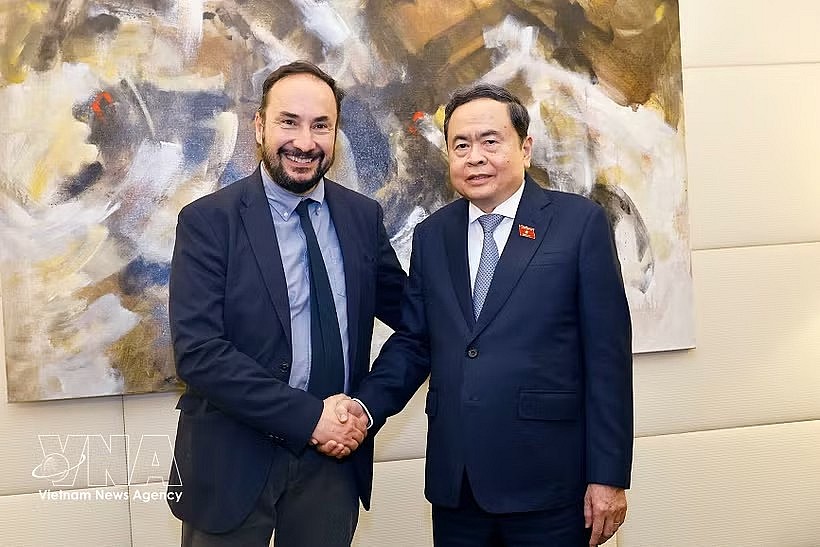 |
| National Assembly Chairman Tran Thanh Man (right) and Maurizio Acerbo, General Secretary of the Communist Refoundation Party (PRC) of Italy, at their meeting on April 14 (Photo: VNA) |
On this occasion, Chairman Man informed his host about Vietnam’s ongoing project to build a Communist Party of Vietnam Museum to preserve, display, and promote the value of important historical documents and artefacts of the Party. He suggested that the PRC support the project by sharing documents, artefacts, management experience, and preservation techniques.
For his part, Acerbo highlighted his special affection for Vietnam, expresssing admiration for the country, whose image has become a symbol of national liberation movements and a source of inspiration for the working class worldwide. He also recalled the historical link between the two countries through President Ho Chi Minh, who once stayed in Italy during his journey to seek ways for national salvation.
Speaking highly of the significance of the 14th National Congress of the CPV, Acerbo expressed his impression of the goals, orientations, and major tasks set out for Vietnam’s development, and appreciated the country’s foreign policy of peace, independence, and self-reliance.
Sharing recent developments of the PRC, he affirmed the importance his party attaches to strengthening its good relations with the CPV and expressed his desire to continue contributing to the promotion of the Vietnam – Italy Strategic Partnership and the friendship between the two countries' people.
Vietnam views FAO as leading partner in agricultural, rural development: NA Chairman
Chairman of the National Assembly Tran Thanh Man met with Qu Dongyu, Director-General of the UN’s Food and Agriculture Organization (FAO), in Rome on April 14, affirming that Vietnam always regards FAO as a leading partner in agricultural and rural development.
At the meeting, part of the Vietnamese leader's official visit to Italy, Chairman Man spoke highly of FAO’s role in the United Nations development system, particularly in promoting agricultural cooperation, rural development, and global food security, especially amid the current challenging global context.
He welcomed the cooperation projects between FAO and Vietnamese ministries, sectors, and localities, including food systems transformation and the project on cultivating one million hectares of high-quality, low-emission rice in the Mekong Delta by 2030.
Noting that Vietnam has established a new growth model to enhance economic competitiveness, with science – technology, innovation, and digital transformation as key drivers, along with its efforts to ensure food security, the top legislator affirmed Vietnam's consistent promotion of sustainable agriculture and food systems transformation, and called on FAO to coordinate in and support these efforts.
Regarding future cooperation orientations, he proposed that FAO assist Vietnam in restructuring its agricultural sector towards higher added value, green, sustainable and smart development, and climate change adaptation; transforming food systems; controlling diseases, especially zoonotic ones; and accelerating digital transformation in agriculture.
For his part, the FAO Director-General expressed his pleasure at meeting Chairman Man and welcoming the first high-ranking Vietnamese leader to visit the FAO headquarters in many years. He recalled his positive impressions from previous visits to Vietnam and witnessing the country’s strong transformation over the years, from its past struggle for independence to its current development path, according to VNA.
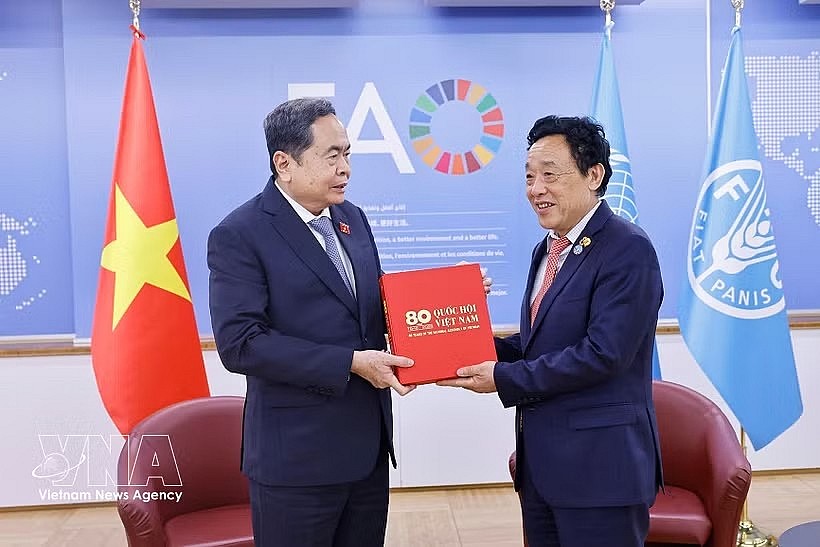 |
| National Assembly Chairman Tran Thanh Man (left) presents the book “80 Years of the Vietnamese National Assembly” to Qu Dongyu, Director-General of the Food and Agriculture Organization of the United Nations (FAO) at their meeting in Rome on April 14. (Photo: VNA) |
Congratulating Vietnam on its remarkable socio-economic achievements, he said Vietnam has truly taken off and will continue to make development breakthroughs under the clear-sighted leadership of Party General Secretary and State President To Lam as well as other leaders, including Chairman Man.
Qu commended Vietnam’s efforts to streamline its apparatus and adjust policies to ensure sustainable development and improve people’s living standards, suggesting the country continue sharing its experience and development model with other countries and regions.
He affirmed that FAO considers Vietnam an important partner in the region and recognises its leadership role in agriculture. He also welcomed its initiatives such as the trilateral cooperation in Africa and the “One Commune, One Product” program.
Sharing Chairman Man’s concern over disease outbreaks and noting that this is also a priority for FAO at present, the FAO leader expressed his hope that Vietnam will continue to work closely with the organization in these efforts.
The Director-General reaffirmed his willingness to promote cooperation with Vietnam in priority areas such as sustainable food systems transformation, green agriculture, and climate change adaptation.
At the meeting, the two sides agreed to keep boosting coordination, bring into play the effectiveness of existing cooperation programs and projects, and broaden their work together in sustainable agriculture, innovation, and food systems transformation, thereby contributing to food security and sustainable development both regionally and globally.
Japan greatly values Comprehensive Strategic Partnership with Vietnam
As the security environment in the Asia-Pacific grows more complex, developing the Comprehensive Strategic Partnership between Japan and Vietnam for peace and prosperity in Asia and the world is becoming increasingly important.
This assessment was made by Wakana Kanikawa, First Secretary and Director of the Information and Culture Centre at the Embassy of Japan in Vietnam, in remarks on the foreign policy of Japanese Prime Minister Takaichi Sanae, with a focus on Japan-Vietnam relations.
According to Kanikawa, at the 14th National Party Congress of the Communist Party of Vietnam, Vietnam emphasised “strategic autonomy” in its foreign policy and promoted deeper international integration. As chair of the Comprehensive and Progressive Agreement for Trans-Pacific Partnership (CPTPP) and the Review Conference of the Treaty on the Non-Proliferation of Nuclear Weapons (NPT), and as host of the Asia-Pacific Economic Cooperation (APEC) forum next year, Vietnam is increasing its presence in the international arena. Japan supports Vietnam in ensuring peace, stability and prosperity for the international community.
In the security field, the two sides held their first deputy ministerial-level “2+2” foreign affairs defence dialogue in Tokyo late last year. Around the same time, the frigate 015-Tran Hung Dao (Brigade 162, Region 4 of the Vietnam People’s Navy), along with a delegation from the navy, visited Japan.
In March this year, the destroyer Onami of the Japan Maritime Self-Defense Force docked at Vung Tau, and the destroyer Asahi is expected to pay a friendship visit to Da Nang city this month. These developments show that cooperation between the two countries in diplomacy and security is being strengthened.
In economic terms, cooperation under the Comprehensive Strategic Partnership continues to develop steadily. In 2025, Japan’s investment in Vietnam hit US$3.1 billion, up 20% from the previous year, bringing cumulative investment to US$80 billion. Bilateral trade over the past decade has increased 1.8-fold to around US$50 billion annually.
Kanikawa said that under the leadership of Party General Secretary and President To Lam, reforms are gradually being carried out and the investment environment continues to improve, thus creating more opportunities for Japanese businesses in Vietnam.
She noted that to achieve double-digit growth in the coming years, Vietnam has identified key sectors including semiconductors, digital transformation, green transformation, and disaster prevention and control. These areas are expected to become new pillars of bilateral cooperation, reported VOV.
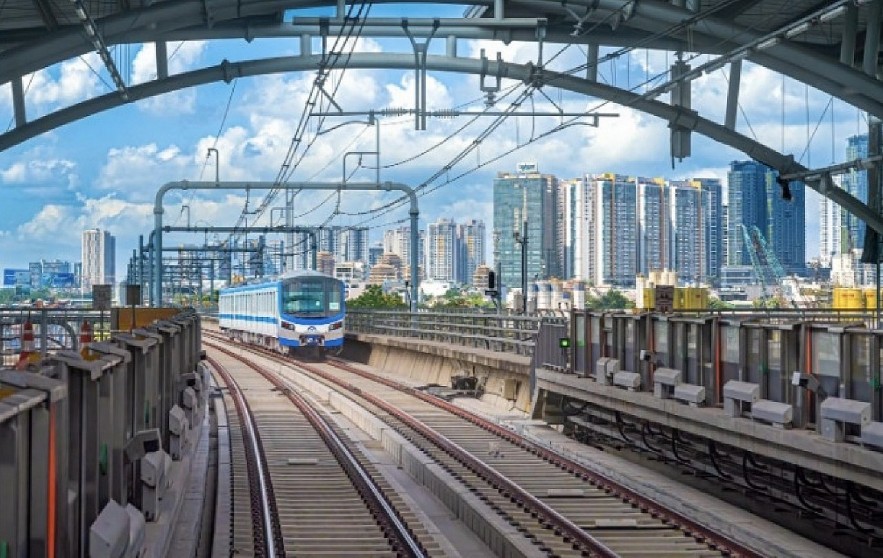 |
| Ho Chi Minh City’s Metro Line No. 1 (Ben Thanh-Suoi Tien), funded by Japan’s ODA through the Japan International Cooperation Agency (JICA) (Illustrative Photo: JICA) |
In the semiconductor sector, Vietnam aims to train 500 PhD students by 2030. Japan has committed to receiving around 250 of them through joint international research programs.
Collaborative research projects between Vietnamese and Japanese universities have already begun, with five projects approved in the first round and 63 PhD students expected to be admitted. At the Vietnam-Japan University (VJU), 106 students are studying in the semiconductor technology program, which started in October 2025.
Amid recent tensions in the Middle East, clean energy has become essential. Kanikawa said Japan’s capital and technology can be effectively utilized. Under the Asia Zero Emission Community (AZEC) initiative proposed by Japan, the two countries have agreed to implement around 15 pilot investment projects with a total value of about US$20 billion, including renewable energy such as offshore wind and liquefied natural gas (LNG) power. She stressed that these projects are of great importance to both sides.
Vietnamese Embassy in Timor-Leste officially begins operations
On April 12, Vietnamese Chargé d'Affaires to Timor-Leste Pham Binh Dam had a meeting with Bendito dos Santos Freitas, Minister of Foreign Affairs and Cooperation of Timor-Leste. Both sides expressed satisfaction with the positive developments in bilateral relations in recent years.
Vietnam's official opening of its embassy in Dili is considered an important milestone, contributing to deepening and enhancing the effectiveness and substance of friendship and cooperation between the two countries, for the benefit of their peoples as well as for ASEAN solidarity and development, they noted.
That same day, the Embassy of Vietnam in Timor-Leste sent a diplomatic note to the Ministry of Foreign Affairs and Cooperation of Timor-Leste, the diplomatic corps, and international organizations in Dili, announcing that the embassy officially begun operations.
The official launch of the Vietnamese Embassy in Timor-Leste takes place as Timor-Leste has become the 11th member of ASEAN. Vietnam continues to affirm its support and readiness to share experience, contributing to Timor-Leste's deeper regional integration and its active role within ASEAN, cited VGP.
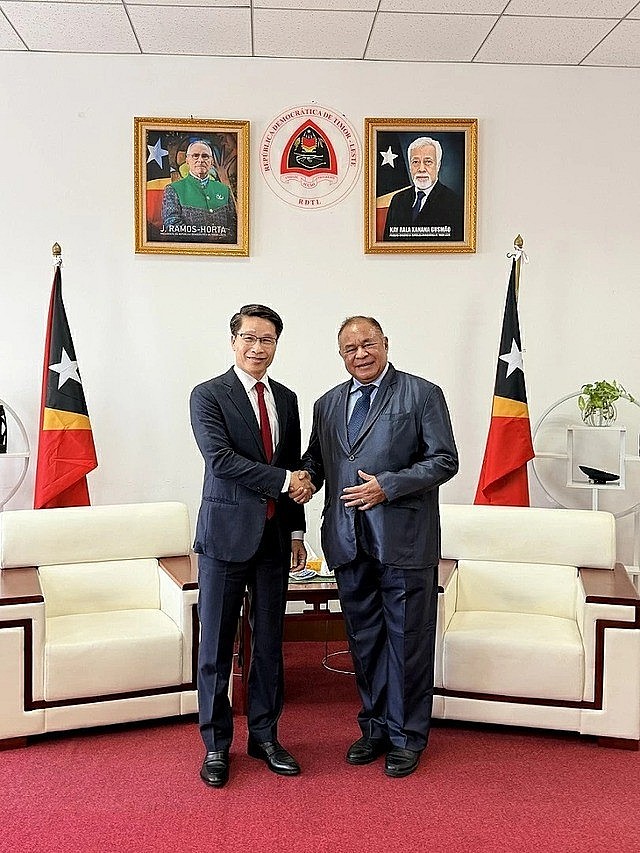 |
| Vietnamese Chargé d'Affaires to Timor-Leste Pham Binh Dam (L) meets Bendito dos Santos Freitas, Minister of Foreign Affairs and Cooperation of Timor-Leste, Dili, April 12, 2026 - Photo: baoquocte.vn |
Previously, the Vietnamese Embassy in Indonesia had been concurrently responsible for Timor-Leste while Timor-Leste has maintained its embassy in Ha Noi since April 2012.
The relations between Vietnam and Timor-Leste have been built on a foundation of strong friendship. Vietnam was among the first countries to recognize the Revolutionary Front for an Independent Timor-Leste (FRETILIN) in 1975. The two countries officially established diplomatic relations on July 28, 2002.
Over the past two decades, bilateral relations have been continuously strengthened via high-level visits, and cooperation across multiple sectors has been stepped up.
 | Vietnam News Today (Apr. 11): Top Leader’s China Visit Set to Open Up New Phase in Bilateral Ties Vietnam News Today (Apr. 11): Vietnam, Italy look to deepen strategic partnership during top legislator’s visit; Vietnam, Cambodia reaffirm strong ties, target US$20 billion in ... |
 | Vietnam News Today (Apr. 12): Vietnam-Thailand Relations Enter New Chapter After 50 Years Vietnam News Today (Apr. 12): Vietnam-Thailand relations enter new chapter after 50 years; New cooperation directions drive Vietnam–Russia ties; Lao, Cambodian, Thai New Year festivals ... |