Vietnam values US business community as trusted partner: NA Vice Chairwoman
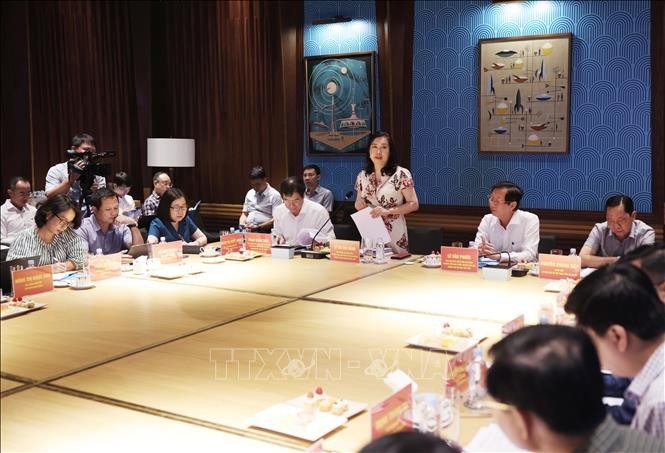
Vice Chairwoman of the National Assembly (NA) Nguyen Thi Hong on April 15 received a delegation from the US-ASEAN Business Council (USABC), reaffirming Vietnam’s strong appreciation of the US business community as a reliable partner in advancing the country’s economic priorities.
During the reception, Hong stressed that Vietnam regards the US as a leading partner and spoke highly of its consistent support for a strong, independent and prosperous Vietnam. She highlighted the effective operation of the US business community and the USABC in particular, describing them as trusted partners with valuable resources to promote Vietnam’s economic goals and priorities.
She expressed hope to advance bilateral ties in line with the Comprehensive Strategic Partnership, for the benefit of the people and businesses of both countries, while contributing to peace, stability and prosperity in the region and the world.
For his part, USABC Interim President and CEO Brian McFeeters thanked the Vietnamese legislator for the meeting, noting it provided an opportunity for both sides to discuss cooperation, clarify regulatory and policy issues, and address obstacles faced by US investors in Vietnam.
He expressed confidence that with close coordination of the NA, the Government and the business community in addressing institutional bottlenecks, Vietnam would achieve strong breakthroughs and enter a phase of rapid, sustainable and high-quality development, according to VNA.
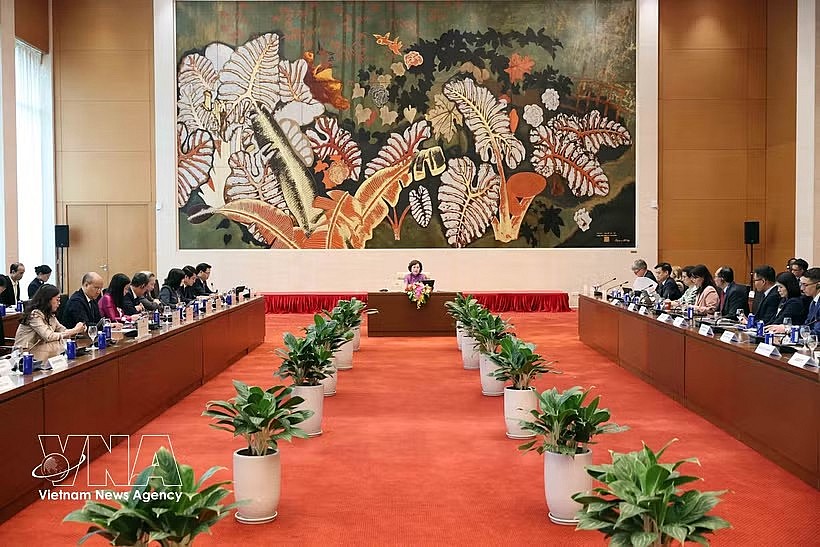 |
| Vice Chairwoman of the National Assembly (NA) Nguyen Thi Hong meets with the delegation from the US-ASEAN Business Council on April 15 in Hanoi. (Photo: VNA) |
Representatives of USABC member companies shared views on investment and business policies in Vietnam, voicing strong confidence in the country’s cooperation potential and investment environment. They also proposed measures to improve the legal and institutional framework, including administrative reform, and ensure greater transparency, consistency and stability in regulations to facilitate foreign investors.
Hong reaffirmed that the Vietnamese NA consistently supports the development of Vietnam–US relations, aiming to bring tangible benefits to both countries. She underlined ongoing efforts to build a stable, transparent and favourable legal and policy framework to enable foreign enterprises, including those from the US, to expand operations and make long-term investments in Vietnam.
She affirmed that the legislature remains ready to listen to the concerns and recommendations of the business community regarding policies and laws.
She called on the USABC and its member enterprises to expand investment in Vietnam, particularly in strategic breakthrough areas such as human resources development, infrastructure, science and technology, innovation and digital transformation, as well as energy security. She also encouraged stronger cooperation with Vietnamese firms and greater technology transfer, especially in core technologies, to help Vietnam integrate more deeply into regional and global value chains.
Hong expressed hope that the USABC and US enterprises would support Vietnam to successfully host APEC Economic Leaders’ Week in 2027 (APEC 2027), thus enhancing market openness, attracting more investments, and improving national competitiveness.
Vietnam, Italy agree on new cooperation directions
The Vietnamese Ministry of Industry and Trade and the Italian Ministry of Foreign Affairs and International Cooperation have convened the 10th session of the countries’ joint committee on economic cooperation during the official visit to Italy by National Assembly Chairman Tran Thanh Man.
The session was co-chaired by Deputy Minister of Industry and Trade Phan Thi Thang and Italian Undersecretary of State for Foreign Affairs and International Cooperation Maria Tripodi. They agreed that the timing of the meeting – shortly after Vietnam successfully held its 14th National Party Congress and consolidated its government leadership and organisational structure – provided a favourable opportunity to define priorities and areas of cooperation aligned with Vietnam’s development orientation for the next five years, as well as Italy’s strategies and policies towards its partners amid an increasingly uncertain regional and global environment.
At the session, the two sides reviewed and assessed cooperation across a wide range of sectors, including trade, energy, development cooperation, culture, sports and tourism, agriculture, industrial machinery, textiles, footwear, stone mining and locality-to-locality partnerships.
They also proposed and agreed on plans to further boost bilateral trade turnover, while maximising the benefits of the EU-Vietnam Free Trade Agreement (EVFTA), with a view to elevating economic cooperation to a level commensurate with the potential of both countries and the evolving global landscape.
Thang stressed that the traditional friendship and cooperation between Vietnam and Italy continue to be strengthened and expanded. On that basis, their business communities have effectively leveraged opportunities provided by the EVFTA to sustain steady growth in bilateral trade, despite global market fluctuations, according to VNA.
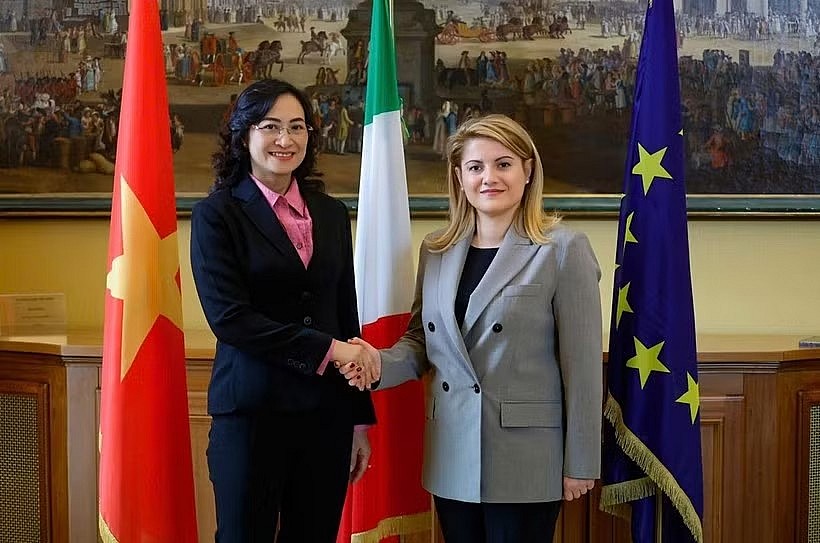 |
| Vietnamese Deputy Minister of Industry and Trade Phan Thi Thang (L) and Italian Undersecretary of State for Foreign Affairs and International Cooperation Maria Tripodi co-chair the 10th session of the countries’ joint committee on economic cooperation. (Photo: Ministry of Industry and Trade) |
Tripodi described Vietnam as an important strategic partner and one of Italy’s most dynamic markets in the Association of Southeast Asian Nations (ASEAN) region. She affirmed Italy’s commitment to enhancing cooperation with the country across all fields, particularly in green transition.
In practice, Italy is among the ten members of the International Partners Group (IPG) that, together with Vietnam, launched the Just Energy Transition Partnership (JETP) in 2022, and has pledged to mobilise approximately 500 million EUR over the next three to five years to support JETP projects. Recently, through Cassa Depositi e Prestiti, Italy became one of six financiers of the Bac Ai pumped-storage hydropower project, the first of its kind in Vietnam.
Tripodi also affirmed Italy’s support for the EU’s lifting of the “yellow card” imposed on Vietnam, recognising the country’s effective measures to combat illegal, unreported and unregulated (IUU) fishing.
The launch of a direct air route between Vietnam and Milan from 2025 has facilitated travel for tourists, businesses and citizens of both sides, she added. Italy will also review procedures to make visa issuance more convenient for Vietnamese nationals, thereby promoting cultural, tourism and economic exchanges.
Both sides agreed to facilitate market access for key export products, and prioritise cooperation in investment attraction and technology transfer in emerging and strategic sectors such as new energy, renewable energy and automation, while continuing to strengthen existing cooperation in textiles, footwear, climate change response, electronics, culture and tourism.
At the conclusion of the session, the two sides signed the meeting minutes and agreed that the 11th edition will be held in Hanoi in next year.
Vietnam faces abnormal heat surge before peak season
Even before the arrival of the traditional early summer marker, Vietnam is already gripped by intense heat across all three regions, with unusually high temperatures raising concerns of a volatile and extreme summer in 2026.
An early and widespread heat surge
Typically, peak heat in Vietnam occurs in May or June. However, 2026 is unfolding differently, with heatwaves arriving earlier and with greater intensity from the very first months of the year.
According to Mai Van Khiem, Director of the National Center for Hydro-Meteorological Forecasting, northern and central regions have experienced heat about two weeks earlier than the long-term average. Since late March, the northwest and areas from Thanh Hoa to Hue have already been exposed to high temperatures.
From April 3, extreme heat expanded from Thanh Hoa to Da Nang, as well as eastern parts of Quang Ngai and Gia Lai, before spreading further across the north. Many monitoring stations have repeatedly recorded temperatures exceeding 40°C.
In southern Vietnam, the first heatwave began in mid-February - around 10 days earlier than usual - and has persisted for nearly a month.
Forecasts indicate that scattered showers and thunderstorms may begin appearing nationwide around April 15-17, helping ease the heat temporarily.
Understanding the causes
Meteorological experts identify three main drivers behind this unusual pattern.
First, the ENSO cycle is gradually shifting toward an El Nino phase. From the second half of the year, the warming phase is expected to dominate, weakening trade winds and intensifying prolonged and extreme heat events.
Second, global climate change continues to push temperatures to record levels. The greenhouse effect has led to the formation of “heat domes” over Southeast Asia, trapping hot air masses over the region for extended periods.
Third, the western low-pressure heat zone has developed more strongly and expanded eastward earlier than usual. Combined with the foehn effect - known locally as the Lao wind - this has driven temperatures sharply higher while reducing humidity, VNN reported.
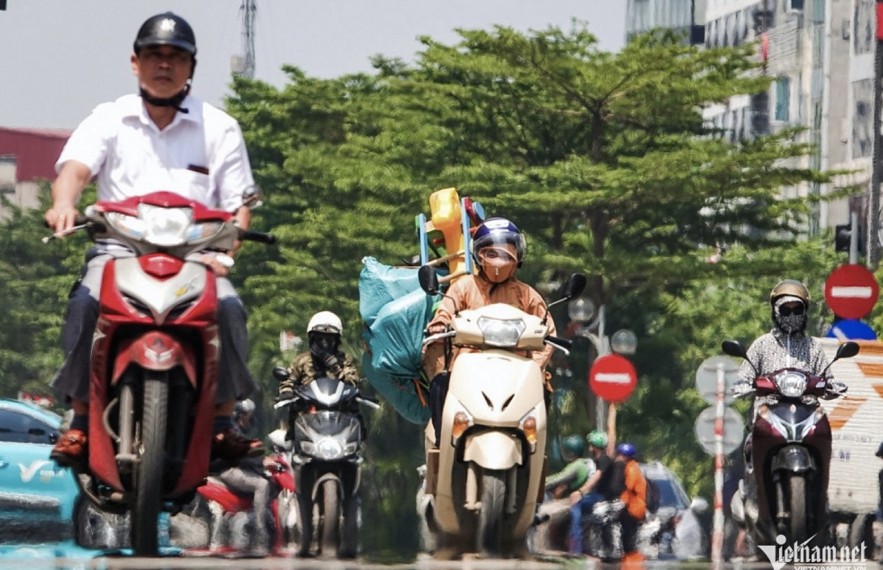 |
| Intense and prolonged heat is affecting regions across the country. Illustrative photo: Thach Thao |
Nguyen Ngoc Huy, a climate change and disaster warning expert, noted that average temperatures in Vietnam over the past week have been 8-12°C higher than the 1981-2010 average.
In contrast, regions such as Bangladesh and India have recorded temperatures 4-6°C below their historical averages, despite typically being hot during this period.
“This is a clear anomaly in weather patterns, deviating from normal climate behavior, and reflects a climate system increasingly disrupted by global warming,” Huy said.
A summer of potential new records
The summer of 2026 is expected to set new temperature records. According to Mai Van Khiem, April temperatures in northern and central regions may be 1.5-2.5°C higher than the long-term average.
The most intense heatwaves are forecast between May and July, with longer durations and fewer cooling periods caused by cold air intrusions. This raises the risk of reduced rainfall, leading to drought, saltwater intrusion, and severe forest fires.
Experts are urging the public to take proactive measures to protect health and property amid increasingly extreme weather conditions. Outdoor activities should be avoided during peak heat hours from 11 a.m. to 4 p.m. to prevent heatstroke and sun exposure.
In addition, households are advised to use air conditioning responsibly, regularly inspect electrical systems and flammable materials, especially during dry heat conditions, and adjust production and daily routines accordingly.
The early heatwave, while temporary in its immediate intensity, may ultimately serve as a warning signal - a preview of a summer that could test both resilience and preparedness across the country.
 | Vietnam News Today (Apr. 12): Vietnam-Thailand Relations Enter New Chapter After 50 Years Vietnam News Today (Apr. 12): Vietnam-Thailand relations enter new chapter after 50 years; New cooperation directions drive Vietnam–Russia ties; Lao, Cambodian, Thai New Year festivals ... |
 | Vietnam News Today (Apr. 13): Vietnam, China Strengthen Youth Exchanges to Deepen Bilateral Ties Vietnam News Today (Apr. 13): Vietnam, China strengthen youth exchanges to deepen bilateral ties; Slovak Prime Minister begins official visit to Vietnam; UNDP backs Vietnam ... |