Vietnam, Cuba target 500 mln USD in two-way trade
Vietnamese Deputy Minister of Industry and Trade Phan Thị Thang and Cuban Vice Minister of International Trade and Foreign Investment Deborah Rivas Saavedra set a target to lift two-way trade to 500 million USD soon as they co-chaired the first session of the Joint Committee of the Vietnam - Cuba Trade Agreement in Havana on December 1.
The meeting launched the first formal periodic mechanism for both nations to monitor the 2020 bilateral trade agreement, remove bottlenecks, and identify priority areas for effective rollout. It was expected to advance economic, trade, and investment ties as the two nations mark their 65th anniversary of diplomatic ties this year.
Both sides conducted a comprehensive review of economic, trade, and investment ties since the agreement took effect on April 1, 2020.
Deputy Minister Thang, who is also Chair of the Vietnamese sub-committee, noted that despite challenges posed by the COVID-19 pandemic, the global economic downturn, and Cuba’s acute economic difficulties, two-way trade has held steady at around 200 million USD, a reflection of the two countries’ concerted efforts to maintain momentum in their trade ties.
Cuba remains one of Vietnam’s 10 key markets in Latin America, while Vietnam is now Cuba’s second largest partner in the Asia-Pacific. Vietnam is also Cuba’s largest Asian investor, and one of its leading foreign investors overall, with seven active projects spanning construction materials, consumer goods, industrial park infrastructure, and energy, VNA reported.
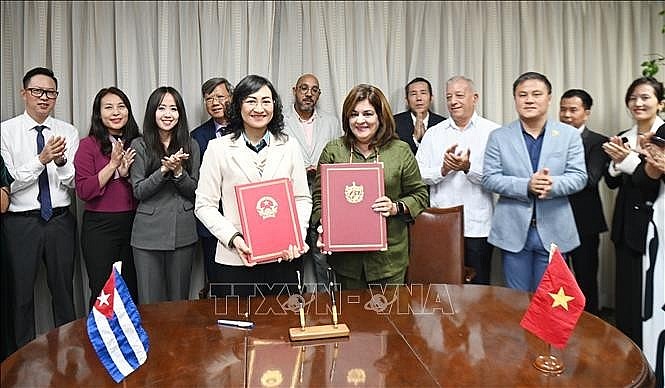 |
| Vietnamese Deputy Minister of Industry and Trade Phan Thị Thang and Cuban Vice Minister of International Trade and Foreign Investment Deborah Rivas Saavedra sign the meeting's minutes (Photo: VNA) |
Looking ahead, Vietnam plans more investment in wholesale and retail, rice cultivation, instant noodle and animal feed production, fertilizers, and joint ventures in research, production, and commercialisation of agricultural and biomedical biotechnology products, she said.
Agreeing with the Vietnamese side, Rivas, who is also Chair of the Cuban sub-committee, highlighted Cuba’s strengths in biotechnology and promising prospects for future cooperation. She pointed to opportunities in joint research and development of vaccines, pharmaceuticals, natural biological products, and potential local production of quality biomedical products in Vietnam.
The committee reviewed progress on tariff reductions, rules of origin, institutional frameworks, and public-awareness campaigns under the five-year-old agreement.
Rivas expressed hope that more Cuban enterprises would capture concrete benefits from the deal, delivering real gains for them and boosting overall trade flows.
Both sides agreed to adopt supportive policies and mechanisms to address existing challenges, particularly those related to payment transactions to facilitate Vietnamese businesses operations in Cuba.
The session closed with the signing of its minutes that lays out immediate next steps to improve the agreement’s impact and generate measurable benefits for businesses and citizens of both countries.
Sweden, Vietnam promote cooperation in building modern, sustainable power grid
On the afternoon of December 1, the EnergyConnect thematic exchange on building efficient power infrastructure for a sustainable future was held in Ha Noi within the framework of the Sweden–Vietnam Energy Alliance. The event attracted the participation of policymakers, industry leaders, and technical experts from both countries for active discussions.
At the event, delegates from Vietnam and Sweden focused on practical solutions for modernising the power grid, including long-distance power transmission, power quality, and renewable energy integration, as well as lessons learned from global best practices — all towards a shared spirit of cooperation in building a modern power grid.
Notably, on the occasion, Swedish companies including Hitachi Energy, Unipower, Comsys, AFRY, Svenska Kraftnät (the Swedish National Grid Authority), and SEK (the Swedish Export Credit Corporation) shared deep insights into technologies, approaches, and financial tools successfully applied in Sweden and other markets. Through sharing experiences, these representatives affirmed their readiness to support Vietnam’s energy transition while agreeing that flexibility must be maintained rather than promoting and imposing a single model for all circumstances.
Meanwhile, Vietnamese partners, including representatives from the Ministry of Industry and Trade, the Electricity Regulatory Authority of Vietnam (ERAV), the Institute of Energy, the National Power Transmission Corporation (EVNNPT), the Northern Power Corporation (EVNNPC), Ha Noi Power Corporation (EVNHanoi), and the National Load Dispatch Centre (NSMO), highlighted priority issues in Vietnam such as rising electricity demand, renewable energy integration, and improving system flexibility.
All parties agreed that solutions must be tailored to Vietnam’s context, ensuring cost-effectiveness, sustainability, and alignment with national strategies.
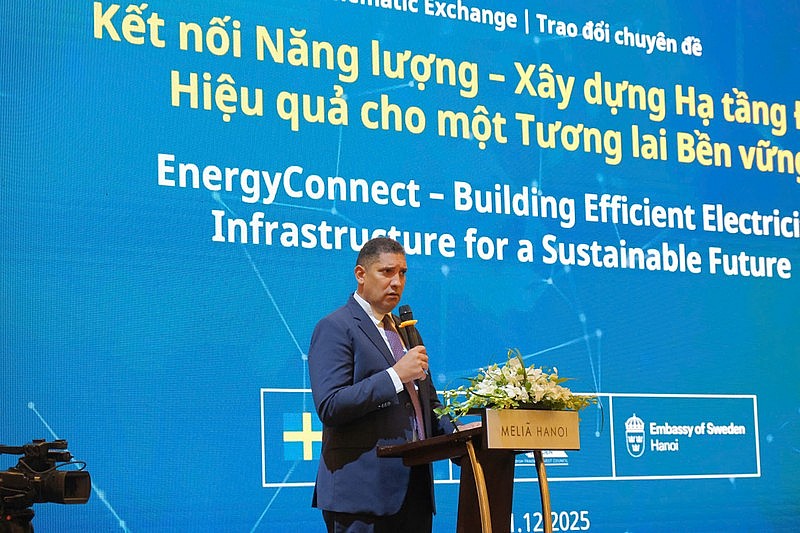 |
| Ambassador of Sweden to Viet Nam Johan Ndisi speaks at the event. |
Sharing a common vision for a sustainable energy future, speakers emphasised the importance of partnership and knowledge exchange. Ambassador Johan Ndisi underlined: “Sweden values the opportunity to share experiences and learn together. Through cooperation, we can support Vietnam’s efforts to build a reliable and sustainable power system.”
Echoing this view, Chandan Singh, Managing Director of Hitachi Energy Vietnam, expressed confidence that cooperation is the foundation of progress. “By combining global expertise with Vietnam’s ambitious energy goals, we are committed to delivering advanced transmission and power quality solutions that will help create a reliable, flexible, and sustainable power grid. Together, we can advance the transition to a greener future,” Singh said.
Sweden is regarded as one of the world’s cleanest and most innovative energy producers. More than 90% of its electricity and 95% of its heating come from non-fossil fuel sources. As of 2024, the country’s energy mix includes nuclear power (33%), biofuels and waste (33%), and hydropower (16%), alongside the rapid expansion of wind power. Sweden introduced the world’s first carbon tax and maintains one of the highest carbon prices globally — key drivers behind its rapid decarbonization, cited NDO.
Also at the event, delegates discussed financial frameworks, regulatory requirements, and international case studies, paving the way for new partnerships, pilot projects and commercial cooperation — all essential factors in supporting Vietnam’s energy transition and long-term net-zero goals.
Delegates agreed that Sweden’s experience demonstrates that sustainability and innovation can go hand in hand. Through knowledge sharing, adapting proven technologies and leveraging flexible financing sources, Sweden and Vietnam can work together towards an energy system that is reliable, cost-effective, and future-ready.
TasteAtlas lists 12 Vietnamese dishes among Southeast Asia’s top 100 specialties
International food website TasteAtlas has included 12 Vietnamese dishes in its list of the Top 100 Southeast Asian specialities.
Scoring 4.5 out of five points, Beef pho (Pho bo) tops the list. The dish is served piping hot in a bowl along with rice noodles, and it’s typically topped with cilantro, sliced onions, and chopped green onions.
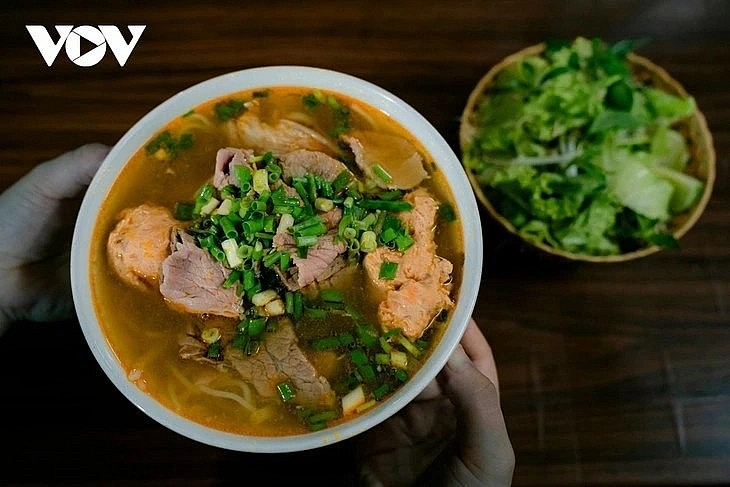 |
| Hue breakfast noodle soup ranks among Southeast Asia’s top 100 dishes according to TasteAtlas. |
The Top 20 of the list are dominated by nine other Vietnamese dishes, with Quang-Style Noodles (Mi Quang), Southern Vietnamese Beef Noodle Salad (Bun bo nam bo), Caramelized Pork Belly (Thit kho tau), Shaking Beef (Bo luc lac), and Roasted Pork Belly Bánh Mì (Banh mi heo quay) coming in at 11th, 16th, 17th, 18th, and 19th positions, respectively.
TasteAtlas also highlights several dishes that can be enjoyed throughout Vietnam, including Beef Stew (Bo kho), Fish Sauce (Nuoc cham), Grilled Pork Meatballs with Vermicelli Noodles (Bun cha), and Sugar Cane Shrimp (Chao tôm), ranking 26th, 27th, 30th, and 49th in the Southeast Asian list.
The 55th and 70th positions went to two dishes from Hue City, namely Hue Breakfast Noodle Soup (Bun bo Hue) and Hue Pancake (Banh khoai).
Founded in 2015 and headquartered in Zagreb, Croatia, TasteAtlas is best known for its global map of traditional dishes. The rankings on TasteAtlas are based on various opinions and reviews offered by culinary experts and critics, ensuring the reliability of the awards.
 | Vietnam News Today (Nov. 29): Vietnam, RoK Step Up Cooperation in Labor, Employment Vietnam News Today (Nov. 29): Vietnam seeks to advance cooperation with Portugal across all fields; Poland ratifies EU-Vietnam Investment Protection Agreement; Ho Chi Minh City ... |
 | Vietnam News Today (Nov. 30): Vietnam Reaffirms Strong Commitment to Work with GMS Members Toward Shared Prosperity Vietnam News Today (Nov. 30): Vietnam, Cambodia deepen traditional friendship, comprehensive cooperation; Party leader’s visit to further deepen Vietnam-Laos special ties; Sultan’s state visit underlines ... |