| Vietnam News Today (Feb. 17) notable headlines Vietnam has potential to reshape Southeast Asia’s economic rankings: Foreign media Green banh chung – Embracing the soul of Vietnamese Tet Spring anchors amid distant sea Ho Chi Minh City named among Asia’s top three food destinations Vietnam national team in 2026: Opportunities and challenges Young people opt for a “minimalist Tet” as spiritual values take priority Hanoi fireworks sites ready for Lunar New Year of the Horse 2026 Nguyen Hue Flower Street opens in HCM City ahead of Lunar New Year Vietnam warship celebrates Tet at sea during multinational naval drills |
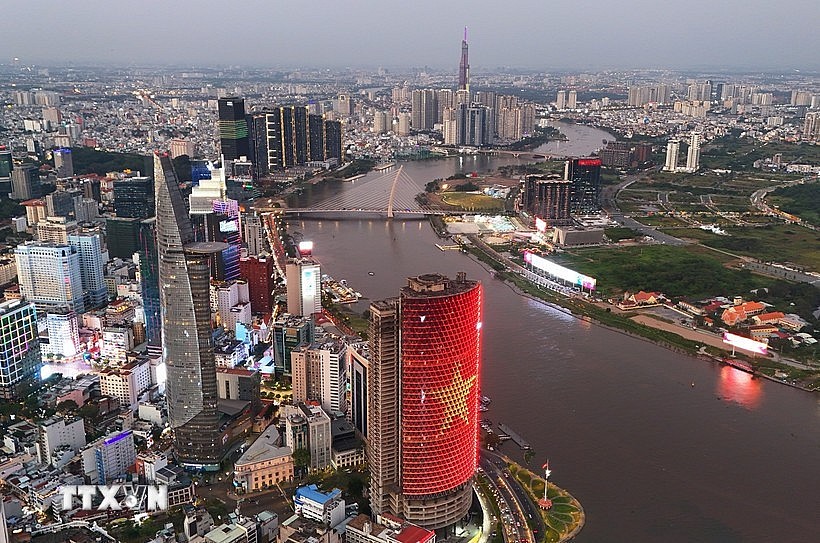 |
| Ho Chi Minh City is striving to grow into a leading urban and financial hub in Southeast Asia. (Photo: VNA) |
Vietnam has potential to reshape Southeast Asia’s economic rankings: Foreign media
Recently, foreign media have shared positive sentiment on Vietnam’s economic prospects, praising the country’s impressive growth as it moves toward becoming a top economy in Southeast Asia.
Reuters reported that Vietnam’s economy expanded by 8% in 2025, accelerating from the previous year. The country is a key link in global supply chains for electronics, textiles, footwear and a wide range of other products. Last year’s growth was underpinned by robust domestic consumption and increased government spending on infrastructure, as Vietnam seeks to rebalance its growth model and reduce excessive reliance on exports.
Bloomberg commented that Vietnam has maintained its position as one of the world’s fastest-growing economies, supported by strong lending policies, state backing, a weaker currency, and a boom in the tourism sector, cited VNA.
Meanwhile, AFP noted that Vietnam has long been regarded as a success story among Asian economies. The country’s economy has demonstrated resilience on the back of robust domestic consumption, rising business investment and public spending. Growth in 2025, the agency said, reflects the nation’s solid economic fundamentals and the Government’s continued pro-private sector orientation.
Free Malaysia Today pointed out that Asian economists have paid particular attention to Vietnam’s announcement of 8% economic growth in 2025. Its experience has become a useful benchmark and an important lesson for other countries.
According to the newspaper, the country’s strong performance in 2025 reflects four “interlocking dynamics”. Exports continued to serve as the main pillar of growth, while the country further consolidated its position as a global manufacturing hub. At the same time, rising domestic demand, especially household consumption and investment, provided a significant boost to overall economic momentum. In addition, strategic adaptability in trade and investment policies enabled Vietnam to effectively withstand external shocks, with tariff pressures accelerating diversification into new markets and sectors.
It also assessed that Vietnam’s growth accomplishment was “not a miracle, but the result of methodical economic positioning that transformed vulnerabilities into engines of expansion”.
The McGill International Review (MIR) of Canada has published an analysis noting that despite structural challenges, Vietnam’s current economic strategy has delivered genuinely impressive growth momentum, positioning the country as a strong contender for the title of an “Asian tiger cub.” According to the article, Vietnam is entering the 7-10% growth range once achieved by the Asian tigers at the height of their industrialisation, underscoring the country’s rising stature in the regional and global economic landscape.
China Daily praised the country’s ongoing reforms and transformation, noting its impressive growth on the road to becoming a top economy in Southeast Asia with an expanding global presence, despite tariff challenges. The paper called its 2025 growth of over 8% a milestone, making the nation a standout amid ongoing global uncertainty.
According to the newspaper, the country is expected to surpass Thailand as ASEAN's third-largest economy by 2026 or 2027. By 2030, its economic position will likely be shaped by its shift toward a high-middle-income status.
Green banh chung – Embracing the soul of Vietnamese Tet
Among the many symbols of the Vietnamese Lunar New Year (Tet), banh chung (traditional square sticky rice cake) remains one of the most enduring. More than a festive dish, it represents heritage, culture, and the gifts of nature that have shaped Vietnamese life for generations. Remembering banh chung is, for many, the same as remembering Tet itself – the ancestral tradition and the warmth of family reunion each spring.
The taste of Tet and memories of togetherness
Square in shape and wrapped in green dong (Stachyphrynium placentarium) leaves, banh chung is made from glutinous rice, yellow mung beans and pork. The harmony of colours evokes the earth, vegetation and abundance. Traditionally, the square form symbolises the earth and expresses hopes for favourable weather and good harvests in the coming year. The cake, therefore, carries not only culinary value but also deep spiritual meaning.
In the final days of the year, as Tet approaches, families across Vietnam gather to make the cakes together – a cherished memory shared by many generations. Some wash leaves, others rinse rice or prepare the filling, while children watch eagerly as adults fold the leaves into neat squares. The cakes are boiled overnight, and the long hours of waiting often become moments for storytelling, laughter and bonding. The pot of banh chung warms not only with the aroma of newly harvested rice but also with the warmth of family connection.
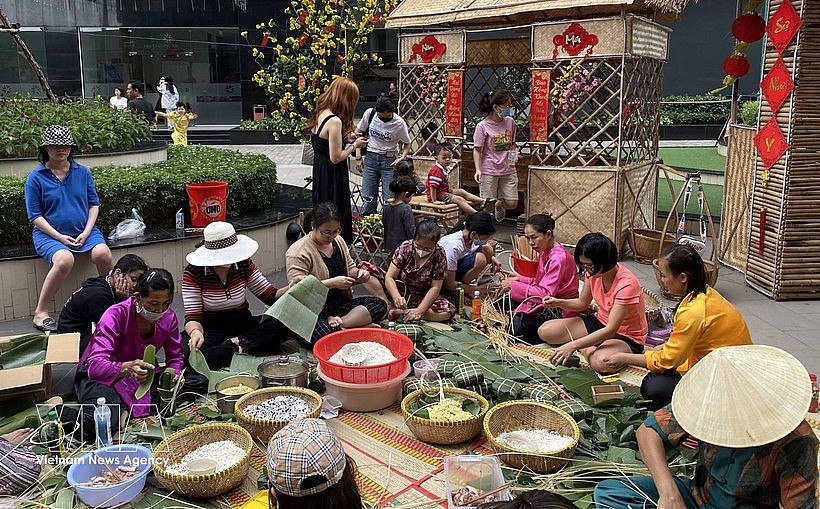 |
| Residents of An Phu apartment complex in Thu Duc, Ho Chi Minh City gather to wrap banh chung in preparation for the Lunar New Year. (Photo: VNA) |
Today, modern lifestyles mean many families choose to buy ready-made cakes rather than prepare them at home. Nevertheless, the cultural value of banh chung remains unchanged. Whether handmade or commercially produced, the cake retains its familiar flavor, one that evokes home and reunion.
Keeping Tet alive far from home
Beyond Vietnam’s borders, banh chung continues to accompany Vietnamese communities around the world. Cake-making gatherings overseas often become small cultural festivals for expatriate communities.
Thousands of kilometers from home in Pretoria, South Africa, Vietnamese keep Tet traditions alive by making green square cakes, symbolizing harmony, reunion, and prosperity.
On cake-making day, the shared kitchen of the Vietnamese Embassy in South Africa fills with laughter and conversation. Embassy staff, along with colleagues from the Defence Attaché Office, the Trade Office and the Vietnam News Agency, gather to prepare banh chung for the community’s Tet celebration, according to VNA.
Thuy Nga, the spouse of a Vietnamese diplomat in South Africa, said: “For me, making banh chung in South Africa is not just cooking; it is how we embrace our roots and preserve the soul of the homeland in the southern hemisphere. Each cake is a reminder that our homeland lives on in every grain of rice, every bamboo string and every shared smile,” she said.
When the cakes are finally lifted from the pot, their fragrance spreading through the air, everyone senses that Tet has truly arrived. No matter how far from home, as long as traditions are preserved and communities stay connected, the homeland remains present – in every slice of banh chung infused with the taste of Tet.
Spring anchors amid distant sea
Amid the vast open sea, Vietnamese Coast Guard vessels continue to quietly cut through the waves to carry out their duties offshore. For Coast Guard officers and soldiers, the Lunar New Year Festival (Tet) is not a holiday but a sacred responsibility — safeguarding peace at sea so that spring on the mainland can be fully enjoyed.
In the final days of the year, the sea looks little different from ordinary days — still deep blue, with winds even colder than usual — but in the hearts of the soldiers, emotions arise that are difficult to name.
Each of them has a family waiting on shore, a home that misses their presence, a year-end reunion meal with an empty seat. But they choose to remain at the ocean’s frontline, because the nation’s peace must always be guarded, even during the most sacred moments of the year.
Inside the common room, spring arrives in simple ways. A small branch of apricot blossom is carefully brought from shore; red couplets are pasted beside the duty room; a pot of Chung cake steams gently while soldiers take turns tending the fire after each patrol shift. Amid the endless sea, the atmosphere becomes unexpectedly warm, as if carrying the breath of home.
There are overnight patrol shifts in the cold wind, missions assisting fishing boats in distress, or simply maintaining a presence at sea so that fishermen feel more secure in continuing their livelihoods. These seemingly ordinary tasks are, in fact, the quiet but steadfast ways in which spring is protected, reported NDO.
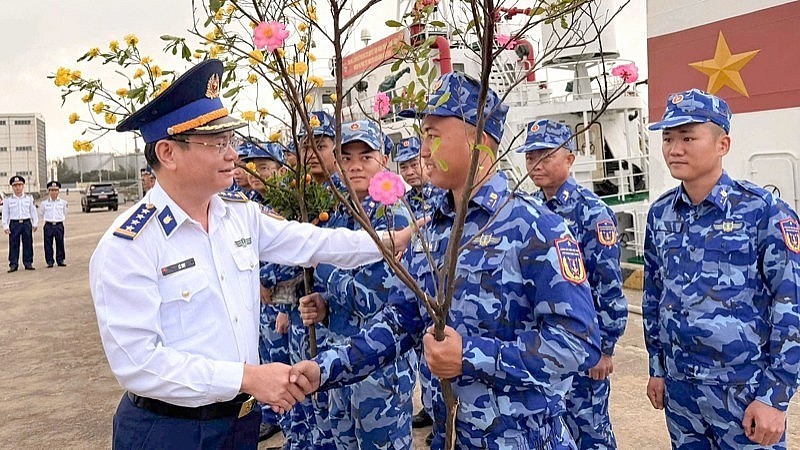 |
| Colonel Le Huy, Political Commissar of Coast Guard Region 2, encourages officers and soldiers before they begin their Tet duty at sea. |
Many young soldiers spending Tet away from home for the first time carry a family photograph, or sometimes just a child’s simple drawing. They seldom speak about their longing, but the way their eyes turn toward the mainland during rare moments of rest says everything. And in time, the sea itself offers them another form of reunion.
That is found in comrades sharing pieces of Chung cake and cups of hot tea in the cold wind; in laughter after long duty shifts; in firm handshakes that replace New Year greetings. There, comrades become family, and the ship becomes a common house.
Spring at sea is not dazzling in colour, but profound and calm. It is not noisy, but deeply filled with affection. Each quietly patrolling vessel becomes a “living marker” affirming sovereignty — a source of reassurance for fishermen at sea and a guarantee that the mainland may enjoy a complete season of reunion.
Ho Chi Minh City named among Asia’s top three food destinations
Ho Chi Minh City has been listed among Asia’s top three food destinations in a recent article by Sophie Steiner, a food, travel and lifestyle photographer and writer, published in the US-based Business Insider.
Steiner shared that she first visited Ho Chi Minh City in 2017 and returned three more times that year alone.
“The city reflects historical influences from China, Cambodia, France and the U.S., culminating in a distinctly southern-style Vietnamese cuisine that bridges bold flavors, ferments and fresh herbs,” she wrote.
Steiner noted that street food forms the backbone of Saigon, with carts feeding the ebb and flow of passersby like blood pumping to the beat of the city’s pulsating heart, VOV reported.
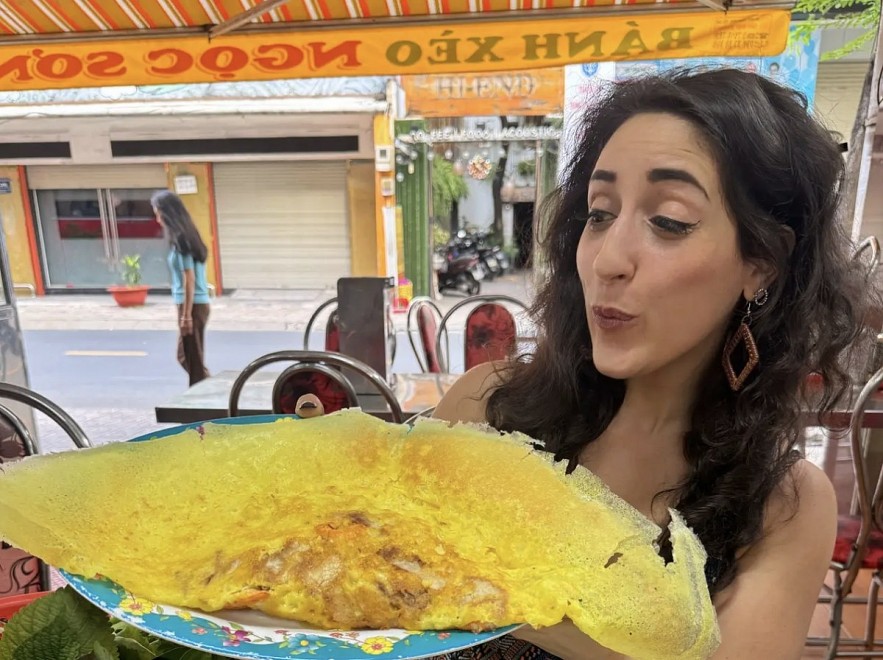 |
| Sophie Steiner enjoys Bánh xèo, also known as Vietnamese crêpe, in Ho Chi Minh City (Photo: Sophie Steiner/Business Insider) |
As evening turns into night, she added, city corners transform into impromptu eateries, with portable tables, plastic stools and motorbikes everywhere.
“I’ve done my fair share of devouring in this street-food mecca. There’s Bún Thịt Nướng — Nguyễn Trung Trực, a no-frills, 30-year-old stall known for heaping bowls of vermicelli topped with grilled pork, crisp egg rolls, pickles and a bouquet of herbs,” the travel writer revealed.
She also mentioned Bun Ca Xe Day, describing it as a late-night street vendor that ladles out steaming bowls of canh chua — a tangy soup flavored with pineapple, tamarind and tomato, topped with fried fish.
At Xiu Mai Chen Den Dau, Steiner noted, springy Vietnamese-style meatballs are served in a fragrant broth, accompanied by a crusty baguette for dipping.
“Regardless of how many times I visit, there’s always another miniature plastic chair flanking a buzzing back-alley pop-up waiting for me to take a seat,” she concluded.
Rounding out Steiner’s list of Asia’s top culinary cities were Bangkok, Thailand, and Chengdu, China.
Vietnam national team in 2026: Opportunities and challenges
Vietnam are expected to face a packed schedule in 2026, competing in both regional and continental tournaments. Their immediate focus will be a rematch with the Malaysia national football team in the Asian Cup 2027 qualifiers, scheduled for late March 2026.
With the Court of Arbitration for Sport (CAS) having temporarily suspended FIFA’s ban on a group of seven naturalized players, Malaysia could recall those players for the March fixture. The team is also reported to be moving forward with the naturalization of additional players ahead of the match against Vietnam.
This will present a major challenge for Kim Sang Sik’s side, but also a good opportunity for Vietnam to show their level. The current national team differs significantly from the one that previously lost in Malaysia. Kim Sang Sik has welcomed back striker Nguyen Xuan Son, along with overseas Vietnamese and naturalized players such as Quang Vinh, Phi Long and Hoang Hen.
Playing at home, Vietnam will first aim to overcome Malaysia before monitoring subsequent developments from CAS and the Asian Football Confederation (AFC), cited VOV.
 |
| The return of striker Nguyen Xuan Son adds more attacking options for the Vietnam national team. |
Another important objective for Vietnam in 2026 is defending the ASEAN Cup title. The tournament will be held under a revised schedule, adding to the challenge facing the defending champions.
Previously, the ASEAN Cup was typically staged at the end of the year, outside the FIFA international window. As a result, some teams were unable to call up their strongest squads because clubs were unwilling to release players.
With the tournament now scheduled for the summer, shortly after the World Cup, teams such as the Thailand national football team, the Indonesia national football team and the Malaysia national football team are expected to have greater access to their best players.
This is likely to increase competition across the tournament and make Vietnam’s title defense more demanding.
Alongside the challenges, there are also opportunities, as Vietnam can show their competitiveness after a strong 2025 from the Vietnam U23 national team.
 | Vietnam News Today (Feb. 11): Vietnam Values Strengthening Multifaceted Cooperation With Norway Vietnam News Today (Feb. 11): Vietnam values strengthening multifaceted cooperation with Norway; FM praises Czech Ambassador’s role in strengthening bilateral ties; Vietnamese, Cambodian localities boost ... |
 | Vietnam News Today (Feb. 13): Vietnam–Canada Ties Gain Fresh Momentum After Ministerial Meeting Vietnam News Today (Feb. 13): Vietnam–Canada ties gain fresh momentum after ministerial meeting; Spring Fair 2026 elevates trade promotion in tandem with market development; FDI ... |