
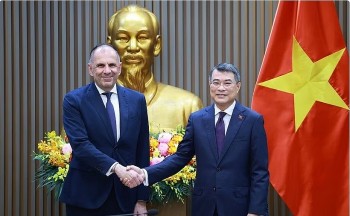
 Vietnam News Today (July 20): Diplomacy Opens New Pathways for Vietnam’s Development Vietnam News Today (July 20): Diplomacy Opens New Pathways for Vietnam’s Development |
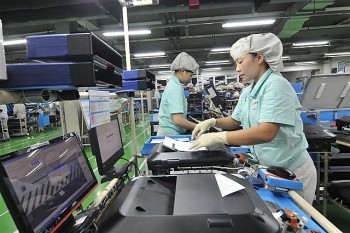 Vietnam News Today (July 21): Standard Chartered Raises 2026 GDP Growth Forecast for Vietnam to 9.5% Vietnam News Today (July 21): Standard Chartered Raises 2026 GDP Growth Forecast for Vietnam to 9.5% |
Vietnam News Today (July 25): Vietnam, ASEAN Continue to Strengthen Foundations of Regional Peace
Vietnam News Today (July 25): Vietnam, ASEAN continue to strengthen foundations of regional peace; Vietnam bridges interests, strengthens ASEAN solidarity; Vietnam targets ASEAN's third-largest international financial center by 2035; Photo exhibition celebrates 50 years of Vietnam-Thailand diplomatic relations.
| Vietnam News Today (July 22): Vietnam Reaffirms Commitment to Human Rights at AMM-59 Vietnam News Today (July 23): Vietnam Promotes Ties With Canada, New Zealand at AMM-59 |
| Vietnam News Today (July 25) notable headlines Vietnam, ASEAN continue to strengthen foundations of regional peace Vietnam bridges interests, strengthens ASEAN solidarity: Indonesian scholar Vietnam targets ASEAN's third-largest international financial center by 2035 Photo exhibition celebrates 50 years of Vietnam-Thailand diplomatic relations Tropical Storm Noul set to enter East Sea as Vietnam’s second storm Malaysian scholar lauds Vietnam as strategic linchpin for ASEAN Vision 2045 Coastal Vietnam told to brace as Typhoon Noul nears East Sea Vietnam pays tribute to fallen heroes in Laos on War Invalids and Martyrs' Day Global supply chain shift opens new opportunities for Vietnam's logistics |
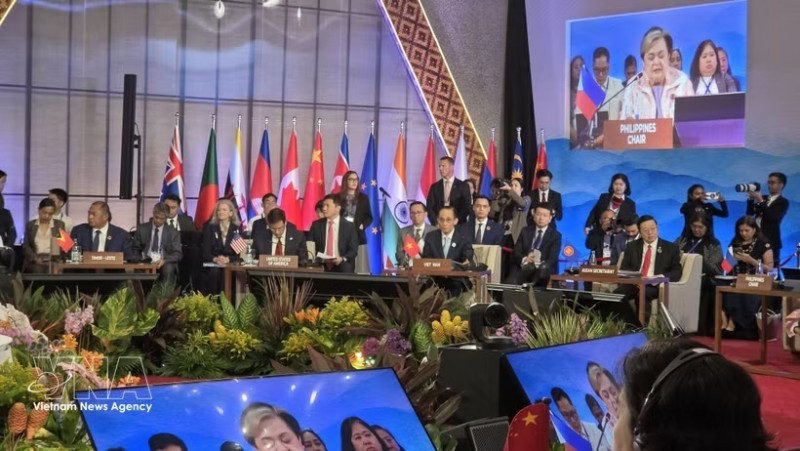 |
| Minister of Foreign Affairs Le Hoai Trung attends the 33rd ASEAN Regional Forum (ARF-33). (Illustrative photo: VNA) |
Vietnam, ASEAN continue to strengthen foundations of regional peace
Fifty years after the Treaty of Amity and Cooperation in Southeast Asia (TAC) was signed and 31 years since Vietnam joined the Association of Southeast Asian Nations (ASEAN), the treaty’s core principles of dialogue, respect for sovereignty, peaceful settlement of disputes and mutually beneficial cooperation continue to demonstrate their enduring relevance.
Serving not only as a cornerstone of the ASEAN Community, the TAC has also enabled member states, including Vietnam, to reinforce regional solidarity, uphold ASEAN centrality and respond effectively to an evolving strategic landscape.
Enduring values in a new context
Over the past five decades, the regional strategic environment has witnessed profound changes, marked by intensifying major-power competition alongside emerging challenges such as cybersecurity, climate change, energy security, supply chain disruptions and transnational crime. These developments have underscored the need for ASEAN to strengthen not only regional peace and stability but also its collective resilience and coordinated action.
According to experts, the principles enshrined in the TAC remain as relevant as ever; what must evolve is the way they are applied. Dr. Arisman, Executive Director of the Center for Southeast Asian Studies (CSEAS) in Indonesia, said the treaty’s strength lies in its flexibility. Respect for sovereignty, peaceful dispute settlement, the renunciation of the threat to use or use of force and mutually beneficial cooperation remain fundamental principles, he noted, but ASEAN should interpret and implement them in ways that address emerging security challenges.
He stressed the importance of preventive diplomacy, confidence-building measures, enhanced maritime cooperation and continued adherence to international law, particularly the 1982 United Nations Convention on the Law of the Sea (UNCLOS), as the basis for resolving disputes, cited VNA.
Sharing this view, Beni Sukadis, Senior Coordinator at the Indonesian Institute for Defence and Strategic Studies (Lesperssi), said adherence to the TAC should go hand in hand with deeper practical cooperation. He highlighted the need for ASEAN to accelerate economic integration, digital transformation and supply chain resilience, and expand cooperation in maritime security, cybersecurity, climate change and other non-traditional security issues.
The TAC's adaptability has enabled it to evolve from a treaty designed for Southeast Asian nations into a widely recognized code of conduct governing ASEAN's relations with external partners. It has also provided a framework for managing differences, broadening cooperation and preserving peace and stability across the region.
Advancing the treaty's values together
Vietnam's 31-year journey within ASEAN reflects the country's consistent commitment to translating the TAC's principles into concrete action. Since joining the bloc on July 28, 1995, during ASEAN's post-Cold War expansion, Vietnam has developed from a new member into an proactive, active and responsible participant, contributing to all three pillars of the ASEAN Community while helping strengthen unity, consensus and centrality.
Vietnam has consistently upheld the TAC's principles of respect for sovereignty, peaceful dispute settlement, non-use or threat of force, dialogue and mutually beneficial cooperation. These principles also underpin the country's foreign policy of independence, self-reliance, multilateralisation and diversification of international relations.
The country's contributions have been evident throughout ASEAN's development, particularly during its two terms as ASEAN Chair in 2010 and 2020 when Vietnam worked closely with fellow member states to promote dialogue, strengthen cooperation and advance ASEAN Community building. During its 2020 chairmanship, despite the unprecedented challenges posed by the COVID-19 pandemic, Vietnam helped maintain ASEAN's cooperation mechanisms, demonstrating the bloc's resilience and reinforcing its central role in the regional architecture.
As ASEAN moves forward with implementing the ASEAN Community Vision 2045, Vietnam remains committed to working with fellow members to build a resilient, innovative and sustainable regional community. In this new phase, steadfast adherence to, and flexible application of the TAC's principles will continue to underpin ASEAN's unity and centrality.
ASEAN Secretary-General Kao Kim Hourn has described Vietnam as an important and constructive member of ASEAN over the past three decades, highlighting its significant contributions to the political-security, economic and socio-cultural pillars. He expressed confidence that Vietnam will continue playing an active role in advancing the ASEAN Community Vision 2045.
New Zealand's Ambassador to ASEAN Joanna Anderson praised Vietnam's effective coordination role, particularly in energy security and economic cooperation, while Indonesia's Ambassador to ASEAN Derry Aman considered Vietnam a cohesive force with a strong commitment to ASEAN's core principles. Their assessments reflect growing international recognition of Vietnam's increasingly proactive and substantive role within the regional grouping.
Half a century after its signing, the TAC has become more than the foundation of cooperation among Southeast Asian nations. It has evolved into a set of internationally respected norms that continue to guide regional peace and cooperation. As the strategic environment grows increasingly complex, the treaty's enduring values of dialogue, trust-building, respect for international law and peaceful dispute settlement remain essential to strengthening ASEAN unity and safeguarding its central role in the evolving regional architecture.
Through its active engagement over the past 31 years, Vietnam has helped translate those principles into action and will continue working with ASEAN to promote peace, stability and sustainable development in the region and the world.
Vietnam bridges interests, strengthens ASEAN solidarity: Indonesian scholar
After more than three decades as a member of ASEAN, Vietnam has evolved from an active participant into a key architect of the bloc, playing an increasingly important role in promoting solidarity, cooperation and the building of the ASEAN Community, according to an Indonesian scholar.
Speaking to the Vietnam News Agency correspondent in Jakartar, Dr. Arisman, Executive Director of the Center for Southeast Asian Studies (CSEAS) in Indonesia, said Vietnam's contributions over the past 31 years have been evident across all three pillars of the ASEAN Community.
In the political-security pillar, Vietnam has consistently supported ASEAN centrality, helping maintain peace and stability while contributing to conflict prevention across the region.
Economically, the country has emerged as one of Southeast Asia's most dynamic economies and an increasingly important link in regional supply chains. Its active participation in the ASEAN Economic Community (AEC), the Regional Comprehensive Economic Partnership (RCEP) and ASEAN-led free trade agreements has strengthened regional economic integration and investment connectivity.
Citing the World Bank, Arisman noted that Vietnam has become one of Southeast Asia's key trading hubs and ranks among the region's fastest-growing economies.
Under the socio-cultural pillar, Vietnam has actively promoted cooperation in sustainable development, climate change response, disaster risk management, education, health care and people-to-people exchanges. It has also taken the initiative in advancing new priorities, including green growth, digital transformation, innovation and inclusive development, helping shape ASEAN's long-term agenda, according to VNA.
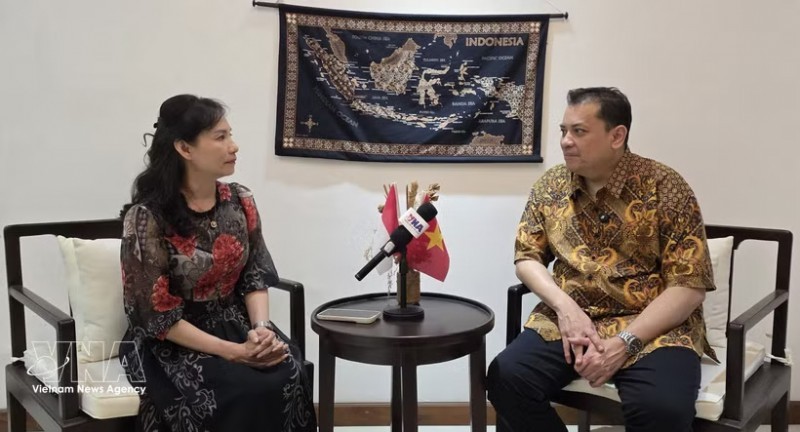 |
| Dr. Arisman (right), Executive Director of the Center for Southeast Asian Studies (CSEAS) in Indonesia, grants an interview to the Vietnam News Agency. (Photo: VNA) |
Commenting on the outcomes of the 59th ASEAN Foreign Ministers' Meeting, recently held in Manila, the scholar said Vietnam has once again demonstrated its role as a proactive and responsible member in reinforcing ASEAN solidarity, strengthening the bloc's strategic autonomy and advancing practical cooperation amid growing regional and global uncertainties.
Against the backdrop of intensifying major-power competition, Vietnam has continued to stress the importance of upholding ASEAN centrality, enhancing internal cohesion and making full use of ASEAN-led mechanisms, including the East Asia Summit (EAS), the ASEAN Regional Forum (ARF) and ASEAN Plus frameworks, he said.
Vietnam also reaffirmed its commitment to implementing the ASEAN Community Vision 2045 while advocating concrete action plans on regional connectivity, digital transformation, innovation, sustainable growth and institutional capacity-building.
On regional issues, particularly the East Sea, Vietnam has maintained the consistent viewpoint on the peaceful settlement of disputes in accordance with international law, especially the 1982 United Nations Convention on the Law of the Sea (UNCLOS), the scholar said. Such positions demonstrate that the country is not only an active participant in ASEAN processes but also a source of initiatives and practical solutions to strengthen the bloc's resilience and cohesion.
Looking ahead to the implementation of the ASEAN Community Vision 2045, Arisman said Vietnam is well placed to make even greater contributions to the region's shared development goals.
He perceived that it could further advance regional economic integration by strengthening digital connectivity, facilitating cross-border trade, developing resilient supply chains and supporting the digital transformation of small and medium-sized enterprises, thereby enhancing ASEAN's competitiveness in an evolving global economy.
Vietnam also has valuable experience to share in renewable energy, the circular economy, sustainable agriculture and climate adaptation, which could help ASEAN achieve its sustainable development goals while reinforcing regional energy security.
As one of ASEAN's leading agricultural and aquaculture producers, Vietnam could also contribute expertise in building climate-resilient food systems, promoting sustainable fisheries management and expanding cooperation in the blue economy.
In addition, the country is well positioned to support ASEAN's digital transformation through cooperation in digital governance, cybersecurity, artificial intelligence, digital skills development and regulatory harmonisation to facilitate cross-border digital trade.
It could also play a greater role in narrowing development gaps among ASEAN members by expanding technical cooperation, sharing development experience and strengthening subregional cooperation programs, he added.
According to Arisman, Vietnam's greatest strength lies in its ability to bridge diverse interests, promote meaningful cooperation and preserve ASEAN solidarity while adapting to emerging challenges.
He expressed confidence that these strengths will enable Vietnam to continue playing an important role in advancing the ASEAN Community Vision 2045 and building a more resilient, innovative, sustainable and people-centered ASEAN.
Vietnam targets ASEAN's third-largest international financial center by 2035
Vietnam has unveiled an ambitious roadmap to develop its newly established international financial center by 2035, aiming to position the country as a key regional capital hub and the third-largest financial center in ASEAN.
Under the newly approved International Financial Center Development Plan to 2035, Vietnam also targets ranking among the top 25 financial centers in the Asia-Pacific region and the top 75 globally, according to the Global Financial Centers Index (GFCI) or an equivalent international benchmark.
The plan was signed on July 22 by Deputy Prime Minister Nguyen Van Thang, chairman of the Governing Council of Vietnam’s International Financial Center.
The overall objective is to transform the international financial center into a major platform for mobilising, allocating and efficiently utilising domestic and international financial resources, supporting rapid and sustainable economic growth while enhancing Vietnam's position within regional and global financial networks.
Building the foundations
During the 2026-2030 period, Vietnam will prioritize establishing a comprehensive legal and institutional framework, governance model, operational mechanisms and supervisory system aligned with international standards to ensure transparency, safety and efficiency.
The country also plans to gradually put into operation core financial, digital, legal and social infrastructure, alongside launching priority financial products and services.
Efforts will focus on attracting international financial institutions, investment funds, global banks and highly skilled financial professionals.
Expanding a modern financial ecosystem
Between 2031 and 2035, the country aims to expand and strengthen a modern financial ecosystem covering capital markets, green finance, digital finance and financial technology (fintech), while improving market depth, diversity and integration with international financial markets.
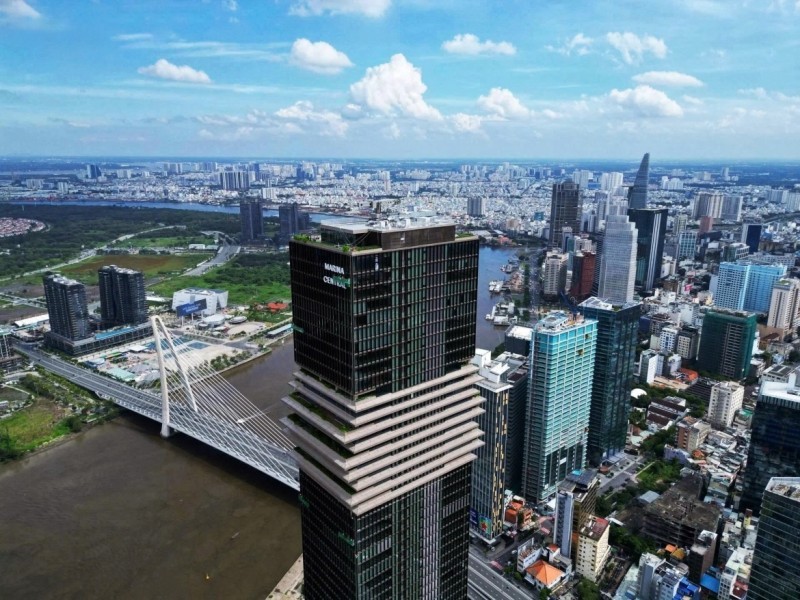
Under the plan, Ho Chi Minh City will serve as Vietnam's comprehensive international financial center, focusing on capital markets, traditional and specialized financial services, asset and fund management, green finance, digital finance and commodity derivatives linked to international trade and logistics.
 |
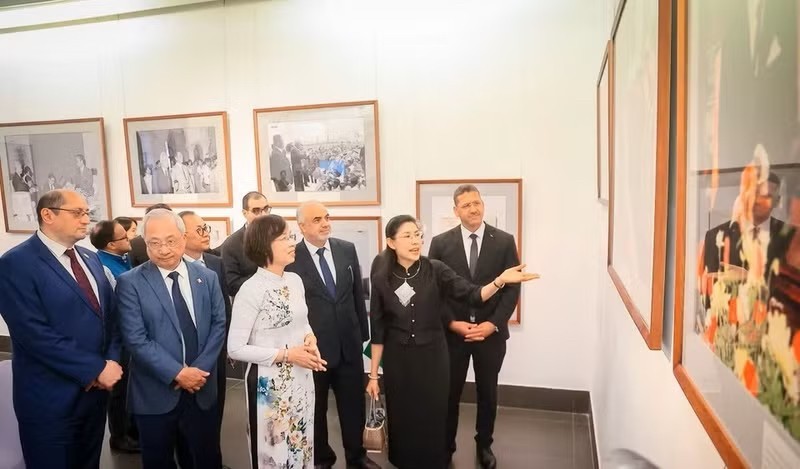
| Delegates visit the photo exhibition marking 50 years of Vietnam-Thailand relations. (Photo: VNA) |
Meanwhile, Da Nang will develop as an innovation- and technology-driven financial hub specialising in digital assets, digital payments, asset tokenisation, specialized trading platforms, startup finance, supply chain financing and regulatory sandbox initiatives for emerging financial technologies and products.
Enhancing global competitiveness
To create a favorable business environment, Vietnam plans to continue refining its institutional framework, introduce internationally competitive policies, digitalise administrative procedures and improve public services for investors and market participants.
The development strategy also prioritizes strengthening financial markets, digital infrastructure and data systems. It will build a highly skilled workforce and attract international experts in finance, technology and legal services to support the operation of a globally competitive financial center.
Vietnam expects the project to enhance the country's ability to mobilise and allocate financial resources more efficiently, accelerate international economic integration and strengthen its position within regional and global financial markets.
The 15th National Assembly adopted a resolution in June 2026 to build Vietnam's International Financial Center.
Under the resolution, the International Financial Center is defined as a geographically designated zone established by the Government and located in both Ho Chi Minh City and Da Nang. While operating under a unified governance and regulatory framework, the two locations are designed to leverage their respective competitive advantages and complementary development models.
Following the establishment of the legal framework, Vietnam has gradually moved from policy planning to implementation.
The Government has issued implementing regulations governing the establishment and operation of the International Financial Center. Both Ho Chi Minh City and Da Nang have inaugurated their respective financial facilities and begun building their operational structures.
The initiative has already attracted growing interest from international financial institutions, multinational corporations, investors and global business organizations, marking an important step toward positioning Vietnam as an emerging regional financial hub.
Photo exhibition celebrates 50 years of Vietnam-Thailand diplomatic relations
The Royal Thai Embassy in Vietnam, in coordination with the Vietnam News Agency (VNA), opened a photo exhibition themed “The Lens of Diplomacy: 50 Years of Thailand–Vietnam Relations” in Hanoi on July 24 morning, in celebration of the 50th founding anniversary of the diplomatic relations between the two countries (August 6, 1976–2026).
The Royal Thai Embassy in Vietnam, in coordination with the Vietnam News Agency (VNA), opened a photo exhibition themed “The Lens of Diplomacy: 50 Years of Thailand–Vietnam Relations” in Hanoi on July 24 morning, in celebration of the 50th founding anniversary of the diplomatic relations between the two countries (August 6, 1976–2026).
The event was attended by Thai Ambassador to Vietnam Urawadee Sriphiromya, VNA General Director and Deputy Head of the Party Central Committee’s Commission for Information, Education and Mass Mobilisation Vu Viet Trang, and representatives of central agencies, ministries and sectors, diplomatic missions and international organizations in Hanoi.
Speaking at the opening ceremony, Ambassador Urawadee Sriphiromya said the exhibition was part of a series of activities organized by the Thai Embassy throughout 2026 to celebrate the 50th anniversary of diplomatic relations between the two countries.
During this special year, the two sides have organized numerous cultural activities, youth exchanges, academic dialogues and business forums. These events reflect the many dimensions of the bilateral partnership while affirming that the Thailand–Vietnam friendship has been steadily nurtured over time and continues to flourish across generations, NDO reported.
 |
| VNA General Director Vu Viet Trang speaks at the opening ceremony. (Photo: VNA) |
On behalf of the Thai Embassy, Urawadee expressed her appreciation to the VNA for its close coordination in turning the exhibition idea into reality. She stressed that each photograph has the power to preserve moments and memories and tell stories that words sometimes cannot fully convey.
Years later, when people look back at these photographs, they will remember not only the events that took place but also the emotions associated with each moment, she said.
The ambassador noted that, in her capacity, she has had the honour of witnessing the friendship between the two countries through numerous daily exchanges and cooperation activities.
These include the warm hospitality extended by Vietnamese people to Thai visitors; the enthusiasm of young people participating in exchange programs, learning each other’s languages and building lasting friendships; and the increasingly extensive cooperation among universities, businesses and local communities in both countries.
It is these ordinary encounters and exchanges that bring vitality to the relationship between the two nations, she added.
Urawadee expressed her belief that the exhibition would enable the public not only to look back at history but also to feel the friendship that has connected the two peoples for half a century and continues to inspire them to build a shared future.
The next 50 years will offer even greater opportunities for cooperation, enabling Thailand and Vietnam to prosper together not only as Comprehensive Strategic Partners but also as neighbours and friends who have enduring trust in one another, she said.
Tropical Storm Noul set to enter East Sea as Vietnam’s second storm
Tropical Storm Noul is forecast to enter the East Sea early July 25 and strengthen further before heading toward China’s Guangdong province.
A tropical depression near the East Sea has strengthened into a storm internationally named Noul. The storm is forecast to enter the East Sea late tonight or early Saturday (July 25), becoming the second storm to affect the sea this year.
According to the National Center for Hydro-Meteorological Forecasting (NCHMF), the tropical depression strengthened into Tropical Storm Noul overnight on July 23. It is the 12th storm to form over the northwestern Pacific this year.
Noul is forecast to enter the northeastern waters of the northern East Sea late tonight or early Saturday (July 25), becoming the second storm to enter the East Sea in 2026.
The storm is then expected to continue toward Guangdong province in China, with an estimated 80% probability of making landfall there on July 26. It is considered unlikely to directly affect Vietnam’s mainland.
As of 7 a.m. on July 24, the storm’s center was located at approximately 18.3 degrees north latitude and 124.2 degrees east longitude, about 210 kilometers east of Luzon Island in the Philippines, VNN reported.
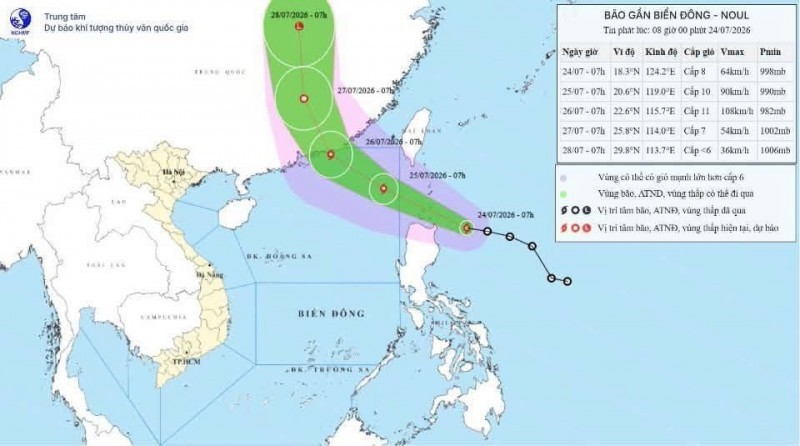 |
| Forecast track and intensity of Tropical Storm Noul as of 8 a.m. on July 24, 2026. Source: NCHMF |
Maximum sustained winds near the center were at Level 8, or 62-74 kph, with gusts reaching Level 10. The storm was moving west-northwest at around 25 kph.
Over the next 24 hours, Noul is forecast to continue moving west-northwest at 25 kph and could strengthen further. By 7 a.m. on July 25, its center is expected to be over the northeastern waters of the northern East Sea, with winds strengthening to Levels 9-10 and gusts reaching Level 12.
El Nino 2026-2027 outlook: Extreme heat and abnormal floods
Over the following 24 hours, the storm is expected to maintain its west-northwest track at around 15-20 kph and continue intensifying.
By 7 a.m. on July 26, its center is forecast to be over coastal waters off Guangdong province, China, with winds at Levels 10-11 and gusts reaching Level 13.
During the next 24 hours, Noul is forecast to change direction and move north-northwest at 15-20 kph while gradually weakening into a tropical depression.
By 7 a.m. on July 27, the center of the tropical depression is expected to be over land in Guangdong province, with winds weakening to Level 7 and gusts at Level 9.
Between 72 and 96 hours from now, the tropical depression is forecast to move mainly northward at 15-20 kph and gradually weaken into a low-pressure area.
Under the influence of Noul, winds over the northeastern waters of the northern East Sea are forecast to strengthen to Levels 6-7 from the evening of July 24, later increasing to Levels 8-9, with waves of 3-5 meters.
Near the storm’s center, winds could reach Levels 10-11, with gusts at Level 13 and waves of 4-6 meters. Seas are expected to be extremely rough.
Vessels operating within the affected areas could face thunderstorms, tornadoes, strong winds and high waves.

Most read


Related Stories
 National
Viet Nam News Today (Oct. 17): Vietnam-EU Ties Set For New Heights With Concrete, Practical Outcomes
Viet Nam News Today (Oct. 17): Vietnam-Russia trade at structural turning point; Vietnam-EU ties set for new heights with concrete, practical outcomes; Vietnam-Denmark ties poised for new momentum after 55 years; European businesses remain upbeat about Viet Nam’s economic outlook
October 17, 2026 | 07:00
 National
Viet Nam News Today (Oct. 16): Vietnam, Australia Work to Turn Momentum Into Substantive Cooperation
Viet Nam News Today (Oct. 16): General Secretary and President To Lam to visit Denmark, EU, Belgium; Vietnam, Australia work to turn momentum into substantive cooperation; Liechtenstein Prime Minister Brigitte Haas to pay official visit to Viet Nam; Vietnamese role highlighted at ICIT 2026 in RoK.
October 16, 2026 | 08:57
 National
Viet Nam News Today (Oct. 15): Viet Nam, US Seek to Deepen Economic Ties, Promote High-Tech Investment
Viet Nam News Today (Oct. 15): Viet Nam gives top priority to relations with Laos; PM calls for stronger cooperation with Hamburg in ports, logistics, green energy; Viet Nam, US seek to deepen economic ties, promote high-tech investment; Timor-Leste and Viet Nam to increase parliamentary cooperation.
October 15, 2026 | 08:37
In topics
National
Viet Nam News Today (Oct. 17): Vietnam-EU Ties Set For New Heights With Concrete, Practical Outcomes
Viet Nam News Today (Oct. 17): Vietnam-Russia trade at structural turning point; Vietnam-EU ties set for new heights with concrete, practical outcomes; Vietnam-Denmark ties poised for new momentum after 55 years; European businesses remain upbeat about Viet Nam’s economic outlook
October 17, 2026 | 07:00
National
Viet Nam News Today (Oct. 16): Vietnam, Australia Work to Turn Momentum Into Substantive Cooperation
Viet Nam News Today (Oct. 16): General Secretary and President To Lam to visit Denmark, EU, Belgium; Vietnam, Australia work to turn momentum into substantive cooperation; Liechtenstein Prime Minister Brigitte Haas to pay official visit to Viet Nam; Vietnamese role highlighted at ICIT 2026 in RoK.
October 16, 2026 | 08:57
National
Viet Nam News Today (Oct. 15): Viet Nam, US Seek to Deepen Economic Ties, Promote High-Tech Investment
Viet Nam News Today (Oct. 15): Viet Nam gives top priority to relations with Laos; PM calls for stronger cooperation with Hamburg in ports, logistics, green energy; Viet Nam, US seek to deepen economic ties, promote high-tech investment; Timor-Leste and Viet Nam to increase parliamentary cooperation.
October 15, 2026 | 08:37
 National
Viet Nam News Today (Oct. 14): Vietnam, Cambodia Sign Defense Cooperation Plan for 2027
Viet Nam News Today (Oct. 14): Defense, security cooperation is an important pillar of Vietnam–Laos ties; Vietnam, Cambodia sign defense cooperation plan for 2027; HCM City expands economic cooperation with Eastern Europe; Russia grants Vietnamese citizens visa-free entry for stays of up to 30 days.
October 14, 2026 | 08:43
Recommended
 National
DNA Collection Offers Hope to Families of Fallen Soldiers
Implementing Plan No. 551/KH-CATP-P.QLHC dated 8 October 2026 issued by the Da Nang City Police on collecting DNA samples from relatives of fallen soldiers whose identities remain unknown in the city, on the morning of 15 October, Quang Phu Ward Police, in coordination with Da Nang City Police and relevant units, organized DNA sample collection for relatives of unidentified fallen soldiers at Hall No. 1 of the Quang Phu Ward Police headquarters.
October 17, 2026 | 15:16
 National
An Giang Collects DNA Samples to Identify Fallen Soldiers
As part of the 500-day campaign to search for and recover the remains of fallen soldiers, DNA sample collection from their relatives plays a vital role in identifying those who sacrificed their lives for the Fatherland. From 15 to 17 October 2026, An Giang Provincial Police will continue the second phase of DNA sample collection for 2026, targeting more than 1,000 samples at nine collection sites covering 92 communes, wards and special administrative zones across the province.
October 17, 2026 | 15:10
 National
Viet Nam News Today (Oct. 13): EU-Vietnam Partnership Set for Deeper Cooperation and Tangible Results
Viet Nam News Today (Oct. 13): EU-Vietnam Partnership set for deeper cooperation and tangible results; Vietnam and China step up parliamentary cooperation to deepen bilateral ties; Vietnam, Australia step up digital technology, AI cooperation; Vietnam’s economic transformation opens up major cooperation opportunities with EU.
October 13, 2026 | 08:28
 National
Lao Media Highlight Significance of Prime Minister Le Minh Hung’s Visit to Laos
On October 10, several Lao media outlets published articles praising the results of Vietnamese Prime Minister Le Minh Hung’s official visit to Laos, highlighting its significance in consolidating the great friendship, special solidarity, comprehensive cooperation and strategic cohesion between Viet Nam and Laos.
October 12, 2026 | 11:05
Popular article
National
Viet Nam News Today (Oct. 14): Vietnam, Cambodia Sign Defense Cooperation Plan for 2027
Viet Nam News Today (Oct. 14): Defense, security cooperation is an important pillar of Vietnam–Laos ties; Vietnam, Cambodia sign defense cooperation plan for 2027; HCM City expands economic cooperation with Eastern Europe; Russia grants Vietnamese citizens visa-free entry for stays of up to 30 days.
October 14, 2026 | 08:43
 National
Viet Nam Welcomes EU Decision to Remove It from Tax Non-Cooperative List
On October 10, Spokesperson of the Ministry of Foreign Affairs Pham Thu Hang said that Viet Nam welcomed the European Union’s (EU) decision to remove Viet Nam from its list of non-cooperative jurisdictions for tax purposes, describing it as recognition of the country’s reform efforts in recent years.
October 12, 2026 | 09:51
 National
Viet Nam News Today (Oct. 12): Viet Nam Pledges to Advance Rule of Law at Home, Uphold Law-based Global Order at UN
Viet Nam News Today (Oct. 12): Top Vietnamese legislator's China visit: Messages on parliamentary cooperation; Viet Nam pledges to advance rule of law at home, uphold law-based global order at UN; Viet Nam-Canada strategic partnership leverages strengths to consolidate positions; German-Vietnamese friendship association marks 50 years of nurturing people-to-people ties.
October 12, 2026 | 08:12
 National
Viet Nam News Today (Oct. 11): Viet Nam, Laos Strengthen Cooperation in Combating Transnational Crime
Viet Nam News Today (Oct. 11): PM calls Angkormilk project proof of Vietnamese businesses’ success in Cambodia; Viet Nam, Laos strengthen cooperation in combating transnational crime; Viet Nam welcomes EU removal from tax non-cooperative list; Viet Nam, Timor-Leste seek broader cooperation in rice, coffee and fisheries.
October 11, 2026 | 09:39