Vietnamese Trade Counselor in Israel: Maintaining trade flows amid regional instability
Escalating tensions involving Israel, the US and Iran are negatively affecting the trade and investment climate in Israel and across the Middle East, while placing additional strain on global supply chains, according to Vietnamese Trade Counselor in Israel Le Thai Hoa.
Speaking to a Vietnam News Agency (VNA) correspondent in Tel Aviv, Hoa said the increasingly complex and expanding conflict has pushed the security and political situation in Israel and several countries in the region into a state of instability. Some nations have closed their airspace and declared a state of emergency, while many airlines have suspended flights to and from Israel. Although seaports remain operational, their capacity has been significantly constrained.
Beyond direct retaliatory strikes between Iran and Israel, forces such as Hezbollah in Lebanon and the Houthi movement in Yemen have intensified activities targeting Israel. Notably, the Houthis have stepped up control over vessels transiting routes leading to the Red Sea, a vital maritime corridor linking Asia and Europe. After consecutive days of hostilities, there are no clear signs of de-escalation.
Assessing the immediate impact, Hoa said the conflict is adversely affecting trade between Vietnam and Israel, as well as between Vietnam and other Middle Eastern markets, particularly in the short term. Heightened risk concerns have made businesses more cautious in making investment decisions as well as signing and implementing contracts.
In the medium and long term, he warned of potential disruptions or rerouting of shipping and transit air routes from Asia to Europe, alongside surging oil prices should Iran move to blockade the Strait of Hormuz, through which about 20% of global oil and gas supplies pass. Rising maritime freight rates, airfares and insurance premiums could drive up production input costs and intensify inflationary pressures not only in the Middle East but also in economies worldwide.
In response, the Trade Counselor urged Vietnamese enterprises to closely monitor developments, maintain regular contact with shipping lines and partners – particularly regarding goods in transit – and promptly address emerging issues. Businesses were also advised to diversify markets, expand partner and supplier networks, and strengthen risk management and cargo insurance measures, cited VNA.
 |
| Vietnamese Trade Counselor in Israel Le Thai Hoa (Photo: VNA) |
Hoa said the Vietnam Trade Office in Israel is maintaining close coordination with local authorities to assist enterprises and provide timely market updates and early warnings. Firms facing difficulties related to the Israeli market are encouraged to contact the office directly for guidance.
So far, no specific losses have been recorded in import-export shipments between businesses of the two countries during the current escalation, a positive sign amid prevailing uncertainties. However, Hoa cautioned that short-term trade sentiment and activities will likely remain under pressure.
At the same time, partial supply disruptions from other sources mean Israel continues to sustain strong import demand to serve domestic production and consumption. The country imports around 100 billion USD worth of goods annually, including approximately 25 billion USD in food, agricultural and consumer products, representing considerable potential for Vietnamese exporters.
Hoa stressed that alongside managing existing contracts, Vietnamese firms should maintain close ties with key Israeli importers and major partners to prepare for the post-conflict period, positioning themselves to capitalise on market opportunities once stability returns.
Global perspective: Beyond GDP expansion, Vietnam can drive deeper reforms and innovation-led growth
International assessments of Vietnam’s economy are increasingly moving beyond headline growth figures. What underpins global confidence today is not merely projected GDP expansion, but the belief that Vietnam can leverage its macroeconomic stability to drive deeper reforms and innovation-led growth.
The year 2026 is widely viewed as the beginning of a new development phase. As the country rolls out its 2026–2030 five-year plan, international observers are paying closer attention to the quality, structure and resilience of its growth model amid lingering global uncertainties.
Following two years of strong recovery, Vietnam enters this new cycle with firmer macroeconomic fundamentals. Inflation remains contained, major economic balances are broadly secured, and market sentiment is gradually improving.
Mariam J. Sherman, World Bank Division Director for Vietnam, Cambodia and Laos assessed that the country's strengths lie in its strategic position along major Asian trade routes, its solid industrial base, an extensive network of free trade agreements, and a workforce that is both cost-competitive and increasingly skilled. These structural advantages continue to place Vietnam among ASEAN's most dynamic economies in 2026 outlooks.
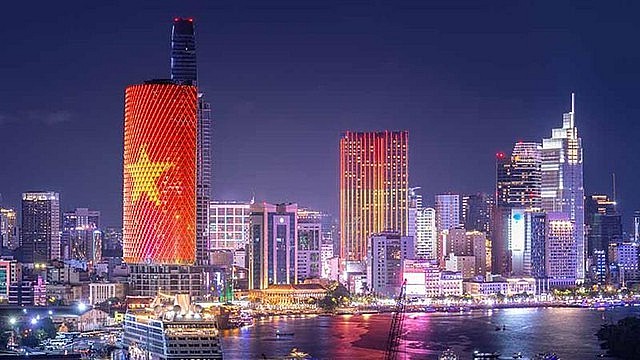
Leading financial institutions have expressed optimism about Vietnam's growth prospects. United Overseas Bank (UOB), Citigroup and Standard Chartered forecast GDP growth in the range of 7.2–8 percent this year, supported by sustained foreign direct investment (FDI) inflows and robust expansion in 2025. Investment in high technology, semiconductors and renewable energy is expected to strengthen industrial output as large projects begin commercial operations, VGP reported.
 |
| Photo: VGP |
At the same time, a recovery in domestic consumption and international tourism—amplified by earlier fiscal and monetary support measures—is providing additional momentum.
More conservative projections from the Asian Development Bank (ADB), the International Monetary Fund (IMF) and the Organization for Economic Co-operation and Development (OECD) place Vietnam's growth between 6 and 6.5 percent. Even so, such performance would significantly exceed the global average. The divergence in forecasts largely reflects caution regarding external risks rather than concerns over domestic fundamentals. Overall, there is consensus that Vietnam's economy has become more resilient to global shocks.
A notable evolution in international analyses this year concerns the drivers of growth. While exports and FDI were previously seen as the dominant pillars, increasing attention is now being paid to the domestic market. With GDP per capita projected to surpass US$5,000 in 2026, Vietnam is approaching upper-middle-income status and witnessing the expansion of a more affluent middle class. A larger domestic consumer base not only offers greater opportunities for local enterprises, but also strengthens Vietnam's appeal to investors pursuing "produce-for-market" strategies.
FDI inflows are also shifting in quality. New projects are increasingly concentrated in high technology, smart manufacturing and renewable energy rather than low-cost, labor-intensive sectors. Vietnam is gradually being recognized not only as an export platform, but as a critical link within regional production networks. This transition opens space for industrial clustering, technology transfer and deeper participation in global value chains.
However, sustaining high growth and achieving a meaningful breakthrough will require more profound structural reforms.
The OECD and IMF note that growth driven primarily by capital accumulation and labor expansion is narrowing in scope. Over the medium and long term, productivity improvements and innovation capacity will be decisive. Continued efforts to streamline administrative procedures, enhance regulatory transparency, deepen capital markets and pilot regulatory sandboxes for emerging industries are considered essential to unlocking a new wave of private investment and entrepreneurship.
Another key priority is strengthening linkages between the FDI sector and domestic firms. As multinational corporations expand their footprint in Vietnam, opportunities for technology diffusion and improved governance practices increase. Empowering local enterprises to upgrade standards, improve risk management and access finance will be crucial to raising domestic value added and reinforcing sustainable growth.
Green transition and digital transformation are equally central to the next stage of development. Stricter environmental requirements in major export markets demand greater investment in renewable energy and energy-efficient technologies. Long-term commitments to green infrastructure, modern logistics systems and the digital economy are widely viewed as indispensable for maintaining competitiveness and aligning with Vietnam's innovation-driven growth strategy.
On the macroeconomic front, the outlook remains reassuring. While exchange rate and interest rate pressures persist, they are considered manageable provided fiscal and monetary policies remain flexible and well-coordinated, and credit is channeled toward productive sectors. Maintaining fiscal discipline and preserving investor confidence will be vital in navigating external volatility.
Ultimately, 2026 represents more than a target of outpacing global growth. It signals the start of a new development phase defined by higher quality, greater resilience and deeper structural transformation. International confidence in Vietnam is grounded not only in promising forecasts, but in the conviction that the country is well positioned to turn macroeconomic stability into a powerful catalyst for reform, innovation and sustainable prosperity.
Booking.com reveals Vietnam’s most welcoming destinations for 2026
Booking.com, one of the world’s leading digital travel platforms, has announced the 10 most welcoming destinations in Vietnam as part of the 14th edition of its Traveler Review Awards.
They include Hoi An Ancient Town in Quang Nam province, Mai Chau in Hoa Binh province, Cu Lao Thu in Binh Thuan province, Ninh Binh province, Ha Giang province, Con Dao, Phong Nha in Quang Binh province, Da Lat, Phu Quoc Special Zone of Kien Giang province, and Cao Bang province.
This year’s list for Vietnam features a diverse range of destinations, from historic old towns and tranquil mountain retreats to sun-drenched coastlines. These destinations reflect the breadth of Vietnam’s travel landscape, united by a shared spirit of hospitality that continues to leave a strong impression on visitors.
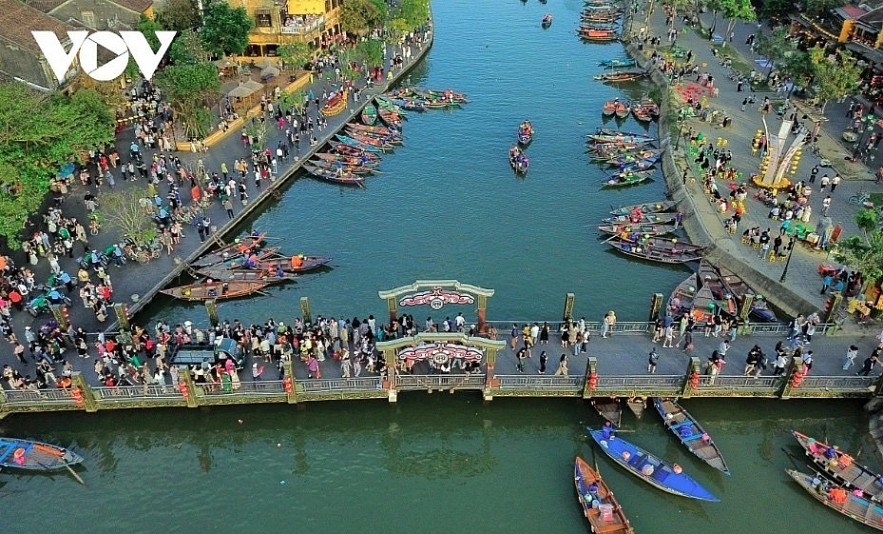 |
| Hoai River in Hoi An. |
Powered by more than 370 million verified traveler reviews worldwide, the awards recognise partners who consistently deliver outstanding hospitality and service. In 2026, 1.81 million partners across 221 countries and territories are being recognised globally, a 5% increase compared with the previous year. This includes 1,817,848 accommodation providers, 1,977 rental car companies and 137 airport transfer suppliers.
In Vietnam, 13,052 accommodation partners, including 6,503 homes, were recognised with a Booking.com Traveler Review Award, reflecting the country’s growing hospitality sector and commitment to delivering memorable guest experiences.
Globally, Italy continued to lead for the ninth consecutive year with 214,666 award-winning partners, followed by France (170,596) and Spain (152,292). Germany (111,685) and the United Kingdom (93,989) round out the top five, VOV reported.
Booking.com’s country head for Vietnam Branavan Aruljothi said a destination is defined as much by the warmth of its people as by its landscapes and heritage. Whether it is a host in Hoi An preserving architectural history or a local community in Ha Giang and Mai Chau welcoming travelers into their daily lives, he added, these interactions shape experiences that travelers remember long after their journey ends.
“The Traveler Review Awards are our way of recognizing these hospitality heroes and expressing gratitude from Booking.com and millions of travelers from all around the world,” Branavan Aruljothi said.
 | Vietnam News Today (Mar. 1): Vietnamese, Portuguese Foreign Ministers Hold Talks in Hanoi Vietnam News Today (Mar. 1): Vietnamese, Portuguese foreign ministers hold talks in Hanoi; Vietnam consolidates traditional ties with Cambodia; Vietnam remains bright spot for FDI ... |
 | Vietnam News Today (Mar. 2): Over 38 Billion USD in Public Investment to Fuel New Growth Momentum Vietnam News Today (Mar. 2): Vietnam, Laos step up parliamentary cooperation to realize strategic cohesion; Tam Chuc complex in Ninh Binh granted special national relic ... |