
500-Day-and-Night Campaign: 1,863 Martyrs’ Remains Recovered, Identification Efforts Accelerated
| Nghe An's 500-Day and Night Campaign Collects 17,831 DNA Samples Nearly 40,000 Phone Calls Are Made To “500-day Campaign” Hotline |
In Tuyen Quang, five mass graves containing approximately 23 sets of martyrs’ remains have been discovered. Search operations in the area were conducted at different times, including at Hills 211A, 685 and 823.
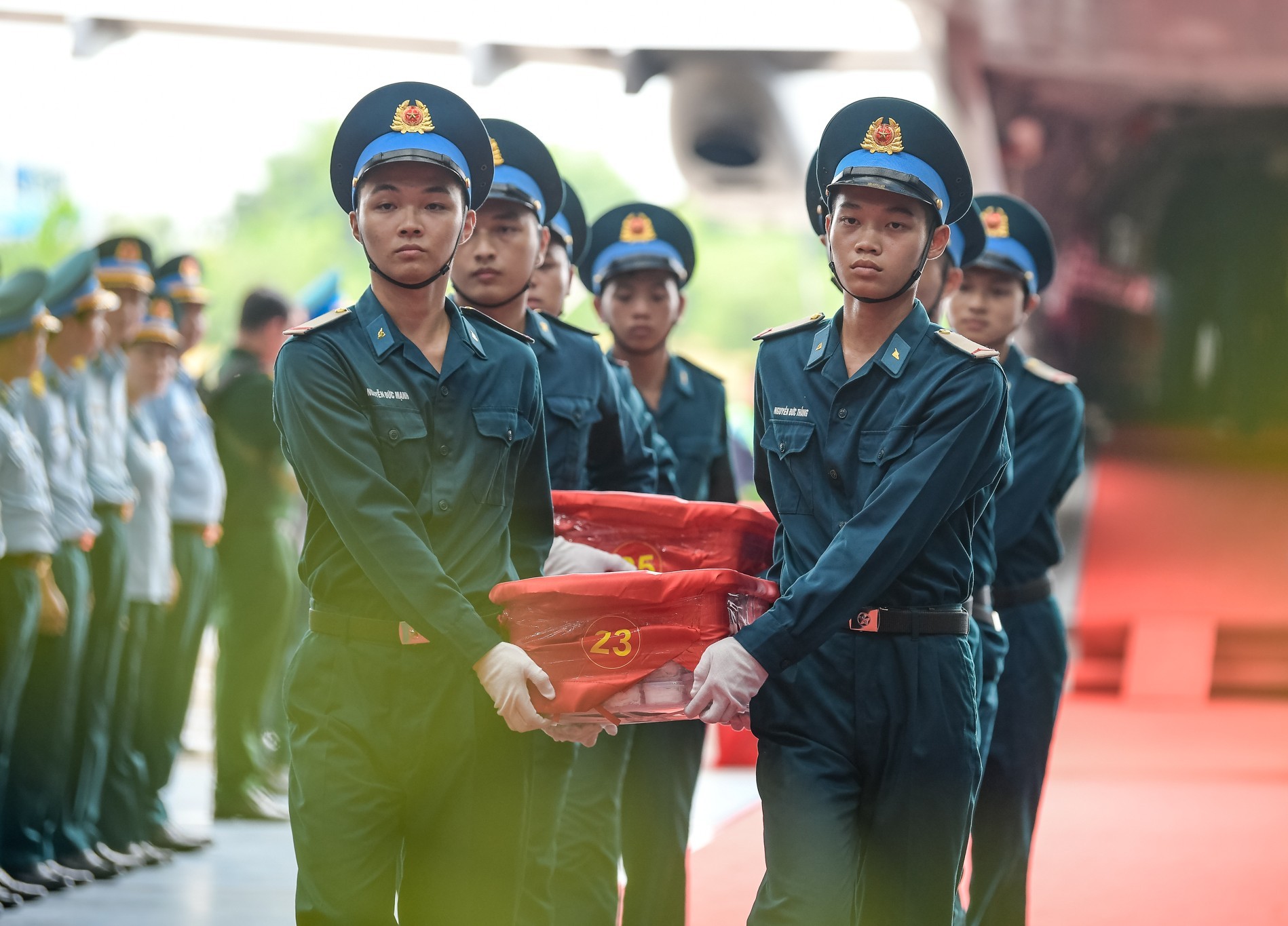 |
| The Vietnam Academy of Science and Technology receives biological samples from martyrs’ remains transferred from the Ho Chi Minh City Steering Committee for the Search, Recovery and Identification of Martyrs’ Remains to Hanoi for DNA testing and identification (Photo: Vietnam Academy of Science and Technology) |
At Le Thi Rieng Park in Ho Chi Minh City, the relevant forces recovered 418 sets of martyrs’ remains. In addition, 13 sets were found in the Cau Nhi area of Quang Tri; 26 in Minh Duc Commune, Dong Nai City; 10 in Dak Pe Commune, Dak Lak; and four in the Truong Chinh Road area of Quang Ngai.
According to figures updated as of August 22, the campaign has mobilized 32 search and recovery teams, with a total of 1,559 personnel. Of these, 13 teams are operating domestically, while 19 are carrying out missions overseas, including eight teams in Laos and 11 in Cambodia. The units have organized 16 memorial and reburial ceremonies for martyrs’ remains, including ceremonies for the repatriation of 850 sets of remains.
An important task of the 500-Day-and-Night Campaign is to collect samples from martyrs’ remains for testing and identification. As of August 22, samples had been collected from 148,601 martyrs’ graves, reaching 69.8% of the target.
Of these, 102,689 graves were eligible for sampling, accounting for 69.1%, while 45,912 graves were not yet eligible for sampling. To date, 11 of the 34 provinces and centrally governed cities have completed the sampling process. To carry out the task, 264 sampling teams have been mobilized, with approximately 3,500 personnel involved.
Efforts to collect samples from martyrs’ relatives have also been accelerated. A total of 265,761 samples have been collected, of which 71,102 have been analyzed and 66,909 synchronized with the database. This is an important source of data for DNA analysis and matching, gradually helping identify martyrs whose information remains incomplete.
Alongside sample collection in localities, the reception, storage and preservation of samples from martyrs’ remains are also being carried out to ensure an adequate supply of samples for testing.
As of August 22, a total of 35,983 samples from martyrs’ remains had been received, stored and preserved from localities. The Military Forensic Institute alone had received 27,169 samples from martyrs’ remains from 16 of the 17 provinces and cities and conducted testing on 195 samples.
Notably, on August 21, a large quantity of biological samples from martyrs’ remains was transported from Ho Chi Minh City to Hanoi for DNA testing. The Ho Chi Minh City Steering Committee for the Search, Recovery and Identification of Martyrs’ Remains, in coordination with units under the Air Defense-Air Force Service, transported 7,104 biological samples from martyrs’ remains by CASA-295 military transport aircraft.
The samples were sealed and packed in 100 specialized containers, with a total weight of approximately 1,300 kg. After being transported to Gia Lam Military Airport, all the samples were taken to the DNA Testing Center under the Institute of Biology of the Vietnam Academy of Science and Technology for receipt, documentation checks and implementation of the necessary professional procedures.
The transportation and handover were carried out under strict procedures to ensure proper management, preservation and the integrity of the samples before they entered the testing process. Under Decision No. 51/QD-BCDQG dated May 31, 2026, issued by the National Steering Committee for the Search, Recovery and Identification of Martyrs’ Remains, the Vietnam Academy of Science and Technology was assigned to receive and conduct DNA testing on samples of martyrs’ remains from eight provinces and cities, including Ho Chi Minh City.
The receipt of more than 7,000 biological samples on this occasion demonstrates the growing scale of DNA testing in the effort to identify fallen soldiers. Behind each biological sample lies not only data for a scientific process but also an opportunity for relatives to obtain more information about those who sacrificed their lives.
With its professional expertise and DNA analysis systems, the Institute of Biology and the DNA Testing Center will carry out specialized procedures on the transferred samples to support the identification of martyrs. This also represents one of the ways in which science and technology are being directly applied to a task of profound political, social and humanitarian significance.
Thus, identification efforts are being carried out simultaneously across multiple stages, from collecting samples from remains and relatives to DNA analysis, storage and data synchronization. The goal is not only to increase the number of samples processed but, more importantly, to improve the capacity for matching and accurately identifying fallen soldiers.
The clearance of bombs, mines and unexploded ordnance continues to be identified as an important task that directly ensures the safety of search and recovery operations. To date, the forces have cleared 11,793.6 hectares out of the planned 22,725 hectares, reaching 51.9% of the target. In the Vi Xuyen/Tuyen Quang core area alone, 4,075.8 out of 4,460 hectares have been cleared, reaching 91.39%.
To carry out the task, 360 mine-clearance teams have been mobilized, using 1,311 detectors and specialized equipment, with a total of 5,183 personnel participating.
The figures show that the workload of the 500-Day-and-Night Campaign remains substantial. In addition to continuing to expand search and recovery operations across different areas, completing sample collection, sample analysis, data synchronization and bomb and mine clearance are decisive tasks for improving the effectiveness of martyrs’ identification.
By simultaneously carrying out search and recovery, sample collection, testing, database development and area safety measures, the 500-Day-and-Night Campaign is gradually establishing an integrated process. Its ultimate goal is to search for, recover and identify an increasing number of fallen soldiers, thereby helping meet the wishes of their relatives and families.
 500-Day Campaign: 28 Martyrs’ Remains Repatriated from Two Lao Provinces 500-Day Campaign: 28 Martyrs’ Remains Repatriated from Two Lao Provinces Despite treacherous terrain, harsh weather conditions, and increasingly scarce information, search and recovery teams from Quảng Trị Province successfully repatriated the remains of 28 fallen soldiers from Laos to Vietnam during the 2025–2026 dry season. |
 500-Day Campaign: Hope of Reunion Through DNA Evidence 500-Day Campaign: Hope of Reunion Through DNA Evidence Implementing Decision No. 27/QD-BCDQG dated March 22, 2026, issued by the National Steering Committee, and in preparation for the 80th anniversary of War Invalids and Martyrs Day (July 27, 1947 - July 27, 2027), the Hanoi People's Committee has launched the “500-Day Campaign for the Search, Recovery, and Identification of Fallen Soldiers' Remains.” |


Most read


Related Stories
 National
An Giang Collects DNA Samples to Identify Fallen Soldiers
 National
DNA Collection Offers Hope to Families of Fallen Soldiers
 Vietnamese Culture
Eight More Sets of Martyrs’ Remains Found at Le Thi Rieng Park
 Vietnamese Culture
Eight Additional Remains of Fallen Soldiers Discovered at Le Thi Rieng Park
Recommended
 Expats in Vietnam
I Chose to Stay Because There Is Still So Much I Don’t Know About Viet Nam
 Vietnamese Culture
Learning to Livestream Agricultural Products
 Vietnamese Culture
Italian Ambassador to Viet Nam: Culture Brings Peoples of Two Countries Closer Together
 Vietnamese Culture
The Joy of Work for Agent Orange Victims
Popular article
 Expats in Vietnam
Football and Friendship Unite 20 International Teams in Hanoi
 Vietnamese Culture
Over 2,300 Hai Phong Students Gain Access to STEAM Learning Spaces and Psychological Counseling
 Vietnamese Culture
260 Households in Lai Chau Receive Emergency Aid Following Floods and Landslides
 Vietnamese Culture