
Argentine Media Highlights Historic Significance of Vietnam’s August Revolution
| Argentine Ambassador Holds Press Conference on His Term's Ạchievements in Vietnam Argentine Media Speak Highly of Vietnam's Efforts in Economic Diplomacy |
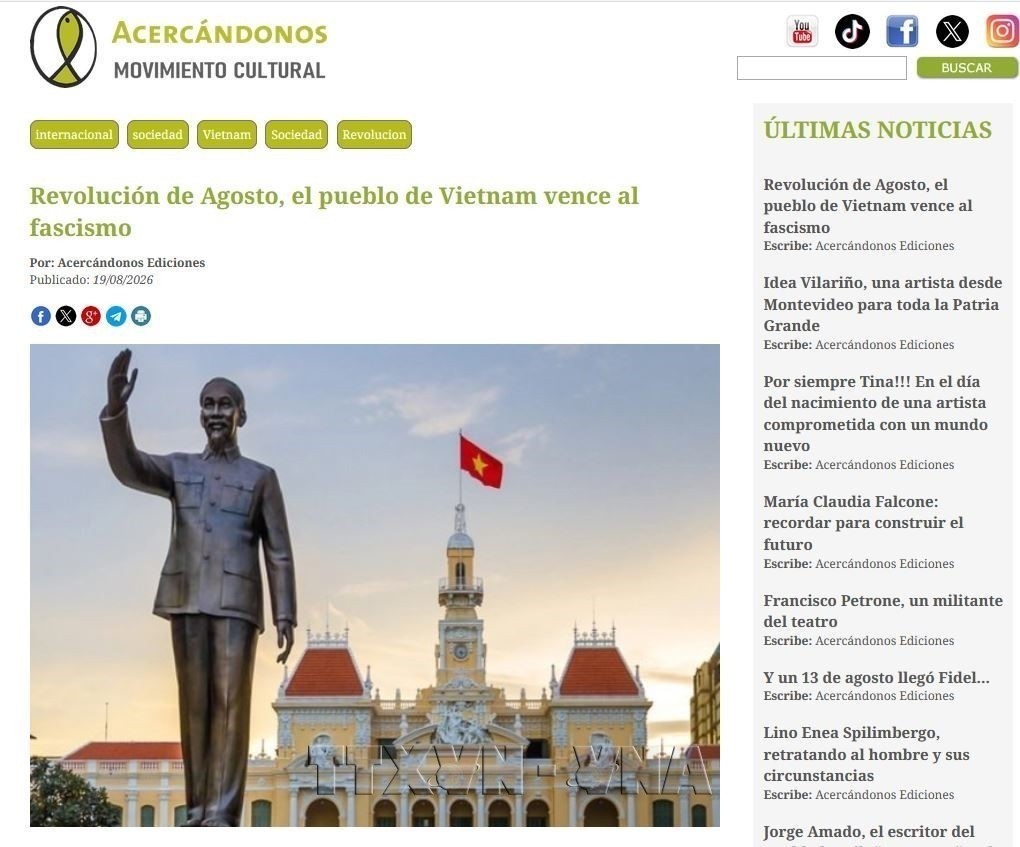 |
| Article published by Acercándonos Ediciones on the occasion of the 81st anniversary of the August Revolution (August 19, 1945-August 19, 2026). (Photo: VNA) |
On August 19 (local time), Argentine publication Acercándonos Ediciones published an article highlighting the historical significance of the 1945 August Revolution, describing it as a turning point that freed the Vietnamese people from colonial and fascist rule, secured independence and sovereignty, and ushered in a new era in the nation’s history, marking the 81st anniversary of the August Revolution (August 19, 1945-August 19, 2026).
According to the Vietnam News Agency (VNA) correspondent in Buenos Aires, under the headline “The August Revolution: The Vietnamese People Defeat Fascism,” the article affirmed that the revolution was the result of the Vietnamese people’s prolonged struggle against oppression and colonial rule under the leadership of President Ho Chi Minh and revolutionary forces.
According to Acercándonos Ediciones, the victory of the August Revolution laid the groundwork for the establishment of the Democratic Republic of Vietnam. On September 2, 1945, President Ho Chi Minh read the Declaration of Independence in Hanoi, announcing to the Vietnamese people and the world the birth of an independent Vietnamese state.
The Argentine publication assessed that the events of August 1945 not only changed the destiny of the Vietnamese nation but also created “aspiration and momentum” for many other peoples to rise up and struggle to break free from the “long nights” of colonial rule.
In its historical overview, Acercándonos Ediciones recalled the process by which French colonialists gradually established their rule in Vietnam beginning in 1858. Over the course of several decades, numerous patriotic movements erupted in different localities, demonstrating the Vietnamese people’s determination not to submit to foreign domination.
The article particularly highlighted the development of the revolutionary movement initiated and led by President Ho Chi Minh. On February 3, 1930, revolutionary leader Nguyen Ai Quoc chaired the conference to unite communist organizations, deciding to establish the Communist Party of Vietnam and marking a major turning point in the Vietnamese revolution.
According to the article, this was the political force pursuing the revolutionary objective of opposing colonialism in Vietnam. In 1941, the Viet Minh Front was established, bringing together different sections of the population in the struggle for national independence.
According to Acercándonos Ediciones, when Japan declared its surrender to the Allies on August 15, 1945, Vietnamese revolutionary forces quickly seized the opportunity. Revolutionary committees in many localities began taking over administrative functions, while the movement to seize power spread. On August 19, 1945, the people of Hanoi seized power. The victory in the capital quickly created a nationwide ripple effect, encouraging people in many localities to rise up and seize power.
According to Acercándonos Ediciones, the August Revolution was not simply a political event in Vietnam’s history. It ushered in a new era in which the Vietnamese people regained their dignity, sovereignty, independence, and right to live in peace. These were also the values for which generations of Vietnamese people made enormous sacrifices.
From this perspective, the August Revolution carried broader significance for national liberation movements around the world. The victory of the Vietnamese people became a source of inspiration for peoples struggling against colonial rule, demonstrating that an oppressed nation could rise up and take control of its own destiny.
Acercándonos Ediciones also emphasized that commemorating the August Revolution is an occasion to remember those who sacrificed their lives in the struggle for independence and to appreciate the achievements enjoyed by subsequent generations.
More than eight decades after the General Uprising, Acercándonos Ediciones’s article shows that the August Revolution continues to be viewed in Argentina as a symbol of the Vietnamese nation’s determination for independence and aspiration for self-determination. At the same time, it is regarded as an event whose significance extends beyond Vietnam’s borders, contributing to the inspiration of national liberation movements around the world.
 Argentine Media Speak Highly of Vietnam's Efforts in Economic Diplomacy Argentine Media Speak Highly of Vietnam's Efforts in Economic Diplomacy In 2024, Vietnam continues to persist in its efforts to further connect with its global partnerships, particularly by exploring new growth drivers in Latin America, Middle East Africa, and developed industrial countries (G7) through the foreign affairs activities of Party and State leaders. |
 Vietnam’s 50-year Reunification Celebration Garners Argentine Press’s Attention Vietnam’s 50-year Reunification Celebration Garners Argentine Press’s Attention The April 30, 1975 triumph stands as one of the most remarkable milestones in the Vietnamese people’s history of national building and defence. |


Related Stories
 World
World
Vietnam’s Rise Draws Praise from Venezuelan Scholars
 Vietnamese Culture
August Revolution: Vietnam’s Historic Victory and Its Enduring Global Legacy
 National
Party Chief Lauds Intellectuals, Scientists, Artists as Pioneers in Innovation
 Focus
Focus
August Revolution in the Eyes of International Friends
Recommended
 World
World
India-Indonesia Relations in the BRICS Context
 World
World
Poland Inaugurates Memorial Plaque Honouring Architect Who Helped Preserve Hoi An
 World
World
India enlarged defense cooperation with Tajikistan, Turkmenistan in Central Asia
 World
World
Viet Nam-Japan Concert Raises Funds for Agent Orange Victims
Popular article
 World
World
India, US plan strategic cooperation in Indian Ocean with focus on ports, maritime and digital infrastructure
 World
World
Arctic Warming Accelerates, Sea Ice Shrinks by Nearly 500,000 sq km Every Decade
 World
World
Viet Nam Hosts Dialogue on Promoting Older Persons’ Right to Health
 World
World