
Integrating Culture - Key to Sustain Vietnamese Among Younger Overseas Generations
 | Kaneya Manabu and His Journey to Discover Viet Nam Through the Vietnamese Language |
| Vietnamese Bookcases: Contributing to Preservation and Development of Vietnamese Language Around the World |
Dr. Do Phuong Thao, Faculty of Viet Nam Studies, Hanoi National University of Education:
Culture is the core component in teaching Vietnamese to Vietnamese abroad
 |
The close relationship between language and culture is a widely recognized principle in linguistics. In foreign-language education, many modern models emphasize four tightly linked activities: learning the language, language awareness, cultural awareness, and cultural experience.
On that basis, teaching Vietnamese to Vietnamese living abroad must integrate Vietnamese cultural elements as an inseparable component of the lesson. Linguistic knowledge becomes meaningful only when it reflects the cultural characteristics embedded in Vietnamese speech, behavior, and customs. This approach not only enhances the effectiveness of learning Vietnamese but also contributes to preserving and nurturing national cultural identity within a global multicultural environment.
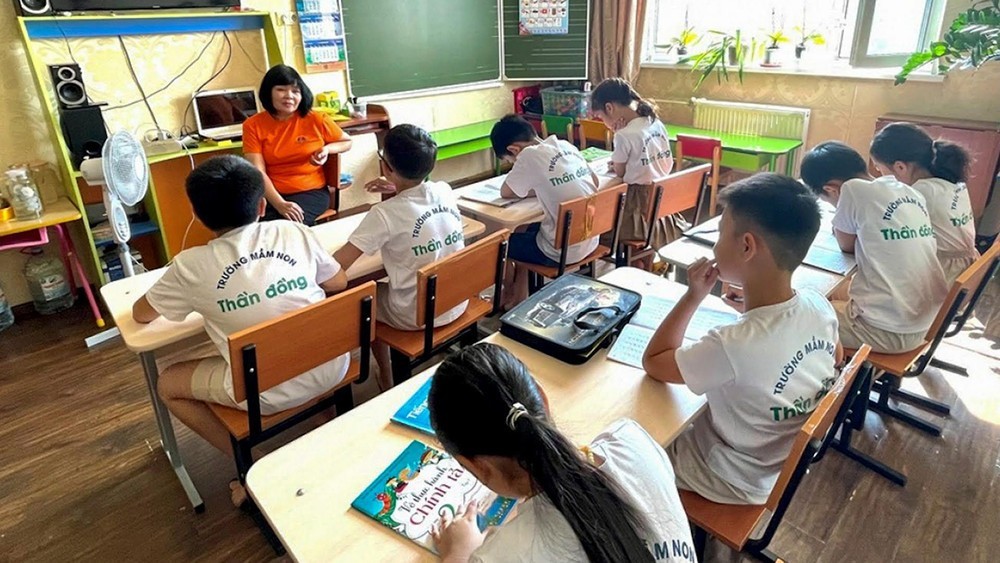 |
| A Vietnamese class at the Asian–European Genius Kindergarten in Moscow, Russian Federation. |
An effective lesson can follow the structure “Recall - Acquisition - Consolidation.” The introduction opens the cultural theme and places learners into a familiar situation. In the recall stage, learners draw on memories, experiences, or basic knowledge about Viet Nam. In the acquisition stage, the lesson supplements new cultural knowledge through stories, images, or interactive activities. The consolidation stage then systematizes the content and creates connections between new knowledge and the learner’s personal experience.
Cross-cultural comparison is also a useful method. Contrasting familiar themes such as food, festivals, history, clothing, or school life between Viet Nam and the host country helps learners more clearly identify Vietnamese cultural identity. This method stimulates observation, deepens understanding of cultural diversity, and fosters emotional attachment to one’s roots.
However, cultural integration must match learners’ levels and capacity. Simple, easily observable values such as greetings or basic communication rules can be absorbed quickly, while abstract values, folk philosophies, or proverbs require deeper understanding. Introducing content that is too difficult or outside the basic vocabulary range in the early stages may overwhelm learners, discouraging rather than inspiring appreciation of Vietnamese culture. Content selection must be planned with an appropriate roadmap and dosage.
In addition, Vietnamese learners abroad are influenced by the cultural value systems of the societies in which they grow up. When exposed to Vietnamese, they naturally compare behaviors and ways of thinking between two cultures. In the early stages, comparison should be considered a central method to clarify differences and similarities. At later stages, learners can develop the ability to generalize and synthesize, thereby recognizing systematic features of Vietnamese culture.
Dr. Vu Thuy Nga, Dai Nam University:
Folk tales - a bridge for naturally acquiring the mother tongue
 |
Teaching Vietnamese to Vietnamese children living abroad is always a complex process requiring significant effort from both families and schools. In an environment where children are exposed almost entirely to the local language, daily listening and speaking time in Vietnamese is often very limited. In this context, Vietnamese folk tales emerge as culturally rich and linguistically valuable material that helps children acquire their mother tongue more naturally and emotionally.
Folk tales are a distinctive part of Viet Nam’s folk literature, reflecting the life, customs, beliefs, and moral values of Vietnamese people over generations. Familiar stories such as Tam Cam, The Starfruit Tree, or Saint Giong are appealing not only for their plots but also for the humane lessons they convey about good versus evil, courage, the defense of what is right, and the aspiration to uphold national traditions.
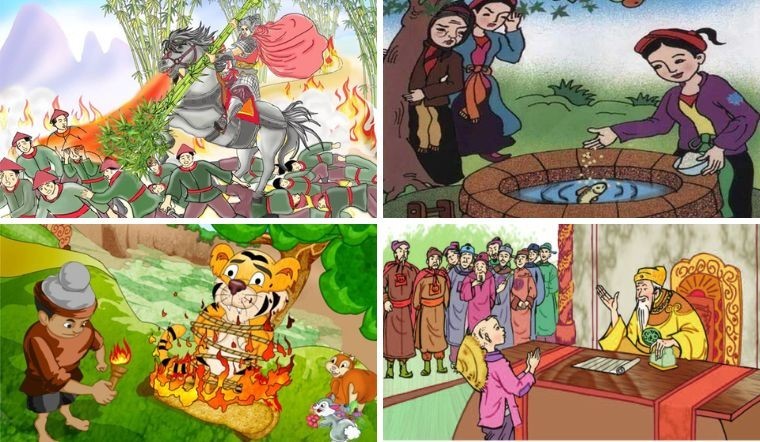 |
| Several Vietnamese folk tales. |
The language in folk tales is usually simple and accessible for children, making it easier for them to become familiar with Vietnamese intonation, sounds, and vocabulary. Today, many stories are published as vividly illustrated comics or animated videos, making them even more accessible to overseas children.
For children who cannot yet read, parents narrating stories in Vietnamese during free moments of the day is an effective way to build listening–comprehension reflexes and create positive emotional associations with the mother tongue. When children reach school age, folk tales can be integrated into Vietnamese-learning activities such as reading practice, writing practice, story summarization, expressing thoughts, or noting down interesting words, with guidance from parents or teachers.
Maintaining and developing Vietnamese for overseas Vietnamese children requires close cooperation between families and communities. Alongside parents’ individual efforts, supportive initiatives from organizations and associations play an important role, such as: translating and publishing bilingual folk tales so children can learn Vietnamese while comparing with the local language; organizing activities where children role-play folk-tale characters and use Vietnamese phrases in daily contexts; creating contests where children record themselves retelling stories or talking about their favorite characters.
Dr. Pham Van Luan, HCMC University of Culture:
Promoting the cultural value of Luc Van Tien to nurture Vietnamese in overseas communities
 |
The Nom verse narrative Luc Van Tien by Nguyen Dinh Chieu is one of Viet Nam’s literary works with a broad international influence. It has been translated into many languages and is well known among foreign readers. With translations into French, Ukrainian, Japanese, English, the RoK, and others, the work has created a unique “cultural sphere” where Vietnamese language, literature, and culture can be accessed, taught, and spread vividly to the international community as well as to Vietnamese communities abroad. From the perspective of cultural studies and language education, Luc Van Tien possesses all the essential values to serve as effective material for teaching and learning Vietnamese for young generations far from home.
Luc Van Tien has a tightly structured, educational narrative built in 2,084 luc bat verses, with characters, events, and settings organized according to the logic of a human life cycle. Moral values concerning family, compassion, loyalty, virtue, the pursuit of goodness, and perspectives on good and evil are expressed consistently through characters and plot. These lessons remain relevant for Vietnamese communities abroad, helping younger generations understand Vietnamese cultural norms through stories that are both accessible and profound.
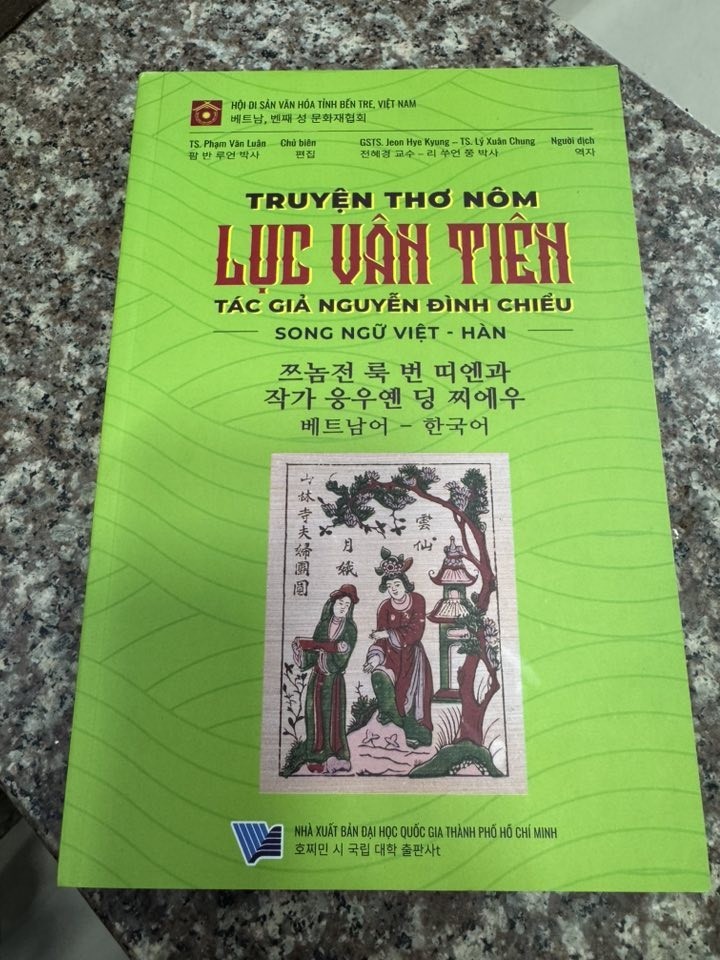 |
| The Nom verse narrative Luc Van Tien translated into Korean. |
The structural, thematic, and linguistic features of the work are also suitable for use in teaching Vietnamese language and culture in different communities. The Vân Tiên chanting tradition, a form of folk performance currently being proposed for recognition as intangible cultural heritage, clearly demonstrates the ability to teach Vietnamese through a popular, natural, lifelong, and accessible learning method. This serves as a valuable model for overseas Vietnamese communities in building Vietnamese-learning environments connected with culture.
On that foundation, various cultural and educational cooperation activities can be implemented to support Vietnamese maintenance among overseas communities, such as: continuing to translate the newest Vietnamese version of Luc Van Tien, reviewed by descendants of Nguyen Dinh Chieu and leading experts; organizing discussions, forums, linguistic games, and recitation or chanting contests based on Luc Van Tien to help students and young people engage with the work naturally and enjoyably; developing writing and translation contests, academic exchanges, and voting activities centered on the work’s core values such as loyalty, integrity, righteousness, and moral virtue.
 | Language Competition: Promoting Vietnamese Language in Land of Rising Sun In recent years, Vietnamese language contests in Japan, such as speech competitions, photo contests, and proficiency exams, have been flourishing. These activities not only help ... |
 | Hikaru Watanabe: Vietnamese Grows from Simple, Everyday Sounds and Greetings Hikaru Watanabe was honored on stage at the 19th Vietnamese Speech Contest in Japan held on November 2, shining under the lights and applause. Holding ... |

Most read


Related Stories
 Overseas Vietnamese
Promoting Important Role of Vietnamese Youth in Japan
 National
Vietnam News Today (Sep. 16): Upgraded Bilateral Ties Open New Space for Vietnam-Slovakia Cooperation
 Friendship
Expectations and Recommendations - Part 1
 Friendship
I Have Become a Citizen of Viet Nam
In topics
 Expats in Vietnam
Three Foreign Writers Spreading Vietnamese Language
 Overseas Vietnamese
Dr. Tra My Reveals the Secret to Helping Her Child Become Fluent in Vietnamese
 Viets Home
Press and Media: Expanding Global Reach of Vietnamese Language
 Overseas Vietnamese
Vietnamese Language "Flourishes" in the Land of Tulips
Recommended
 Overseas Vietnamese
Mid-Autumn Festival Brings Vietnamese Youth Together in Japan
 Overseas Vietnamese
National Day Celebrations Abroad: Remembering History, Strengthening Community and Friendship
 Overseas Vietnamese
Vietnamese Community Football Tournament in Japan Celebrates National Day
 Overseas Vietnamese
Vietnamese Community Builds Bridges Between Vietnam and Thailand
Popular article
 Overseas Vietnamese
Vietnamese Community Supports Kumamoto Authorities in Earthquake Recovery Efforts
 Overseas Vietnamese
Vietnamese Community in Singapore Urged to Contribute to Deeper Bilateral Ties
 Overseas Vietnamese
Vietnam’s 81st National Day Celebrated in Malaysia
 Overseas Vietnamese