| Vietnam News Today (Apr. 26) notable headlines Vietnam–Singapore trade witnesses strong growth amid global volatility Visit to Truong Sa, DK1 connects overseas Vietnamese to Fatherland's sea and islands Hung Kings’ Commemoration Day reinforces Vietnam’s cultural roots and national identity Vietnam win at ASEAN U17 Championship grabs Southeast Asian headlines Vietnam targets to rank among world’s top 30 economies by 2030 Vietnam supports UNESCO's people-centred approach, multilateral cooperation: official Unique palanquin procession at Hung Temple Xoan villages bustling during Hung Kings’ commemoration festival Vietnam’s integrated approach to mine action, sustainable development introduced at Geneva meeting |
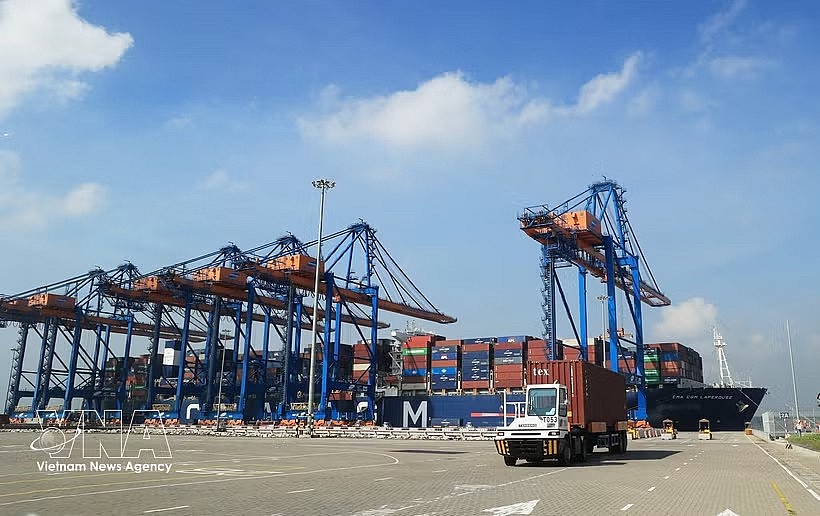 |
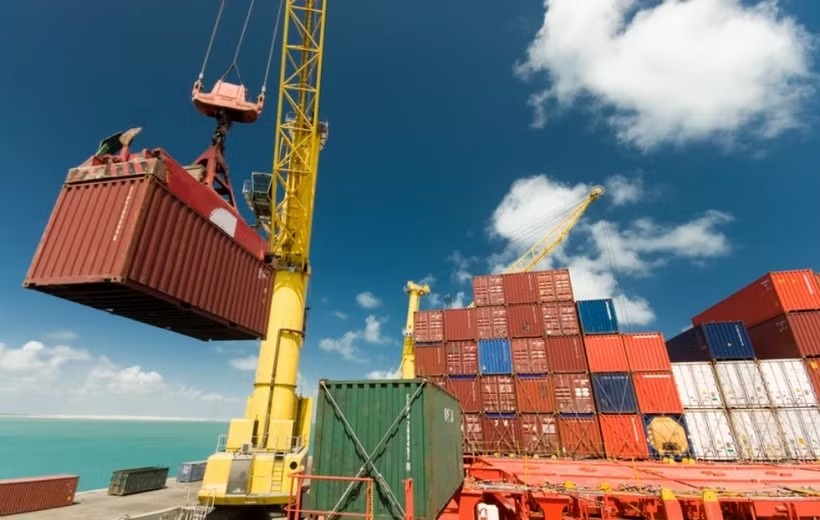
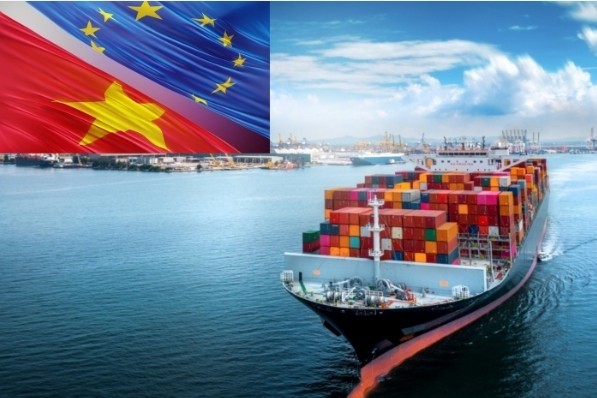
| Container trucks operate at Gemalink International Port, part of the Cai Mep port complex in Tan Phuoc ward. (Photo: VNA) |
Vietnam–Singapore trade witnesses strong growth amid global volatility
Data from Enterprise Singapore indicated that bilateral trade reached 13.6 billion SGD (10.6 billion USD) in Q1, up 38.3% year-on-year. Singapore’s exports to Vietnam rose 6.5% to 7.7 billion SGD (6.03 billion USD), while imports from Vietnam jumped 128.7% to 5.8 billion SGD, a strong signal of Vietnam’s rapidly growing export momentum in the Singapore market.
In the first quarter of 2026, Vietnam–Singapore trade sustained strong growth, with key product groups posting positive two-way expansion, reflecting their deeper integration into global value chains and increasingly aligned cooperation between the two economies amid ongoing global volatility.
Vietnam remained Singapore’s 10th largest trading partner during the period. The country was also a major trading source for Singapore across three key categories: electrical machinery and equipment and parts (HS85); mineral fuels, oil and related products (HS27); and nuclear reactors, boilers, machinery and mechanical appliances (HS84).
All three groups recorded positive growth in both exports and imports. Specifically, HS85 exports from Singapore to Vietnam rose 9.4%, while Singapore’s imports from Vietnam surged 147%. HS27 exports grew 15.5% and 380.9% respectively, while HS84 products increased 24.7% and 245.5%, cited VNA.
These trends align with Singapore’s broader trade performance and the shared trade objectives of both countries. A recent report by Singapore’s Ministry of Trade and Industry showed that non-oil domestic exports (NODX) and re-exports (NORX) rose 15.3% and 61.4%, respectively, in March 2026, extending quarterly gains.
This underscores Singapore’s deepening participation in global value chains, particularly by capitalising on rising global demand for electronic components used in artificial intelligence technologies. Meanwhile, the increase in petrol-related trade values likely reflects higher global oil prices.
Data from Enterprise Singapore indicated that bilateral trade reached 13.6 billion SGD (10.6 billion USD) in Q1, up 38.3% year-on-year. Singapore’s exports to Vietnam rose 6.5% to 7.7 billion SGD (6.03 billion USD), while imports from Vietnam jumped 128.7% to 5.8 billion SGD, a strong signal of Vietnam’s rapidly growing export momentum in the Singapore market.
Visit to Truong Sa, DK1 connects overseas Vietnamese to Fatherland's sea and islands
According to the State Committee for Overseas Vietnamese, from April 17 - 23, Fisheries Surveillance Ship KN-490 departing from Cam Ranh International Port carried a working delegation, including 48 overseas Vietnamese from 22 countries and territories, along with representatives of domestic agencies, businesses, artists and journalists to Truong Sa and DK1 offshore platforms.
A recent visit to the Truong Sa (Spratly) archipelago and DK1 offshore platforms has helped deepen connections between overseas Vietnamese and the country’s sea and islands, reinforcing national solidarity and awareness of maritime sovereignty.
According to the State Committee for Overseas Vietnamese, from April 17 - 23, Fisheries Surveillance Ship KN-490 departing from Cam Ranh International Port carried a working delegation, including 48 overseas Vietnamese from 22 countries and territories, along with representatives of domestic agencies, businesses, artists and journalists to Truong Sa and DK1 offshore platforms.
During the trip, delegates took part in a range of meaningful activities such as visiting and presenting gifts to officers, soldiers and residents on the islands and platform, attending flag-raising ceremonies, memorial services for fallen soldiers, and cultural exchanges with naval forces. The delegation visited seven islands and one platform, including Song Tu Tay, Son Ca, Nam Yet, Sinh Ton, Truong Sa, and DK1/19 Que Duong.
A highlight of the journey was the inauguration of a roofed vegetable garden on Truong Sa island, funded by the Hoang Sa–Truong Sa Club and the Vietnamese community in Poland. The initiative reflects practical and sustained support from overseas Vietnamese for island communities.
Contributions from overseas Vietnamese during the trip exceeded 1.2 billion VND, including cash, equipment and essential goods, helping to improve living conditions for military personnel and residents. An additional 250 million VND (9,500 USD) was pledged to support the “Greening Truong Sa” program, according to VNA.
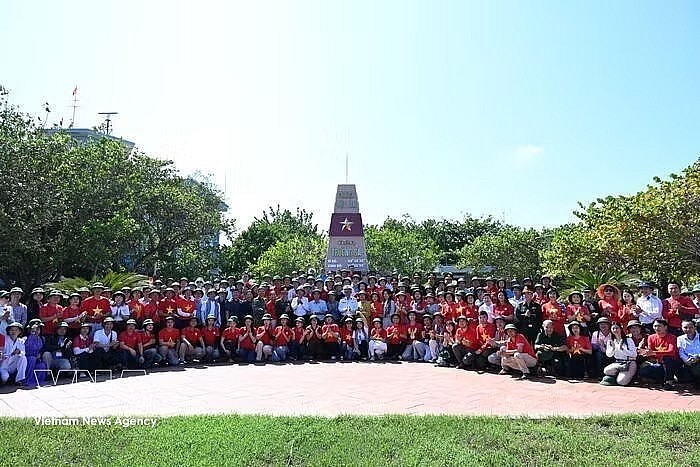 |
| A delegation, comprising 48 overseas Vietnamese from 22 countries and territories, along with representatives of several agencies, organizations, businesses, artists and journalists at home, visit the Truong Sa (Spratly) archipelago and the DK1 offshore platforms. (Photo: VNA) |
Through firsthand experiences, participants gained deeper insights into the daily life, hardships and resilience of forces stationed on remote islands, as well as Vietnam’s policies and efforts in safeguarding maritime sovereignty.
The visit also featured cultural and community-building activities onboard, strengthening bonds between delegates and soldiers, while discussions among overseas Vietnamese representatives focused on community organization, youth engagement, preservation of the Vietnamese language, and innovation networks.
Officials emphasised that the annual program, held since 2012, plays an important role in affirming national sovereignty, mobilising resources for maritime development, and reinforcing the unity between overseas Vietnamese and the homeland.
Hung Kings’ Commemoration Day reinforces Vietnam’s cultural roots and national identity
Hung Kings’ Commemoration Day, observed on the 10th day of the third lunar month, honours Vietnam’s legendary founders and highlights enduring cultural values and national identity, a tradition recognised by UNESCO as intangible cultural heritage.
Though not strictly historical figures in academic terms, the Hung Kings are revered in Vietnamese tradition as semi-mythical rulers who established the ancient state of Van Lang thousands of years ago. Their legacy, preserved through generations, forms a cornerstone of Vietnam’s origin narrative and a powerful symbol of national unity.
Each year, millions of pilgrims journey to the Hung Kings Temple complex in Phu Tho province, widely regarded as the ancestral land of the Vietnamese people. The commemoration is marked by solemn rituals, incense offerings and large-scale gatherings, as visitors return to what is often described as the “cradle of the nation.”
Beyond ritual practices, the day holds profound cultural and moral significance. According to Associate Professor Bui Xuan Dinh, an ethnologist in Vietnam, the tradition reflects the enduring Vietnamese ethos of gratitude expressed in the saying “when drinking water, remembering its source,” underscoring respect for ancestors and the continuity of traditions across generations, cited VOV.
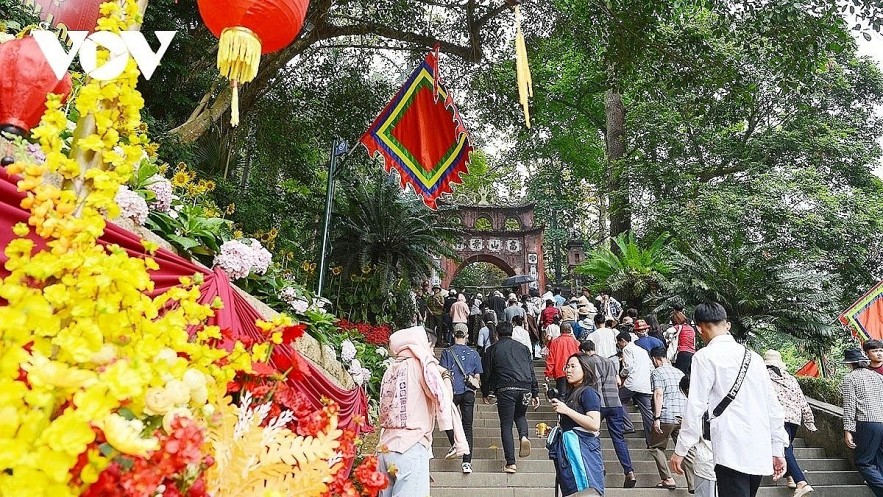 |
| Crowds from across the country gather at the Hung Kings Temple complex in Phu Tho province to offer incense in tribute to the nation’s founders. |
“This cultural practice expresses the spirit of ancestral reverence and forms an important moral foundation in Vietnamese society,” he noted.
The significance of Hung Kings’ worship has also been recognised internationally. In 2012, UNESCO inscribed the belief and associated rituals on the Representative List of the Intangible Cultural Heritage of Humanity. UNESCO highlights its role in strengthening community identity and maintaining a shared sense of origin among Vietnamese people.
Scholars at the Ho Chi Minh National Academy of Politics also regard the practice as a distinctive cultural institution that has endured since ancient times and continues to shape Vietnam’s spiritual life and national identity. Researcher Le Van Loi describes it as “a defining element of Vietnamese cultural identity formed and preserved over generations.”
Vietnam win at ASEAN U17 Championship grabs Southeast Asian headlines
Media outlets across Southeast Asia have reacted with strong praise after Vietnam defeated Malaysia 3–0 in the final of the ASEAN U17 Boys’ Championship 2026 on April 24.
Thailand-based Seasia Goal highlighted Vietnam’s growing dominance, writing on social media: “Vietnam’s dominance continues. With this victory, they now hold the record for the most titles in the tournament’s history with four championships.”
The outlet also noted that Vietnam now lead the all-time standings, ahead of Thailand and Australia (three titles each), while Myanmar, Indonesia and Malaysia have each won the tournament once.
Regional platform ASEAN Football congratulated Vietnam and described the result as a reflection of the country’s growing strength in youth football. The outlet added that the team’s victory marked its fourth regional title and extended an impressive unbeaten run of around 20 matches since 2025.
Indonesian outlet Superball described the result as expected, pointing to Vietnam’s earlier 4–0 win over Malaysia in the group stage:
“Malaysia struggled to build play and lost composure under Vietnam’s controlled style. Despite several saves from goalkeeper Adam Nurfakrullah, he could not prevent defeat,” Superball noted.
The Asian Football Confederation, via its official channel for the AFC Asian Cup, praised Vietnam’s achievement and described the team’s campaign as well deserved.
Meanwhile, Malaysian newspaper Harian Metro reported disappointment over the loss, noting that Malaysia were unable to avenge their earlier defeat to Vietnam.
The report pointed to a lack of concentration early in the match, when Vietnam opened the scoring in the 11th minute through Dao Quy Vuong following a corner. It added that Malaysia attempted to respond but were hindered by inexperience, while Vietnam’s tactical discipline and physical advantage proved decisive, VOV reported.
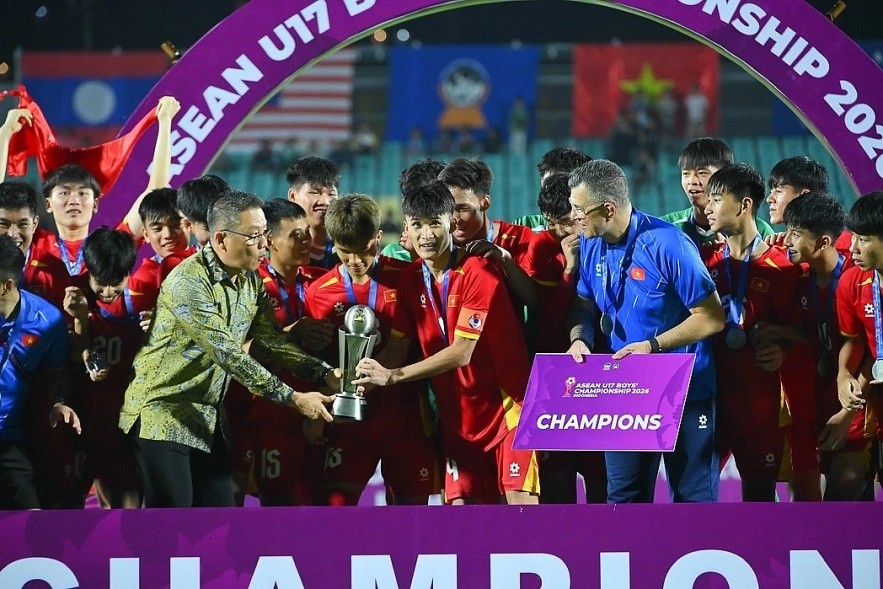 |
| Vietnamese players clinch ASEAN U17 Boys' Chamionship title on April 24, 2026. (Photo: VFF) |
However, the outlet said that Malaysia fielded a very young squad, including players from U16 and even U15 levels, and suggested that reaching the final was already a promising achievement for the future development of the team.
Similarly, New Straits Times described Vietnam as the stronger side in the final, noting that Malaysia had aimed to cause an upset but were ultimately outplayed.
In the final on April 24, Vietnam secured a convincing 3–0 victory, with goals from Dao Quy Vuong and a brace by Nguyen Van Duong.
Under head coach Cristiano Roland, Vietnam completed the tournament unbeaten in five matches, scoring 19 goals and conceding just once.
The triumph marks Vietnam’s fourth AFF U17 title, making them the most successful team in the competition’s history and reinforcing their status as a leading force in Southeast Asian youth football.
Vietnam targets to rank among world’s top 30 economies by 2030
Vietnam has set the goal to become one of the world’s top 30 economies in terms of GDP size by the end of this decade.
The 16th National Assembly on Friday adopted the five-year socio-economic development plan for 2026-2030 at its first working session.
Under the plan, Vietnam targets to become one of the world's top 30 economies in terms of GDP size by 2030, while the country's business environment is projected to rank 3rd in ASEAN and 30th globally, VGP reported.
Vietnam will also strive to achieve an average annual GDP growth rate of at least 10 percent in association with maintaining macroeconomic stability, controlling inflation, ensuring major balances, and comprehensively improving people's living standards.
The Southeast Asian nation expects to raise the average GDP per capita to US$8,500 by 2030 compared to US$5,026 in 2025; the average life expectancy to 75.5 by 2030 from 74.8 in 2025.
The number of foreign arrivals is expected to reach 45-50 million by 2030.
 | Vietnam News Today (Apr. 21): RoK President's Visit to Vietnam to Mark Strategic Leap in Bilateral Ties Vietnam News Today (Apr. 21): RoK President's visit to Vietnam to mark strategic leap in bilateral ties; Chinese expert: China-Vietnam cooperation rises to higher level; ... |
 | Vietnam News Today (Apr. 23): Vietnam–China Border Forces Hold Talks, Confer Friendship Envoy Title Vietnam News Today (Apr. 23): Vietnam’s top leader hosts welcome ceremony for RoK President; Vietnam values ties with Estonia – a Baltic gateway; Vietnam proposes ... |