| Vietnam News Today (Apr. 21) notable headlines RoK President's visit to Vietnam to mark strategic leap in bilateral ties: diplomat Chinese expert: China-Vietnam cooperation rises to higher level Vietnamese cultural showcase blends tea, tradition, melody in Paris Korean, Thai media highlight Sa Pa as a top travel destination Rain, storms dominate northern forecast over next 10 days Hanoi launches holiday tourism drive for April 30–May 1 holiday Vietnam's industry spearheads transition to circular economy Lawmakers suggest groundbreaking mechanisms to revive Vietnamese culture Quang Ninh taps cultural industries to drive green growth, tourism |
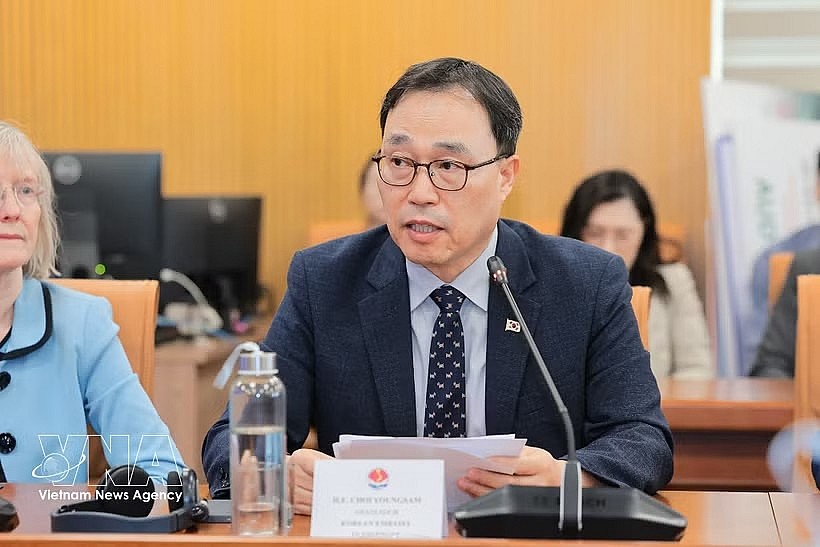 |
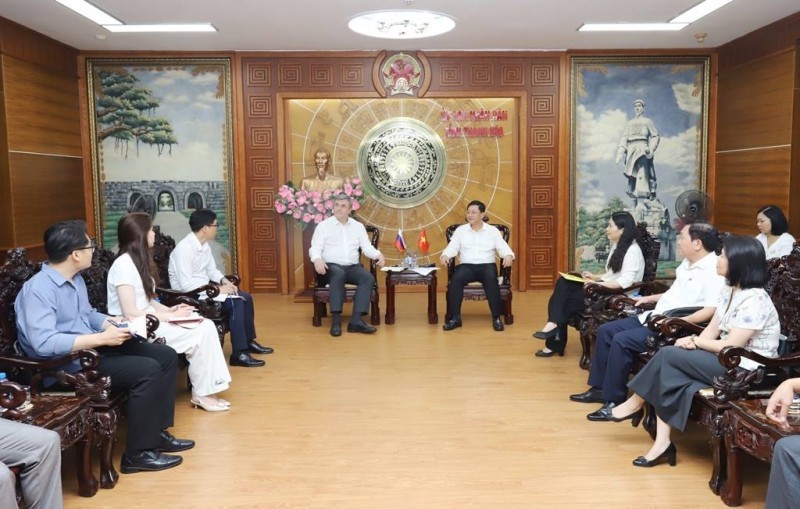
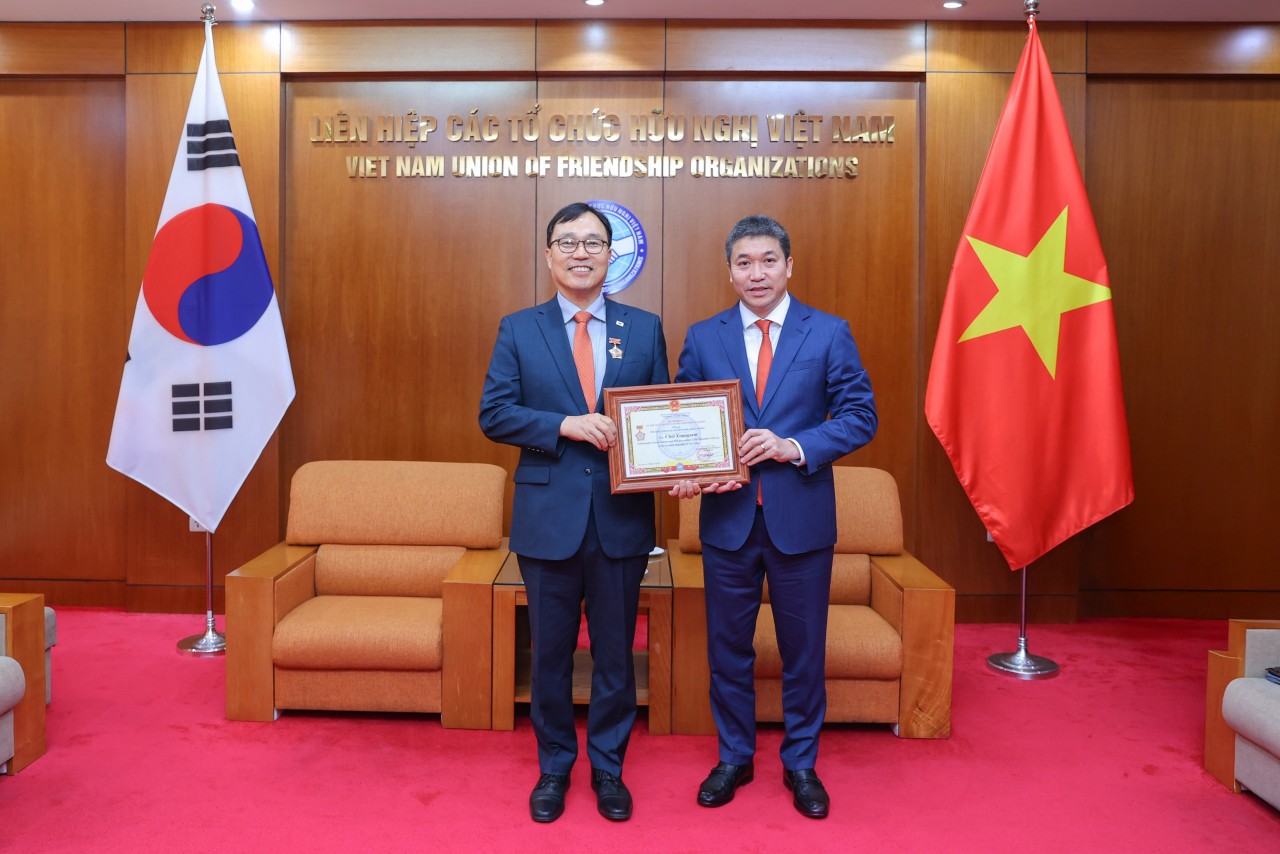
| Ambassador of the Republic of Korea to Vietnam Choi Young Sam (Photo: VNA) |
RoK President's visit to Vietnam to mark strategic leap in bilateral ties: diplomat
The upcoming state visit to Vietnam by President of the Republic of Korea (RoK) Lee Jae Myung is expected to become a special milestone in the 34-year history of diplomatic relations between the two countries, marking the starting point for a strategic leap forward in bilateral ties amid evolving global dynamics, according to RoK Ambassador to Vietnam Choi Young Sam.
The diplomat underlined that the visit from April 21 to 24, which follows General Secretary of the Communist Party of Vietnam Central Committee To Lam’s state visit to the RoK in August 2025, carries significance in many aspects.
Science – technology emerging as “new pillar”
A key feature shaping the future of the Vietnam – RoK relations is the strong shift in their economic cooperation model. Moving beyond a phase centerd on labor-intensive manufacturing, the two countries are now working together to build a future-oriented industrial ecosystem and share responsibility for ensuring global supply-chain stability.
Both sides are striving to realize the trade target of 150 billion USD by 2030 through breakthroughs in key sectors, the ambassador noted.
Within this strategic orientation, science – technology, innovation and digital transformation have been elevated to a new pillar of cooperation. According to Choi, the RoK wishes to become Vietnam’s most reliable partner in digital transformation and green growth.
Large-scale infrastructure projects under discussion include the development of a high-speed railway network, smart city building, and renewable energy and LNG projects aimed at addressing climate change.
High-tech cooperation has already produced tangible results through major initiatives such as the Vietnam – Korea Institute of Science and Technology (VKIST) project in the Hoa Lac Hi-Tech Park, which is expected to soon enter its second phase; the National Innovation Center, the Can Tho Technology Incubator, and the largest research and development center in Southeast Asia established by Samsung in Hanoi.
Priority areas of cooperation include semiconductors, artificial intelligence, biotechnology and advanced materials. Logistics collaboration is also opening new avenues, particularly through the goal of linking the comprehensive ecosystem of the Port of Busan with next-generation port projects in Hai Phong, Da Nang, Ho Chi Minh City, Gia Lai, An Giang and Ca Mau.
Prof. Choe Won Gi, Director of the Center for ASEAN – Indian Studies at the Korea National Diplomatic Academy, said Vietnam and the RoK should build a foundation for next-generation technology cooperation that goes beyond consumer products.
Human resources training and technology transfer will be key for the two countries to move up the global value chain, he noted, adding that the combination of Korean technology and capital with Vietnam’s high-quality workforce and dynamic growth potential will create strong synergy internationally.
Promoting people-to-people exchanges
During his policy speech at Yonsei University in the RoK last August, Party General Secretary To Lam highlighted the Northeast Asian country’s “humanomics” philosophy, which places people at the center while combining innovation with inclusive and sustainable development. Vietnam similarly identifies people as the center, the key stakeholder, a resource, the most important driving force, and the ultimate goal of development.
The community of more than 350,000 Vietnamese in the RoK, nearly 200,000 Koreans in Vietnam, and more than 100,000 multicultural families has helped connect the two nations. Meanwhile, tourism exchanges between the two countries reach around five million visits annually.
These exchanges have become even more dynamic in the digital era. Vietnam’s Ambassador to the RoK Vu Ho noted that the two countries hold vast potential for cooperation in digital content, with young people engaging actively through films, music, video games and webtoons.
In sports, the friendship has also been strengthened by contributions of Korean experts, including coaches Park Hang Seo and Kim Sang Sik, who recently helped Vietnam’s men’s U23 football team secure a third-place finish at the 2026 AFC U23 Asian Cup.
Beyond bilateral ties, President Lee’s visit also carries significance for enhancing cooperation on the international stage. Prof. Choe noted that Vietnam is a key partner in the RoK's policy towards Southeast Asia, particularly within the framework of the Korea – ASEAN Solidarity Initiative (KASI).
During high-level meetings, leaders of both countries have consistently affirmed their commitment to supporting each other at multilateral forums. This cooperation is reflected in the two sides' coordination for APEC 2025 in the RoK and APEC 2027 in Vietnam, as well as in promoting the Mekong – RoK Summit.
With the nature of a comprehensive strategic partnership, the state visit to Vietnam by President Lee is expected to herald a new phase of development with long-term strategic orientations for bilateral relations.
Ho described the visit as not only politically and diplomatically significant but also instrumental in aligning visions between the two sides in the new period, helping shape a long-term cooperation framework. “The spirit of the new phase can be summarized as higher trust, deeper cooperation and stronger connectivity,” he stressed.
Choi expressed his confidence that the trip will pave the way for a strategic breakthrough to lift bilateral ties to a higher level.
Notably, President Lee will become the first head of state to pay a state visit to Vietnam following the country’s completion of its top leadership in early April 2026, promising bright prospects for the Vietnam – RoK relations and providing a strong and solid impetus for their long-term development based on durable trust between the two sides' high-ranking leaders.
Chinese expert: China-Vietnam cooperation rises to higher level
A Chinese expert has said China-Vietnam cooperation is rising to a higher level, citing outcomes from the recent state visit by Vietnam’s Party General Secretary and President To Lam to China from April 14 to 17.
Lei Xiaohua, a researcher at the Institute of Southeast Asian Studies under the Guangxi Academy of Social Sciences, wrote in the Global Times, a publication of the People’s Daily, the mouthpiece of the Communist Party of China, that the two sides issued a joint statement during the visit proposing to advance the building of a China-Vietnam community with a shared future that carries strategic significance at a higher level.
This shows China-Vietnam relations are accelerating toward a new stage, a choice both sides have actively made based on shared strategic interests, practical development needs and responsibility for regional stability.
According to the author, the push for stronger cooperation stems from profound changes in the international environment, where regional stability and strategic cooperation have become more important than ever.
The world today is increasingly unstable, with rising unilateralism and protectionism, major shifts in global industrial and supply chains, intensifying geopolitical competition, and growing uncertainty.
In this context, strengthening strategic exchanges and deepening cooperation between China and Vietnam is not only necessary for each country’s modernization, but also a requirement for jointly addressing shared challenges. Lei said the upgrade in cooperation is reflected in four aspects.
First, a higher level of political trust. The joint statement states that the two countries share common aspirations and a shared future. It identifies building a China-Vietnam community with a shared future of strategic significance at a higher level as the common direction for bilateral relations in the new period, showing stronger positioning of ties and deeper strategic trust.
Second, a higher level of strategic linkage. In an article published in the People’s Daily, To Lam proposed raising the level of strategic linkage between the two countries. The joint statement also sets out specific directions, including linking development plans between the Belt and Road Initiative and the “Two Corridors, One Belt” framework; strengthening connections across trade, infrastructure, logistics and markets; accelerating rail, road and border connectivity; and making railway cooperation a new focus of strategic cooperation.
After travelling on China’s high-speed rail, To Lam noted that although he passed through only a few provinces, he could still see balanced development among them. This observation shows that consensus is forming between the two Parties and the two countries on major issues such as governance, as well as on conditions for boosting cooperation in specific areas such as railways.
Third, cooperation has reached a higher level. The two sides signed 32 cooperation documents across fields including economics, supply chains, customs, science and technology, people’s livelihoods and human resource development.
During his visit to Nanning, the top Vietnamese leader said, “I hope Vietnam and China will work together to make science, technology and innovation a core driving force”.
This statement shows that cooperation has moved beyond traditional trade and economic exchange, shifting from expansion in scale to improvements in quality and modernization, and from traditional cooperation to a higher level of industrial coordination and modernization.
Fourth, a stronger public foundation. During the visit in Nanning, To Lam expressed confidence in the younger generations of both countries, saying that nurture great aspirations, continue to innovate, dare to think and act, and become a bridge of knowledge and strong vitality, helping bring China-Vietnam relations firmly into the future.
The joint statement also proposes organizing activities such as the China-Vietnam People’s Forum, border residents’ festivals, and study programs for Vietnamese youth in China, while promoting tourism as an important bridge for people-to-people exchange.
The expert added that for China-Vietnam cooperation to promote in a stable and in-depth manner, traditional “comrades and brothers” ties need to be turned into broader, more stable and more sustainable social consensus.
He also explained the significance of elevating cooperation to a higher level. First, bilateral relations are developing from cooperation between two countries into an important positive driver for regional stability, according to VOV.
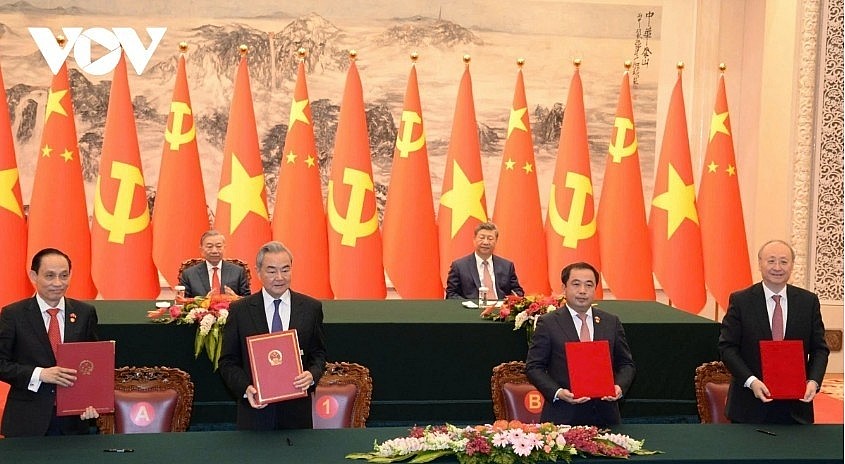 |
| Party General Secretary and President To Lam and his Chinese counterpart Xi Jinping witness the signing ceremony of cooperation documents between the two countries during the former's state visit to China from April 14 to 17.. |
The stronger China-Vietnam relations are, the greater their support for regional peace and stability. Second, both sides support multilateralism and open cooperation, and are committed to maintaining an international system centered on the United Nations and an international order based on international law.
Third, in an increasingly unstable world, a stable, sustainable and more strategic China–Vietnam relationship makes an important contribution to regional peace and prosperity.
The article concludes that elevating China-Vietnam cooperation to a higher level is a necessary choice shaped by global changes, regional conditions and the needs of bilateral relations.
The article concludes that elevating China-Vietnam cooperation to a higher level is a necessary choice to respond to global changes, regional conditions and the needs of bilateral relations.
It stems from shared strategic interests, is pushed forward by modernization needs, and benefits from high-level political determination and deep bonds between the two peoples.
As the international situation becomes more complex and uncertain, the value of high-level cooperation stands out more clearly.
As long as both sides follow high-level directions, deepen strategic trust, expand mutually beneficial cooperation and strengthen public support, building a China-Vietnam community with a shared future will make rapid progress.
Vietnamese cultural showcase blends tea, tradition, melody in Paris
A Vietnamese cultural showcase, themed “Hands and Hearts in Notes and Colors” (La main et le cœur aux notes et couleurs), unfolded in an intimate yet refined atmosphere in Paris on April 19, drawing a large turnout of French and foreign guests with a keen interest in Asian culture.
From the moment attendees entered the exhibition space, they were enveloped in a harmonious blend of sensory experiences, with the delicate aroma of tea, the robust notes of coffee, and the vivid colors of Vietnamese handicrafts. Curated display tables presented an array of signature teas and coffees, each accompanied by stories of their origins, processing methods and the philosophies of appreciation rooted in Vietnamese cultural life.
Guests were invited not only to sample the beverages but also explore different brewing techniques. Several of the featured products met organic standards and were linked to sustainable farming models, a point that particularly resonated with French visitors, who are increasingly focused on responsible consumption.
Historian Catherine Chadefaud delivered a presentation tracing the history of tea’s arrival in France, providing fresh insight into centuries of East-West cultural exchange. This was followed by classical music performances from Maria Lucia Barros and Philippe Foulon, which evoked the intimate ambiance of 18th-century European salons.
A standout segment titled “Musical Thé” merged tea tasting with live music, creating a multi-sensory experience in which participants savoured Vietnamese tea while immersed in gentle melodies. The innovative pairing offered a fresh approach to cultural promotion, blending relaxation with deeper engagement, cited VNA.
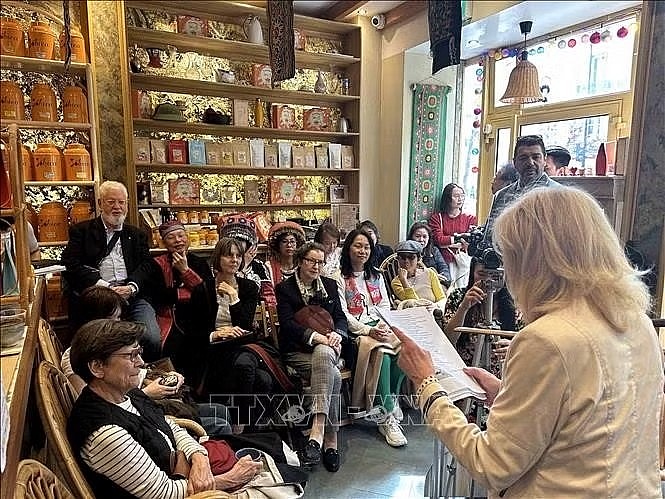 |
| French and foreign guests at the Vietnamese cultural showcase (Photo: VNA) |
Traditional Vietnamese brocade textiles also captivated visitors. Showcasing intricate patterns, natural materials and contemporary reinterpretations, the display invited exploration of the production processes and cultural significance behind each piece.
Hang Vu, owner of the Sobica Vietnamese tea shop, said the event builds on the success of a previous exhibition in Paris and aims to further introduce Vietnam’s traditional handicrafts. She expressed hope to hold additional activities through June to highlight brocade, regional specialties and traditional industries, including tea, coffee and spices.
Rosine Young, member of the organising committee, said although she has limited opportunities to explore Vietnam in depth, the experience allowed her to appreciate the richness of a nation comprising 54 ethnic groups, each contributing its own distinct cultural hues.
In her view, brocade products are not only visually appealing but also carry profound human values, reflecting the craftsmanship, creativity, and dedication of their makers.
She also expressed admiration for the Vietnamese community in France, noting their resilience in integrating into society while preserving their cultural identity, along with their intellectual curiosity and openness. According to her, it is precisely this spirit of cultural exchange and connection that gave the event its unique appeal.
Korean, Thai media highlight Sa Pa as a top travel destination
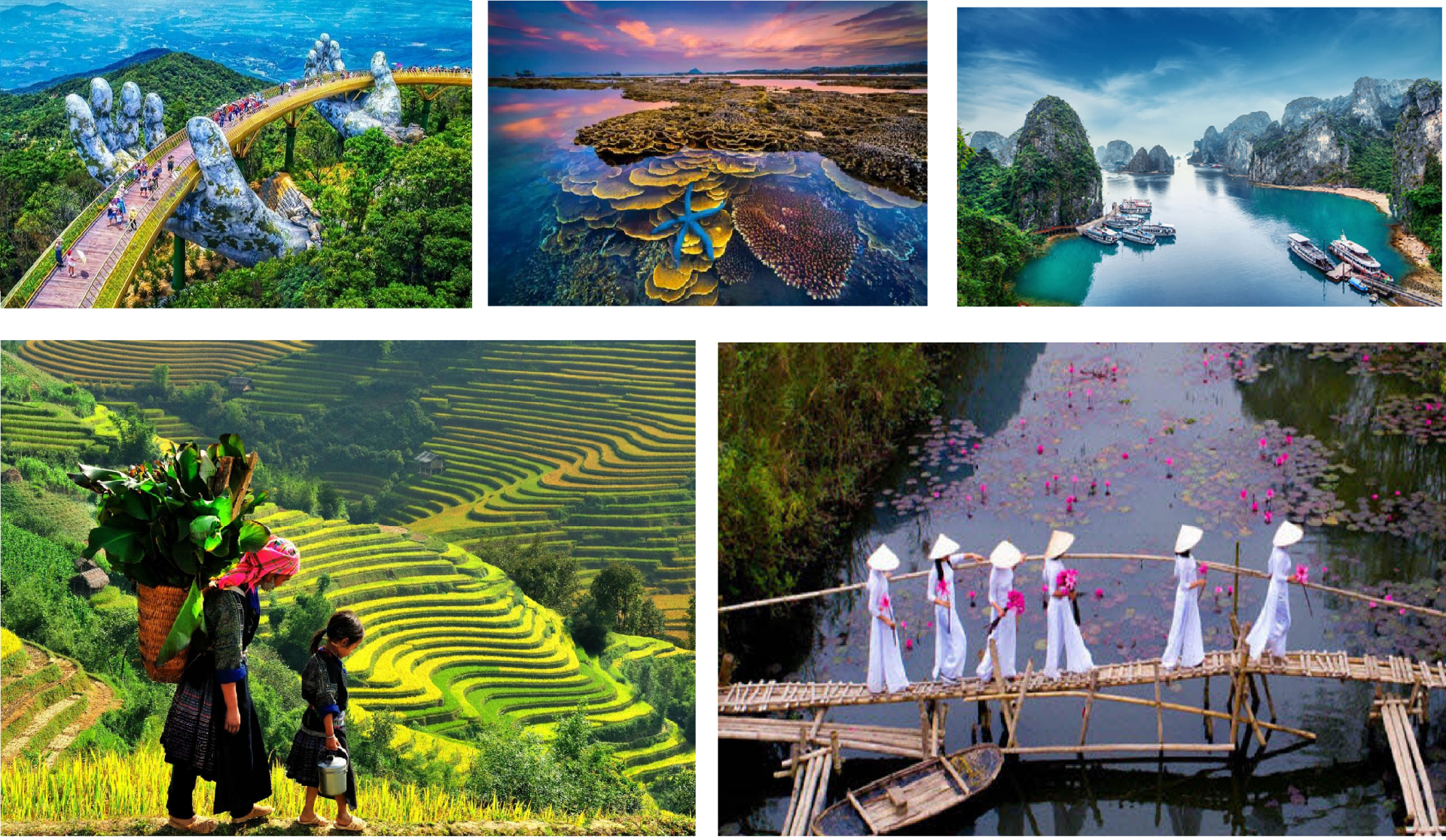
Sa Pa in Lao Cai province, northern Vietnam, is drawing growing international attention, with Korean and Thai media highlighting it as a top family travel destination for 2026 for its blend of relaxation, nature exploration and cultural experiences.
Ahead of “Family Month” in May, Naver, the Republic of Korea’s leading internet company, described Vietnam as an ideal getaway due to its proximity and similar time zone, noting that Sa Pa is particularly suitable for middle-aged and senior travellers. Visitors can reach the summit of Fansipan, known as the “Roof of Indochina”, by cable car in about 20 minutes, providing access to its spiritual complex without strenuous trekking.
Echoing this view, Thailand’s Bangkok Today described Sa Pa as a destination combining romance and adventure, recommending the Muong Hoa mountain railway through scenic valleys and visits to Ban May cultural village, which recreates the daily life of ethnic minority communities in the highlands.
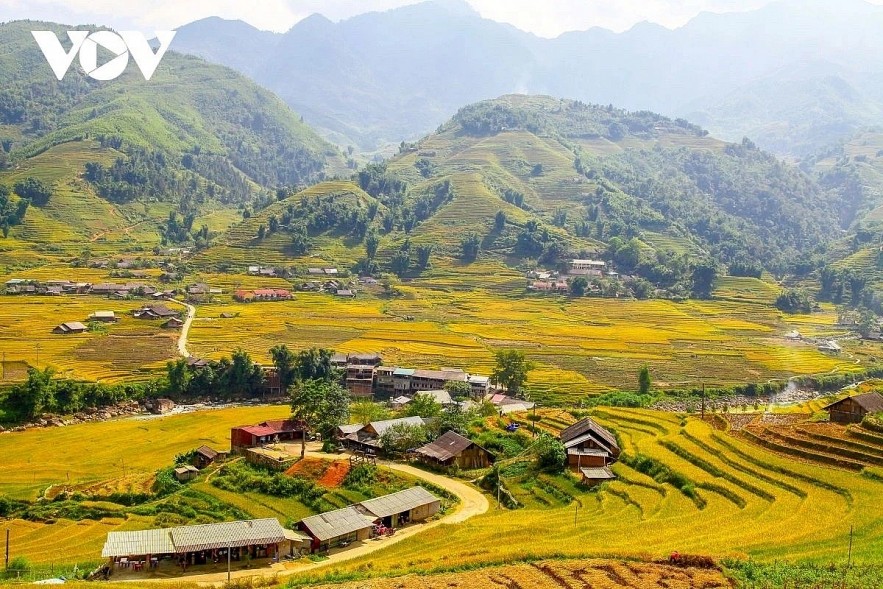 |
| Terraced rice fields in Sa Pa. |
Beyond Asia, Sa Pa has strengthened its global appeal after being listed among the world’s 53 most beautiful small towns by Condé Nast Traveller. Its terraced rice fields, trekking routes and distinctive local culture continue to attract international visitors.
The attention from international media has translated into strong tourism growth for Lao Cai province, which has welcomed about 3.4 million visitors so far this year, including more than 515,000 international arrivals, generating an estimated VND12.87 trillion in revenue, exceeding 25% of its annual target.
Digital platforms have become important channels for promotion, attracting hundreds of thousands of monthly interactions.
The period from February to May is considered the best time to visit Sa Pa, with highlights including a 50,000 sq.m rose festival in late April and vibrant spring blossoms across the northwest highlands.
Rain, storms dominate northern forecast over next 10 days
Over the next 10 days, northern and central Vietnam are expected to experience rapidly shifting weather patterns, alternating between thunderstorms and localised heat, while the southern region continues to endure prolonged sunshine.
The National Center for Hydro-Meteorological Forecasting reported that from now until the end of April 2026, northern Vietnam is forecast to see frequent thunderstorms due to a low-pressure trough combined with successive weak cold air masses. Temperatures are expected to drop, with no widespread heatwaves anticipated.
Specifically, throughout April 20, the northern region, along with Thanh Hoa and western Nghe An, will continue to experience scattered showers and thunderstorms, with common rainfall of 15-30mm and some areas exceeding 70mm. These conditions bring a high risk of whirlwinds, lightning, and hail.
After a brief period of drier weather, another round of thunderstorms is expected from the night of April 22 to April 24.
For Hanoi, the Northern Regional Hydro-Meteorological Center forecasts cloudy skies on April 20, with occasional showers and thunderstorms, creating cool conditions. Temperatures are expected to range from 24-26 degrees Celsius in the early morning and night, rising to 27-29 degrees during the day.
On April 21-22, Hanoi is likely to see dry weather with light southeast winds, and temperatures may increase slightly, peaking at 31-32 degrees Celsius.
Due to the influence of two additional weak cold air surges, thunderstorms are expected to return to Hanoi between April 23-25 and again from April 27 through the end of the month.
Across central Vietnam, weather conditions are expected to diverge significantly. On April 20, areas from Nghe An to Hue will see scattered showers and thunderstorms, particularly in the western regions during the afternoon and evening. From April 21, localised heat may develop, VNN reported.
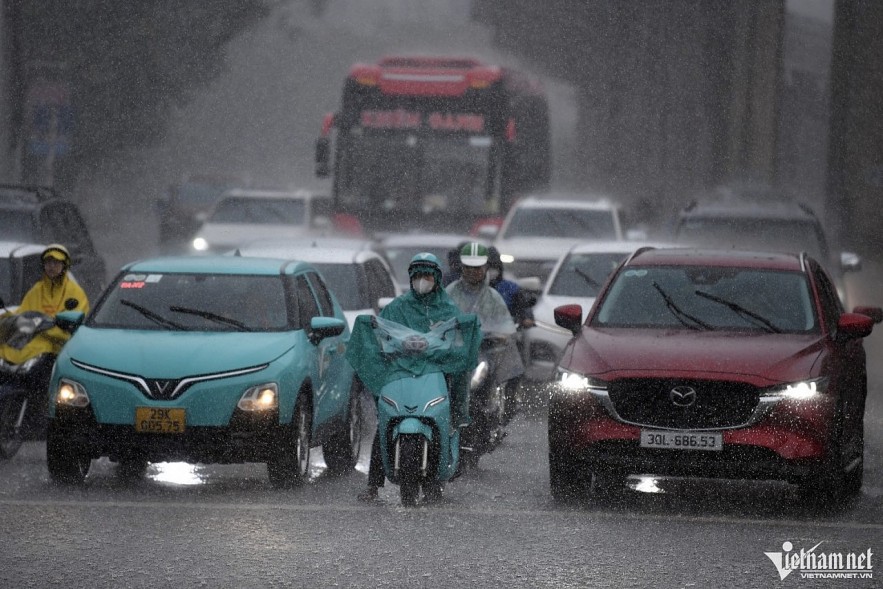 |
| Northern Vietnam faces consecutive thunderstorms. Photo: Hoang Minh |
Notably, on April 22, widespread heat is likely across the north-central and central regions. However, this will quickly give way to another round of scattered thunderstorms from April 23-25, particularly from Quang Tri to Hue, with some areas experiencing heavy rain.
Meanwhile, the south-central region, Central Highlands, and southern Vietnam will continue to see sunny conditions, with some areas experiencing heat. From around April 24-25, widespread heat is likely in the south, although isolated showers and thunderstorms may occur in the late afternoon and evening.
Caution urged during seasonal transition
Meteorological authorities noted that from mid-April to mid-May, the country may experience several widespread rainfall events, with heavier precipitation concentrated in northern mountainous areas.
Rainfall in the northern region and Thanh Hoa is expected to exceed the long-term average by 10-30mm, while other regions may face dry conditions.
Experts emphasized that this is a seasonal transition period in northern Vietnam, the Central Highlands, and the south. The interaction of different air masses increases the likelihood of extreme weather events such as whirlwinds, lightning, hail, and strong gusts, particularly following periods of intense heat.
Residents are advised to closely monitor weather developments and take proactive measures to ensure safety for both people and property.
 | Vietnam News Today (Apr. 17): Vietnamese Prime Minister Holds Phone Talks with Singaporean Counterpart Vietnam News Today (Apr. 17): Vietnamese Prime Minister holds phone talks with Singaporean counterpart; Vietnam-Turkey cooperation creates impetus for each country’s development; China's Nanning steps ... |
 | Vietnam News Today (April 18): Vietnam, China Sign 32 Cooperation Documents Vietnam News Today (April 18): Vietnam, China sign 32 cooperation documents; Leaders of Vietnamese, Lao parliaments pledge to share legislative experiences; Vietnam – Denmark partnership ... |