| Vietnam News Today (Jun. 16) notable headlines Vietnam - bridge in advancing ASEAN–Russia relations Vietnam, China promote development strategy connectivity, substantive cooperation Vietnam-France cooperation supports comprehensive child development Vietnam charts new course for FDI attraction Nha Trang named world's cheapest destination for five-star luxury stays Coffee enterprises of Vietnam and China promote cross-border value chain Very strong El Nino may be among the strongest since 1950 Ho Chi Minh City's five-month exports approach US$40 billion Foreign-invested sector an important component of national economy |
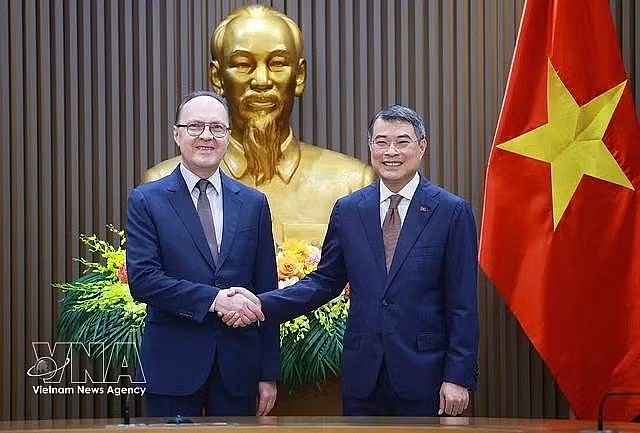 |
| Prime Minister Le Minh Hung (R) receives Russian Ambassador to Vietnam Gennady Bezdetko in May 2026. (Photo: VNA) |
Vietnam - bridge in advancing ASEAN–Russia relations
Prime Minister Le Minh Hung’s upcoming trip to Russia from June 16–18 for the ASEAN–Russia Commemorative Summit marking the 35th anniversary of dialogue relations and bilateral activities underscores Vietnam’s commitment to the ASEAN–Russia Strategic Partnership and highlights its role as a bridge fostering closer cooperation between the grouping and Russia.
Thirty-five years of ASEAN–Russia partnership
The Association of Southeast Asian Nations (ASEAN) and Russia established dialogue relations in 1991 and elevated ties to a Strategic Partnership in 2018. Since then, cooperation has expanded across political-security, economic and socio-cultural pillars.
Political and security cooperation has deepened through regular high-level dialogue, Russia’s active participation in ASEAN-led mechanisms and joint efforts to combat transnational crime, cybersecurity threats and drug trafficking. The two sides have held five summit meetings since 2005.
Economic ties have also strengthened through trade and investment programmes and cooperation between ASEAN and the Eurasian Economic Union (EAEU). Russia remains an important ASEAN partner in areas such as energy and food security.
Implementation of the ASEAN–Russia Comprehensive Plan of Action, extended through 2026, reached 82% during 2021–2025. Two-way trade totalled 17.81 billion USD in 2025. Both sides are working to finalise the ASEAN–Russia Plan of Action for 2026–2030 to guide future cooperation.
People-to-people exchanges have expanded through cultural, educational and academic initiatives, including youth and young diplomats’ forums.
The commemorative summit in Kazan on June 17–18 takes place amid a rapidly evolving global environment, with ongoing conflicts continuing to affect peace, security, economic growth, trade and supply chains.
According to Deputy Foreign Minister Dang Hoang Giang, head of the ASEAN Senior Officials’ Meeting (SOM) delegation of Vietnam, the summit will focus on three key priorities.
First, leaders will conduct a comprehensive review of ASEAN–Russia relations, assess achievements and challenges, identify new priorities and propose practical measures to strengthen mutually beneficial cooperation, particularly in energy security and connectivity across the broader Eurasian region.
Second, ASEAN and Russian leaders will exchange views on regional and international issues of common concern to deepen mutual understanding, strengthen strategic trust and address shared challenges in accordance with international law, cited VNA.
Third, the summit is expected to adopt key documents that will shape ASEAN–Russia cooperation in the coming years and better meet the development needs of both sides.
Vietnam’s active role
As an important bridge between Russia and ASEAN, Vietnam has consistently supported cooperation between the two sides.
Vietnamese Ambassador to Russia Dang Minh Khoi noted that Vietnam has proposed numerous initiatives to strengthen ASEAN–Russia relations and supported Russia’s deeper engagement with ASEAN institutions. Vietnam’s traditional friendship with Russia has also helped facilitate broader cooperation.
Vietnam supports expanding collaboration in trade, energy, science and technology, education and training, responses to non-traditional security challenges, and cooperation between ASEAN and organisations such as the EAEU, the Shanghai Cooperation Organisation (SCO) and BRICS.
PM Hung’s participation reflects Vietnam’s foreign policy of independence, self-reliance, peace, cooperation and diversified international relations, while reaffirming its strong support for ASEAN–Russia ties and its longstanding partnership with Russia.
Giang said the visit aims to leverage Vietnam’s role as a bridge, promote consensus and generate fresh momentum for ASEAN–Russia cooperation. This is particularly significant as Vietnam helped build ASEAN consensus for the summit and will serve as ASEAN coordinator for relations with Russia during 2027–2030.
Vietnam will advocate a practical, balanced and results-oriented approach, focusing on trade, science and technology, digital transformation, non-traditional security, education, tourism, people-to-people exchanges and energy cooperation.
The country also seeks to expand cooperation between ASEAN and the wider Eurasian region. As the first ASEAN member to sign a free trade agreement with the EAEU in 2015, Vietnam has valuable experience in promoting trade, investment, logistics and business connectivity.
Vietnam will also engage in discussions on issues affecting peace, stability, energy security and development, aiming to strengthen understanding and trust between ASEAN and Russia through dialogue and respect for international law.
Ekaterina Koldunova, Director of the ASEAN Center at the Moscow State Institute of International Relations, said the summit offers an opportunity for Russia and ASEAN countries to exchange initiatives and identify new avenues for cooperation. She noted that discussions will cover not only ASEAN–Russia relations but also broader cooperation with the EAEU, particularly in areas such as energy, interregional cooperation, health care, biotechnology, food security, education and creative industries.
Ambassador Khoi expressed his belief that the summit would set strategic directions for a new phase of ASEAN–Russia cooperation and create fresh momentum for mutually beneficial collaboration while providing a platform to discuss key regional and international issues.
Vietnam, China promote development strategy connectivity, substantive cooperation
Vietnam consistently considers the development of ties with China as a consistent policy, an objective requirement, a strategic and natural choice, and a top priority in Vietnam’s foreign policy of independence, self-reliance, multilateralisation and diversification, said Prime Minister Le Minh Hung during his phone talks with Chinese Premier Li Qiang on June 15.
In an atmosphere of friendship, trust, substance, and openness, the two cabinet leaders expressed their pleasure in holding the first phone call following the first session of Vietnam’s 16th National Assembly, which completed the Government leadership elections and appointments.
Premier Li warmly congratulated PM Hung on being elected as Prime Minister of Vietnam. He also expressed appreciation for and highly valued the important contributions made by PM Hung to China–Vietnam relations in various previous positions.
PM Hung highly valued the view of China’s Party and State leadership on prioritising the development of relations with Vietnam in its neighborhood diplomacy.
The leaders appreciated the positive progress in relations between the two Parties and the two countries over recent times, particularly in the urgent and timely development and implementation of action plans and programmes to realise the important common perceptions between the countries’ top leaders.
They agreed to maintain regular, sincere and trust-based exchanges and close coordination to further concretise high-level agreements and the outcomes of General Secretary of the Communist Party of Vietnam Central Committee and State President To Lam’s very successful recent state visit to China, as well as General Secretary of the Communist Party of China Central Committee and President of China Xi Jinping’s 2025 state visit to Vietnam.
Regarding future cooperation, PM Hung proposed that the two sides further strengthen strategic trust, well organise high-level exchanges and contracts as well as existing cooperation mechanisms, including the 3+3 Strategic Dialogue mechanism between the foreign affairs, national defence and public security ministers.
They will promote infrastructure connectivity and the development of a multimodal transport system, with priority given to railway cooperation and connectivity with other countries and regions; and advance bilateral trade in a balanced and sustainable manner, soon operationalise smart border gate models, and develop cross-border economic cooperation zones to facilitate trade, investment, and sectoral cooperation, according to VNA.
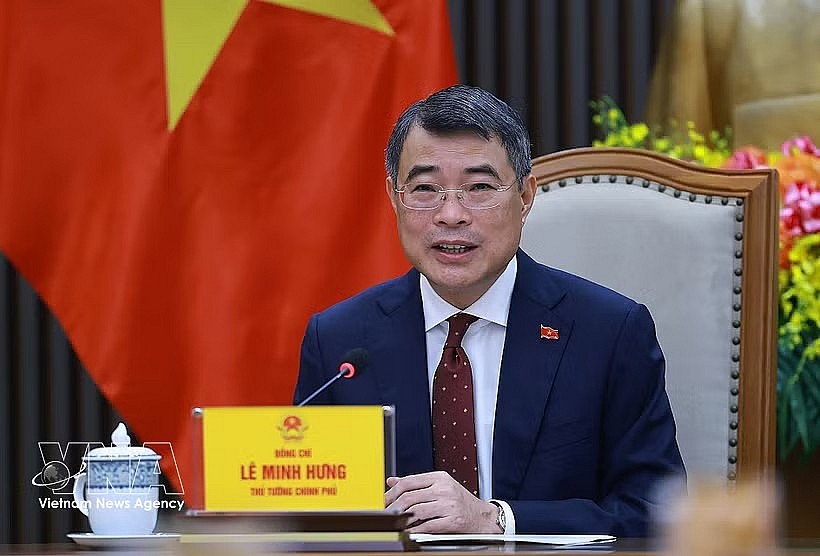 |
| Prime Minister Le Minh Hung holds phone talks with Chinese Premier Li Qiang on June 15. (Photo: VNA) |
He also expressed the desire to expand cooperation in science and technology, education, high-quality human resource training, health care, especially traditional medicine; strengthen cultural and tourism cooperation; and effectively implement the Vietnam–China Tourism Cooperation Year 2026–2027; while further enhancing existing local-level cooperation mechanisms, especially between border provinces, and expanding cooperation among regions with strong potential.
Premier Li affirmed that China always regards Vietnam as a priority in its neighborhood diplomacy policy. China will work with Vietnam to closely follow high-level common perceptions, deepen development strategy connectivity, and promote substantive cooperation across fields.
Agreeing with PM Hung’s proposals, he stated that China is ready to promote railway cooperation between the two countries and strengthen connectivity with other countries and regions; advance industries and agricultural trade, inspection and quarantine cooperation. The country will encourage reputable and capable enterprises to expand high-quality investment, especially in science, technology and innovation; enhance cooperation in energy security and power connectivity; effectively implement the China–Vietnam Tourism Cooperation Year 2026–2027; and strengthen people-to-people exchanges and social welfare cooperation projects.
The leaders also exchanged views on international and regional issues of mutual concern, affirming close coordination to ensure the success of the APEC Years 2026 and 2027 hosted by China and Vietnam, respectively. They also agreed to better control and properly handle differences, maintain peace and stability at sea, and strengthen a favourable environment for each country’s development.
Vietnam-France cooperation supports comprehensive child development
French Ambassador to Vietnam Olivier Brochet and a delegation visited the Bac Ninh General Social Protection Center on June 15 as part of ongoing Vietnam-France cooperation to support the comprehensive development of children.
The delegation also included Florence Cavalier, President of Enfance Partenariat Vietnam (EPVN). Representing Bac Ninh province were Vice Chairman of the provincial People’s Committee Le Xuan Loi and representatives of several provincial departments and agencies.
Speaking at the working session, Le Xuan Loi affirmed that Vietnam-France relations have been built on a foundation of friendship, mutual respect and long-term cooperation. People-to-people exchanges, education, healthcare and social work, he said, play an important role in connecting communities and spreading humanitarian values.
Bac Ninh consistently views economic development in tandem with human development and social welfare, with care for children in special circumstances remaining a priority. In recent years, the French Embassy and EPVN have carried out a range of practical activities at the Bac Ninh General Social Protection Center, thereby bringing practical benefits to children being cared for and raised there.
Provincial leaders also noted that economic cooperation between Bac Ninh and French partners has yet to match the potential and strengths of both sides. Bac Ninh hopes that the French Ambassador to Vietnam will continue serving as a bridge to introduce French businesses and investors seeking to study and invest in the province’s key sectors, while bolstering cultural cooperation, particularly in preserving and promoting UNESCO-recognised heritage sites.
The province also called on the French Embassy and EPVN to continue implementing programmes on healthcare, psychological support, life skills education, foreign language training and youth exchanges, while strengthening experience-sharing in social work, human resource training and the development of comprehensive childcare models.
Brochet expressed his pleasure at witnessing the results of cooperation between EPVN and the Bac Ninh General Social Protection Center. According to the Ambassador, cooperation between a French organisation and a Vietnamese social protection facility is vivid evidence of the friendship between the peoples of the two countries as well as the strong cooperative relationship between Vietnam and France.
Speaking highly of EPVN’s contributions, Brochet said the organisation is a French humanitarian organisation dedicated to supporting Vietnamese children. Through its activities over the past two decades, the image of Vietnam and its people has been shared more widely with the French public.
The Ambassador also acknowledged the attention paid by Vietnamese agencies to childcare at the center. He said EPVN’s support has helped the facility better fulfil its mission of caring for and raising children, not only through material assistance but also through emotional and psychological support. Many French students specialising in therapy-related fields have visited the center to interact with children with disabilities, including hearing-impaired children, while sharing knowledge and providing support.
Brochet hailed EPVN’s practical contributions to strengthening friendship between the peoples of the two countries and affirmed that he would continue supporting the center’s activities in the future.
Cooperation between the Bac Ninh General Social Protection Center, EPVN and French experts and student volunteers has produced positive results in recent years, VOV reported.
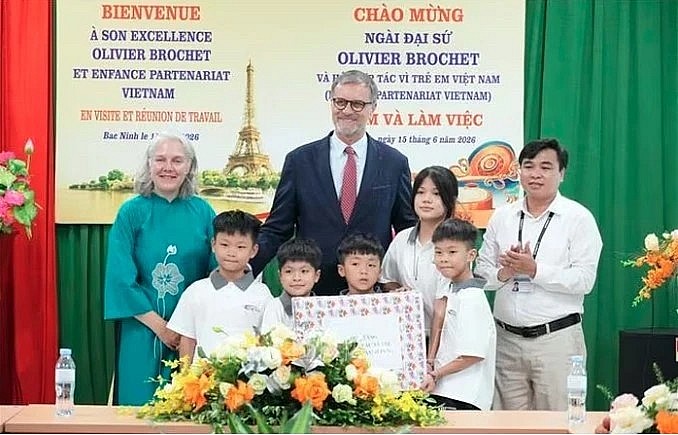 |
| French Ambassador to Vietnam Olivier Brochet and his delegation present gifts to the Bac Ninh General Social Protection Center (Photo: VNA) |
From late May to mid-June 2026, French experts and student volunteers carried out a range of healthcare, life skills education and psychological support activities for children at the center. A group of six medical students conducted health screenings, vision checks and support for children with refractive errors, while also providing training in first aid, oral healthcare and health education.
In addition, a group of eight experts and students specialising in speech and language therapy implemented intervention methods for children with autism, hearing impairments and language difficulties. They also guided caregivers on sensory regulation techniques, behaviour management and the application of appropriate therapeutic measures for individual cases.
A range of cultural, sports and experiential activities were also organised, creating an environment for children to develop physically and mentally while contributing to the integration of children in special circumstances into the community.
During the visit, Brochet and the delegation toured accommodation areas for children and elderly residents at the center, presented gifts to those receiving care there and attended the inauguration of a pickleball court sponsored by EPVN.
Vietnam charts new course for FDI attraction
The Politburo issues Resolution 10-NQ/TW (Resolution 10), dated June 8, 2026 on the development of the foreign-invested economic sector.
Resolution 10 aims to transform Vietnam into one of Asia's leading centers for foreign investment, innovation, research and development, and high-tech manufacturing, making it a key link in global supply chains.
The development of the foreign-invested sector must be viewed within the broader context of national development, as Vietnam establishes a new growth model based on science and technology, innovation, digital transformation, green transition, and enhanced strategic autonomy.
Resolution 10 clearly reflects a new mindset in the development of the foreign-invested sector, affirming that it is an important component of the national economy and setting the goal of making Vietnam a competitive destination for high-quality, medium- and long-term foreign investment.
Specifically, by 2030, Vietnam aims to rank among ASEAN's leading countries in terms of the business and investment environment, competitiveness, innovation, public service quality and capacity to attract high-quality foreign investment projects, cited VGP.
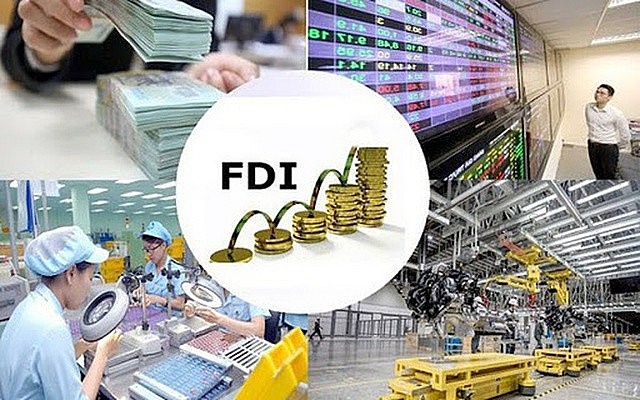 |
| Photo: VOV |
During the 2026-2030 period, Vietnam is targeting annual registered foreign investment of approximately US$40-50 billion and annual disbursements of US$ 30-40 billion.
Of the registered investment, around 75 percent is expected to come from developed economies with strong technological capabilities, substantial capital resources, and modern management expertise.
It places the development of the foreign-invested sector within the broader strategy of enhancing national autonomy and competitiveness.
The resolution sets a target of having around 10,000 Vietnamese enterprises participating in the value and supply chains of foreign-invested companies by 2030, including approximately 500-1,000 first-tier suppliers. The average localization rate in key industries is expected to reach 45-50 percent.
By 2045, the foreign-invested sector is expected to account for around 25 percent of total social investment and contribute approximately 30 percent of GDP.
Resolution 10 is expected to create a legal and policy ecosystem that encourages foreign enterprises to grow alongside Vietnamese businesses. This comes at a time when the private sector has been positioned as one of the central drivers of the national economy.
Nha Trang named world's cheapest destination for five-star luxury stays
Nha Trang, formerly a city and now a ward in the southcentral province of Khanh Hoa, has been named the world’s cheapest destination for five-star luxury stays, with luxury hotel rooms averaging just £70 (US$95) per night, according to the latest Hotel Price Index 2026 published by Hotels.com.
Based on data from more than 11,000 travelers and international booking platforms, the report found that the Vietnamese beach destination offers the lowest average five-star hotel rates among the world's top-value luxury destinations.
Nha Trang topped the list ahead of Zaragoza in Spain and Wrocław in Poland, where the average price for a five-star hotel room was £120 (US$163) per night.
Other destinations featured in the ranking included Tirana in Albania, Riga in Latvia, Zagreb in Croatia, Sofia in Bulgaria, Heraklion on the Greek island of Crete and Tallinn in Estonia, cited VOV.
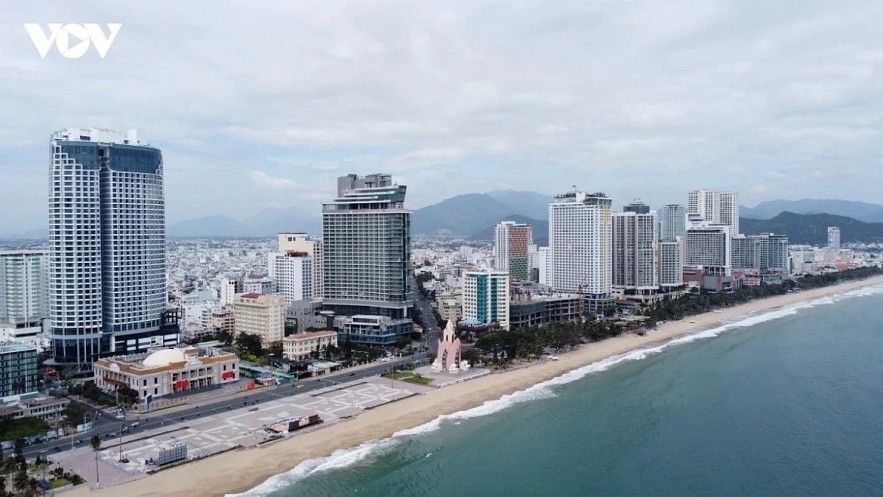 |
| A view of Nha Trang, the world's cheapest destination for five-star luxury stays, according to the 2026 Hotel Price Index published by Hotels.com. |
The report highlighted destinations offering luxury accommodation for less than £200 (US$270) per night while also examining changing travel habits and evolving definitions of luxury among travelers.
Hotels.com experts noted that booking accommodation within seven days of departure can save travelers an average of 26% compared with reservations made more than four months in advance.
The report also showed that checking in on a Sunday rather than a Saturday can reduce hotel costs by around 14%, while January remains the most affordable month for travel.
 | Vietnam News Today (Jun. 12): Government Chief Greatly Values JICA's New ODA Proposals for Vietnam Vietnam News Today (Jun. 12): Government chief greatly values JICA's new ODA proposals for Vietnam; Vietnam proposes three Asian cooperation orientations; Vietnam and India join ... |
 | Vietnam News Today (Jun. 13): Vietnam’s Economy Demonstrates Resilience Amid Cost Pressures, External Uncertainties Vietnam News Today (Jun. 13): Vietnam, Japan cultivate energy collaboration; Vietnam’s economy demonstrates resilience amid cost pressures, external uncertainties; Vietnam targets digital economy to contribute ... |